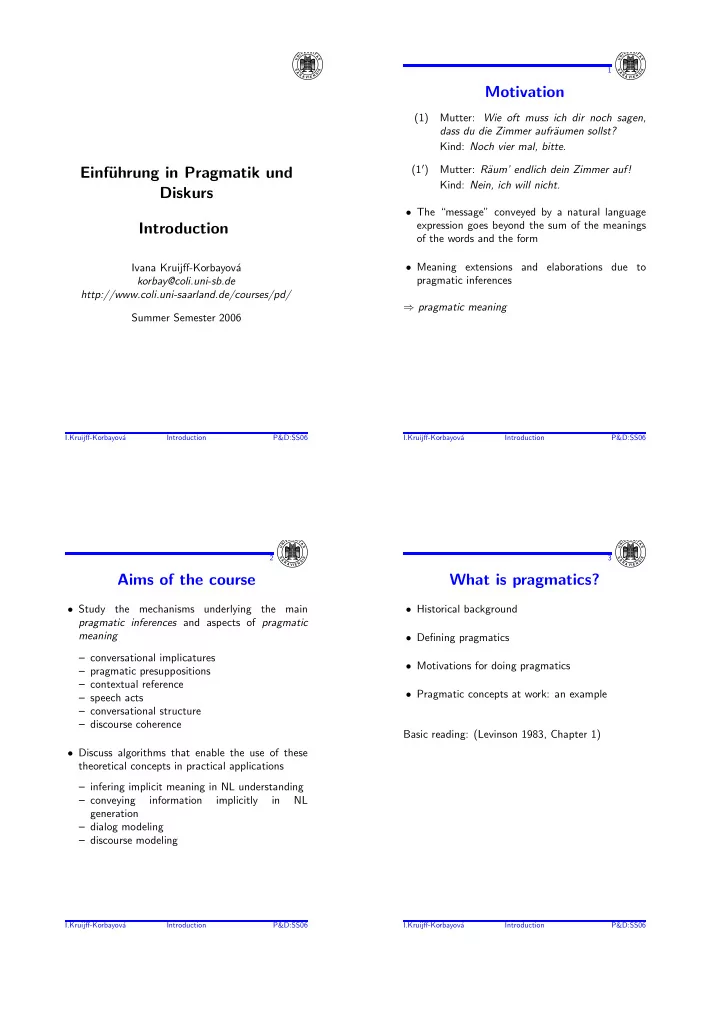
Motivation (1) Mutter: Wie oft muss ich dir noch sagen, dass du die - - PDF document

motivation
SMART_READER_LITE
LIVE PREVIEW

Motivation (1) Mutter: Wie oft muss ich dir noch sagen, dass du die - - PDF document

E R S E R S V I V I I T I T N N A A U S U S 1 S S S S A I A I S S R N R N A A V I E V I E Motivation (1) Mutter: Wie oft muss ich dir noch sagen, dass du die Zimmer aufr aumen sollst? Kind: Noch vier


slide-1
SLIDE 1

U N I V E R S I T A S S A R A V I E N S I S

Einf¨ uhrung in Pragmatik und Diskurs Introduction

Ivana Kruijff-Korbayov´ a korbay@coli.uni-sb.de http://www.coli.uni-saarland.de/courses/pd/ Summer Semester 2006

I.Kruijff-Korbayov´ a Introduction P&D:SS06 1

U N I V E R S I T A S S A R A V I E N S I S

Motivation

(1) Mutter: Wie oft muss ich dir noch sagen, dass du die Zimmer aufr¨ aumen sollst? Kind: Noch vier mal, bitte. (1) Mutter: R¨ aum’ endlich dein Zimmer auf! Kind: Nein, ich will nicht.

  • The “message” conveyed by a natural language

expression goes beyond the sum of the meanings

  • f the words and the form
  • Meaning extensions and elaborations due to

pragmatic inferences ⇒ pragmatic meaning

I.Kruijff-Korbayov´ a Introduction P&D:SS06 2

U N I V E R S I T A S S A R A V I E N S I S

Aims of the course

  • Study

the mechanisms underlying the main pragmatic inferences and aspects of pragmatic meaning – conversational implicatures – pragmatic presuppositions – contextual reference – speech acts – conversational structure – discourse coherence

  • Discuss algorithms that enable the use of these

theoretical concepts in practical applications – infering implicit meaning in NL understanding – conveying information implicitly in NL generation – dialog modeling – discourse modeling

I.Kruijff-Korbayov´ a Introduction P&D:SS06 3

U N I V E R S I T A S S A R A V I E N S I S

What is pragmatics?

  • Historical background
  • Defining pragmatics
  • Motivations for doing pragmatics
  • Pragmatic concepts at work: an example

Basic reading: (Levinson 1983, Chapter 1)

I.Kruijff-Korbayov´ a Introduction P&D:SS06

slide-2
SLIDE 2

4

U N I V E R S I T A S S A R A V I E N S I S

Historical Background

I.Kruijff-Korbayov´ a Introduction P&D:SS06 5

U N I V E R S I T A S S A R A V I E N S I S

Origin of Pragmatics

Charles Sanders Peirce (1898–1903):

  • semeiotic (semiotics, science of signs): how signs

enable us to understand, reason and talk about reality, which is external to the human mind

  • pragmaticism:

a methodology for conducting enquiry and understanding reality (how we go from perception to knowledge)

  • an undecomposable triadic sign structure: the

sign, is related to the object by virtue of being interpreted as such

I.Kruijff-Korbayov´ a Introduction P&D:SS06 6

U N I V E R S I T A S S A R A V I E N S I S

Non-Autonomy of Semantics w.r.t. Pragmatics

(2) It is better to get married and have a child than to have a child and get married.

  • p and q is semantically equivalent to q and p, so

(2) is either contradictory or meaningless

  • pragmatic inference allows us to interpret “and”

as “and then” in some contexts

  • pragmatic inference before semantic interpretaton

is what leads to asigning the correct truth- conditions to (2)

I.Kruijff-Korbayov´ a Introduction P&D:SS06 7

U N I V E R S I T A S S A R A V I E N S I S

Origins of Pragmatics

Charles Morris (1938)

  • also interested in semiotics as a science of signs
  • similarly

to Peirce, a broad definition

  • f

pragmatics: all aspects of the functioning of signs in general

  • distinguishes thee branches of semiotics (three

ways of studying signs): – syntax: formal relations between signs – semantics: the relation between signs and

  • bjects to which the signs are applicable

– pragmatics: the relations between signs and interpreters

  • allows pragmatics to be considered ‘outside’ of

syntax and semantics, or: syntax and semantics to be considered ‘without’ pragmatics, i.e., (unlike Peirce) decomposes the triadic relation into diadic

  • nes, studied separately

I.Kruijff-Korbayov´ a Introduction P&D:SS06

slide-3
SLIDE 3

8

U N I V E R S I T A S S A R A V I E N S I S

Origins of Pragmatics

Rudolph Carnap (1938)

  • if an investigation makes explicit reference to

language users, it is assigned to pragmatics Bar-Hillel (1954), Montague (1968):

  • pragmatics is the study of languages, both natural

and artificial, that contain indexical or deictic terms

  • interesting to logicians, because of a potential

failure of generally valid schemes of reasoning: I am Greta Garbo. Greta Garbo is a woman. So, I am a woman.

I.Kruijff-Korbayov´ a Introduction P&D:SS06 9

U N I V E R S I T A S S A R A V I E N S I S

Summary

Two ensuing uses of the term “pragmatics”:

  • broad use:

the study of psycholinguistic and sociological phenomena in sign systems in general

  • r

in language in particular (as a division

  • f

linguistic semiotics; including disciplines such as psycholinguistics, sociolinguistics, neurolinguistics)

  • successive narrowing of scope in anglo-american

analytical philosophy and linguistics: – the study of abstract concepts that make reference to agents (Carnap) – the study of indexicals or deictic terms (Bar- Hillel and Montague) – since late 1960’s: ∗ syntax: combinatorics of words and their parts ∗ semantics: meaning (traditionally: truth-conditions) ∗ pragmatics: language usage But, there is no agreed upon definition.

I.Kruijff-Korbayov´ a Introduction P&D:SS06 10

U N I V E R S I T A S S A R A V I E N S I S

Defining Pragmatics

I.Kruijff-Korbayov´ a Introduction P&D:SS06 11

U N I V E R S I T A S S A R A V I E N S I S

Definition 3 (e.g., Katz and Fodor 1963)

Pragmatics is the study

  • f

the (performance) principles of language usage, and has nothing to do with the description of linguistic structure.

  • grammar

is concerned with the context-free assignment

  • f

meaning to linguistic forms, while pragmatics is concerned with the further interpretation of those forms in context

  • pragmatic theories explicate the reasoning of

speakers and hearers

  • cf. also (Chierchia and McConnel-Ginet, 1990):

– semantics: what linguistic expressions mean – pragmatics: what speakers mean in using linguistic expressions Problem:

  • linguistic structure sometimes encodes or interacts

with features of the context, e.g., bunny vs. rabbit implicate different types of addressees; cf. also, e.g., honorifics or address forms in German The inter-relation

  • f

language structure and principles of language usage is important!

I.Kruijff-Korbayov´ a Introduction P&D:SS06

slide-4
SLIDE 4

12

U N I V E R S I T A S S A R A V I E N S I S

Definition 4 (e.g., Brown and Levinson 1978)

Pragmatics is the study of relations between language and context that are grammaticalized (i.e., encoded in lexicon, morphology, syntax or phonology), or encoded in the structure of a language.

  • restricts the field to purely linguistic matters,

guarantees linguistic relevance

  • includes deixis, presupposition, speech acts

Problem:

  • excludes

principles

  • f

language use and interpretation that explain how extra meaning can be ‘read into’ utterances without being encoded in them, e.g., conversational implicatures (inferences arising on the basis of general rules or maxims of conversational behaviour)

I.Kruijff-Korbayov´ a Introduction P&D:SS06 13

U N I V E R S I T A S S A R A V I E N S I S

Definition 5 (e.g., Gazdar 1979)

Pragmatics is the study of all those aspects of meaning not captured in a semantic theory. Pragmatics = Meaning - Truth-conditions

  • a broad understanding of meaning:

involves different kinds of meaning components: – truth-conditions and entailments – conventional implicatures – presuppositions – felicity conditions – generalized conversational implicatures – particularized conversational implicatures – inferences based on conversational structure Problems:

  • defines pragmatics as the residue left by semantics

(“pragmatics waste-basket”).

  • fails

to identify context-dependence as the unifying characteristic of pragmatic phenomena

I.Kruijff-Korbayov´ a Introduction P&D:SS06 14

U N I V E R S I T A S S A R A V I E N S I S

Definition 6

Pragmatics is the study of the relations between language and context that are basic to an account

  • f language understanding (i.e., calculation of the

intended meaning). i.e., the study of the inferences that connect what is said (utterance) to what is mutually assumed or what has been said before (i.e., context) Strengths:

  • recognizes that pragmatics is essentially concerned

with inference

  • avoids drawing a distinction between semantics

and pragmatics along the line

  • f

what is encoded/unencoded in linguistic structure

  • includes most aspects of the study of principles
  • f language usage:

for each systematic set of constraints on the use of language, there is a corresponding set of inference-procedures applied in understanding

I.Kruijff-Korbayov´ a Introduction P&D:SS06 (cont’d) 15

U N I V E R S I T A S S A R A V I E N S I S

Problems with Definition 6

  • Includes in pragmatics the study of the interaction

between linguistic knowledge and the entirety of participants’ knowledge of the world. Example: (Charniak 1972): Jill wanted to get Bill a birthday present, so she went and found her piggy-bank; she shook it, but there was no noise; she would have to make Bill a present. Needed knowledge, at least: – presents are usually bought with money – piggy-banks are used to hold money – money inside a piggy-bank rattles

  • Relies on a notion of context,

but there is no theory of (how to predict) what are the (linguistically) relevant contextual features in actual utterance situations.

  • What is it to understand an utterance?

⇒ See Grice’s conveyed meaning, meaning-nn

I.Kruijff-Korbayov´ a Introduction P&D:SS06

slide-5
SLIDE 5

16

U N I V E R S I T A S S A R A V I E N S I S

Definition 7

Pragmatics is the study of the ability of language users to pair sentences with the contexts in which they would be appropriate. i.e., concerned with a recursive assignment of appropriateness conditions

  • appeals to those who consider pragmatics part
  • f linguistic competence (as involving a cognitive

ability): linguists, e.g., van Dijk 1976, Lyons 1977; philosophers, e.g., Austin 1972, Searle 1969 Problems:

  • exact overlap with sociolinguistics as the study of

communicative competence (Hymes 1971)

  • requires fundamental idealization of a culturally

homogeneous speech community

  • language “elasticity”:

– speakers can be ‘inappropriate’ – pragmatic constraints are generally defeasible, i.e., not invariable – exploitation of conventions to communicate some further pertinent message

I.Kruijff-Korbayov´ a Introduction P&D:SS06 17

U N I V E R S I T A S S A R A V I E N S I S

Summary

There is no entirely satisfactory definition

  • f

pragmatics as an independent component! Crucial:

  • context
  • inference

I.Kruijff-Korbayov´ a Introduction P&D:SS06 18

U N I V E R S I T A S S A R A V I E N S I S

Motivations for Doing Pragmatics

I.Kruijff-Korbayov´ a Introduction P&D:SS06 19

U N I V E R S I T A S S A R A V I E N S I S

Motivations

Why is it useful? What motivates its investigation?

  • an antidote to Chomsky’s idea of language as

a ‘mental ability’ (i.e., linguistic competence) dissociated from its uses, users and functions

  • to account for context-dependent phenomena

(e.g., pragmatic constraints

  • n

morphology, syntax or prosody)

  • to simplify the task of semantics
  • to narrow the gap between linguistic theory
  • f

language and accounts

  • f

linguistic communication

  • to offer functional explanations for linguistic facts,

i.e. by motivation by principles outside the scope

  • f linguistic theory
  • to establish the effects of language use on its

structure, e.g., by cross-linguistic functionally-

  • riented studies one can discover more subtle ways
  • f linguistic encoding

I.Kruijff-Korbayov´ a Introduction P&D:SS06

slide-6
SLIDE 6

20

U N I V E R S I T A S S A R A V I E N S I S

Simplifying semantics

(3) Some politicians are corrupt. intuitively means Some and not all politicians are corrupt. But one can say (4) Some, and perhaps all politicians are corrupt. without uttering a contradiction

  • semantic solution: “some” is ambiguous
  • pragmatic solution:

explain how principles of language usage allow for systematically ‘reading in” to utterances more than they conventionally

  • r literally mean

I.Kruijff-Korbayov´ a Introduction P&D:SS06 21

U N I V E R S I T A S S A R A V I E N S I S

Pragmatics at work: An Example

I.Kruijff-Korbayov´ a Introduction P&D:SS06 22

U N I V E R S I T A S S A R A V I E N S I S

Pragmatics at work: An example

(1) A. So can you please come over here again right now? (2) B. Well, I have to go to Edinburgh today Sir. (3) A. Hmm. How about this Thursday?

  • What information does this dialog provide above

and beyond the semantic content of its sentences?

  • What implications are carried by the sentences

about the context in which they are being used? We infer the following facts:

I.Kruijff-Korbayov´ a Introduction P&D:SS06 23

U N I V E R S I T A S S A R A V I E N S I S

Inferred facts

  • Information about conversation structure

It is neither the end nor the beginning of the conversation

  • Information about Speakers intentions

A is requesting B to come to A at the time of speaking; B implies he cannot comply; A repeats the request for some other time.

  • Information

about Speakers beliefs and intentions In requesting, A must: (a) want B to come, (c) think B is not already there, (d) think B was not about to come anyway, (e) expect that B will respond with acceptance

  • r rejection and if B accepts, A expects he will

come, (f) thinks that asking B may be a possible motive for B to come, (g) not be in a position to order B to come.

I.Kruijff-Korbayov´ a Introduction P&D:SS06

slide-7
SLIDE 7

cont’d 24

U N I V E R S I T A S S A R A V I E N S I S

Inferred facts

  • Information about Speakers beliefs and about

spatial relationships between participants A assumes B knows where A is; A and B are not in the same place; neither A nor B are in Edinburgh; A thinks B has been to A’s place before

  • Information about temporal parameters of

conversation The day is not Thursday, nor Wednesday

  • Information

about social relationships between participants A is male; B acknowledges that A has a higher social status than him

I.Kruijff-Korbayov´ a Introduction P&D:SS06 25

U N I V E R S I T A S S A R A V I E N S I S

Partial Summary

  • On hearing the text, the Hearer can compute the

contextual assumptions made by this text i.e facts about spatial, temporal and social relationships between participants and about the beliefs and intentions of the participants.

  • These inferences are systematic i.e.

decodable by different interpreters in the same way.

  • Without these inferences, the dialog cannot be

understood.

  • Hence

these inferences are part

  • f

the communicated meaning. How are they communicated?

I.Kruijff-Korbayov´ a Introduction P&D:SS06 26

U N I V E R S I T A S S A R A V I E N S I S

Communicative Intentions Recognition

I1: It is neither the end nor the beginning of the conversation (1) A: So can you please come over here again right now? is not a possible opening utterance (not a regular

  • pening form; “So” ties current utterance to previous

utterance in same dialog segment). ⇒ discourse coherence relations (3) A: : Hmm. How about this Thursday? is not a possible closing utterance (requires a response; Not a regular closing form). ⇒ Inference due to expectations about structure

  • f conversation and use of discourse cues.

I.Kruijff-Korbayov´ a Introduction P&D:SS06 27

U N I V E R S I T A S S A R A V I E N S I S

I2i: A is requesting B to come to A at the time

  • f speaking

Interrogative form (1) A: So can you please come over here again right now? functions as request, cf. also “please” ⇒ Speech Act theory I2ii: B implies he cannot comply B’s response (2) Well, I have to go to Edinburgh today, Sir is interpreted as an answer, because a request requires a response: ⇒ Conversational Structure and as a refusal: Implication relies on general principles of interactional cooperation: apparently irrelevant answer triggers inference to preserve the assumption of relevance. ⇒ Conversational Implicatures

I.Kruijff-Korbayov´ a Introduction P&D:SS06

slide-8
SLIDE 8

28

U N I V E R S I T A S S A R A V I E N S I S

I2iii: A repeats the request for some other time. (3) A: Hmm. How about this Thursday? is interpreted as a repeat request. This results from:

  • Interpretation
  • f

“how about . . . ?” as a suggestion (Speech Act theory);

  • Relevance assumption (Conversational implicature)

and

  • The interactional function of “Hmm” as a turn

holding device (conversational structure).

I.Kruijff-Korbayov´ a Introduction P&D:SS06 29

U N I V E R S I T A S S A R A V I E N S I S

I3: In requesting, A must: (a) want B to come, (c) think B is not already there, (d) think B was not about to come anyway, (e) expect that B will respond with acceptance or rejection and if B accepts, A expects he will come, (f) thinks that asking B may be a possible motive for B to come, (g) not be in a position to order B to come. These inferences follow from assumption that dialog participants behave rationally and from conversational principles: if A request B to come then (a-g) follow. ⇒ Speech act theory, Conversational implicatures

I.Kruijff-Korbayov´ a Introduction P&D:SS06 30

U N I V E R S I T A S S A R A V I E N S I S

I4: A assumes B knows where A is; A and B are not in the same place; neither A nor B are in Edinburgh; A thinks B has been to A’s place before Inferences arise from context-dependent meaning of deictics such as “here, come, go, you now” and the presuppositions of “again”. I5: The day is not Thursday, nor Wednesday. Inference due to meaning of deixis “thursday, today” I6: A is male; B acknowledges that A has a higher social status than him Inference based on conventional implicature of word “sir”.

I.Kruijff-Korbayov´ a Introduction P&D:SS06 31

U N I V E R S I T A S S A R A V I E N S I S

Course Overview

Time-plan for the course and reading: see project website http://www.coli.uni-saarland.de/courses/pd/

I.Kruijff-Korbayov´ a Introduction P&D:SS06