Motivating Change for Multiple Health Behaviours: An - - PDF document

motivating change for multiple health behaviours an
SMART_READER_LITE
LIVE PREVIEW

Motivating Change for Multiple Health Behaviours: An - - PDF document

#teachproject Peter Selby , MBBS, CCFP, FCFP, MHSc, Dip ABAM Megan Barker , MA Rosa Dragonetti , MSc Centre for Addiction and Mental Health and University of Toronto Centre for Addiction and Mental Health Centre for Addiction and Mental Health


slide-1
SLIDE 1
  • #teachproject

Motivating Change for Multiple Health Behaviours: An Interprofessional CME Program

BEST PRACTICES AND INNOVATIONS IN CME

Peter Selby, MBBS, CCFP, FCFP, MHSc, Dip ABAM

Centre for Addiction and Mental Health and University of Toronto Department of Addiction Medicine

Rosa Dragonetti, MSc

Centre for Addiction and Mental Health

Megan Barker, MA

Centre for Addiction and Mental Health

1 Twitter: #teachproject

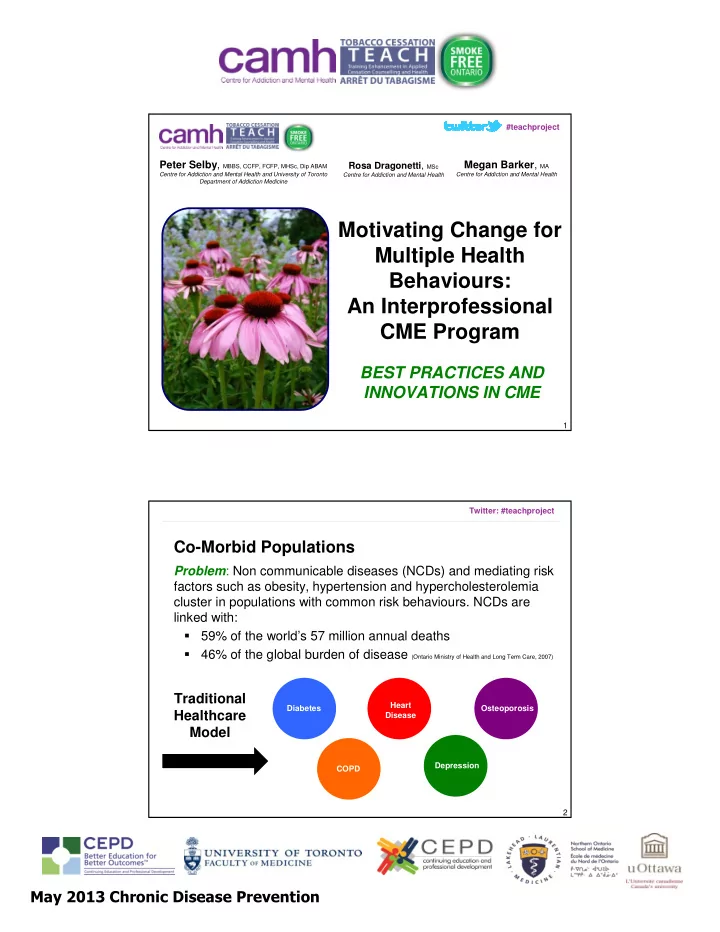
Co-Morbid Populations

Problem: Non communicable diseases (NCDs) and mediating risk factors such as obesity, hypertension and hypercholesterolemia cluster in populations with common risk behaviours. NCDs are linked with:

  • 59% of the world’s 57 million annual deaths
  • 46% of the global burden of disease (Ontario Ministry of Health and Long Term Care, 2007)

Diabetes Depression Heart Disease COPD Osteoporosis

Traditional Healthcare Model

2

slide-2
SLIDE 2
  • Twitter: #teachproject

Integrated Health Promotion

Solution: Increase capacity among healthcare practitioners with innovative education to address co-morbid chronic disease in an integrated way.

SELECTED CHRONIC DISEASES Cardiovascular Disease Diabetes Cancer Mental Health

MODIFIABLE BEHAVIOURAL RISK FACTORS Smoking Physical Activity Alcohol Nutrition Stress Tolerance Sleep

INTERMEDIATE PHYSICAL/ PHYSIOLOGICAL RISK FACTORS High blood pressure Cholesterol/lipids Glucose intolerance Overweight/obesity 3 Twitter: #teachproject

Integrated Chronic Disease Prevention: Addressing the Risks An integrated, interprofessional CME program

Two-day specialty course

  • Offered 8 times since 2010

(7 English, 1 French)

  • 613 professionals from <15

disciplines trained

  • Overall satisfaction rating of

4.56/5 (5=highest/best) Interprofessional faculty engaged

(physicians, psychiatrists, nurses, dietitians, social workers and pharmacists)

4

slide-3
SLIDE 3
  • Twitter: #teachproject

5

Participant Demographics

Twitter: #teachproject 6

Participant Demographics

slide-4
SLIDE 4
  • Twitter: #teachproject

Course Model: The Health Promotion-6 Pack (HP-6)

7 Twitter: #teachproject

No smoking 5 servings of fruits and vegetables per day Manage stress effectively- family, friends Reduce drinking to or below low risk drinking guidelines 30 minutes or more of physical activity per day 7 to 9 hours

  • f sleep per

night

Achieving the HP-6 Pack

8

slide-5
SLIDE 5
  • Twitter: #teachproject
  • Dr. Peter Selby (2010)

9

Biopsychosocial Framework: Environment, Behaviour, Biology

ENVIRONMENT BEHAVIOUR BIOLOGY

Twitter: #teachproject

Course content is delivered in a highly interactive style emphasizing case- based learning and application of skills.

10

slide-6
SLIDE 6
  • Twitter: #teachproject

Overall Learning Assessment Results

(All 8 courses to date) Scale: 0 = Very Low, 10 = Very High Learning Assessments measure practitioners’ ratings of feasibility, importance, and confidence in implementing knowledge and skills pre- and post- course. Ratings increased significantly post training, and 97.0% set practice objectives.

* * *

*p<0.01

11 Twitter: #teachproject

p e t e r . s e l b y @ c a m h . c a @ P S Q u i t S m

  • k

i n g w w w . t e a c h p r

  • j

e c t . c a