Morphological Image Processing Preechaya Srisombut Graduate School - - PDF document

morphological image processing
SMART_READER_LITE
LIVE PREVIEW

Morphological Image Processing Preechaya Srisombut Graduate School - - PDF document

Morphological Image Processing Preechaya Srisombut Graduate School of Information Sciences and Engineering,Tokyo Institute of Technology For IP seminar, 4 November 2004 Reference: Rafael C. Gonzalez, Richard E. Woods, Digital Image Processing


slide-1
SLIDE 1

Morphological Image Processing

Preechaya Srisombut

Graduate School of Information Sciences and Engineering,Tokyo Institute of Technology For IP seminar, 4 November 2004

Reference: Rafael C. Gonzalez, Richard E. Woods, “Digital Image Processing,” Second Edition,

Prentice Hall, p.519-560&617-621

Contents:

  • 1. Introduction
  • 2. Preliminaries
  • Basic Concepts from Set Theory
  • Logic Operations
  • 3. Morphological Operations
  • Dilation and Erosion
  • Opening and Closing
  • The Hit-or-Miss Transformation
  • 4. Basic Morphological Algorithms
  • Boundary Extraction
  • Region Filling
  • Extraction of Connected Components
  • Convex Hull
  • Thinning
  • Thickening
  • Pruning
  • 5. Extensions to Gray-Scale Images
  • Dilation, Erosion, Opening, and Closing

6. Some Applications

  • f

Gray-Scale Morphology

  • Morphological smoothing
  • Morphological gradient
  • Top-hat transformation
  • Textural segmentation
  • Granulometry
  • 7. Summary

Appendix: Summary of Morphological Operations

  • n Binary Images
  • 1. Introduction

Morphology commonly denotes a branch of biology that deals with the form and structure of animals and plants. Here, the same word morphology is used as a tool for extracting image components that are useful in the representation and description of region shape. It is also used for pre- or post processing, such as filtering. The language of mathematical morphology use set theory to represent objects in an image.

  • 2. Preliminaries
  • Basic Concepts from Set Theory

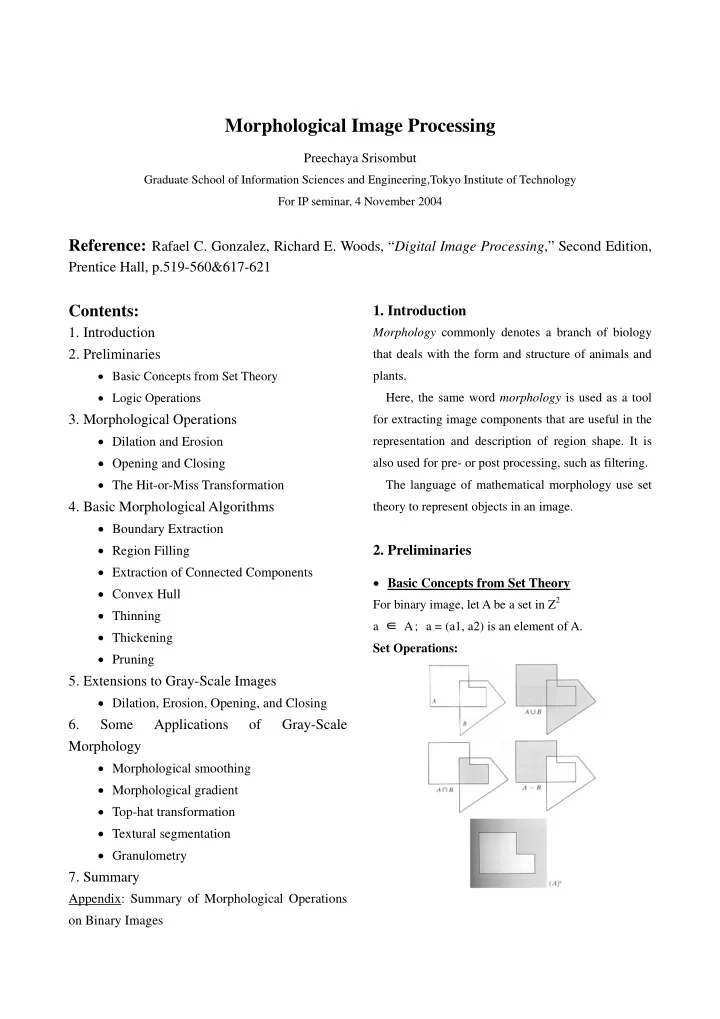
For binary image, let A be a set in Z2 a ∈ A; a = (a1, a2) is an element of A. Set Operations:

slide-2
SLIDE 2

Addition Operation: Reflection: Translation:

  • Logic Operations
  • 3. Morphological Operations
  • Dilation and Erosion

Dilation: Set B is commonly referred to as the structuring element, and also viewed as a convolution mask. Although dilation is based on set operations where convolution is based on arithmetic operations, the basic idea is analogous. B is flipping about its origin and slides over set (image) A. Dilation: Joining broken segments One immediate advantage of the morphological approach

  • ver

lowpass filtering is that the morphological method resulted directly in a binary image, while lowpass filtering started with producing gray-scale image. Erosion:

slide-3
SLIDE 3

Erosion & Dilation: eliminating irrelevant detail Suppose we want to eliminate all the squares except largest one. We can do this by eroding the image with a structuring element of a size somewhat smaller than the objects we wish to keep. After that, we can restore it by dilating them with the same structuring element we used for erosion.

  • Opening and Closing

Opening generally smoothes the contour object, breaks narrow isthmuses, and eliminates thin

  • protrusions. Closing also tends to smooth sections of

contours but, ass opposed to opening, it generally fuses narrow breaks and long thin gulfs, eliminates small holes, and fills gaps in the contour. Opening: Closing: Opening: roll B around the inside of A. Closing: roll B around the outside of A. Opening & Closing: Noise Filter The light elements are completely eliminated in first erosion stage, but unfortunately image is smaller so we have to restore it with dilation (erosion then dilation →opening of A by B). However, new gaps were created. To counter this effect we have to perform closing on an image again.

slide-4
SLIDE 4
  • The Hit-or-Miss Transformation

The Hit-or-Miss transform is a basic tool for shape

  • detection. The objective is to find the location of one
  • f the shapes in image.

The small window, W, is assumed that have at least

  • ne-pixel-thick than an object. Anyway, in some

applications, we may be interested in detecting certain patterns, in which case a background is not required.

  • 4. Basic Morphological Algorithms
  • Boundary Extraction
  • Region Filling

Beginning with a point p inside the boundary, the

  • bjective is to fill the entire region with 1’s, by

iteratively processing dilation.

slide-5
SLIDE 5

Adding the intelligence to detect a black inner point of sphere, we can use region filling to fill up the sphere to be completely white.

  • Extraction of Connected Components

The equation is similar to region filling. The only difference is the use of A instead of its complement. Using connected components to detect foreign

  • bjects in packaged food.

After extracting the bones from the background by using a single threshold, to make sure that only

  • bjects of significant size remain by eroding the

thresholded image. The next step is to analyze the size

  • f the objects remain
  • Convex Hull

A is said to be convex if the straight line segment joining any two points in A lies entirely within A. with , and let (“conv”→convergence) Then the convex hull of A is

slide-6
SLIDE 6

In other words, the procedure consists of iteratively applying the hit-or-miss transform to A with B; when no further changes occur, we perform the union with A and call the result D. The limiting growth of convex can also be applied for better result.

  • Thinning
  • Thickening

The structuring elements have the same form as in thinning but with all 1’s and 0’s interchanged. However, a separate algorithm for thickening is seldom used in practice. The usual procedure is to thin the background instead.

  • Pruning

Pruning methods are an essential complement to the procedures that tend to leave parasitic components that need to be “cleaned up” by post processing. For example, the automated recognition of hand printed characters. . Thinning 3 times. End-point detectors. Grow line. Restore the character.

  • 5. Extensions to Gray-Scale Images

Throughout the discussions, we deal with digital image functions of the form f(x, y) and b(x, y), where f(x, y) is the in put image and b(x, y) is a structuring element.

slide-7
SLIDE 7
  • Dilation
  • Erosion

Dilation is expected to produce an image that is brighter that the original and in which small, dark details have been reduced or eliminated. In the other hand, erosion produces darker image, and the sizes of small, bright features were reduced.

  • Opening, and Closing

Opening: Close: Note that opening decreases sizes of the small bright detail, with no appreciable effect on the darker gray levels, while the closing decreases sizes of the small dark details, with relatively little effect on bright features.

  • 6. Some Applications of Gray-Scale Morphology
  • Morphological smoothing

One way to achieve smoothing is to perform a morphological opening followed by a closing.

slide-8
SLIDE 8
  • Morphological gradient

The morphological gradient highlights sharp gray-level transitions in the input image.

  • Top-hat transformation

Note the enhancement of detail in the background region below the lower part of the horse’s head.

  • Textural segmentation

A simple gray-scale image composed of two texture

  • region. The large blobs on right and small on left.
  • 1. Closing with the small blobs, leaving left area

with light background.

  • 2. Opening with the large blobs, leaving a dark

region on right. ⇒ The process has produced a light region on the left and a dark region on the right.

  • Granulometry

Granulometry is a field that deals principally with determining the size distribution of particles in an image As the particles are lighter than the background, we use opening with increasing size of structuring elements, and compute the difference between the

  • riginal image and its opening. The histogram of that

difference indicates the presence of three predominant particle sizes in the input image.

  • 7. Summary

The morphological concepts constitute a powerful set of tools for extracting features of interest in an

  • image. A significant advantage in terms of

implementation is the fact that dilation and erosion are primitive operations.