MORPHOLOGICAL APPROACH TO CHINESE URBAN SUSTAINABILITY - - PowerPoint PPT Presentation

morphological approach to chinese urban sustainability
SMART_READER_LITE
LIVE PREVIEW

MORPHOLOGICAL APPROACH TO CHINESE URBAN SUSTAINABILITY - - PowerPoint PPT Presentation

MORPHOLOGICAL APPROACH TO CHINESE URBAN SUSTAINABILITY Science and Design informing Sustainability in High-density Cities Forum THNS 2011


slide-1
SLIDE 1

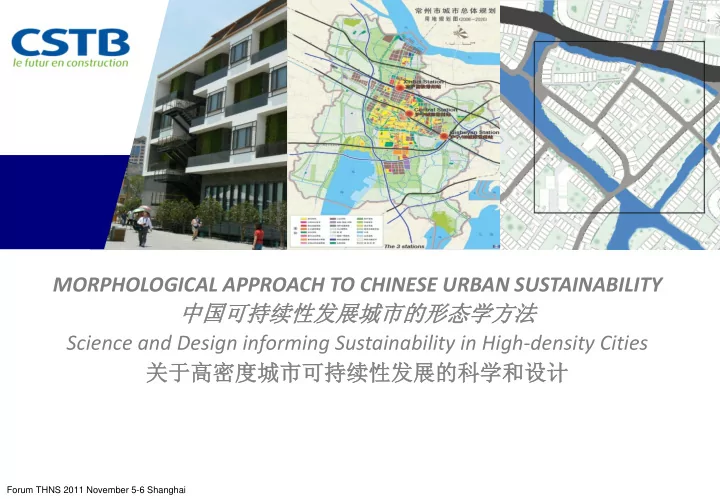
MORPHOLOGICAL APPROACH TO CHINESE URBAN SUSTAINABILITY 中国可持续性发展城市的形态学方法 Science and Design informing Sustainability in High-density Cities 关于高密度城市可持续性发展的科学和设计

Forum THNS 2011 November 5-6 Shanghai
slide-2
SLIDE 2

Content 内容

The Project 项目 The Building Scale : the Eco Home in Shanghai 建筑规模: 上海沪上生态家 From Green Buildings to Eco Districts 从绿色建筑到生态小区 Global Study of Urban Morphologies 城市形态的研究 Assessing Urban Forms 城市形态评估

Forum THNS 2011 November 5-6 Shanghai

2

slide-3
SLIDE 3

Content 内容 The Project 项目 The Building Scale : the Eco Home in Shanghai  From Green Buildings to Eco Districts Global Study of Urban Morphologies Assessing Urban Forms

Forum THNS 2011 November 5-6 Shanghai

3

slide-4
SLIDE 4

The project 项目

Chinese eco-cities and sustainable buildings of the future 中国生态城市和未来可持续发展建筑

The CSTB project is mainly financed by a FASEP fund (administered by the DGTresor, French Ministry of Economy). 法国建筑科学技术中心(CSTB)项目由FASEP基金提供资金(该基金 专门用于由法国经济部的巴黎财税及经济政策总署(DGTresor)领导 的私人领域的研究.)

Forum THNS 2011 November 5-6 Shanghai

4

slide-5
SLIDE 5

The project 项目

It aims at creating synergies between innovative French firms, which have until now offered separate systems and products, in order to build sustainable buildings and cities. 项目旨在协调为中国提供了建筑系统和产品的法国企业,以建造可持续发展 的建筑和城市。 The CSTB (French Scientific and Technical Construction Center) brought its scientific and technical expertise to develop concepts and guidelines to build eco-cities and sustainable buildings, as a support

  • f an integrated offer of systems and products.

法国建筑科学技术中心(CSTB)将其科技经验带入到 生态城市和可持续发 展建筑的概念和指导原则中,为整体化系统和产品服务提供了有力的支持。

Forum THNS 2011 November 5-6 Shanghai

5

slide-6
SLIDE 6

The Partners in France

在法国的合作伙伴

Forum THNS 2011 November 5-6 Shanghai

6

slide-7
SLIDE 7

Mission Economique

To p lev el Resea rch and accademical network Wide and efficient Net w o rk a nd Lo g ist ics Strong partnerships with lo ca l K ey d ecisio n makers

Op er a tiona l p r ofessiona l exchanges & introduction of French technologies

FASEP coordination

Ecohome pavillon joint design and construction Scientific partnership Scientific collaboration On Econeighborhood And ecocity design

Cornell university Shanghai Research Institute on Building Science College of Architecture and Urban Planning Tongji University Les Ateliers de Cergy Pontoise

4

Partenariats 合作机构

7

Forum THNS 2011 November 5-6 Shanghai

slide-8
SLIDE 8

Content 内容 The Project The Building Scale : the Eco Home in Shanghai 建筑规模: 沪上生态家  From Green Buildings to Eco Districts Global Study of Urban Morphologies Assessing Urban Forms

8

Forum THNS 2011 November 5-6 Shanghai

slide-9
SLIDE 9

The Eco Home project 项目

The project has been done in cooperation with the SRIBS, CSTB’s counterpart in Shanghai. CSTB has contributed to the conception of the Ecohome Pavilion.

该项目和上海建筑科学研究院合作进行, 它是在上海的和法国建筑科学技术中心 同类型的机构。法国建筑科学技术中心 为沪上生态家的设计和建造做出了贡献.

Forum THNS 2011 November 5-6 Shanghai

9

slide-10
SLIDE 10

The Eco Home project 项目

沪上生态家由上海市建筑科学研究 院(SRIBS)技术支持,是理想的 可持续建筑的原型,计划在世博会 后向全国推广。作为中国唯一此种 类型的建筑,其影响范围超越了上 海市。 Built by the SRIBS (Shanghai Research Institute of Building Sciences), it is a prototype of the perfect sustainable building, aiming at being reproduced in the whole China after the expo. Being the only Chinese building of this type, its influence goes past the city of Shanghai.

Forum THNS 2011 November 5-6 Shanghai

10

slide-11
SLIDE 11

Zero Energy Building: general concept

零耗建筑 : : 概念

Forum THNS 2011 November 5-6 Shanghai

11

slide-12
SLIDE 12

Implemented technologies 成果:细致明确的技术提供

Isolation walls ceilings windows Motors Automatisms

自动化

Shading system

Proposal and integration of efficient solutions by the industrial partners of the project 项目双方的有效技术方案的建议和整合

Thermal diagnosis

热效诊断

12

Forum THNS 2011 November 5-6 Shanghai

slide-13
SLIDE 13

Implemented technologies 成果:细致明确的技术提供

Forum THNS 2011 November 5-6 Shanghai

13

slide-14
SLIDE 14

Content 内容 The Project The Building Scale : the Eco Home in Shanghai From Green Buildings to Eco Districts 从绿色建筑到生态小区 Global Study of Urban Morphologies Assessing Urban Forms

Forum THNS 2011 November 5-6 Shanghai

14

slide-15
SLIDE 15

From Green Buildings to Eco Districts 从绿色建筑到生态小区

Forum THNS 2011 November 5-6 Shanghai

15

8 Design principles for an eco-district

8个生态小区的设计原则: Principle 1 – High density / Mixed use Principle 2 – A pedestrian and bicycle network Principle 3 – A strong density of short connections Principle 4 – Public space Principle 5 – Self-sufficient districts Principle 6 – Heterogeneous communities Principle 7 – The existing conditions of the site Principle 8 – The relationship of people to space

slide-16
SLIDE 16

From Green Buildings to Eco Districts 从绿色建筑到生态小区

Design principles for an eco-district 设计原则

Forum THNS 2011 November 5-6 Shanghai

16

slide-17
SLIDE 17

From Green Buildings to Eco Districts 从绿色建筑到生态小区

17

Heat networks 热能网络 Integrated Systems for energy efficiency 整合效率能源系统 Design institutes : Design of the sites 设计部门:场地设计

A project at the size of a district: pilot programme in Shanghai area 小区层面的项目:上海示范小区 Plan the integration of the building in the district 将建筑物融入小区中

集合多种资源,提供创新科技

Forum THNS 2011 November 5-6 Shanghai

slide-18
SLIDE 18

From Green Buildings to Eco Districts 从绿色建筑到生态小区 Hu Lu Dao Workshop 葫芦岛工作站

18

The building scale: Ecohome 建筑层面:生态家园

Forum THNS 2011 November 5-6 Shanghai

slide-19
SLIDE 19

From Green Buildings to Eco Districts

从绿色建筑到生态小区 Hu Lu Dao Workshop 葫芦岛工作站

19

The building scale: Ecohome 建筑层面:生态家园

Forum THNS 2011 November 5-6 Shanghai

Hu Lu Dao International Workshop, March 2009

slide-20
SLIDE 20

From Green Buildings to Eco Districts

从绿色建筑到生态城市 Changzhou Workshop 常州工作站

20

The building scale: Ecohome 建筑层面:生态家园

Forum THNS 2011 November 5-6 Shanghai

slide-21
SLIDE 21

From Green Buildings to Eco Districts

从绿色建筑到生态城市 Changzhou Workshop 常州工作站

21

The building scale: Ecohome 建筑层面:生态家园

Forum THNS 2011 November 5-6 Shanghai

slide-22
SLIDE 22

Content 内容 The Project The Building Scale : the Eco Home in Shanghai  From Green Buildings to Eco Districts Global Study of Urban Morphologies 城市形态研究 Assessing Urban Forms

Forum THNS 2011 November 5-6 Shanghai

22

slide-23
SLIDE 23

Global Study of Urban Morphologies 城市形态研究

Forum THNS 2011 November 5-6 Shanghai

23

A comparison of the urban morphologies and energy- efficiency of selected cities around the world. Studied cities:

Paris Shanghai (Tongji University) Hong Kong (The University of Hong Kong) Guangzhou (Guangzhou Urban Planning & Design Survey Institute) Kyoto (Ritsumeikan University) Tokyo ( University of Tokyo – Todai)

In progress:

Shenzhen (Shenzhen Institute of Building Research) Beijing (Tsinghua University) Suzhou (Suzhou Municipality, Tongji University) Vienna (University of Vienna)

slide-24
SLIDE 24

Various Scales of Urban Analysis 城市规模分析

Forum THNS 2011 November 5-6 Shanghai

24

Most research in the field of sustainability in the built environment is focused on either large-scale urban planning, or the design of individual buildings and systems. The intermediate scale of the urban fabric is often left unaddressed.

區域尺度 街區尺度 單體尺度 城市尺度 城區尺度 Source: Chinese University of Hong Kong

slide-25
SLIDE 25

Urban Morphology & Energy 城市形态和能源

Forum THNS 2011 November 5-6 Shanghai

25

Urban Morphology Parameters: 城市形态因素 Energy Usage 能源利用:

  • Heating
  • Cooling
  • Lighting
  • Transport
  • Building mass organization (built-up

area, FAR, contiguity, height of the buildings, compacity…)

  • Openness to the sky

(occlusivity, solar admittance)

  • Passive volume
  • Street networks

Scale of the Urban Fabric

Singapore City 800m*800m sample 200m*200m sample

slide-26
SLIDE 26

Why Urban Morphology? 为什么要研究城市形态

Our research has shown that an efficient urban fabric alone can reduce energy consumption and carbon emissions by a factor of 2 - a factor too large to ignore. This means that Urban Morphology has the potential to halve a city’s energy and carbon emissions. It is an essential lever towards more sustainable cities in the future.

Urban morphology 城市建筑 Building physics (architecture, materials) 建筑体 (设计风格 材料) Systems (heating/cooling systems) 供热供冷体系 Occupants’ behaviour 居住居民行为 Climate 气候

Forum THNS 2011 November 5-6 Shanghai

26

slide-27
SLIDE 27

Avoiding Le Corbusier’s Mistake 避免科布西耶的错误

Le Corbusier’s modernist morphologies turned out not to be energy efficient at all !

Old Paris Morphology predicted by Le Corbusier

Le Corbusier wanted to replace the dense, historic urban fabric

  • f Paris by large towers and mega forms:

equal scale

Forum THNS 2011 November 5-6 Shanghai

27

slide-28
SLIDE 28

Urban Morphology & Energy Consumption 城市形态和能耗

Forum THNS 2011 November 5-6 Shanghai

28

Heating Energy density due to factors of urban morphology (GJ / year / m ²)

18-19th C Traditional courtyard 1918-1980 Modernist fabric 1980-2000 Contemporary courtyard

Due to urban morphology, the modernist texture consumes 1.7 times more energy for heating than contemporary or traditional Paris urban blocks!

0,21

GJ/year/m²

0,36

GJ/year/m²

0,20

GJ/year/m²

  • High solar admittance, bad

shape factor and low ratio Passive Volume/total Volume (Vp/Vt)

  • Very low building density, FAR

and block density

  • Medium building density
  • Medium block density and

ratio Passive Volume/Total Volume

  • Very high building

density

  • High FAR and high block

density

  • Good ratio Vp/Vt
  • Bad solar admittance

A study

  • f Paris
slide-29
SLIDE 29

Combination of all Influential Urban Morphology Parameters 对城市形态有影响的所有因素

Forum THNS 2011 November 5-6 Shanghai

29

Good urban fabric Good building Good heating system Good people behavior ~ 25 times less energy consumption than

  • Bad urban fabric
  • Bad building
  • Bad heating system
  • Bad people behaviour

While in reality some parameters compensate others, between the two extreme cases the overall factor for carbon emissions per inhabitant can be as important as 9 !

slide-30
SLIDE 30

Building Mass Organization: Built-up area density 宏观建筑规划: 城市密度的建立 Shanghai, Hong Kong, Guangzhou 上海 香港 广州

Forum THNS 2011 November 5-6 Shanghai

30

Shanghai (Lianyang), residential area Hong Kong (Central and Western District) Offices and residential Guangzhou (Tianhe) Offices and residential

High-rise high density vs High-rise low density

slide-31
SLIDE 31

Building Mass Organization: FAR & building height 宏观建筑规划: 占地密度和建筑高度 Shanghai, China 中国上海

Forum THNS 2011 November 5-6 Shanghai

Ancient morphologies in Shanghai can reach FAR similar or > to the new development, but with low-rise construction, due to an efficient use of land. Ancient morphologies (lilongs)

FAR = 1.9 FAR = 1.2 FAR = 1.2

New development

31

slide-32
SLIDE 32

Old Paris versus Modern Asian Cities 巴黎老城和亚洲现代城市

Forum THNS 2011 November 5-6 Shanghai

Built-up area density = 19% FAR = 3.1 Buildings height = mainly above 30 – 40 floors Built-up area density = 61% FAR = 4.5 Buildings height = about 6 - 7 floors high Built-up area density = 11% FAR = 3.7 Buildings height = mainly above 45 floors FAR * 1.5 Height / ~6 FAR * 1.2 Height / ~9 HK, North Point Old Paris Shanghai, CBD

Dense low-rise versus high rise

32

slide-33
SLIDE 33

Building Mass Organization: Comparison at smaller scale 宏观建筑规划: 小范围比较 Shanghai, Hong Kong, Guangzhou 上海 香港 广州

Forum THNS 2011 November 5-6 Shanghai

200*200 meters urban sites Guangzhou Hong Kong Shanghai Built-up area density = 14% FAR = 2.2 Buildings height = mainly 10 to 25 floors Built-up area density = 54% FAR = 11.8 Buildings height = mainly 20 to 50 floors Built-up area density = 15% FAR = 5 Buildings height = mainly 30 floors FAR * 5 Height * ~1.8 FAR *2.3 more or less similar heights

33

slide-34
SLIDE 34

Conclusions: Building Height & Density 结论: 建筑高度和密度

Forum THNS 2011 November 5-6 Shanghai

Land management plays a major role. A dense area is not synonymous with high rise constructions. Some high-rise (40+ floor) districts in HK have similar FAR to 4-6 storey Paris!

34

slide-35
SLIDE 35

Conclusions: Building Height & Density 结论: 建筑高度和密度

Forum THNS 2011 November 5-6 Shanghai

Paris: 40 % of Paris reaches a density superior to 40000 hab/ km2, without resorting to high-rise constructions. Current average living space in Paris: 32 m2/hab . Hong Kong: population density reaches an average of 40000 hab/ km2 in most places . Very high-rise buildings and average living space only 12 m2...!

35

slide-36
SLIDE 36

Effect of Compacity 高密度效应

Forum THNS 2011 November 5-6 Shanghai

New high-rise developments C ~ 8

HK Guangzhou Shanghai Old parts of Guangzou and Shanghai Old Paris

C ~ 5 C ~ 3 Historic urban fabric

36

slide-37
SLIDE 37

Effect of Passive Volume 自然採光效应

Forum THNS 2011 November 5-6 Shanghai

Shanghai, Lujiazui (CBD) Ratio = 43 %

∑ ∑

=

buildings buldings

e BuiltVolum ume PassiveVol Ratio

Guangzhou, Tianhe Ratio =66 % Hong Kong, North Point (residential) Shanghai, Hongkou (lilongs) Paris, 19th century Ratio ~ 80%

6 m

Passive volume Built volume 37

slide-38
SLIDE 38
  • Ex. of Singapore Morphology

新加坡形态案例

Forum THNS 2011 November 5-6 Shanghai

38

slide-39
SLIDE 39

Effect of Street Network and Density 街道网络和密度效应

Forum THNS 2011 November 5-6 Shanghai

Traffic is one of the main reasons for energy consumption and greenhouse emissions. The effect of urban sprawl on transportation energy is huge.

Traffic in Beijing

Newman-Kenworthy Curve: E = k/d

39

slide-40
SLIDE 40

Street Network & Connectivity 街道网络和相互联系性

Forum THNS 2011 November 5-6 Shanghai

Comparative analysis of Street Networks in our various studied cities have shown a number of conclusions thus far regarding connectivity: Greater cyclomatic number (average # connections between 2 points); Smaller distances between intersections; And greater density of intersections, generally indicate a more connected, accessible city fabric.

40

slide-41
SLIDE 41

Street Network & Connectivity 街道网络和相互联系性

Forum THNS 2011 November 5-6 Shanghai

Based on graph theory

Cyclomatic number Average distance btw intersections Intersection density

51 6 88 83 6.38 1.93 6.5 19.24

Old Paris Guangzhou, CBD HK, C & W District Kyoto

41

slide-42
SLIDE 42

Effect of Street Network Street density 街道网络和街道密度的效应

Forum THNS 2011 November 5-6 Shanghai

Street density (Nr / Ha)

1 2 3 4 5 6 W & C district Mongkok Tianhe Panyu Hongkou Lianyang III ardt II ardt Hong Kong Guangzhou Shanghai Paris

Greater density of intersections indicates a more connected city fabric

42

slide-43
SLIDE 43

Effect of Street Network distance between Intersections 交接口之间街道网络距离的效应

Average distance between intersections (m)

100 200 300 400 500 600 700 W & C district Mongkok Tianhe Panyu Hongkou Lianyang III ardt II ardt Hong Kong Guangzhou Shanghai Paris

Smaller distances between intersections indicate a more connected city fabric

Forum THNS 2011 November 5-6 Shanghai

43

slide-44
SLIDE 44

Effect of Street Network 街道网络效应

Forum THNS 2011 November 5-6 Shanghai

The analysis of various networks of streets in Singapore, and comparisons with other cities will reveal the degree of connectivity, traffic congestion and accessibility.

44

slide-45
SLIDE 45

Urbanisation in High Density Cities 高密度城市的城市化

How to deal with population growth in a restricted land area with an already high level of urbanisation? 如何解决在有限的土地 (而这个土地有已高度城市化)上不断壮大的人口?

Forum THNS 2011 November 5-6 Shanghai

45

slide-46
SLIDE 46

High rise tendencies for “Densification” 高密度化高空发展趋势

2011 International Conference on Green Building and Energy Efficiency Low-Carbon City, Green Building

Current and future development tends to be high-rise to accommodate “density”…

Forum THNS 2011 November 5-6 Shanghai

46

slide-47
SLIDE 47

The Impact of Future Development 对未来发展的影响

Forum THNS 2011 November 5-6 Shanghai

New design proposals have the potential for massive environmental impact… …and should be assessed for their resultant energy-efficiency

47

slide-48
SLIDE 48

Environmental Effects 对环境的影响

  • Urban Heat Island Effect

– the city to becomes 1 to 6 degrees warmer than surrounding landscapes – reduced soil moisture – intensification of CO2 emissions

Forum THNS 2011 November 5-6 Shanghai

48

slide-49
SLIDE 49

Achieving Urban Sustainability 实现城市可持续性发展

Forum THNS 2011 November 5-6 Shanghai

Urban Morphology Analysis can help to: Optimize density of population and housing Reduce the need for building energy through actions on:

  • heat transmission through buildings walls
  • penetration of sunlight and solar heat
  • wind penetration

Reduce the need for private transportation Reduce CO2 emissions through impact on the dispersion of pollutants Reduce the impact of climate change

49

slide-50
SLIDE 50

Benefits to Urban Planning 城市规划的好处

Forum THNS 2011 November 5-6 Shanghai

The results of Urban Morphology Analysis can be used to inform more energy-efficient urban design and planning: Identification of low energy performance areas requiring priority attention Identification of future areas for development to minimize environmental impact Performance evaluation of current design guidelines Assessment of the energy performance of future development proposals Creation of ‘energy-efficient’ urban design guidelines Assistance in the calculation of a set of sustainability indicators

50

slide-51
SLIDE 51

Content 内容 The Project The Building Scale : the Eco Home in Shanghai  From Green Buildings to Eco Districts Global Study of Urban Morphologies Assessing Urban Forms

Forum THNS 2011 November 5-6 Shanghai

51

slide-52
SLIDE 52

The Book论著

Cities and Forms on Sustainable Urbanism 城市可持续性发展, 城市和形状

Forum THNS 2011 November 5-6 Shanghai

52

slide-53
SLIDE 53

The building scale: Ecohome 建筑层面:生态家园 Thank you for your attention 感谢您的殷切关注 ! bruno.mesureur@cstb.fr www.cstb.fr

53