Moores Law Gordon E. Moore, Cramming More Components onto Integrated - - PowerPoint PPT Presentation

moore s law
SMART_READER_LITE
LIVE PREVIEW

Moores Law Gordon E. Moore, Cramming More Components onto Integrated - - PowerPoint PPT Presentation

Moores Law Gordon E. Moore, Cramming More Components onto Integrated Circuits, Electronics, pp. 114117, April 19, 1965. Cramming More Components onto Integrated Circuits A manifesto about the promise of integrations Gordon


slide-1
SLIDE 1

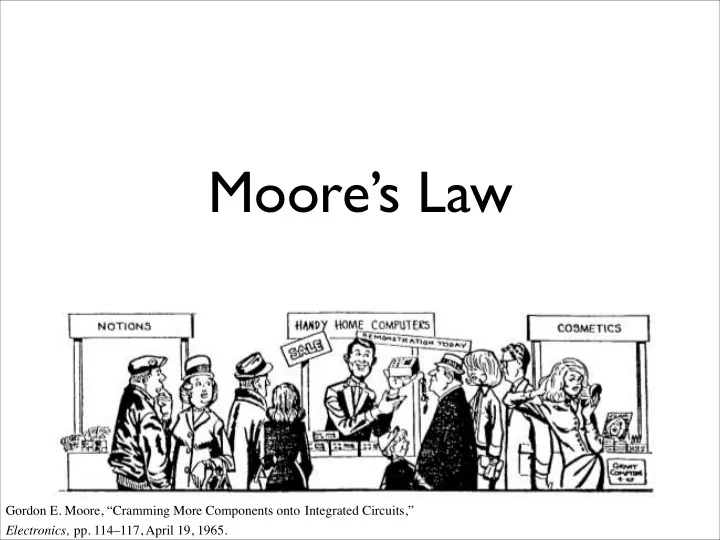
Moore’s Law

Gordon E. Moore, “Cramming More Components onto Integrated Circuits,” Electronics, pp. 114–117, April 19, 1965.
slide-2
SLIDE 2

Cramming More Components

  • nto Integrated Circuits
  • A manifesto about the promise of

integrations

  • Gordon Moore predicts a huge range of

applications

  • And a bunch of advantages
  • He’s selling hard!
slide-3
SLIDE 3

The promise

  • Apps -- scientific advancement, home

computers, automatic auto control, cell phones, electronic wrist watches, large scale data processing, and communication networks.

slide-4
SLIDE 4

The Promise

  • Reliability
  • Compactness
  • Weight
  • Power efficiency
  • Simpler designs -- see 8008 to 8086 evolution
slide-5
SLIDE 5

Moore’s Law

  • The number of minimum

cost xtrs per die increases exponentially

  • Density decreases

cost

  • Yield problems

increases cost

slide-6
SLIDE 6

Moore’s Law

  • xtrs count double

s every year.

  • Not quite right
  • Moore’s law: 250

xtrs in 2009

  • Reality: 232
  • Probably fewer

“cheapest”

slide-7
SLIDE 7

How it played out

slide-8
SLIDE 8

Moore’s Law

  • Since 1975
  • 1,100 x decrease in feature size
  • 1.2M x increase in density
  • About 45% per year. Doubling every 22

months.

slide-9
SLIDE 9

Observations

  • Other components (caps, inductors) will be

elusive.

  • Constant power scaling (formalized by

Dennard)

  • Chip size is roughly constant
  • Moore says 1/4 sq. in. = 161mm2
slide-10
SLIDE 10

Observations

  • Very optimistic about reliability.
  • Electron beam lithography (this is still just a

few years away)

  • Multiple metal layers!!!
  • Other technologies
  • attaching active components to “thin film

arrays”

slide-11
SLIDE 11

Corollaries to Moore’s Law

  • Moore’s law performance scaling
  • Switching speed goes up with decreasing

feature sizes -- Moore doesn’t comment

  • n this.
  • We have leveraged density + switching

speed to increase performance roughly with Moore’s law.

slide-12
SLIDE 12

Performance Growth

Performance grows faster than Moore’s law (45%/year)

An In-Depth Look at Computer Performance Growth, Magnus Ekman, Fredrik Warg, and Jim Nilsson, CHALMERS UNIVERSITY OF TECHNOLOGY, Department of Computer Engineering technical report 2004-9, 2004.

slide-13
SLIDE 13

Beating Moore

An In-Depth Look at Computer Performance Growth, Magnus Ekman, Fredrik Warg, and Jim Nilsson, CHALMERS UNIVERSITY OF TECHNOLOGY, Department of Computer Engineering technical report 2004-9, 2004.

slide-14
SLIDE 14

In Context

  • It’s hard to overestimate the importance of the

impact of Moore’s law.

  • However...
  • Note that it’s not about performance.
  • It’s strictly about density.
  • Not that this stops anyone from abusing it.
  • A pretty compelling vision for what integrated

circuit could do.

slide-15
SLIDE 15

More on Scaling

  • Seminal paper on scaling is Dennard et. al.

“Design of ion-implanted MOSFET's with very small physical dimensions”, 1974

  • Lays out how to truly scalable transistors.
slide-16
SLIDE 16

Dennardian Scaling

  • Given a scaling factor k.

Substrate

L

Gate

tox

Oxide

W drain sink

slide-17
SLIDE 17

Dennardian Breakdown

500 1000 1500 2000 0.2 0.4 0.6 0.8 1 relative leakage Vt 1 1.5 2 2.5 3 3.5 4 2 3 4 5 6 7 8 Energy * Delay @ Vt = 300mV Vdd/Vt

  • The problem with leakage
slide-18
SLIDE 18

Dennardian Breakdown

slide-19
SLIDE 19

Dennardian Breakdown