Monitoring drug and alcohol Traffic accidents cost about 3.7 billion - - PDF document

monitoring drug and alcohol
SMART_READER_LITE
LIVE PREVIEW

Monitoring drug and alcohol Traffic accidents cost about 3.7 billion - - PDF document

9 th Extra Workshop ICTCT in Ribero Preto, Brazil April 24 th 25 th 2014 International Co-operation on Theories and Concepts in Traffic Safety 78.5 million vehicles, including cars, buses, trucks and motorcycles; Brazil is


slide-1
SLIDE 1

International Co-operation on Theories and Concepts in Traffic Safety

9th Extra Workshop ICTCT in Riberão Preto, Brazil

April 24th – 25th 2014

  • Dr. Rafael Menck de Almeida

Detecting Alcohol and Illicit Drugs in Oral Fluid Samples Collected from Truck Drivers in the State of São Paulo, Brazil

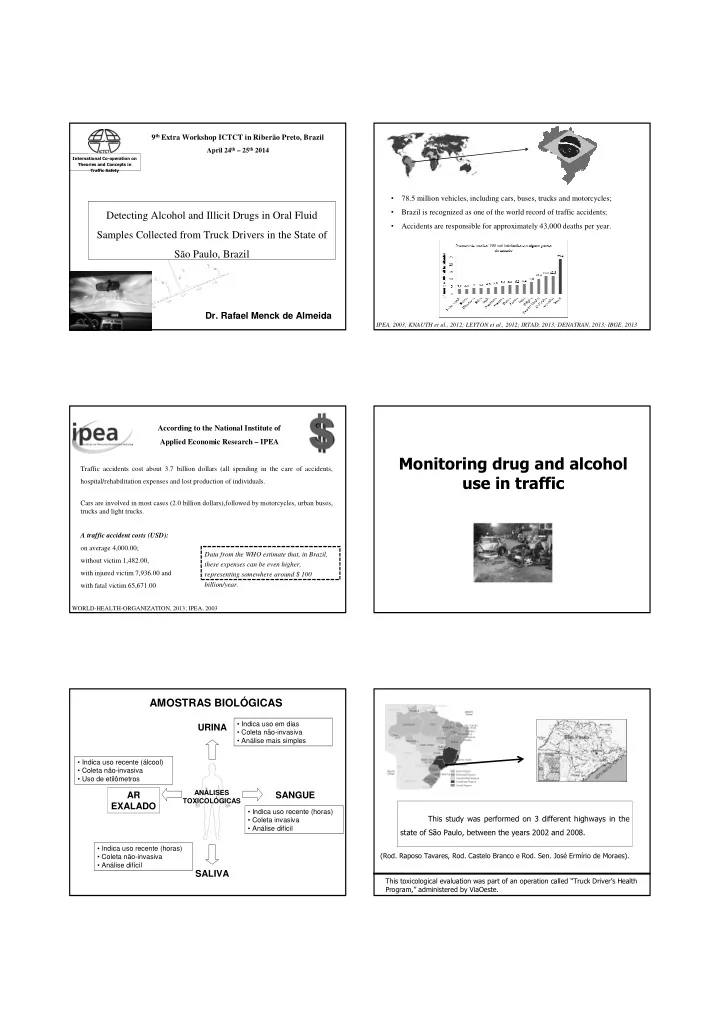
  • 78.5 million vehicles, including cars, buses, trucks and motorcycles;
  • Brazil is recognized as one of the world record of traffic accidents;
  • Accidents are responsible for approximately 43,000 deaths per year.

IPEA, 2003; KNAUTH et al., 2012; LEYTON et al., 2012; IRTAD, 2013; DENATRAN, 2013; IBGE, 2013 WORLD-HEALTH-ORGANIZATION, 2013; IPEA, 2003

Traffic accidents cost about 3.7 billion dollars (all spending in the care of accidents, hospital/rehabilitation expenses and lost production of individuals. Cars are involved in most cases (2.0 billion dollars),followed by motorcycles, urban buses, trucks and light trucks. A traffic accident costs (USD):

  • n average 4,000.00;

without victim 1,482.00, with injured victim 7,936.00 and with fatal victim 65,671.00

According to the National Institute of Applied Economic Research – IPEA

Data from the WHO estimate that, in Brazil, these expenses can be even higher, representing somewhere around $ 100 billion/year.

Monitoring drug and alcohol use in traffic

AR EXALADO SALIVA

AMOSTRAS BIOLÓGICAS

URINA SANGUE

  • Indica uso recente (horas)
  • Coleta invasiva
  • Análise difícil
  • Indica uso recente (horas)
  • Coleta não-invasiva
  • Análise difícil
  • Indica uso recente (álcool)
  • Coleta não-invasiva
  • Uso de etilômetros
  • Indica uso em dias
  • Coleta não-invasiva
  • Análise mais simples

ANÁLISES TOXICOLÓGICAS

This study was performed on 3 different highways in the state of São Paulo, between the years 2002 and 2008.

(Rod. Raposo Tavares, Rod. Castelo Branco e Rod. Sen. José Ermírio de Moraes). This toxicological evaluation was part of an operation called “Truck Driver’s Health Program,” administered by ViaOeste.

slide-2
SLIDE 2

Volunteers and Procedures

Truck drivers were randomly stopped and were asked by police officers to participate in research. As soon as the interview was carried out the oral fluid was collected using salivette    device during the morning (9 to 11 a.m.).

Sample Collection and Analyses

About 1 minute

Centrifugation 700g 10 min. Oral Fluid Salivette   

Sample Collection and Analyses Determination of ethanol and drug abuse in Oral Fluid

+ 2uLButyl chloroformate +30mg de NaHCO3/K2CO3 (2:1) + internal standards

  • anphetamine-d5
  • methanfetamine-d5
  • cocaíne-d3

+

SPME / GC-MS

Amphetamine Methamphetamine Cocaine

+ 1mL n- propanol HS / GC-FID

ethanol n-propanol

The wool NaOH 1M + 0,5mL acetic acid + internal standard THC-d3

THC

Of the 1298 truck drivers stopped, 1277 agreed (98.4%) to participate and provided oral fluid samples then 1250 samples were analyzed. Then they answered the questionnaire administered by a staff member.

Analyses (2002-2008):

All participants were male, and most were married (average and 95% confidence interval: 70.8%: 67.9–73.6%, n = 1005)

Questionnaire results

slide-3
SLIDE 3

Questionnaire results

School–level educations (63.5%: 60.4–66.5%, n = 1002)

The ages of the drivers ranged between 18 and 80 years and the average was 39.1 years old (38.4–39.8, n = 996).

Questionnaire results

The majority of the study group (77.6%: 74.3–79.6%, n = 994) reported that they had never been in traffic accidents.

  • 18 for ethanol
  • 8 for amphetamine (1 for methanfetamine)
  • 7 for cocaine
  • 5 for THC
  • 1 for cocaine and THC

Results of toxicological analyses (3.1%)

  • LEI 12.760/2012
  • Art. 1o Esta Lei altera dispositivos da Lei no 9.503, de 23 de setembro de 1997,

que institui o Código de Trânsito Brasileiro, com a finalidade de estabelecer alcoolemia 0 (zero) e de impor penalidades mais severas para o condutor que dirigir sob a influência do álcool (...)

  • Art. 165. Dirigir sob a influência de álcool ou de qualquer outra substância

psicoativa que determine dependência: Infração - gravíssima;

  • Art. 276. Qualquer concentração de álcool por litro de sangue ou por litro de ar

alveolar sujeita o condutor às penalidades previstas no art. 165. Parágrafo único. O Contran disciplinará as margens de tolerância quando a infração for apurada por meio de aparelho de medição, observada a legislação metrológica.

Law (Alcohol, drugs and traffic)

Illicit drugs

Cannabis Amphetamines – Amphetamine – Methamphetamine – MDMA (Ecstasy) – MDEA – MDA Cocaine Heroin

Psychoactive medicines

Medicines that can affect driving safety – Are often misused by drug addicts Most common: sleeping agents and tranquilizers/sedatives – Diazepam (Valium etc.) – Oxazepam (Sobril etc.) – Clonazepam (Rivotril etc.) – Bromazepam (Lexotan etc.) – Flunitrazepam (Rohypnol etc.) – Zopiclone (Imovane etc.) Also: strong pain killers (opioids) – Codeine – Morphine – Tramadol

slide-4
SLIDE 4

Conclusion

The finding that drug use is more common than alcohol use among truck drivers emphasizes the need for prevention, fiscalizations and educational campaigns highlighting not only the risks of using alcohol but also of abusing drugs. Despite the current Brazilian traffic code, which states that “driving under the influence of alcohol or any other psychoactive substances that cause dependence” is a serious offense, random testing and checkpoints are only performed to control alcohol use (breath testing). Therefore, a more intense and judicious surveillance of traffic regarding impaired driving is necessary to better promote safety for everyone.

UNIVERSIDADE DE SÃO PAULO

Faculdade de Ciências Farmacêuticas Departamento de Análises Clínicas e Toxicológicas Laboratório de Análises Toxicológicas

  • Dr. Rafael Menck de Almeida

rafaelmenck@usp.br