SLIDE 1
Monday, April 8
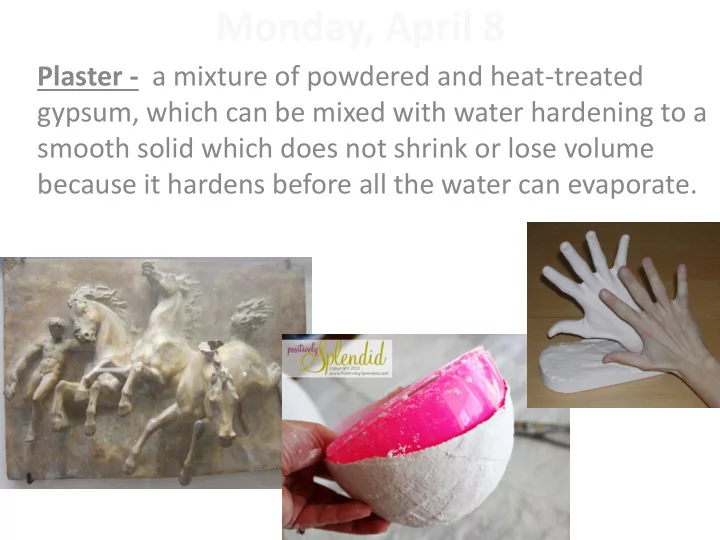
Plaster - a mixture of powdered and heat-treated gypsum, which can be mixed with water hardening to a smooth solid which does not shrink or lose volume because it hardens before all the water can evaporate.
SLIDE 2
Robert Indiana (Clark): Pop artist from Indiana. Well known for his 1958 postage stamp design of “LOVE” with a tilted “O”. Many sculptures mimic this art work.
SLIDE 3
Ceramics: the art of making vessels out of clay, fashioning them hollow, baking them in a kiln until the clay is hard, and sometimes finally glazing them for water tightness, durability, and appearance.
SLIDE 4
Gesso (Prounounced Jesso): Plaster or a fine plaster- like material. Applied to canvas or other surface prior to painting to ensure a durable, smooth surface.
SLIDE 5
Technique: Any method or way of working with art materials to produce an art object. Craftsmanship: The quality of what a person does. Craftsmanship is most admired when a person creates something with good skill by hand whether with or without tools.
SLIDE 6 Portfolio: A portable case for holding material, such as loose drawings, photographs, or other
- images. It may also be the materials collected in such
a case, especially when they are representative of an artist's work.
SLIDE 7
Linocut: A linoleum block or plate used for making relief prints. Linoleum is a durable, washable material formerly used more for flooring as vinyl flooring is used today.
SLIDE 8
Score: To scratch lines in unfired clay before applying moisture to join pieces of clay. Slip: Clay mixed with water until it becomes a liquid form about the consistency of cream. Slip is used in joining two pieces of clay together.
SLIDE 9
Bust – In art, a sculpture depicting a person’s head and shoulders.
SLIDE 10
Coil: Coils are long, snake-like ropes of clay that are used in making pottery Slab: A pottery technique in which a form is built up by joining shapes cut from thick sheets of damp clay.
SLIDE 11 Landscape: A painting, photograph or other work
- f art which depicts scenery such as mountains,
valleys, trees, rivers and forests. There is invariably some sky in the scene
SLIDE 12 Still Life: A picture of a grouping of inanimate
- bjects. Common still life subjects include vessels,
food, flowers, books, clothing
SLIDE 13
Printmaking: A print is a shape or mark made from a block or plate or other object that is covered with wet color (usually ink) and then pressed onto a flat surface, such as paper.
SLIDE 14
Varnish: A protective transparent finish applied in a liquid state to a surface. Many are available with a matte, semi-gloss, or glossy finish.
“
SLIDE 15 Wedge or Wedging: Mixing moist clay by cutting and recombining cut sections (slamming clay together) and by kneading it. This will also take the air pockets
- ut so the piece will not blow up in the kiln.
SLIDE 16
Wire: A usually pliable metallic strand made in many lengths and diameters (gauges). Gauge (pronounced “geyj”): Measurements of wire diameters (thicknesses or widths) are expressed in gauge numbers and decimals of an inch.
SLIDE 17
Kiln: A special oven or furnace that can reach very high temperatures and is used to bake, or fire clay. Kilns may be electric, gas, or wood-fired.
SLIDE 18
Pinch Pot: Finger manipulation of clay in the palm of one hand, using pressure of the fingers and gravity to form a lump of clay into a hollow shape.
SLIDE 19
Bisque: an unglazed ware that has been fired once. Once it is fired over 500* F., the water evaporates and the clay can no longer be softened.
SLIDE 20
Brayer: A tool used to roll ink onto a surface by hand, usually in block printing and in mono-printing.