SLIDE 1
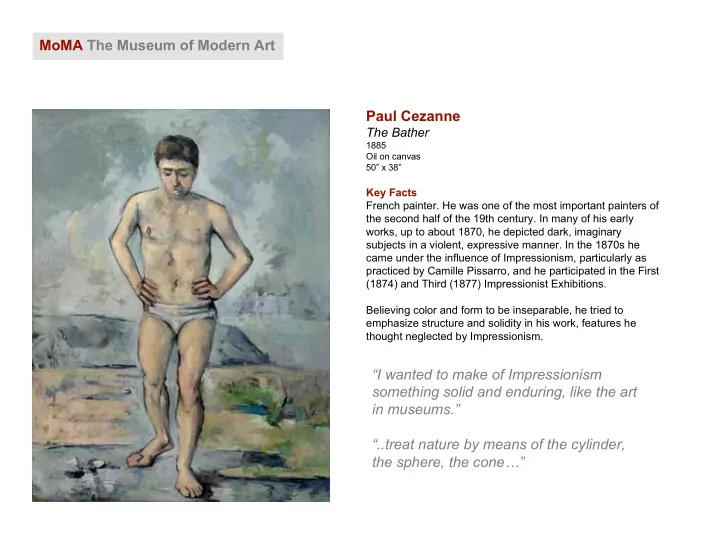
Paul Cezanne
The Bather
1885 Oil on canvas 50” x 38”
Key Facts French painter. He was one of the most important painters of the second half of the 19th century. In many of his early works, up to about 1870, he depicted dark, imaginary subjects in a violent, expressive manner. In the 1870s he came under the influence of Impressionism, particularly as practiced by Camille Pissarro, and he participated in the First (1874) and Third (1877) Impressionist Exhibitions. Believing color and form to be inseparable, he tried to emphasize structure and solidity in his work, features he thought neglected by Impressionism.
“I wanted to make of Impressionism something solid and enduring, like the art in museums.” “..treat nature by means of the cylinder, the sphere, the cone…” MoMA The Museum of Modern Art
SLIDE 2 Auguste Rodin
Monument to Balzac
1898 cast in 1954 Bronze
About this Work Commissioned to honor one of France's greatest novelists, Rodin spent seven years preparing for Monument to Balzac, studying the writer’s life and work, posing models who resembled him, and ordering clothes to his measurements. Ultimately, though, Rodin’s aim was less to create a physical likeness of Honoré de Balzac (1799–1850) than to communicate an idea or spirit of the man and a sense of his creative vitality: "I think of his intense labor, of the difficulty of his life, of his incessant battles, and of his great courage. I would express all that," he said. Several studies for the work are nudes, but Rodin finally clothed the figure in a robe inspired by the dressing gown that Balzac often wore when writing. About The Artist French sculptor and draughtsman. He is the only sculptor of the modern age regarded in his lifetime and afterwards to be
- n a par with Michelangelo. Both made images with
widespread popular appeal, and both stressed the materiality
- f sculpture. Rodin’s most famous works—the Age of Bronze,
The Thinker, The Kiss, the Burghers of Calais and Honoré de Balzac—are frequently reproduced outside a fine-art context to represent modern attitudes that require poses and encounters freed from allegory, idealization and propriety.
MoMA The Museum of Modern Art “To the artist there is never anything ugly in nature.”
SLIDE 3
Vincent van Gogh
Portrait of Joseph Roulin
1889 Oil on canvas
About The Artist Dutch painter. His life and work are legendary in the history of 19th- and 20th-century art. In the popular view, van Gogh has become the prototype of the misunderstood, tormented artist, who sold only one work in his lifetime—but whose Irises (sold New York, Sotheby’s, 11 Nov 1987) achieved a record auction sale price of £49 million. Romantic clichés suggest that van Gogh paid with insanity for his genius, which was understood only by his supportive brother Theo (1857–91). Van Gogh was active as an artist for only ten years, during which time he produced some 1000 watercolours, drawings and sketches and about 1250 paintings ranging from a dark, Realist style to an intense, expressionistic one. Almost more than on his oeuvre, his fame has been based on the extensive, diary-like correspondence he maintained, in particular with his brother. Key Facts Post Impressionism [ emotionalist ] Japanese Influence japonisme This is a portrait of Vincent’s postman, Joseph Roulin, one of Vincent’s few close friends Vincent was incredibly argumentative and had few friends This was painted in the year that Vincent entered an asylum. Became friends with Paul Gaugin, but drove him away.
“I put my heart and my soul into my work, and have lost my mind in the process.” MoMA The Museum of Modern Art
SLIDE 4 Paul Cezanne
Turning Road at Montgeroult
1898 Oil on canvas 32” x 25”
About This Image Cézanne’s lyrical works from this late period are characterized by more violent colors and a greater articulation
- f volumes into facets. In his landscapes Cézanne
emphasized the rough appearance of sites, mixing wild vegetation with rocks in unusual, asymmetric framings. His composition became less serene and his color more violent. The most extraordinary landscapes of the late period are the series of paintings of Mont Sainte-Victoire that Cézanne produced from 1900 until his death. Composed of discrete patches of color, the image becomes almost illegible beneath the intricate surface pattern of brushstrokes, showing a tendency towards abstraction. Nature was almost always Cezanne’s subject, but he was never bound by it. He selected and discarded elements from nature as they “pleased his canvas”. His aim was, first and foremost, to arrange elements in a manner that brought solidity and order to the picture plane.
"Art is a harmony which runs parallel with nature -- what is one to think of those imbeciles who say that the artist is always inferior to nature?"
MoMA The Museum of Modern Art
SLIDE 5 Gustav Klimt
Hope II
1907 Oil, Gold, and Platinum on Canvas 43” x 43”
Key Facts Associated with the Art Nouveau Movement Friends with Egon Schiele. Influenced visually by the flattened spaces of Byzantine art Many images address the beginning and end of life Allusions to prayerful activities The flattened space of Japanese prints was also influential Klimt remains Austria’s most prized painter He was equally inspired by modernism and the history of art. His images push and pull the viewer through space. He simultaneously confirms and denies the illusion of form
“Sometimes I miss out the morning’s painting session and instead study my Japanese books in the open.” “Whoever wants to know something about me
- as an artist which alone is significant - they
should look attentively at my pictures and there seek to recognize what I am and what I want.” MoMA The Museum of Modern Art
SLIDE 6 Marc Chagall
I and the Village
1911 Oil on canvas
Key Facts Painted the year after Chagall came to Paris, I and the Village evokes his memories of his native Hasidic community outside
- Vitebsk. In the village, peasants and animals lived side by
side, in a mutual dependence here signified by the line from peasant to cow, connecting their eyes. The peasant's flowering sprig, symbolically a tree of life, is the reward of their
- partnership. For Hasids, animals were also humanity's link to
the universe, and the painting's large circular forms suggest the orbiting sun, moon (in eclipse at the lower left), and earth. Chagall hovers between art historical categories. Some think Chagall a Surrealist, but many more refer to him as a Cubist. Though his picture plane resembles the fractured spaces of artist such as Braque and Picasso, his subject matter is much more rooted in the ideas presented by the Surrealist group.
“For the Cubists, painting was a surface covered with forms in a certain order. For me, a painting is a surface covered with representations of things...in which logic and illustration have no importance”
MoMA The Museum of Modern Art
SLIDE 7
Ernst Ludwig Kirchner
Street, Berlin
1913 Oil on canvas
Key Facts German painter. He was a prominent member of the German Expressionism movement. Rejecting academic painting, his work is composed of vibrant sections of color and angular forms, reflecting the energy of Berlin before World War I. Co- founding the Expressionist group Brücke, he began his Berlin period in 1911, which produced this painting of prostitutes in the red-light district of Berlin. After volunteering for the army and suffering a nervous breakdown, his work began to reflect the horror and pain associated with Germany’s struggle through World War I. His work was banned by the Nazis during their attack on modern art, causing him to destroy much of his own work and eventually commit suicide.
“A painter paints the appearance of things, not their objective correctness, in fact he creates new appearances of things.” MoMA The Museum of Modern Art
SLIDE 8
Giorgio de Chirico
Gare Montparnasse
1914 Oil on canvas 55 1/8” x 6’ 5/8”
Key Facts Influenced by his Greek culture, his mother, the death of his father, and Symbolist painter Arnold Bocklin He tried to evoke a sense of enigma (mystery) Used strong horizontal, vertical, and diagonal lines with flat colors and numerous vanishing points (this painting has 6) Places that de Chirico lives influenced his paintings. He was part of a metaphysical art movement and founded the School of Metaphysics Metaphysics The branch of philosophy that examines the nature of reality, including the relationship between mind and matter, substance and attribute, fact and value. He was a large influence on Surrealism Repeated symbols in his paintings include: bananas, smokestacks, and white statues (the latter two representing the death of his father)
“To become truly immortal, a work of art must escape all human limits: logic and common sense will only interfere. But once these barriers are broken, it will enter the realms of childhood visions and dreams.” MoMA The Museum of Modern Art
details
SLIDE 9 Marcel Duchamp
Network of Stoppages
1914 Oil and pencil on canvas
About This Work A working note of Duchamp's describes his idea for this enigmatic work: "A straight horizontal thread one meter long falls from a height of one meter onto a horizontal plane twisting as it pleases and creates a new image of the unit of length." Here, three such threads, each fixed to its own canvas with varnish, and each canvas glued to its
- wn glass panel, are enclosed in a box, along with three
lengths of wood (draftsman's straightedges) cut into the shapes drawn by the three threads. Duchamp later said that 3 Standard Stoppages opened the way "to escape from those traditional methods of expression long associated with art," such as what Duchamp called "retinal painting," art designed for the luxuriance of the eye. This required formal intelligence and a skillful hand on the part of the artist. The Stoppages, on the other hand, depended on chance—which, paradoxically, they are at the same time fixed and "standardized."
MoMA The Museum of Modern Art
French painter, sculptor and writer. The art and ideas of Duchamp, perhaps more than those of any other 20th-century artist, have served to exemplify the range of possibilities inherent in a more conceptual approach to the art-making process. Not
- nly is his work of historical importance—from his early
experiments with Cubism to his association with Dada and Surrealism—but his conception of the ready-made decisively altered our understanding of what constitutes an object of art. About The Artist
“I have forced myself to contradict myself in
- rder to avoid conforming to my own taste.”
SLIDE 10 Max Pechstein
Dancer in the Mirror
1923 Woodcut
Key Facts A German artist and member of the German Expressionist movement, his bold and dramatic work reflected the social upheaval in Post-World War I Germany. Focusing on anti- bourgeois subjects like this cabaret dancer, Pechstein utilized strong diagonals and angular shapes to reflect upon the
- ppression of such a role. The indifferent mood of this
woodcut contrasts with the events depicted, suggesting the political and social instability at that time.
“Art is not a pastime, it is a duty with respect to the people, a public affair.” MoMA The Museum of Modern Art
SLIDE 11 Otto Dix
Doctor Mayer Hermann
1926 Watercolor and plaster on muslin, mounted on cardboard 24” x 20”
About This Work
- Dr. Mayer–Hermann was a renowned throat specialist
whose waiting room was filled with the most prominent singers and actresses of his day. Dix was among his
- patients. While Dix is best known for his unflinching,
audacious depictions of prostitutes, crippled war veterans, and other traumatized subjects, here he depicts a member of the professional class with wit and
- satire. The abundance of circular shapes that fill the
canvas parody the doctors round body and face from the curves of the doctors chubby hands and the round bags under his eyes, to the reflector on his headband and the mirror above his head. About The Artist German painter and printmaker. Volunteering as a machine-gunner during World War I, he served in the German army (1914–18), making innumerable sketches of war scenes, using alternately a realistic and a Cubo-Futurist style. The experience of war, moreover, became a dominant motif of his work until the 1930s. “People were already beginning to forget, what horrible suffering the war had brought them. I did not want to cause fear and panic, but to let people know how dreadful war is and so to stimulate people's powers of resistance.”
MoMA The Museum of Modern Art
SLIDE 12 Charles Sheeler
American Landscape
1930 Oil on canvas 24x31”
Key Facts Sheeler was originally a photographer. Many of his famous works were made with his time at the Ford Motor Company River Rouge Plant. He used “precisionism” which was a term he coined in which the subjects were exact, hard, flat, big, industrial, and full of exchanges with photography. His subject matter usually consisted of machinery and structures. His first real subject was his farmhouse, especially his stove. He used crisp lines with strong horizontal, vertical, and diagonals He uses geometric shapes with a photographic quality
“Photography is nature seen from the eyes
- utwards. Painting is nature seen from the
eyes inwards.” MoMA The Museum of Modern Art
SLIDE 13
Edward Hopper
Gas
1940 Oil on canvas 26 x 40 1/4“
About the Artist Hopper began as an illustrator, then moved to printmaking, watercolors, and finally oil painting. Some large influences on his life were his two trips to Europe, his wife Jo Nivison, and his cross country trips to Mexico. His paintings general consist of lone figures with the prominent feeling of loneliness and existentialism. His paintings are known for their geometric shapes, artificial lighting, clear cut lines, and strong horizontal and vertical lines
“To me the most important thing is the sense of going on. You know how beautiful things are when you're travelling.” MoMA The Museum of Modern Art
This work resulted from a composite representation of several gasoline stations seen by the artist. The light in this painting—both natural and artificial—gives the scene of a gas station and its lone attendant at dusk an underlying sense of drama. But rather than simply depicting a straightforward narrative, Hopper's aim was "the most exact transcription possible of my most intimate impressions of nature"—in this case, the loneliness of an American country road. Fellow artist Charles Burchfield believed these paintings would remain memorable beyond their time, because in his "honest presentation of the American scene . . . Hopper does not insist upon what the beholder shall feel." About This Work
SLIDE 14
Robert Motherwell
Western Air
1946-47 Oil and sand on canvas 6' x 54"
Key Facts American Abstract Expressionist. Influenced by Surrealists. Joined with Jackson Pollock, William de Kooning, Mark Rothko, and Franz Kline to change the face of American painting at the time. Motherwell had an interest in exploring the deeper sense of reality beyond the recognizable image. Major themes of life are expressed in Motherwell’s paintings. This work consists of black, organic ovals that are squeezed by stiff vertical bars.
“The public history of modern art is the story of conventional people not knowing what they are dealing with.” “Art is much less important than life, but what a poor life without it.” MoMA The Museum of Modern Art
SLIDE 15 Armando Reverón
Muñeca
1940’s Synthetic fiber, textile, wire, cotton fiber, printed paper, jute, and pigment
Key Facts NY educated uncle- Academia Nacional de Bellas Artes. 1911 Scholarship towards Europe; Studied at Real Academia de Bellas Artes de San Fernando (by Carbonero- same as Dali!) Influenced by Francisco Goya, Diego Velazquez, and El
- Greco. Travels France, Venezuela during Blue Period
Lived in Castillete, his little castle, during the White Period There he suffered acute depression, went through a semi- delirious expressionist stage.
“I have liked the world of the fantastic, of dolls that are like living characters but do not speak. They only look. It is I who
- speak. They look at me and listen to me.”
MoMA The Museum of Modern Art
SLIDE 16 Barnett Newman
Vir Heroicus Sublimis
1950-51 Oil on canvas 7’ 11 3/8” x 17’ 9 _”
About this Work
Abstract Expressionist. Born and lived in New York. Came to believe that a new art form was necessary that reconnected people with their emotions. His art work focuses on the chromatic contrasts of
Newman may appear to concentrate on shape and color, but he insisted that his canvases were charged with symbolic meaning. Like Piet Mondrian and Kazimir Malevich before him, he believed in the spiritual content of abstract art. The very title of this painting—in English, "Man, heroic and sublime"—points to aspirations of transcendence. Abstract Expressionism is often called "action painting," but Newman was one of the several Abstract Expressionists who eliminated signs of the action of the painter's hand, preferring to work with broad, even expanses of deep color. Vir Heroicus Sublimis is large enough so that when the viewer stands close to it, as Newman intended, it creates an engulfing environment—a vast red field, broken by five thin vertical stripes. Newman admired Giacometti’s bone thin human figures, and the thin vertical strips or “zips” in his painting may be seen as symbolizing figures in a void. They set off a perfect square in the middle of the canvas.
“Painting, like passion, is a living voice.” “A painter is a choreographer of space.” MoMA The Museum of Modern Art
SLIDE 17 Mark Rothko
1950 Oil on canvas 9’ 9” x 8’ 11”
Key Facts Key player in the Abstract Expressionist Movement Considered a Color Field painter Though his paintings seem simple, they were highly complex. Wants his viewer to be engulfed with color as emotion Stated that his work should be viewed from 18” away Received incredible fame in his own time. Was an abrasive and argumentative person. Committed suicide
“There is no such thing as a good painting about nothing.”
“The fact that people break down and cry when confronted with my pictures shows that I can communicate those basic human emotions.. the people who weep before my pictures are having the same religious experience I had when painting them. And if you say you are moved only by their color relationships then you miss the point.”
MoMA The Museum of Modern Art
SLIDE 18 Robert Rauschenberg
Bed
1955 Combine painting: oil and pencil on pillow, quilt, and sheet
Key Facts Regarded as principal bridge between Abstract Expressionism of the 1950’s and Pop Art of the 1960’s. Reflects his personal attitude towards modern art Mocks the seriousness of this ambitious art Bed looses its function, but not its association with the private, inner life of human beings.(sleep, dreams, sex) About this Piece
Bed is one of Robert Rauschenberg's first Combines, the artist's term for his technique of attaching cast–off items, such as tires or old furniture, to a traditional
- support. In this case he framed a well–worn pillow,
sheet, and quilt, scribbled on them with pencil, and splashed them with paint, in a style reminiscent of Abstract Expressionism. Legend has it that these bedclothes are Rauschenberg's own. The work is thus as personal as a self–portrait, or more so—a quality consistent with Rauschenbergs statement, "Painting relates to both art and life.... (I try to act in that gap between the two.)"
MoMA The Museum of Modern Art
About the artist American painter, sculptor, printmaker, photographer and performance artist. While too much
- f an individualist ever to be fully a
part of any movement, he acted as an important bridge between Abstract Expressionism and Pop art and can be credited as one of the major influences in the return to favor of representational art in the
- USA. As iconoclastic in his
invention of new techniques as in his wide-ranging iconography of modern life, he suggested new possibilities that continued to be exploited by younger artists throughout the latter decades of the 20th century.
"There is no reason not to consider the world as
SLIDE 19 Hans Hofmann
Kaleidos
1958 Oil on plywood 6’ x 32”
About the Artist German born artist who moved the America in 1932 as the Nazi’s began to gain influence in Germany. Best known for his school, the Hans Hofmann School of Fine Arts, where he encouraged his students to explore and experiment while still taking visual cues from the world around them. One of the most famous art educators of all time. Played a crucial role in the Abstract Expressionist movement, teaching many of the young New York painters to approach their canvases with “feeling, not knowing”. He believed that the possibilities of painting must be sensed, and that the painter should approach the canvas without any preconceptions about what the painting will be in the end. For Hofmann, the experience
- f painting was far more important than the
visual record of that experience. His work is characterized by crudely painted geometric forms and the thick application and layering of paint on the surface. “When I paint, I improvise. I deny theory and method and rely only on empathy and feeling.” “When I paint, I paint under the dictate of feeling or sensing, and the outcome all the time is supposed to say something.” “My aim is to eliminate the unnecessary, so that the necessary may speak.”
MoMA The Museum of Modern Art
SLIDE 20 Robert Rauschenberg
First Landing Jump
1961 Combine painting: cloth, metal, leather, electric fixture, cable, and oil paint
- n composition board, with automobile tire and wood plank
7’ 5” x 6’ 8”
About the artist American painter, sculptor, printmaker, photographer and performance artist. While too much of an individualist ever to be fully a part of any movement, he acted as an important bridge between Abstract Expressionism and Pop art and can be credited as one of the major influences in the return to favor
- f representational art in the USA. As iconoclastic in his
invention of new techniques as in his wide-ranging iconography of modern life, he suggested new possibilities that continued to be exploited by younger artists throughout the latter decades of the 20th century. About this work He composed First Landing Jump out of a rusted license plate, an enamel light reflector, a tire impaled by a street barrier, a man's shirt, a blue lightbulb in a can, and a black tarpaulin, as well as paint and canvas. Jasper Johns coined the term "Combine" for such works, which he described as "painting playing the game of sculpture." Though the taut metal coil alludes to the motion of a parachute jump, referenced by the title, and the lightbulb is lit with electricity, in their second lives these items are divested of their original purpose and fixed into the work of art..
MoMA The Museum of Modern Art "There is no reason not to consider the world as one gigantic painting,”
SLIDE 21 Richard Hamilton
Glorious Techniculture
1961-64 Oil, Gold, and Platinum on Canvas 48 3/8 x 48 3/8"
Key Facts English painter and printmaker. James Joyce and Marcel Duchamp were major influences in his life. Investigated printmaking techniques. The work takes its title from a lecture Hamilton gave in 1959 entitled "Glorious Technicolour, Breathtaking Cinemascope and Stereophonic Sound“. Glorious Techniculture was conceived as a spectacular collection of the myths of popular culture. Fused a wide variety
- f painterly styles and imagery into a constantly shifting play of
visual information. Combining drawing and graphic styles he creates a collage of images from advertising and magazine illustration into a painterly style. Positive mix of the earlier approaches of the Dadaists and Futurists.
His definition of Pop Art: "Pop Art is: popular, transient, expendable, low-cost, mass- produced, young, witty, sexy, gimmicky, glamorous, and Big Business.” MoMA The Museum of Modern Art
SLIDE 22 Cy Twombly
Leda and the Swan
1962 Oil, pencil, and crayon on canvas 6’ 3” x 6’ 6 _”
Key Facts
An American artist with background in Abstract Expressionism. Twombly works on a scale much larger than just an easel. Challenging convention, he often forces himself to use his left hand and sometimes draws in the dark. Robert Rauschenberg and Jasper Johns were among his friends. No painter of his time more consistently invites association with the language of graffiti. His scrawled calligraphic markings may recall the automatic writing of Surrealism, another inheritance passed on to him through Abstract Expressionism, but they also evoke the scratches and scribbles on the ancient walls of Rome. Rome supplies another touchstone for Twombly through his fascination with classical antiquity. Here he refers to the myth in which Jupiter, lord of the gods, took the shape of a swan in order to ravish the beautiful Leda. (This violation ultimately led to the Trojan War, fought over Leda's daughter Helen.) Twombly's version of this
- ld art-historical theme supplies no contrasts of feathers and flesh but
an orgiastic fusion and confusion of energies within furiously thrashing overlays of crayon, pencil, and ruddy paint. A few recognizable signs—hearts, a phallus—fly out from this explosion. A drier comment is the quartered, windowlike rectangle near the top of the painting, an indication of the stabilizing direction that Twombly's art was starting to take.
“My line is childlike but not childish. It is very difficult to fake….To get that quality you need to project yourself into the child’s line. It has to be felt.” “Graffiti is linear and it's done with a pencil, and it's like writing on walls. But in my paintings it's more lyrical. ”
MoMA The Museum of Modern Art
SLIDE 23 Lee Friedlander
Galax, Virginia
1962 Photograph
Key Facts American photographer. Studied, explored, and exemplified the “social landscape” of America, a term which he coined. His style of photography is known as photojournalism; his pieces are named for the hotels he stayed in along his journey around the country, much like a personal journal of his experiences. Another escapade of his was his self-portrait series, in which he appeared in the most oblique ways (as a shadow on another person, in a mirror across the street, etc.). He also tried to address the issue of the urban setting vs. the beauty
- f nature after returning from a trip in Japan.
MoMA The Museum of Modern Art “It fascinates me that there is a variety of feeling about what I do. I’m not a premeditative photographer. I see a picture and I make it. If I had a chance, I’d be out shooting all the time. You don’t have to go looking for pictures. The material is generous. You go out and the pictures are staring at you.”
SLIDE 24 Robert Motherwell
Elegy to the Spanish Republic, 108
1965-67 Oil on canvas 6’ 10’’ x 11’ 6 _”
Key Facts American painter and key member of the Abstract Expressionist movement. Originally wanted to be a philosopher and was heavily influenced by the writings of Alfred North Whitehead. The Elegy series was painted in response to the Spanish Civil War. They were intended as a “lamentation or funeral song.” Emotional and experimental, Motherwell’s art often consists
- f the repetition of dark ovals arranged on a geometric
background of simple shapes like squares and rectangles. Elegy to the Spanish Republic, 108 describes a stately passage of the organic and the geometric, the accidental and the deliberate. Like other Abstract Expressionists, Motherwell was attracted to the Surrealist principle of automatism—of methods that escaped the artist's conscious intention—and his brushwork has an emotional charge, but within an overall structure of a certain severity. In fact Motherwell saw careful arrangements of color and form as the heart of abstract art, which, he said, "is stripped bare of other things in order to intensify it, its rhythms, spatial intervals, and color structure."
“Without ethical consciousness, a painter is only a
- decorator. Without ethical consciousness, the
audience is only sensual, one of aesthetics.”
MoMA The Museum of Modern Art
His recurring motif here is a rough black oval, repeated in varying sizes and degrees of compression and distortion. Instead of appearing as holes leading into a deeper space, these light-absorbent blots stand out against a ground of relatively even, predominantly white upright rectangles. They have various associations, but Motherwell himself related them to the display of the dead bull's testicles in the Spanish bullfighting ring.
SLIDE 25 Cy Twombly
Untitled
1968
Key Facts Born 1928 in Virgina. Twombly studied art in Boston, New York, and at Black Mountain Collage where he met
- Rauschenberg. He Later traveled the world, and served in the
Army as a cryptographer. Twombly guided along Abstract Expressionism, leading toward the direction of Minimalist art. Twombly explains his process of work consists of sitting for 2 to 3 hours, then jumping up and doing a painting in 15 minutes. Using a variety of materials from house paint to children’s crayons.
“My line is childlike but not childish. It is very difficult to fake... to get that quality you need to project yourself into the child's line. It has to be felt.” MoMA The Museum of Modern Art