Molecular Mechanism of Bacterial Flagellar Protein Export Tohru - - PowerPoint PPT Presentation

molecular mechanism of bacterial flagellar protein export
SMART_READER_LITE
LIVE PREVIEW

Molecular Mechanism of Bacterial Flagellar Protein Export Tohru - - PowerPoint PPT Presentation

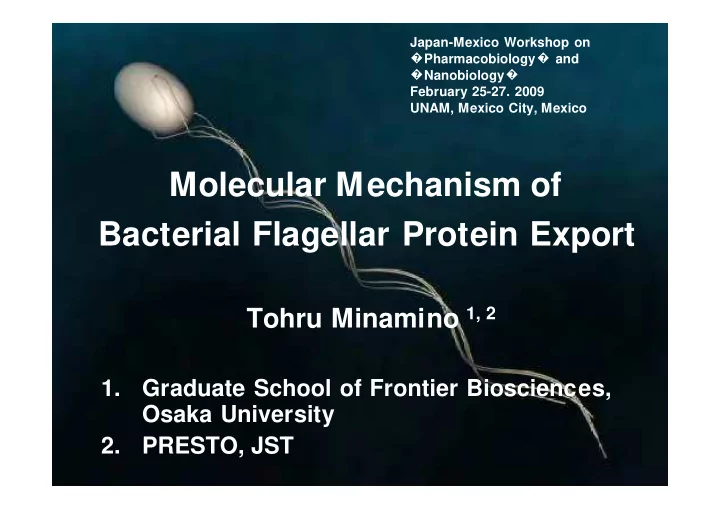
Japan-Mexico Workshop on Pharmacobiology and Nanobiology February 25-27. 2009 UNAM, Mexico City, Mexico Molecular Mechanism of Bacterial Flagellar Protein Export Tohru Minamino 1, 2 1. Graduate School of Frontier Biosciences,


slide-1
SLIDE 1

Molecular Mechanism of Bacterial Flagellar Protein Export

Tohru Minamino 1, 2

1. Graduate School of Frontier Biosciences, Osaka University 2. PRESTO, JST

Japan-Mexico Workshop on Pharmacobiology and Nanobiology February 25-27. 2009 UNAM, Mexico City, Mexico

slide-2
SLIDE 2

Bacterial flagella are filamentous organelles extended from the cell surface and is responsible for bacterial motility

Electron micrograph of Salmonella enterica serovar Typhimurium A reversible rotary motor, which is located at the base of the filament, is powered by the electrochemical potential gradient of proton across the cytoplasmic membrane

slide-3
SLIDE 3

Swimming behavior of Salmonella enterica serovar Typhimurium in aqueous environments

slide-4
SLIDE 4

Flagellar bundle is disrupted by quick reversal change of the direction of flagellar motor rotation, changing the swimming direction of bacteria

(Macnab & Ornston, J. Mol. Biol. 1977)

slide-5
SLIDE 5

Bacterial flagellum

slide-6
SLIDE 6

Hook completion

Rod/hook

  • type

Filament

  • type Switching of export

specificity of the export apparatus

Rod/hook

  • type

Filament

  • type

(Kutsukake, Minamino et al., J. Bacteriol. 1994; Minamino et al., Mol. Microbiol. 1999; Minamino et al., J. Mol. Biol. 2004 ; Minamino et al., J. Mol. Biol. 2006a; Moriya, Minamino et al., J. Mol. Biol. 2006)

FliK acts as a ruler to measure hook length in the cell exterior and switches export specificity of FlhB, an integral membrane component of the export apparatus, allowing such huge and complex architecture to be built efficiently in a well regulated manner.

OM PG CM

The order of flagellar protein export exactly parallels that of flagellar assembly
slide-7
SLIDE 7

Flagellar protein export apparatus

(Minamino & Macnab, J. Bacteriol. 1999; Minamino & Macnab, Mol. Microbiol. 2000)

Export components

<Integral membrane proteins> FlhA, FlhB, FliO, FliP, FliQ, FliR (Export gate) <Cytoplasmic proteins> FliH (ATPase regulator), FliI (ATPase), FliJ (Putative chaperone)

slide-8
SLIDE 8

The flagellar export pathway is one example of a type III pathway

Flagellar protein export Secretion of virulence factors (effectors) SALTY Function YEREN SALTY EPEC SHIFL PSESH (Ysc) (SPI-1) FlhA Export gate LcrD InvA EscV MxiA HrcV FlhB Export gate YscU SpaS EscU Spa40 HrcU FliO Export gate ? ? ? ? ? FliP Export gate YscR SpaP EscR Spa24 HrcR FliQ Export gate YscS SpaQ EscS Spa9 HrcS FliR Export gate YscT SpaR EscT Spa29 HrcT FliH Regulator YscL ? ? MxiN? HrpF? FliI ATPase YscN InvC EscN Spa47 HrcN FliJ General chaperone YscB? InvI Orf15? Spa13? HrcP?

Component proteins of the flagellar export apparatus share substantial sequence similarities with those of type III secretion system (injectisome)

  • f pathogenic bacteria such as Yersinia, Salmonella, EPEC, Shigella, and

Pseudomonus, which is responsible for direct secretion of virulence factors into host cells.

slide-9
SLIDE 9

Hook-basal body complex and Injectisome (secretes virulence factors) look similar to each other.

Hook-basal body Injectisome The sequence and structural similarities between the flagellum and the injectisome suggest an evolutional origin shared by these molecular machines.

slide-10
SLIDE 10

Today s topics

  • 1. Dynamic, specific and

cooperative interaction between export component proteins involved in the early stages of flagellar protein export.

  • 2. Energy source for

flagellar protein export

slide-11
SLIDE 11

Sequence similarity between FliI ATPase and the α/β subunits of the proton-translocating F1 ATPase

slide-12
SLIDE 12

FliI can be superimposed to the F1 ATPase α/β subunits

(Imada, Minamino et al., PNAS. 2007)

The whole structure of FliI shows a striking similarity to the α and β subunits

  • f F1 ATPase and nucleotide binds to the P-loop in FliI in a similar way as in

the F1-α/β subunits, implying a similarity in the functional mechanism between FliI and F1-ATPase.

slide-13
SLIDE 13

Enzymatic characteristics of FliI ATPase

Km: 0.71 Hill s cooperativity coefficient: 1.78

(Minamino et al., J. Mol. Biol. 2006)

Unlike F1-ATPase, FliI can self- assemble into homohexamer and hence fully exerts its ATPase activity.

(Imada, Minamino et al., PNAS. 2007)

FliI hexamer

slide-14
SLIDE 14

FliH binds to the extreme N-terminal region of FliI and suppresses the ATPase activity of FliI

(Minamino & Macnab. Mol. Microbiol. 2000b; Okabe, Minamino et al., FEBS lett. 2009 )

Pull down assays with Ni-NTA affinity chromatography ATPase activity of the FliH/FliI complex FliH-binding

slide-15
SLIDE 15

Sequence similarity between FliH and F0F1 ATP synthase components

FliH represents a fusion of domains homologous to second stalk proteins of the F0F1 syntase (the b and δ subunits) essential for connecting F1 with F0

(Pallen et al., Protein Sci. 2006) (González-Pedrajo et al., Mol. Microbiol. 2002; Minamino et al., J. Mol. Biol. 2002)

FliHN FliHC

Interaction with FliI ATPase 100 140

b subunit δ subunit

Dimerization

slide-16
SLIDE 16

(Minamino et al., J. Bacteriol. 2003)

A FliH defect can be bypassed by overproduction of FliI or by a second- site mutation in FlhA or FlhB, integral-membrane components of the export apparatus, suggesting that FliH plays an important role in the effective docking of FliI ATPase to the FlhA-FlhB platform.

Bypass effects on the FliH defect

slide-17
SLIDE 17

(González-Pedrajo, Minamino et al., Mol. Microbiol. 2006)

Interaction of FliH and FliN (one of the switch proteins, which participate not only in the motor function but also in the flagellar/assembly export process)

62 47.5 25 32.5 16.5 kDa

FliH + His-FliN

FliH His-FliN

600 600 Imidazole (mM)

Pull down assays Gel filtration chromatography

slide-18
SLIDE 18

Fli I ∆fliR ∆fliH ∆fliN WT

The reduced secretion activity of a fliN null mutant is partially recovered by overproduction of FliI ATPase.

(McMurry et al., Biochemistry. 2006)

The C ring seems to provide docking sites for the FliH-FliI complexes near the export gate so that they can efficiently dock to the FlhA-FlhB platform of the export gate.

slide-19
SLIDE 19

FliH/FliI complex acts as a pilot to deliver export substrate into the export gate

(González-Pedrajo, Minamino et al., Mol. Microbiol. 2006; Minamino & Macnab, Mol. Microbiol. 2000a, b; Minamino et al., J. Bacteriol. 2003; Minamino et al., J. Mol. Biol. 2006.)

1. The FliH2FliI complex binds to the chaperone-export substrate complex in the cytoplasm. 2. The FliH2FliI-chaperone-substrate complex docks to the C ring through the FliH-FliN interaction. 3. The FliH2FliI-chaperone-substrate complex can efficiently dock to the platform made of integral membrane export components, where FliI forms the hexamer ring and its specific binding to the FlhA-FlhB platform promotes initial entry of the N-terminal segment of the substrate.

slide-20
SLIDE 20

What is energy source for flagellar protein export

Translocation of many soluble proteins across cell membranes requires bioenergies such as ATP and proton motive force.

X X

Since fliI mutants cannot export any flagellar proteins, FliI has been thought to provide the energy for the translocation of export substrates into the narrow channel of the growing flagellar structure.

slide-21
SLIDE 21

Role of Salmonella InvC (FliI homolog) in type III secretion of virulence factor

(Akeda, Y. & Galán, J. E. Nature. 2005)

InvC binds to chaperone-effector complexes and acts as an unfoldase to induce chaperone release from and unfolding of the effector to be secreted in an ATPase-dependent manner

slide-22
SLIDE 22

The diameter of the central channel, which is the physical path for flagellar protein export, is only 2 nm.

Atomic model of the flagellar filament structure solved by cryo-EM and helical image analysis

(Yonekura et al.,Nature, 2003)

Does FliI act as an unfoldase to drive flagellar protrein export in an ATP-dependent manner?

slide-23
SLIDE 23

Motility assays of a fliH-fliI double null mutant

(Minamino & Namba, Nature. 2008)

Unlike a fliI null mutant, Salmonella cells missing both FliH and FliI formed swarms on soft agar plates after prolonged incubation, suggesting that FliI is not absolutely required for flagellar protein export.

slide-24
SLIDE 24

(Minamino & Namba, Nature. 2008)

Isolation of pseudorevertants from the ∆fliH-fliI mutant.

The second-site mutations in FlhB and FlhA substantially improved both flagellar protein export and motility of the fliH-fliI double null mutant. These gain-of-function mutations increase the probability of flagellar protein entry into the export gate, thereby increasing export efficiency. The amounts of FlgD and FliK secreted by the pseudorevertants were even larger than those of wild-type, suggesting that the translocation of export substrate is not powered by the chemical energy derived from ATP hydrolysis by FliI.

slide-25
SLIDE 25

Effect of carbonyl cyanide m-chlorophenylhydrazone (CCCP) on secretion of flagellar proteins

(Minamino & Namba, Nature. 2008)

Intracellular ATP level

When PMF was gradually collapsed by adding CCCP, the secretion levels of export substrates decreased significantly at the CCCP concentration above 10 µM and diminished at 25 µM although the intracellular levels of export substrates and ATP were

  • maintained. These results indicate that PMF is

absolutely essential for the export process regardless of the presence or absence of FliH and FliI.

slide-26
SLIDE 26

1. The FliH/I complex facilitates only the initial entry of export substrates into the gate. 2. The rest of the successive unfolding/translocation process of the substrates is driven by proton motive force. 3. The energy of ATP hydrolysis by FliI seems to be used to disassemble and release the FliH/I complex from the export gate and the protein about to be exported.

Distinct roles of FliI ATPase and proton motive force in bacterial flagellar protein export

(Minamino & Namba, Nature. 2008)

slide-27
SLIDE 27

Similarity between flagellar protein export apparatus and F0F1ATPsynthase

1. The entire structure of FliI is almost identical to the α and β subunits. 2. Sequence similarity between FliH and the b/δ subunits. 3. Energy source for both the translocation of flagellar protein and ATP synthesis is proton motive force across the cytoplasmic membrane.

These two remotely related systems may be similar to each other for their entire structural architectures.

slide-28
SLIDE 28

Collaborators

Osaka University & ICORP, JST

  • Keiichi Namba
  • Katsumi Imada
  • Nobunori Kami-ike
  • Yukio Furukawa
  • Yumiko Saijo-Hamano
  • Yumiko Uchida
  • Miki Kinoshita-Minamino
  • Ken-ichi Kazetani
  • Masafumi Shimada
  • Tatsuya Ibuki
  • Shinsuke Yoshimura
  • Hirofumi Suzuki
  • Aiko Tahara
  • Nao Moriya

Yale University

  • Robert M. Macnab
  • May Kihara
  • Mayuko Okabe

UNAM

  • Bertha González-Pedrajo