Module 16 E mployee Mentor ing 1 Module Sixteen: Employee - - PDF document

module 16 e mployee mentor ing
SMART_READER_LITE
LIVE PREVIEW

Module 16 E mployee Mentor ing 1 Module Sixteen: Employee - - PDF document

In the last two modules, we looked at developing employees and having a positive influence. Module 16 takes this one step further. Mentoring. In order to have a steady stream of capable and knowledgeable leaders, an importance must be placed


slide-1
SLIDE 1

Module Sixteen: Employee Mentoring 1

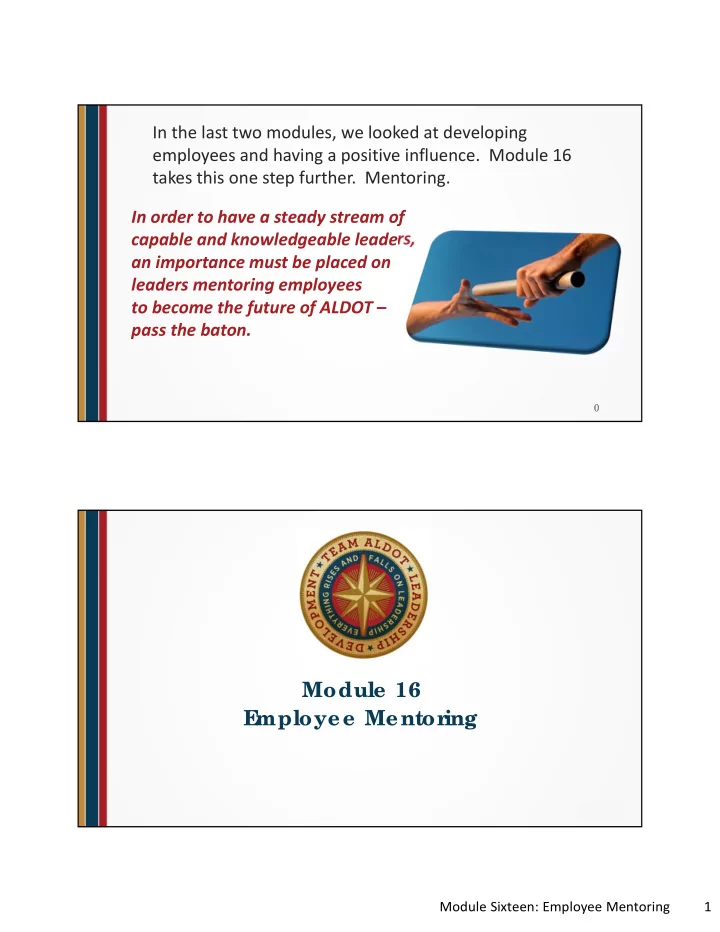
In the last two modules, we looked at developing employees and having a positive influence. Module 16 takes this one step further. Mentoring. In order to have a steady stream of capable and knowledgeable leaders, an importance must be placed on leaders mentoring employees to become the future of ALDOT – pass the baton.

1

Module 16 E mployee Mentor ing

slide-2
SLIDE 2

Module Sixteen: Employee Mentoring 2

2

Objectives

  • Identify what mentoring is and is not.
  • Understand the importance of mentoring.
  • Recognize the benefits and challenges of mentoring.
  • Implement the steps in a mentoring program.

3

LEADERSHIP MOMENT Rex Bush, Assistant Bureau Chief, Preconstruction Video Title: Mentoring Employees

Rex Bush, PE/PLS Assistant Chief Engineer, Pre‐Construction, Retired Employee Mentoring

slide-3
SLIDE 3

Module Sixteen: Employee Mentoring 3

4

Mentoring

  • A way to develop more leaders
  • A one‐on‐one developmental relationship
  • A more senior/experienced supervisor paired with a more junior/less‐

experienced employee

  • Mutually beneficial to mentor and mentee
  • Not the same as supervision or coaching

5

Mentoring

Mentoring is a brain to pick, an ear to listen, and a push in the right direction. John C. Crosby

slide-4
SLIDE 4

Module Sixteen: Employee Mentoring 4

6

Discussion

Have you had a career mentor? If yes, what did you gain from the relationship?

7

Mentoring is a priority.

  • Mentoring is a top leadership need in many DOT’s.
  • Employees have a deep longing to develop relationships with their

leaders.

  • Mentoring is a key feature of succession planning.
  • Successful organizational practices and institutional memory can be

shared through mentoring.

7

slide-5
SLIDE 5

Module Sixteen: Employee Mentoring 5

8

Mentoring is a priority.

  • It helps build organizational loyalty and pride.
  • It can be used to build diversity.
  • Mentoring is a contributing factor for employee retention.
  • It creates a desire for those being mentored to focus on helping the

whole organization succeed.

  • Mentoring provides the tools and information for organizational

success to happen.

8

9

Advice to Mentors

  • Make “people development” your top priority by creating a

supportive environment for learning and development.

  • Limit the number of mentees you mentor at any time.
  • If possible, develop a relationship before beginning the process.
  • Mentor others without expecting anything back.
  • Be a good, active listener.
slide-6
SLIDE 6

Module Sixteen: Employee Mentoring 6

10 10

Advice to Mentors

  • Let the mentee work with you for a period, using the following

model:

  • 1. Mentor does it.
  • 2. Mentor does it, and mentee watches.
  • 3. Mentee does it, and mentor watches.
  • 4. Mentee does it and becomes proficient at it.

11 11

Advice to Mentors

  • Equip the mentee by regularly sharing leadership books, CDs, and

DVDs and by recommending seminars to develop skills and gain confidence.

  • Stay with the mentee until he or she can perform successfully.
slide-7
SLIDE 7

Module Sixteen: Employee Mentoring 7

12 12

Advice to Mentors

  • Assign the mentee meaningful tasks and try to short‐circuit

situations that impede progress, like the following:

  • lack of clear directions
  • bureaucracy
  • busywork
  • poor communication

13 13

Implementing a Mentoring Program

Step 1 Identify and recruit an administrator and champions for the program. Step 2 Identify and recommend employees and mentors. Schedule exploratory meetings. Step 3 Establish a clear purpose for the mentoring process and develop mutually agreeable expectations based on commitment by both mentors and mentees.

13

slide-8
SLIDE 8

Module Sixteen: Employee Mentoring 8

14 14

Implementing a Mentoring Program

Step 4 Establish a written Action Plan based on the purpose and expectations of the process. The following categories of activities can be considered and evaluated for potential inclusion in the written Mentoring Action Plan:

  • Periodic work place shadowing
  • Information sharing
  • Evaluation of leadership practices
  • Reading leadership development resources
  • Social interaction

14

15 15

Implementing a Mentoring Program

Step 5 Establish an Action Plan. The mentor and mentee should establish written meeting schedules, communication expectations between meetings, and success measures for pre‐established milestones. These drive the success of the program because both people are held accountable. Step 6 As the program unfolds, conduct periodic updates of the Action Plan and modify it as needed to benefit the development and growth of the mentee. Step 7 Celebrate mentoring successes and begin mentoring others.

15

slide-9
SLIDE 9

Module Sixteen: Employee Mentoring 9

16 16

Benefits of Mentoring

Mentor Benefits:

  • Source of learning
  • Some assistance with tasks
  • Opportunity for recognition by others
  • Networking opportunity
  • Relational and psychological benefits
  • Rewarding experience
  • Loyal support from employees
  • Workplace or professional legacy
  • Development of relationships with employees

16

17 17

Mentee Career‐Related Benefits:

  • Exposure and visibility
  • Protection and sponsorship while learning
  • Challenging assignments with skill building

and knowledge transfer Mentee Psychological Benefits:

  • Role model
  • Work‐related friendship with leader
  • Acceptance and confirmation by leaders
  • Appropriate counseling

Benefits Of Mentoring

slide-10
SLIDE 10

Module Sixteen: Employee Mentoring 10

18 18

Benefits for the Organization:

  • Energized mentors and mentees
  • New leaders with enhanced skills and attitudes
  • Mentors and mentees who are significantly equipped to pursue higher

leadership positions

  • An internal reputation as an organization that cares about its people
  • An external reputation as a great organization that cares about its people
  • Employees’ realization that they can become leaders and increase

performance

  • Improved morale among employees
  • A recognition program for rewarding employees
  • Greater networking and team development internal to ALDOT

Benefits Of Mentoring

19 19

Challenges of Mentoring

  • Time and energy commitment of mentor and mentee
  • Insecurity of supervisor
  • Ego of supervisor
  • Supervisor’s inability to recognize leadership potential
  • Incorrect concept of success on the part of the supervisor
  • Lack of training on the supervisor’s part
  • Lack of chemistry between mentor and mentee
  • Poor alignment of mentee’s goals and mentor’s skill set

19

slide-11
SLIDE 11

Module Sixteen: Employee Mentoring 11

20 20

Maintaining a Formal Mentoring Program

  • Monitor the program.
  • Evaluate the program.
  • Identify the criteria to track the effectiveness.
  • Link evaluation criteria to goals and objectives.

20

21 21

Discussion Questions

Have you mentored someone else? What did you gain from being a mentor?

21

slide-12
SLIDE 12

Module Sixteen: Employee Mentoring 12

22 22

Discussion:

Suppose you don’t have access to a formal mentoring program.

  • How do you obtain an informal mentor or mentee?
  • What should you look for in a mentor or mentee?
  • Do we have a responsibility to our profession to mentor others?

22

23 23

Group Exercise

  • Discuss ways your section, bureau or division could encourage

mentoring among supervisors and employees.

  • What obstacles would ALDOT need to overcome?
  • What benefits could we expect to achieve at ALDOT?
  • Identify a prospective mentor and a prospective mentee for

yourself.

23

slide-13
SLIDE 13

Module Sixteen: Employee Mentoring 13

24 24

A good mentor is at heart a teacher.

Anonymous

Final Thoughts

A lot of people have gone further than they thought they could because someone else thought they could.

Zig Ziglar

The best teachers teach from the heart, not from the book.

Anonymous