Modeling stent-type structures using geometrically exact beam theory - - PowerPoint PPT Presentation

modeling stent type structures using geometrically exact
SMART_READER_LITE
LIVE PREVIEW

Modeling stent-type structures using geometrically exact beam theory - - PowerPoint PPT Presentation

Modeling stent-type structures using geometrically exact beam theory Nora Hagmeyer, Ivo Steinbrecher, Alexander Popp University of the Bundeswehr Munich, Institute for Mathematics and Computer-Based Simulation October 24th 2018 Institute for

slide-1
SLIDE 1

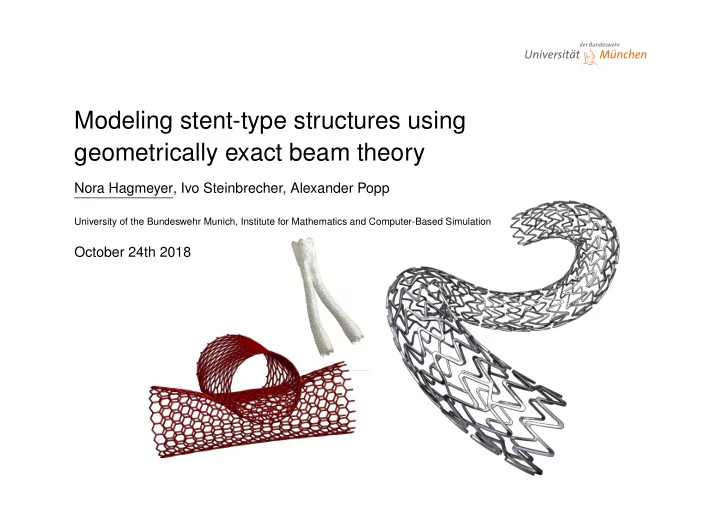
Modeling stent-type structures using geometrically exact beam theory

Nora Hagmeyer, Ivo Steinbrecher, Alexander Popp

University of the Bundeswehr Munich, Institute for Mathematics and Computer-Based Simulation

October 24th 2018

slide-2
SLIDE 2

Institute for Mathematics and Computer- Based Simulation

Overview

Motivation Abdominal Aortic Aneurysm(AAA) Endovascular Aortic Repair(EVAR) Bottom-up modeling approach Beam interaction frameworks Beam-to-solid meshtying Beam-to-solid contact Beam-to-beam contact Fluid-beam interaction Outlook

Nora Hagmeyer| Modeling stent-type structures using geometrically exact beam theory 2

slide-3
SLIDE 3

Institute for Mathematics and Computer- Based Simulation

Abdominal Aortic Aneurysm(AAA)

  • AAA = ballooning of the aorta (diameter

> 3.5 cm) in abdominal region

  • catastrophic rupture in 25% of all cases,

rupture mortality 90%

  • epidemiology (Germany):

200,000 people affected 15,000 surgeries/year

Figure: c

Vascular Surgery @ TUM

  • surgical repair

conventional open repair endovascular repair (EVAR)

30-day peri-operative mortality rate

  • Open repair: 4,7%
  • EVAR: 1,9%

[Greenhalgh et al., Lancet, 2004]

Nora Hagmeyer| Modeling stent-type structures using geometrically exact beam theory 3

slide-4
SLIDE 4

Institute for Mathematics and Computer- Based Simulation

Endovascular Aortic Repair(EVAR)

  • still early ( 4%) and late ( 15%) major

complications

stent graft migration endoleakage (type I / type II) damage of arterial wall secondary AAA rupture possible

  • success of EVAR is still limited by these

risks

  • difficult to predict – even for experienced

surgeons

  • availability of experimental / clinical data

is limited

  • EVAR process is largely dominated by

arterial stent graft [Lin et al., J Vasc Surg, 2011]

Figure: c

Vascular Surgery @ TUM

Nora Hagmeyer| Modeling stent-type structures using geometrically exact beam theory 4

slide-5
SLIDE 5

Institute for Mathematics and Computer- Based Simulation

Bottom-up modeling approach

×

[Demanget et al., J Endovasc Ther, 2013] Complex microstructure of stents and stent grafts

  • stent wire shapes:

helix, sine waves, . . .

  • graft topology:

straight, curved, bifurcated, . . .

  • stent-graft

connection: sutures, bonding, pre-stressed, . . .

  • materials and

boundary conditions: anisotropy, inelasticity, crimping, . . .

Nora Hagmeyer| Modeling stent-type structures using geometrically exact beam theory 5

slide-6
SLIDE 6

Institute for Mathematics and Computer- Based Simulation

Modeling stent structures using reduced order models

Figure: 100 volume elements (3D) vs. 1 beam element (1D) Figure: Simo-Reissner beam centerline

Equilibrium equations (Simo-Reissner beam theory) f + ˜ f = ˙ Lt m + r × f + ˜ m = ˙ Ht

  • geometrically exact (GE) beam element formulations:

known for their high accuracy and computational efficiency [Romero, 2008], [Bauchau et al., 2014]

  • Simo-Reissner theory of thick rods

(6 modes: axial tension, 2x shear, torsion, 2x bending) [Reissner, 1972], [Reissner, 1981], [Simo, 1985]

  • Kirchhoff-Love theory of thin rods

(4 modes: axial tension, torsion, 2x bending) [Kirchhoff, 1859], [Love, 1944]

Nora Hagmeyer| Modeling stent-type structures using geometrically exact beam theory 6

slide-7
SLIDE 7

Institute for Mathematics and Computer- Based Simulation

Beam interaction frameworks

Beam-to-solid meshtying e.g. stent and graft bonding Beam-to-solid contact e.g. stent placement in artery Beam-to-beam contact e.g. stent crimping in catheter Fluid-beam interaction e.g. stent placement in artery

Nora Hagmeyer| Modeling stent-type structures using geometrically exact beam theory 7

slide-8
SLIDE 8

Institute for Mathematics and Computer- Based Simulation

Beam-to-solid meshtying

Beam-to-solid meshtying Enforcement of the Meshtying constraint

Wmt =

  • Γ(1)

mt

1 2ε

  • r (1) − ˆ

x(2) r (1) − ˆ x(2) ds

  • r

WLM =

  • Γ(1)

mt

λ

  • r (1) − ˆ

x(2) ds reaction force[N] bending angle [◦]

Figure: Experimental setup at University of Tokyo and Shibaura Institute of Technology

  • simple bending of initially straight stent

graft

  • characteristic load case during stent

graft lifetime

  • realistic geometrical and material

parameters

Nora Hagmeyer| Modeling stent-type structures using geometrically exact beam theory 8

slide-9
SLIDE 9

Institute for Mathematics and Computer- Based Simulation

Beam-to-solid contact

Beam-to-solid contact KKT-type conditions modeling contact mechanics gn (X, t) ≥ 0 pn (X, t) ≤ 0 pn (X, t) · gn (X, t) = 0

  • contact introduces nonlinearity
  • inequality constraints require additional

consideration

Figure: Projection

Nora Hagmeyer| Modeling stent-type structures using geometrically exact beam theory 9

slide-10
SLIDE 10

Institute for Mathematics and Computer- Based Simulation

Beam-to-beam contact

  • point-to-point

contact formulation

  • line-to-line contact

formulation

  • all-angles beam

contact (ABC) formulation Beam-to-beam contact Contact constraint formulations

Wc,point = 1

2εg2

  • r

Wc,line = l1

Γ0

1 2εg (ξ)2ds1

a) Point-to-point contact formulation b) Line-to-line contact formulation

Nora Hagmeyer| Modeling stent-type structures using geometrically exact beam theory 10

slide-11
SLIDE 11

Institute for Mathematics and Computer- Based Simulation

Fluid-beam interaction

FSI forces using the fluid shape functions to calculate the forces acting on the beam

xf,1 xf,2 xf,3 xf,4 xbeam a) FSI forces xf,1 xf,2 xf,3 xf,4 xbeam b) Velocity "spreading"

Velocity spreading operator Sxf to transfer the beam velocities to the adjacent fluid nodes using the fluid shape functions

  • Immersed Boundary type method
  • large movements possible
  • possibility to model interaction between

blood and arterial fluid via ALE approach

  • possibility of integrating beam-wall

contact mechanics Fluid-beam interaction aNS (v, p; ∂v, δp) = Ff (δv, δp) abeam (r (s) , Λ (s) ; δr, δθ) = Fbeam ()

  • Γbeam

σ (v, p) n ds = ˆ

s

f ds

˙

r (s) vbeam = vf

Nora Hagmeyer| Modeling stent-type structures using geometrically exact beam theory 11

slide-12
SLIDE 12

Institute for Mathematics and Computer- Based Simulation

Outlook

  • Implementation of the Fluid-beam interaction framework
  • Convergence studies and comparison to full 3D simulations
  • Comparison of different constraint enforcement techniques
  • Segmentation of integration domain
  • Coupling of the rotational DOFs of the beam
  • Combining the different frameworks

Nora Hagmeyer| Modeling stent-type structures using geometrically exact beam theory 12

slide-13
SLIDE 13

Institute for Mathematics and Computer- Based Simulation

Thank you for your attention

Nora Hagmeyer| Modeling stent-type structures using geometrically exact beam theory 13

slide-14
SLIDE 14

Institute for Mathematics and Computer- Based Simulation

References

Andreas D Rauch, Anh-Tu Vuong, Lena Yoshihara, and Wolfgang Wall. A coupled approach for fluid saturated poroelastic media and immersed solids for modeling cell-tissue interactions. International journal for numerical methods in biomedical engineering, page e3139, 08 2018. Christoph Anton Meier. Geometrically exact finite element formulations for slender beams and their contact interaction. PhD thesis, Technische Universität München, 2016. Charles S Peskin. The immersed boundary method. Acta numerica, 11:479–517, 2002. Alexander Popp. Mortar methods for computational contact mechanics and general interface problems. PhD thesis, Technische Universität München, 2012.

Nora Hagmeyer| Modeling stent-type structures using geometrically exact beam theory 14