
SLIDE 1
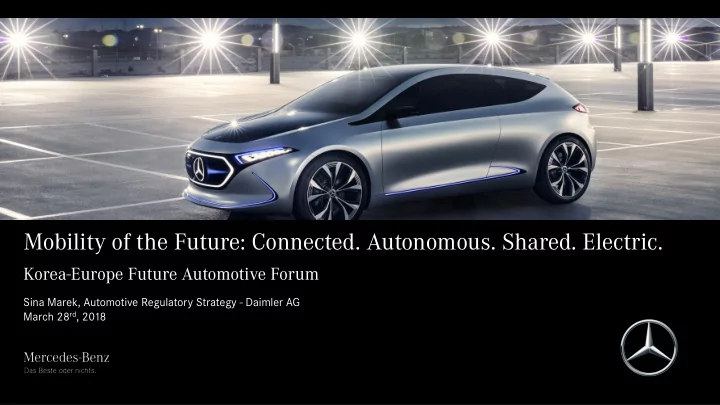
Mobility of the Future: Connected. Autonomous. Shared. Electric.
Korea-Europe Future Automotive Forum
Sina Marek, Automotive Regulatory Strategy - Daimler AG March 28rd, 2018
Mobility of the Future: Connected. Autonomous. Shared. Electric. - - PowerPoint PPT Presentation
Mobility of the Future: Connected. Autonomous. Shared. Electric. Korea-Europe Future Automotive Forum Sina Marek, Automotive Regulatory Strategy - Daimler AG March 28 rd , 2018 Daimler has a long-term commitment to zero emission mobility 8
Mobility of the Future: Connected. Autonomous. Shared. Electric.
Korea-Europe Future Automotive Forum
Sina Marek, Automotive Regulatory Strategy - Daimler AG March 28rd, 2018
8 Plug in Hybrids on the street until 2017… …followed by 10 Battery Electric Vehicles until 2022
Daimler has a long-term commitment to zero emission mobility…
2
Future line-up of electrified vehicles @Daimler. 10 bn € will be spent in extension of the „EQ“-branded portfolio within the next years.
8 vehicles in stock. More to come! 10 pure electric models by 2022
2019 B-Class electric drive
(BEV)
GLC F-Cell
(Hydrogen)
2018 2017 Sprinter/Vito
(BEV)
Citaro E-Cell
(BEV)
Urban eTruck Fuso Canter E-Cell
(BEV)
2018 2014 2017 2016 2015 smart electric drive
(BEV)
2020
BEV = Battery Electric Vehicle
EQC EQA (202x) EQS/EQE (202x)
(BEV)
2017 2018
RegStrat WS NAFTA / Marek, Kunz – EA/R /
Commercial EVs Purely electric vehicles /“EQ“ Plug-in Hybrids AMG
3
The fame and art family are our key to vary the degree of electrification from 12V to High Voltage Plug-In with consistent modularization.
Otto Diesel
Utilization Flexibility fame: family of modular engines | art: architecture of rear wheel transmissions
4Cyl 6Cyl
Utilization Flexibility
HV 48V
Utilization Flexibility
4
All-new powertrain setup guarantees flexibility with a wide range of concepts from ICE to xEV.
5
In the next decade, Battery Electric Vehicles and FuelCell Electric Vehicles will play an important role. But transformation needs time.
Percentage of passenger cars
Generic illustration but not a real product plan
2019 2016 2030 2021 2017 2018 2022 2026 2020 2023 2024 2025 2027 2028 2029 Battery Electric Vehicle /FCell Mild Hybrid 48V Plug-In Hybrid Conventional Engine 12V 100% 0%
6
We support the installation of charging infrastructure worldwide – together with strong partners.
home work
Charging processes in everyday life
80-90%
public highway
10-20%
Charging stations
Joint Venture with OEM Partners Together with industry partners worldwide
7
3,6 KW 11 KW 50 KW 150 KW 350 KW
Example of 100 km-charge with different charging capacities
8
7 h 2 h 30 min 10 min 5 min
DC: Direct Current
Goal of IONITY: Charging = Refueling
AC: Alternating Current
100 km ≈ 22 kWh
Home / Workplace Charging >80% Destination Charging ~10% High Power Charging ~10% › Long-distance capability is a critical factor in the buying decision for an EV. Long-distance capability
Connectivity will optimize and support automated drive functions in the long term
9
Connected driving
The exchange of data between vehicles and the infrastructure, and the resulting ability to inform drivers of hazards and the traffic situation, make traffic safer and more efficient.
Automated driving
In-Vehicle sensors and image recognition enable the vehicle to drive autonomously.
Worldwide agreed levels of vehicle automation
Level 1 Driver Assistance
Single control functions such as speed selection, braking or lane keeping are automated Driver in charge
Level 2 Partial Automation
More than one control function is automated Driver expected to take care of all remaining aspects
driving task
Level 3 Conditional Automation
Vehicle can perform the dynamic driving task in certain modes Driver expected to respond to requests to take control
Level 4 High Automation
Vehicle can perform the dynamic driving task in certain modes Driver not expected to respond to requests to take control
Level 5 Full Automation
Vehicle can perform the dynamic driving task in all modes that can also be managed by a human driver No driver needed
Level 0 No Automation
full-time performance by the human driver of all aspects of the dynamic driving task, even when enhanced by warning or intervention systems
Level 0-2
Human driver monitors the driving environment
Level 3-5
Automated driving system (“system”) monitors the driving environment
Source: SAE – Society of Automotive Engineers
10
Stakeholder dialogue key to solve multidimensional challenges
CYBER SECURITY Data collection, storage, local/offshore transfer & Security HD MAP mandatory map scrambling TESTING & HOMOLOGATION e.g. exemptions approval INFRASTRUCTURE e.g. V2X infra., road signs and markings TELECOM. Frequency assignment for radar & V2X mandatory application VEHICLE Vehicle regulations incompatible with AD vehicles So far, no application for L4/5 visible, risking technology readiness before regulatory environment is established. Open questions regarding liability, ethics, data storage and data security have to be solved. Special regulations necessary for specific use cases such as automated parking or truck platooning. Short term goal: Establish regulatory framework to enable testing of L4/L5 vehicles on public roads.
11
Our answer to profound changes in the automotive industry is…
12