Mobile Station Execution Mobile Station Execution Environment (MExE - - PowerPoint PPT Presentation

mobile station execution mobile station execution
SMART_READER_LITE
LIVE PREVIEW

Mobile Station Execution Mobile Station Execution Environment (MExE - - PowerPoint PPT Presentation

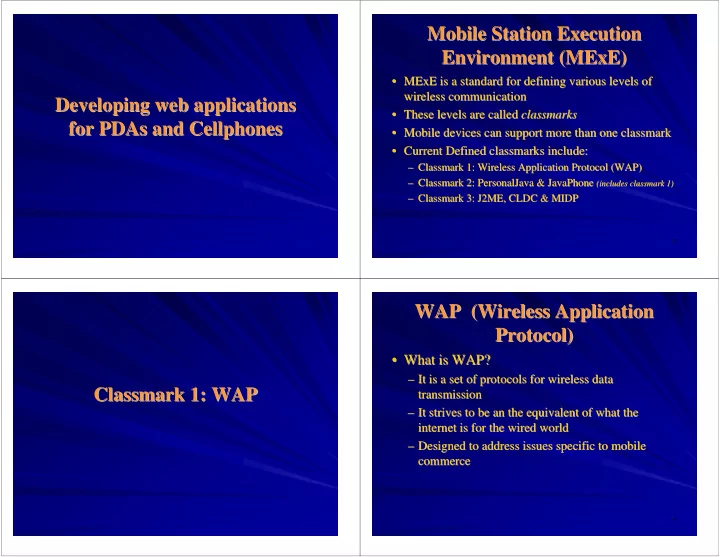
Mobile Station Execution Mobile Station Execution Environment (MExE MExE) ) Environment ( MExE MExE is a standard for defining various levels of is a standard for defining various levels of wireless communication wireless


slide-1
SLIDE 1

Developing web applications Developing web applications for for PDAs PDAs and and Cellphones Cellphones

2

Mobile Station Execution Mobile Station Execution Environment ( Environment (MExE MExE) )

  • MExE

MExE is a standard for defining various levels of is a standard for defining various levels of wireless communication wireless communication

  • These levels are called

These levels are called classmarks classmarks

  • Mobile devices can support more than one

Mobile devices can support more than one classmark classmark

  • Current Defined classmarks include:

Current Defined classmarks include:

– – Classmark Classmark 1: Wireless Application Protocol (WAP) 1: Wireless Application Protocol (WAP) – – Classmark Classmark 2: 2: PersonalJava PersonalJava & & JavaPhone JavaPhone (includes

(includes classmark classmark 1) 1)

– – Classmark Classmark 3: J2ME, CLDC & MIDP 3: J2ME, CLDC & MIDP

Classmark Classmark 1: WAP 1: WAP

4

WAP (Wireless Application WAP (Wireless Application Protocol) Protocol)

  • What is WAP?

What is WAP?

– – It is a set of protocols for wireless data It is a set of protocols for wireless data transmission transmission – – It strives to be an the equivalent of what the It strives to be an the equivalent of what the internet is for the wired world internet is for the wired world – – Designed to address issues specific to mobile Designed to address issues specific to mobile commerce commerce

slide-2
SLIDE 2

5

Issues WAP Addresses Issues WAP Addresses

  • The limitations of wireless communication

The limitations of wireless communication

– – Intermittent network connectivity Intermittent network connectivity – – Large latency Large latency

  • Providing an easy to uses interface for mobile devices

Providing an easy to uses interface for mobile devices

– – The screens are small The screens are small – – Limited input types Limited input types

  • Security concerns of transmitting wireless data

Security concerns of transmitting wireless data

  • Limited power and computational resources of

Limited power and computational resources of mobile devices mobile devices

6

WAP Gateway WAP Gateway

  • The WAP gateway provides a solution to the

The WAP gateway provides a solution to the limitations of the wireless networks limitations of the wireless networks

  • Mobile users connect to the gateway and any

Mobile users connect to the gateway and any communications they request will be passed through communications they request will be passed through the gateway the gateway

  • It provides a access point to the rest of the web

It provides a access point to the rest of the web

  • Takes over many

Takes over many cpu cpu intensive operations for the intensive operations for the mobile device mobile device

  • Handles encryption and decryption as different (less

Handles encryption and decryption as different (less strenuous) encryption protocols are used for mobile strenuous) encryption protocols are used for mobile devices devices

7

Wireless Application Protocols Wireless Application Protocols

  • WAP is based on:

WAP is based on:

– – WAE (Wireless Application Environment) WAE (Wireless Application Environment)

  • WML (Wireless Markup Language)

WML (Wireless Markup Language)

  • WMLScript

WMLScript (the (the javascript javascript equivalent for WML) equivalent for WML)

  • WTAI/WTA (Wireless Telephony Application

WTAI/WTA (Wireless Telephony Application Interface) Interface)

– – WSP WSP (Wireless Session Protocol) (Wireless Session Protocol) – – WTP WTP (Wireless Transaction Protocol) (Wireless Transaction Protocol) – – WTLS (Wireless Transport Layer Security) WTLS (Wireless Transport Layer Security) – – WDP WDP (Wireless Datagram Protocol) (Wireless Datagram Protocol)

8

Wireless Markup Language Wireless Markup Language

  • WML is XML based

WML is XML based

– – Follows strict xml formatting rules Follows strict xml formatting rules

  • Replaces HTML in the WAP browser

Replaces HTML in the WAP browser

  • WML sites are called decks and are made up

WML sites are called decks and are made up

  • f cards
  • f cards
  • The cards are the pages that the users views

The cards are the pages that the users views

slide-3
SLIDE 3

9

Wireless Markup Language Wireless Markup Language

<?xml version="1.0"?> <?xml version="1.0"?> <!DOCTYPE <!DOCTYPE wml wml PUBLIC " PUBLIC "-

  • //WAPFORUM//DTD WML 1.1//EN"

//WAPFORUM//DTD WML 1.1//EN" "http://www. "http://www.wapforum wapforum.org/DTD/ .org/DTD/wml wml_1.1.xml"> _1.1.xml"> < <wml wml> > <card id=card1> ….. </card> <card id=card1> ….. </card> <card id=card2> ….. </card> <card id=card2> ….. </card> ….. ….. <card id=card3> ….. </card> <card id=card3> ….. </card> </ </wml wml> >

  • WML pages have their own DTD

WML pages have their own DTD

  • A deck is the WML document

A deck is the WML document

– – Enclosed in < Enclosed in <wml wml> . . . </ > . . . </wml wml> >

  • A card is the WML document

A card is the WML document

– – Enclosed in < Enclosed in <wml wml> . . . </ > . . . </wml wml> >

10

Wireless Markup Language Wireless Markup Language

  • Variables defined in a one card are accessible

Variables defined in a one card are accessible from all cards from all cards

  • Some other tags:

Some other tags:

– – <! <!--

  • ->, <head>, <meta>, <template>, <

>, <head>, <meta>, <template>, <br br>, <p>, >, <p>, <table>, <td>, < <table>, <td>, <tr tr>, <b>, <big>, < >, <b>, <big>, <em em>, <a>, >, <a>, <anchor>, < <anchor>, <img img>, <do>, < >, <do>, <onevent

  • nevent>, <

>, <postfield postfield>, >, <go>, <timer>, <input>, < <go>, <timer>, <input>, <optgroup

  • ptgroup>, <option>,

>, <option>, <select>, < <select>, <setvar setvar> > – – These are not all of the tags but as you can see These are not all of the tags but as you can see many are the same as in HTML many are the same as in HTML

11

WMLScript WMLScript

  • It is a lightweight version of JavaScript

It is a lightweight version of JavaScript

  • Runs client side

Runs client side

  • Is compiled at a WAP gateway and sent to the

Is compiled at a WAP gateway and sent to the device in byte code device in byte code

  • Not embedded in WML document

Not embedded in WML document

  • Stored in a WMLS file (

Stored in a WMLS file (ie ie script. script.wmls wmls) )

  • Includes Dialogs, Float, Lang, String, URL

Includes Dialogs, Float, Lang, String, URL and and WMLBrower WMLBrower function Libraries function Libraries

12

Wireless Session Protocol Wireless Session Protocol

  • Session level protocol

Session level protocol

  • It is the HTTP equivalent for WAP

It is the HTTP equivalent for WAP

  • WSP is much more efficient than HTTP due to

WSP is much more efficient than HTTP due to the bandwidth constraints of mobile devices the bandwidth constraints of mobile devices

  • Uses binary data

Uses binary data vs vs text data text data

slide-4
SLIDE 4

13

Wireless Transaction Protocol Wireless Transaction Protocol

  • Provides both reliable and unreliable data

Provides both reliable and unreliable data transport transport

  • Similar to TCP

Similar to TCP

  • Built to minimize network traffic and be most

Built to minimize network traffic and be most effective over a wireless link effective over a wireless link

14

Wireless Transaction Layer Wireless Transaction Layer Security Security

  • Security layer protocol

Security layer protocol

  • Similar to SSL (Secure Socket Layer)

Similar to SSL (Secure Socket Layer)

  • Provides authentication and encryption

Provides authentication and encryption functionality functionality

  • Like SSL it is only used when needed

Like SSL it is only used when needed

15

Wireless Datagram Protocol Wireless Datagram Protocol

  • Similar to UDP (User Datagram Protocol)

Similar to UDP (User Datagram Protocol)

  • Lowest layer WAP protocol

Lowest layer WAP protocol

  • Lower layers are normally device dependent

Lower layers are normally device dependent and some common interfaces are PPP (Point and some common interfaces are PPP (Point-

  • to

to-

  • Point Protocol), SMS (Short Messaging

Point Protocol), SMS (Short Messaging Service), and GPRS (General Packet Radio Service), and GPRS (General Packet Radio System) System)

16

WAP and the rest of the web WAP and the rest of the web

  • Fewer that 1% of sites are written in WML

Fewer that 1% of sites are written in WML

  • Google

Google has implemented a tool which converts has implemented a tool which converts regular HTML websites to WML for WAP regular HTML websites to WML for WAP browsers browsers

  • This allows WAP users access to the web

This allows WAP users access to the web content not specifically designed for mobile content not specifically designed for mobile devices devices

slide-5
SLIDE 5

Classmark Classmark 2: 2: JavaPhone JavaPhone

Java Telephony API and its Java Telephony API and its components components

18

What is JavaPhone? What is JavaPhone?

  • It was created by the creators of Java, Sun

It was created by the creators of Java, Sun Microsystems Microsystems

  • It is a Java like API for creating applications

It is a Java like API for creating applications

  • n cellular telephones
  • n cellular telephones
  • Object Oriented

Object Oriented

19

What is it used for? What is it used for?

  • JavaPhone is used to develop applications for

JavaPhone is used to develop applications for use on a variety of mobile devices use on a variety of mobile devices

  • It can also be used by telephone service

It can also be used by telephone service providers to provide the connectivity to providers to provide the connectivity to dynamic information services dynamic information services

20

How does it work? How does it work?

  • Much like regular Java, JavaPhone relies on an

Much like regular Java, JavaPhone relies on an underlying virtual machine, or application underlying virtual machine, or application environment which allows the telephone OS to environment which allows the telephone OS to seem transparent to the programmer. seem transparent to the programmer.

  • For JavaPhone this environment is either

For JavaPhone this environment is either PersonalJava or EmbbededJava depending on PersonalJava or EmbbededJava depending on the cellular hardware the cellular hardware

slide-6
SLIDE 6

21

Communications Communications

  • Additional packages are available for

Additional packages are available for communications communications

  • The Communication API, which allows for

The Communication API, which allows for communication with serial and parallel ports communication with serial and parallel ports

  • The SSL package for use by applications to

The SSL package for use by applications to communicate securely communication over communicate securely communication over TCP/IP sockets TCP/IP sockets

22

Summary Summary

  • JavaPhone is an API that can be used to develop

JavaPhone is an API that can be used to develop applications for mobile devices in the same way that applications for mobile devices in the same way that applications are developed for a computer. applications are developed for a computer.

  • It allows for the development of programs to access

It allows for the development of programs to access the web as well as other internet protocols (FTP, the web as well as other internet protocols (FTP, STMP, ect.) STMP, ect.)

  • It also provides portability in an industry where many

It also provides portability in an industry where many different hardware and OS implementations exist different hardware and OS implementations exist

Classmark Classmark 3: J2ME 3: J2ME Environment Environment

24

MIDP MIDP – – Mobile Information Device Profile Mobile Information Device Profile CLDC CLDC – – Connected Limited Device Configuration Connected Limited Device Configuration KVM KVM – – K Virtual Machine K Virtual Machine

Java 2 Platform Java 2 Platform

Our Focus Our Focus

slide-7
SLIDE 7

25

Java 2 Micro Edition Java 2 Micro Edition

  • Java Virtual Machine ported onto a wide

Java Virtual Machine ported onto a wide

  • J2EE JVM equivalent for the

J2EE JVM equivalent for the

  • Growing processing power

Growing processing power

  • More use of portable java

More use of portable java

  • Less use of lower, more efficient languages

Less use of lower, more efficient languages J2ME is the K Virtual Machine (KVM) J2ME is the K Virtual Machine (KVM) range of Operating Systems range of Operating Systems

26

J2ME Continued J2ME Continued

Targeted for Targeted for

  • Small, Standalone Devices

Small, Standalone Devices

  • Connectable Consumer Devices

Connectable Consumer Devices

  • Cellular phones

Cellular phones

  • Personal Digital Assistants

Personal Digital Assistants Two Primary Components Two Primary Components

  • Configurations

Configurations

  • Profiles

Profiles

27

Configuration Configuration

Defines Minimum Java Platform for Defines Minimum Java Platform for

  • A range of devices

A range of devices

  • Requirements for memory and power

Requirements for memory and power

  • Minimum Java Libraries

Minimum Java Libraries

  • Virtual Machine Capabilities

Virtual Machine Capabilities

28

CLDC CLDC

(Connected Limited Device Configuration) (Connected Limited Device Configuration) Specifies Java Environment For Specifies Java Environment For

  • Mobile Phones

Mobile Phones

  • Personal Digital Organizers

Personal Digital Organizers Devices Devices

  • Intermittent, low bandwidth network link

Intermittent, low bandwidth network link

  • Limited Memory, 128 kb

Limited Memory, 128 kb -

  • 512 kb

512 kb

  • Most often wireless

Most often wireless

  • Constrained UI’s, small screens

Constrained UI’s, small screens K Virtual Machine (KVM) K Virtual Machine (KVM)

  • CLDC runs on top of KVM

CLDC runs on top of KVM

  • JVM designed for resource constrained devices

JVM designed for resource constrained devices

slide-8
SLIDE 8

29

Profile Profile

A collection of Java technology based A collection of Java technology based APIs that add on to a Configuration to APIs that add on to a Configuration to provide capabilities for a device provide capabilities for a device type and extends its specific demands type and extends its specific demands

30

MIDP MIDP

(Mobile Information Device Profile) (Mobile Information Device Profile) Specifies Java Environment For Specifies Java Environment For

  • Mobile Phones

Mobile Phones

  • Personal Digital Organizers

Personal Digital Organizers Addresses issues such as Addresses issues such as

  • User Interface

User Interface

  • Store, Manage persistent local data

Store, Manage persistent local data

  • Networking

Networking

  • Application Model

Application Model Runs on top of the CLDC Runs on top of the CLDC Developed by a group of 20 companies Developed by a group of 20 companies representing the wireless industry representing the wireless industry

31

Yellow Pages, Bus schedule, Yellow Pages, Bus schedule, Tickets, Games Tickets, Games UI, HTTP 1.1 network … UI, HTTP 1.1 network … Java Java lang lang, , Java lang. Java lang.microedition microedition… … Threads, no Floats Threads, no Floats Rom, Flash Ram Rom, Flash Ram Risc Risc processor processor

J2ME Wireless Device Stack J2ME Wireless Device Stack

32

J2ME Devices J2ME Devices

slide-9
SLIDE 9

33

J2ME Software J2ME Software

Active Desktop Access your home desktop from your mobile phone Web Viewer Supports HTML forms, image maps, GIFs, and JPEGs UEMail Mail client that communicates with any POP3/SMTP server Street Fighter The most famous arcade fighting game, with basic features

34

J2ME Software J2ME Software

M-Sports Soccer

Possibly the best soccer simulation available for mobile devices

All this software is available as shareware at All this software is available as shareware at

http://j2me http://j2me-

  • software.com/repository/index.jsp

software.com/repository/index.jsp

35

J2ME Development Tools J2ME Development Tools

  • They are available now

They are available now

  • Most are free

Most are free

  • They are all you need to create mobile

They are all you need to create mobile Java applications Java applications

  • References

References http://java.sun.com/j2me/ http://java.sun.com/j2me/ http://java.sun.com/products/ http://java.sun.com/products/cldc cldc/ / http://java.sun.com/products/ http://java.sun.com/products/midp midp/ /

36

J2ME Code J2ME Code

import javax.microedition.midlet.*; import javax.microedition.io.*; import javax.microedition.lcdui.*; import java.io.*; public class HttpMIDlet extends MIDlet implements CommandListener {};

slide-10
SLIDE 10

37

Testing Testing Applications Applications

  • Available Virtual Mobile Device

Available Virtual Mobile Device

SmartCards SmartCards

39

Smart Cards Smart Cards

  • tamper

tamper-

  • resistant devices, usually containing an

resistant devices, usually containing an embedded 8 embedded 8-

  • bit microprocessor

bit microprocessor

  • utilize Application Protocol Data Units

utilize Application Protocol Data Units (APDU) to communicate with host devices (APDU) to communicate with host devices through PIN codes and cryptographic keys through PIN codes and cryptographic keys

  • Many different kinds including SIM, Java

Many different kinds including SIM, Java Card, UIM, WIM and S@T Card, UIM, WIM and S@T

  • Used in cell phones,

Used in cell phones, PDAs PDAs, satellite receivers, , satellite receivers, credit cards, etc. credit cards, etc.

40

SIM Cards SIM Cards

  • Subscriber Identity Module

Subscriber Identity Module

  • Consist of microprocessor, ROM, EEPROM

Consist of microprocessor, ROM, EEPROM memory, volatile RAM, and serial I/O memory, volatile RAM, and serial I/O interface interface

  • Software usually consists of an OS, file

Software usually consists of an OS, file system, and application programs system, and application programs

  • SIM cards rely on their GSM handset for

SIM cards rely on their GSM handset for battery and clock battery and clock

slide-11
SLIDE 11

41

The SIM Toolkit (STK) The SIM Toolkit (STK)

  • API used for securely loading applications onto SIM cards

API used for securely loading applications onto SIM cards

  • Allows mobile operator to create/provide services by loading

Allows mobile operator to create/provide services by loading them in the SIM without changing anything in the GSM them in the SIM without changing anything in the GSM

  • handset. A convenient way of doing this is through Short
  • handset. A convenient way of doing this is through Short

Message Service (SMS). Message Service (SMS).

  • Once loaded, applications may be triggered through events

Once loaded, applications may be triggered through events such as incoming/outgoing calls, call duration, and/or location such as incoming/outgoing calls, call duration, and/or location

  • f the mobile device
  • f the mobile device.

. Control software in the SIM monitors

Control software in the SIM monitors these events and reports them via SMS to a network based these events and reports them via SMS to a network based application server. application server.

42

WIM Cards WIM Cards

  • WAP Identity Module

WAP Identity Module

  • Used in conjunction with a SIM card

Used in conjunction with a SIM card

  • Introduced with WAP spec 1.2 (Wireless

Introduced with WAP spec 1.2 (Wireless Application Protocol) Application Protocol)

  • Provides end

Provides end-

  • to

to-

  • end security for WAP

end security for WAP applications, improving on the limitations of applications, improving on the limitations of spec 1.1 spec 1.1

  • Allows the user to store certificates and digital

Allows the user to store certificates and digital signatures signatures