
SLIDE 1
MOAA FY16 African Community Grant Pre-Bidders Orientation Meeting
Office On African Affairs Executive Office of the Mayor
Government of the District of Columbia
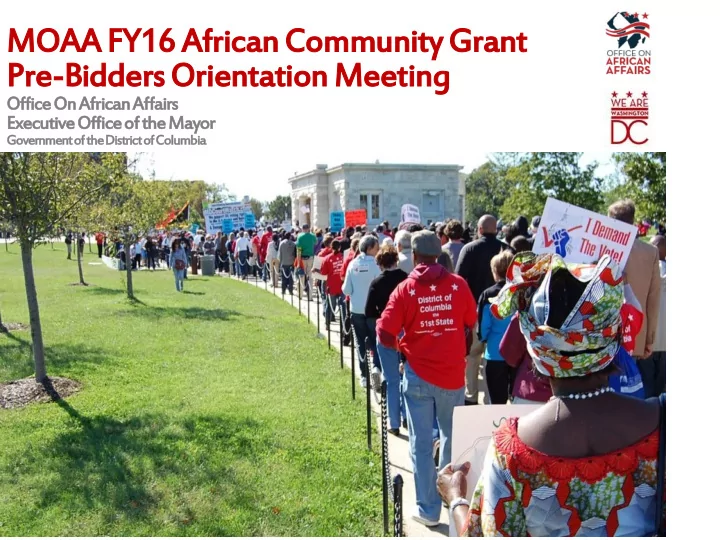
MOAA FY16 African Community Grant Pre-Bidders Orientation Meeting - - PowerPoint PPT Presentation
MOAA FY16 African Community Grant Pre-Bidders Orientation Meeting Office On African Affairs Executive Office of the Mayor Government of the District of Columbia OUTLINE The Office on African Affairs An overview of MOAAs history and
Office On African Affairs Executive Office of the Mayor
Government of the District of Columbia
– An overview of MOAA’s history and mission – Program areas
– Funding priority areas – Eligibility – Grant disbursement – Application review and awards – Submission guidelines & format – Proposal components – Proposal attachments & appendices – Scoring criteria – Application checklist
The DC Mayor’s Office on African Affairs (MOAA) was established on March 23, 2006 by the District Council when it passed D.C. Act 16-313
MOAA aims to:
life of the District’s diverse African born constituencies and their children;
public engagement in the District’s African immigrant communities; and
development among African-born immigrants
District Government Agencies and the Mayor.
and inquiries regarding District Agencies, resources and service delivery.
constituent cases.
government services to the African communities through continuous monitoring, assessment and data collection.
Capacity Building— MOAA works to support and build the capacity of local entrepreneurs, small businesses, nonprofits and community-based organizations. Constituent Services— MOAA serves as a principle liaison
African communities, the Mayor, and District government. Outreach and Education— MOAA organizes and facilitates educational outreach programs and activities, around health, education, public safety, human rights, economic development, employment, social services and housing to ensure that community members access services and resources they need to improve their quality of life.
strengthening the voice of African youth and forging partnerships by encouraging civic engagement and participation. We promote leadership and create platforms for youth to express their unique experiences and challenges as District residents.
MOAA works to strengthen the connection among the District’s African communities & showcase their contributions to the city
designated as a grant-maker agency with the capacity to strengthen community-based
specific areas identified as policy priorities.
community-based organizations funding to serve African constituents by providing health linkages, workforce development and training, educational platforms in arts and culture, and youth empowerment programs.
– Open House to introduce Mayor Bowser’s new administration and MOAA’s incoming director, Mamadou Samba. – Business and Media Mixers (March-April, 2015) – Immigration Workshop (in English, French and Amharic); connecting community leaders to resources, creating networks and identifying government resources that meet community needs.
– Cultural Competency Training to government agencies. – Public Safety Taskforce launched in May, 2015
– Diaspora in Dialogue Film Project (in final production) – 6th Annual DC Africa Festival (September, 2015)
– Workshop on African Diaspora Marketplace 2015 (in partnership with USAID) – providing funds for business ideas that support African Diaspora investment and innovation on the continent. – Workshop on grant writing for Community-based Organizations (May, 2015)
– MOAA’s Annual Young African ConneXions Summit (in collaboration with President Obama’s Young African Leadership Initiative, Howard University) – First-ever Mandela Day of Service DC (July 18, 2015)
We Count! Survey and is an effort to provide basic and disaggregated demographic information and analysis of African residents of the District.
learning) provides capacity building and technical assistance to the diverse African communities in the District with less access to technology services and technology education. EKO supports Mayor Bowser’s commitment to quality education, nurturing the DC tech sector, and advancing digital inclusion.
2013
Mayor’s priorities and provide culturally and linguistically targeted services and resources to the District’s African residents and businesses.
African Community Grant applications are required to align with Mayor Muriel Bowser’s policy priorities listed below:
501(c)(3) status in-hand or have evidence of fiscal agent relationship with a 501 (c)(3) organization
the District of Columbia
DC Department of Consumer & Regulatory Affairs, Corporation Division, and the DC Office of Tax and Revenue
Grants for three consecutive award cycles are NOT eligible to apply for a period of one fiscal year following their last award.
programming with other African-serving community-based
services.
address specific needs of the community and fill existing gaps in service delivery.
segments of the District’s African community, particularly those with culturally and linguistically diverse African communities in the District.
within the District’s African Community.
10 grants
$5,000 to $20,000 per eligible organization.
9 months starting January 2016 and ending September 30, 2016.
conducted and evaluated during this period
contingent on continued funding from the grantor
MOAA to make an award
applications and submit recommendations of all eligible applicants
individuals selected for their knowledge of the District’s African community, their experiences in grant- making and program development, and their familiarity with funding priority areas set forth in this RFA
proposals and submit recommendations for awards
electronically via email.
attachments) in electronic PDF format and email the complete package to oaa@dc.gov
Application – [your organization’s full name]’
submission according to the Application Checklist included in the RFA.
in the correct order listed in the Application Checklist.
your application
single-sided pages (without including attachments)
Courier font
(Attachments A, B, and C)
(Attachment D)
Qualification of project staff, brief description of evaluative methodology, and a timetable can also be included.
important need that can be met by your project. Could include a description of the target population and geographic area, statistical data, and concrete examples.
the stated need. Emphasize why your organization (as opposed to any other) would be better positioned to tackle the problem or fulfill the stated need.
approached for support.
– Detailed description of proposed program
how the project will address funding priority areas specified in the African Community Grant.
– Collaboration description (if applicable) – Detailed discussion of expected outcomes and impact – Implementation plan
– State the intended result in broad terms that lead to measurable results – Describe the behavior or condition expected to change – Address outcomes but not how outcome will be achieved – Should lead clearly to one or more measurable results
– Describe your activity – Define your desired result – Choose your evaluation measure (methods/instruments0 – Define your standard of success – Describe your beneficiaries
– To <action verb and statement of results and measurement indicator> by <degree of change> by <deadline> – Example: To increase by at least one grade level the reading skills of 75% of the children who complete the Reading Enrichment Program by end of summer 2016.
– Clearly explain the nature and extent of the problem/ need to be addressed – Connect the need to the purposes and goals of your
– Identify current gaps in services or programs – Include quantitative and qualitative documentation and supporting information. – Describe benefits to be gained. – Make a compelling case.
serve low-income and underserved African youth, K-12, in the District of Columbia.
competency; diversity of staff; unique position to implement program and track record of organization; how will program be documented and monitored.
Certifications
Profiles
(1)Budget Summary (2) Budget Description Narrative
Plan
Plan
Performance Plan
– Budget Summary (figures) – Budget Description Narrative (explanation)
– Personnel: salary or hourly rate, percentage of time paid – Direct costs: consultants, training, fringe benefits and; – Indirect costs: printing and copying; communication;
such as administrative costs: legal, accounting, liability insurance, audits, etc.
replace funds for other grant sources.
program, their positions, the percent (%) of time on the program.
that the hiring will occur, the job description
corresponding staff should be noted here.
implementation and completion; responsible staff
Elementary School Program Responsible Person Description of Task/Activity and/or Organization Start Date Completion Date Identify and enroll at least 75 students to the Elementary Elementary School School Program Program Manager Oct 2013 Sept 2014 Conduct pre-survey for students for Program Evaluation Elementary School purposes Program Manager Oct 2013 Nov 2013 Condu ct at least one academic enrichment workshop per Elementary School week Program Manager Oct 2013 Sept 2014 Conduct at least one cultural enrichment workshop per Elementary School week Program Manager Oct 2013 Sept 2014 Organize at least 10 hours of community service activities Elementary School per semester Program Manager Oct 2013 Sept 2014 Coordinate one DC Holiday Activity to showcase AALEAD Elementary School students and programs Program Manager Dec 2013 Dec 2013 Elementary School Record student attendance in ETO Program Manager Oct 2013 Sept 2014 Conduct post-survey for students for Program Evaluation Elementary School
– Specific: What will the goal accomplish? How and why will it be accomplished? – Measurable: Goal should be measurable so that you have tangible evidence of accomplishing it. – Achievable: Goals should push you slightly to feel challenged but be defined enough so that you can achieve them. You must possess the appropriate knowledge, skills, and abilities to achieve the goal. – Results-focused: Goals should measure outcomes, not activities. – Time-bound: Goals should be linked to a timeframe that creates a sense of
specific targets by quarter.
evaluated.
1. Job Descriptions 2. Staff Resumes 3. Organizational chart 4. Current Board list with names, affiliation, and contact information 5. Copy of current organizational budget 6. Balance Sheet (if applicable) 7. Audited financial statements - most recent 990 or cash flow statements for 2012 and year-to-date (if applicable) 8. Copy of current IRS tax-exempt determination letter 9. Memorandum of Agreement/Understanding, if applicable. Do NOT send general letters of support
(20 points)
Services (15 points)
Relevant Experience (35 points)
Budget (15 points)
Proposal Narrative:
– Collaboration description – Program goals and objectives – Organizational capabilities – Fundraising plan
Other required application materials:
– Certifications (Attachment A) – Assurances (Attachment B) – Agency Profile (Attachment C) – Budget (Attachment D) – Staffing Plan (Attachment E) – Work Plan (Attachment F) – Performance Plan (Attachment G)
Appendices:
and contact information
(if applicable)
determination letter
Agreement/Understanding, if applicable. Do NOT send general letters of support.
relevant)
CONTACT: Deputy Director, Heran Sereke-Brhan Reeves Center of Municipal Affairs 2000 14th Street, NW, Suite 400 N. Washington, DC 20009 Phone: 202.724.7670 Email: heran.sereke-brhan@dc.gov
RFA available for download:
http://oaa.dc.gov
Follow OAA on Facebook and Twitter!
‘DCMayorOAA’ ‘DC Mayors Office on African Affairs’