Mixed-Use Villages and the Related Energy Savings Andrew Gast-Bray, - - PowerPoint PPT Presentation

mixed use villages and the related energy savings
SMART_READER_LITE
LIVE PREVIEW

Mixed-Use Villages and the Related Energy Savings Andrew Gast-Bray, - - PowerPoint PPT Presentation

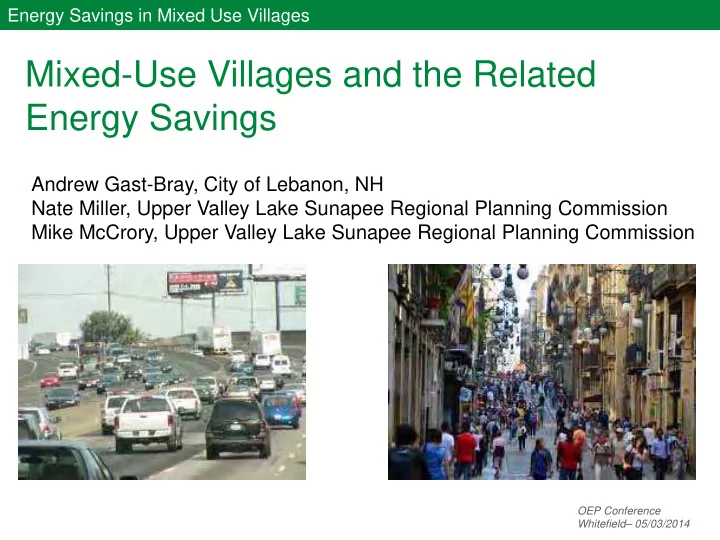
Energy Savings in Mixed Use Villages Mixed-Use Villages and the Related Energy Savings Andrew Gast-Bray, City of Lebanon, NH Nate Miller, Upper Valley Lake Sunapee Regional Planning Commission Mike McCrory, Upper Valley Lake Sunapee Regional


slide-1
SLIDE 1

OEP Conference Whitefield– 05/03/2014

Energy Savings in Mixed Use Villages

Mixed-Use Villages and the Related Energy Savings

Andrew Gast-Bray, City of Lebanon, NH Nate Miller, Upper Valley Lake Sunapee Regional Planning Commission Mike McCrory, Upper Valley Lake Sunapee Regional Planning Commission

slide-2
SLIDE 2

OEP Conference Whitefield– 05/03/2014

Energy Savings in Mixed Use Villages

Overview of Lebanon Planning for Mixed Use Villages in Lebanon Non-transportation Benefits of Mixed Use Villages Transportation Benefits of Mixed Use Villages Energy/Emissions Savings Due to Transportation Mode Shift

  • Mode Shift in General Behavior (Local)
  • Mode Shift due to Sprawl Avoidance (Regional)

Conclusions

Introduction

slide-3
SLIDE 3

OEP Conference Whitefield– 05/03/2014

Energy Savings in Mixed Use Villages

Residential Population in Lebanon

2,000 4,000 6,000 8,000 10,000 12,000 14,000 16,000

Population

Lebanon Population, 1930 ‐ 2030

Census Data OEP Projections

slide-4
SLIDE 4

OEP Conference Whitefield– 05/03/2014

Energy Savings in Mixed Use Villages

Historic Non-Residential Development

0.00 1,000,000.00 2,000,000.00 3,000,000.00 4,000,000.00 5,000,000.00 6,000,000.00 7,000,000.00 8,000,000.00 Pre‐1960 1960‐69 1970‐1979 1980‐1989 1990‐1999 2000‐2009

Decade Growth

  • Cum. Total
slide-5
SLIDE 5

OEP Conference Whitefield– 05/03/2014

Energy Savings in Mixed Use Villages

Approved Non-Residential Development

Total SF Iron Horse 667,200 River Park* 714,020 Altaria Industrial PUD* 217,970 Altaria Planned Biz Park 240,000 ICV (Bldg 2) 56,364 DHMC-Williams 162,000 Chaloux Conf. Center 96,306 2,153,860

2014- 2030 Approved – yet to be built

* 160 +/- residential units Iron Horse

slide-6
SLIDE 6

OEP Conference Whitefield– 05/03/2014

Energy Savings in Mixed Use Villages

What do we do with all these people?

Putting them into “sprawl” development is not desirable Concentrating development would be beneficial. Creating Mixed Use Villages would be a way to concentrate the development patterns without creating the undesirable negative effects of “density”

slide-7
SLIDE 7

OEP Conference Whitefield– 05/03/2014

Energy Savings in Mixed Use Villages

What is Mixed Use?

slide-8
SLIDE 8

OEP Conference Whitefield– 05/03/2014

Energy Savings in Mixed Use Villages

Corner Store: 1500-3000sqft Along major local roads at the busiest entry Convenience Center: 10,000-30,000sqft Anchored by small specialty food market or pharmacy Needs ~2000hh Neighborhood Center: 70,000-90,000sqft Anchored by full supermarket 6-8K hh

“Mixed Use” - One Size Does Not Fit All

slide-9
SLIDE 9

OEP Conference Whitefield– 05/03/2014

Energy Savings in Mixed Use Villages

“Mixed Use” - One Size Does Not Fit All

Community Center: 250-350Ksqft Multiple anchors (small mall)

  • Pop. 50,000

Regional Center: >900Ksqft Multiple full-scale anchors (lg mall)

  • Pop. 150,000

Lifestyle Center: Upscale “town center” >75K hh, min. salary >$75K

slide-10
SLIDE 10

OEP Conference Whitefield– 05/03/2014

Energy Savings in Mixed Use Villages

So, What is a Mixed-Use Village?

What it isn’t?

OR

slide-11
SLIDE 11

OEP Conference Whitefield– 05/03/2014

Energy Savings in Mixed Use Villages

So, What is a Mixed-Use Village?

What it is A walkable community with a mixed-use core or “Main Street” at its most accessible location (usually its center)

slide-12
SLIDE 12

OEP Conference Whitefield– 05/03/2014

Energy Savings in Mixed Use Villages

Same Size – 1 mixed use, 1 not

slide-13
SLIDE 13

OEP Conference Whitefield– 05/03/2014

Energy Savings in Mixed Use Villages

Mixed Use Villages in Lebanon

slide-14
SLIDE 14

OEP Conference Whitefield– 05/03/2014

Energy Savings in Mixed Use Villages

14

Mixed Use Village Opportunity – West Lebanon

slide-15
SLIDE 15

OEP Conference Whitefield– 05/03/2014

Energy Savings in Mixed Use Villages

15

slide-16
SLIDE 16

OEP Conference Whitefield– 05/03/2014

Energy Savings in Mixed Use Villages

Planning Layers Co-Align with Mixed Use Villages

slide-17
SLIDE 17

OEP Conference Whitefield– 05/03/2014

Energy Savings in Mixed Use Villages

Mixed Use Advantages

Organizing in terms of Villages enables Lebanon to do many things with fewer resources.

Fewer miles of roads to achieve the same connectivity. Park and rides, transit stops and bike parking occur at village

centers allowing access to everything without need for cars.

Allows someone to “park once” and not need to get back in a car

to go to other things

Could allow intensification in villages enabling district power

generation, combined heat and power systems, and village-by- village recycling.

Allows buildings to intensify as well, allowing more activities in a

smaller area consuming less resources (e.g. less area consumed by parking)

slide-18
SLIDE 18

OEP Conference Whitefield– 05/03/2014

Energy Savings in Mixed Use Villages

Mixed Use Villages are generally a good idea for municipalities

Cost 10% per household (hh) less in police, fire and ambulance services Cost 10-50% less on infrastructure per hh GENERATE MORE THAN 10X THE TAX REVENUE!

Courtesy of Peter Katz

slide-19
SLIDE 19

OEP Conference Whitefield– 05/03/2014

Energy Savings in Mixed Use Villages

Because They Told Us to!

Master Plan connection

Mixed Use in Land Use chapter Transportation chapter Energy chapter

slide-20
SLIDE 20

OEP Conference Whitefield– 05/03/2014

Energy Savings in Mixed Use Villages

Support for Mixed Use Villages

Local encouragement to promote/support mixed- use villages

With over 100 references to mixed use and infill and

  • ver 400 references to energy (savings). Over 250

references to pedestrians and walking and over 125 references to bikes and bicycling. Whereas cars and automobiles are mentioned less than 100 times.

Walkabouts support for village centers, anti-sprawl City organizing implementation around the village

concept

slide-21
SLIDE 21

OEP Conference Whitefield– 05/03/2014

Energy Savings in Mixed Use Villages

Energy adopted into Lebanon’s Master Plan

slide-22
SLIDE 22

OEP Conference Whitefield– 05/03/2014

Energy Savings in Mixed Use Villages

Energy adopted into Lebanon’s Master Plan

slide-23
SLIDE 23

OEP Conference Whitefield– 05/03/2014

Energy Savings in Mixed Use Villages

List of ancillary benefits, indirectly related to energy savings

Streetlights Climate resiliency Distributed generation and local trips Increased building efficiencies Self reliance (N.B. NH generates almost no energy of its own)

slide-24
SLIDE 24

OEP Conference Whitefield– 05/03/2014

Energy Savings in Mixed Use Villages

Consideration: Lighting

Lighting is not really just about streetlamps: How does lighting relate to streets and villages? What roles does lighting play? AFTER BEFORE West Lebanon

slide-25
SLIDE 25

OEP Conference Whitefield– 05/03/2014

Energy Savings in Mixed Use Villages

Consideration: Lighting

Streetlights in the Community Commercial districts Residential neighborhoods Rural areas Energy Efficiency Options Privately owned.

  • Efficiency grants and

financing opportunities.

Utility owned.

  • What can they do

according to their own billing structure?

slide-26
SLIDE 26

OEP Conference Whitefield– 05/03/2014

Energy Savings in Mixed Use Villages

Consideration: Lighting

Streetlights in a Mixed Use District – Comingling Uses Colocation of commercial and residential uses – shared use of a resource. Higher intensity use of land translates to higher efficiency and lower per capita costs. Goals of the Lebanon Streetlight Redesign Project

♦ Maintain public safety & sense of security. ♦ Reduce costs & energy consumption. ♦ Maintenance program for existing

streetlights.

♦ Design guidelines for new streetlights. ♦ Reduce light pollution.

http://www.redefiningfederalism.org/prepossessing-led-street-lights-adelaide/ http://www.annarbor.com/

slide-27
SLIDE 27

OEP Conference Whitefield– 05/03/2014

Energy Savings in Mixed Use Villages

Energy Savings Due to Transportation Changes Based on Mixed Use Villages

Need to shift away from Single Occupancy Vehicle (i.e. cars) transportation

Because of lack of capacity Because of costs other than energy

slide-28
SLIDE 28

OEP Conference Whitefield– 05/03/2014

Energy Savings in Mixed Use Villages

Traffic Management Trends

Continued growth in single-

  • ccupancy vehicle travel

may exceed the capacity of the downtown street system without a multimodal system

Congestion

slide-29
SLIDE 29

OEP Conference Whitefield– 05/03/2014

Energy Savings in Mixed Use Villages

Cost to Move People

Through additional facilities are added on a given thoroughfare, the capacity to move people is increased even more, so the cost to move people actually goes down.

slide-30
SLIDE 30

OEP Conference Whitefield– 05/03/2014

Energy Savings in Mixed Use Villages

Mode Shift

What is Mode Shift?

Shifting from car mode to other modes of

transportation i.e. multimodal transportation

How do we get Mode Shift?

Shifting to multimodal transportation requires

not only multimodal infrastructure, but distances that can be easily, efficiently and cost-effectively managed by willing multimodal traffic – i.e. land use must also enable the mode shift.

slide-31
SLIDE 31

OEP Conference Whitefield– 05/03/2014

Energy Savings in Mixed Use Villages

Mode Shift Benefits (Local)

How could the implementation of a mixed- use, village-based development pattern in Lebanon affect transportation for today’s Lebanon residents, and what energy and environmental benefits could result from that change?

slide-32
SLIDE 32

OEP Conference Whitefield– 05/03/2014

Energy Savings in Mixed Use Villages

How do people move in Lebanon today (mode share)?

slide-33
SLIDE 33

OEP Conference Whitefield– 05/03/2014

Energy Savings in Mixed Use Villages

How could mode share change if Lebanon implemented a mixed-use, village-based development pattern?

slide-34
SLIDE 34

OEP Conference Whitefield– 05/03/2014

Energy Savings in Mixed Use Villages

Public Transportation

Target is based on regional goal of one million fixed-route rides by 2030. Mixed-use village development would make transit service even more viable because of increased population density and co-location of housing and employment centers.

Current Mode Share in Lebanon: 4.4% Target: 6.0%

slide-35
SLIDE 35

OEP Conference Whitefield– 05/03/2014

Energy Savings in Mixed Use Villages

Carpooling

Target is based on meeting the current regional average carpool mode share

  • f 9.4%.

Mixed-use village development would make carpooling more viable because increased population density will make it easier for people to find convenient rideshare matches.

Current Mode Share in Lebanon: 7.6% Target: 9.4%

Many local, regional, and statewide partners are already trying to improve carpool mode share in the Upper Valley.

slide-36
SLIDE 36

OEP Conference Whitefield– 05/03/2014

Energy Savings in Mixed Use Villages

Walking

Target is based on meeting the current statewide average walking mode share of 3.1%. Mixed-use village development would make walking more viable because of the co-location

  • f housing and

employment centers, as well as the pedestrian amenities provided in Lebanon’s proposed street design guidelines.

Current Mode Share in Lebanon: 1.6% Target: 3.1%

Improved sidewalk infrastructure connects Lebanon’s key arteries to the City Green.

slide-37
SLIDE 37

OEP Conference Whitefield– 05/03/2014

Energy Savings in Mixed Use Villages

Bicycling

Target is based on meeting a 2.0% local goal for bicycle mode share. Mixed-use village development would make biking more viable because of the co- location of housing and employment centers, as well as bike infrastructure proposed in Lebanon’s street design guidelines.

Current Mode Share in Lebanon: 0.8% Target: 2.0%

Improved bicycle accommodations on Bank Street (U.S. Route 4 in downtown Lebanon.

slide-38
SLIDE 38

OEP Conference Whitefield– 05/03/2014

Energy Savings in Mixed Use Villages

If Lebanon achieves this, what would that mean for real world environmental and energy benefits?

Achieving the targeted mode shifts would result in the following changes in travel patters in Lebanon (based on today’s population):

Driving Alone: 886 less trips per day Carpooling: 266 more trips per day Public Transportation: 225 more trips per day Bicycle: 177 more trips per day Walking: 218 more trips per day

slide-39
SLIDE 39

OEP Conference Whitefield– 05/03/2014

Energy Savings in Mixed Use Villages

If Lebanon achieves this, what would that mean for real world environmental and energy benefits (time for some math)?

(Conservative) Assumptions: Average trip length across all modes in Lebanon: 4.6 Miles Average carpool size: 2 people Percentage of public transit riders with a car available: 53%

BLACK BOX (aka Microsoft Excel)

2,915 Vehicle Miles Traveled (VMT) would reduced/avoided in the City of Lebanon every day.

slide-40
SLIDE 40

OEP Conference Whitefield– 05/03/2014

Energy Savings in Mixed Use Villages

Let’s be conservative in our estimates again, and assume that VMT reductions are only achieved on “business days” (i.e. not

  • n weekends or holidays).

Assuming there are 250 business days in the average year, Lebanon would achieve… 250 Days/Year X 2,915 VMT Avoided/Day 728,750 VMT Avoided/Year

Time for (more) math…

slide-41
SLIDE 41

OEP Conference Whitefield– 05/03/2014

Energy Savings in Mixed Use Villages

Mode Shift Benefits (Regional)

How could the implementation of a mixed-use, village-based development pattern in Lebanon affect transportation for residents of the region, and what energy and environmental benefits could result from that change?

slide-42
SLIDE 42

OEP Conference Whitefield– 05/03/2014

Energy Savings in Mixed Use Villages

Housing/Jobs Distribution at a Regional Scale

slide-43
SLIDE 43

OEP Conference Whitefield– 05/03/2014

Energy Savings in Mixed Use Villages

Housing/Jobs in Lebanon

slide-44
SLIDE 44

OEP Conference Whitefield– 05/03/2014

Energy Savings in Mixed Use Villages Average regional commute length to the Lebanon/Hanover Employment Center: 15.8 Miles This is one direction commute, so an average traveler commutes 31.6 miles daily

Commuting Patterns in the UVLSRPC Region

slide-45
SLIDE 45

OEP Conference Whitefield– 05/03/2014

Energy Savings in Mixed Use Villages

Lebanon’s Growth in the Future

2,153,860 SF Approved Non-residential Development 4,300 New Employees 4,300 New Employees Working at Those Developments 1,500 New Lebanon Residents (35%) 2,800 New Non-Lebanon Residents (65%)

slide-46
SLIDE 46

OEP Conference Whitefield– 05/03/2014

Energy Savings in Mixed Use Villages

Lebanon’s Growth in the Future

4,300 New Employees 4,300 New Employees Working at Those Developments 1,500 New Lebanon Residents Assuming the City’s Mixed-use, Village-based Development Pattern is Implemented, and Using the Same Analysis Previously Discussed 151,340 VMT Avoided per Year

slide-47
SLIDE 47

OEP Conference Whitefield– 05/03/2014

Energy Savings in Mixed Use Villages

Regional Benefits What if Lebanon’s mixed-use, village-based development pattern is successful?

People recognize the financial benefits of living closer to where

they work, and thus, more people choose to live in Lebanon rather than rural communities farther away from the employment center.

Thus, more people have access to multimodal transportation

AND are not driving as far, if they commute by car.

Let’s assume that because of these benefits, 50% of Lebanon’s new employees choose to live in Lebanon rather than the historical average of 35%.

slide-48
SLIDE 48

OEP Conference Whitefield– 05/03/2014

Energy Savings in Mixed Use Villages

Regional Benefits Instead of 2,800 (65%) new Lebanon employees living

  • utside of Lebanon, only 2,150 (50%) live outside of

Lebanon. Thus, 650 People will have an average commute of only 4.6 miles instead of an average commute of 15.8 miles. Each person choosing to live in Lebanon would save an average of 11.2 miles both commuting to and from work day…for an average daily savings of 22.4 miles per day per person.

3,640,000 VMT Avoided per Year

slide-49
SLIDE 49

OEP Conference Whitefield– 05/03/2014

Energy Savings in Mixed Use Villages

What’s the Total?

728,750 VMT Avoided per Year

Savings from Today’s Lebanon Population

151,340 VMT Avoided per Year

Savings from Tomorrow’s (Expected) Lebanon Population

3,640,000 VMT Avoided per Year

Potential Regional Benefit of Lebanon’s Land Use Changes

+ +

slide-50
SLIDE 50

OEP Conference Whitefield– 05/03/2014

Energy Savings in Mixed Use Villages

What’s the Total?

4,520,090 VMT Avoided per Year

  • Approx. 191,529 Gallons of Fuel Saved per year

Average fuel economy of automobiles is currently 23.6 miles/gallon

  • Approx. 2.02 Tons of Volatile Organic Compound (VOC)

emissions avoided per year

  • Approx. 65.33 Tons of Carbon Monoxide (CO) emissions

avoided per year

  • Approx. 1.82 Tons of Oxides of Nitrogen (NOx) emissions

avoided per year

What does 4,520,090 VMT avoided per year translate into?

slide-51
SLIDE 51

OEP Conference Whitefield– 05/03/2014

Energy Savings in Mixed Use Villages

Better land use patterns can bring many benefits when dealing with existing and new development – both to municipalities and residents Land use changes can induce transportation mode shifts, and this should be considered during local master planning processes. Small changes in transportation mode splits can have big impacts on energy use and emissions. Lebanon, NH (with approximately 1% of New Hampshire’s population), could reduce over 4.5 million VMT per year even under conservative mode shift assumptions through its land use decisions.

Conclusions From this Analysis

slide-52
SLIDE 52

OEP Conference Whitefield– 05/03/2014

Energy Savings in Mixed Use Villages

Final Note: Land use changes can heavily influence travel choices, but actually affecting the mode shift requires capable partners providing good, reliable services (e.g. public transportation and rideshare matching). We need you to help make this possible!

slide-53
SLIDE 53

OEP Conference Whitefield– 05/03/2014

Energy Savings in Mixed Use Villages

Thank you

Additional questions or comments: andrew.gast-bray@lebcity.com nmiller@uvlsrpc.org