Minutes of the Beckley and Peasmarsh Schools Federated Governing Body - - PDF document

minutes of the beckley and peasmarsh schools federated
SMART_READER_LITE
LIVE PREVIEW

Minutes of the Beckley and Peasmarsh Schools Federated Governing Body - - PDF document

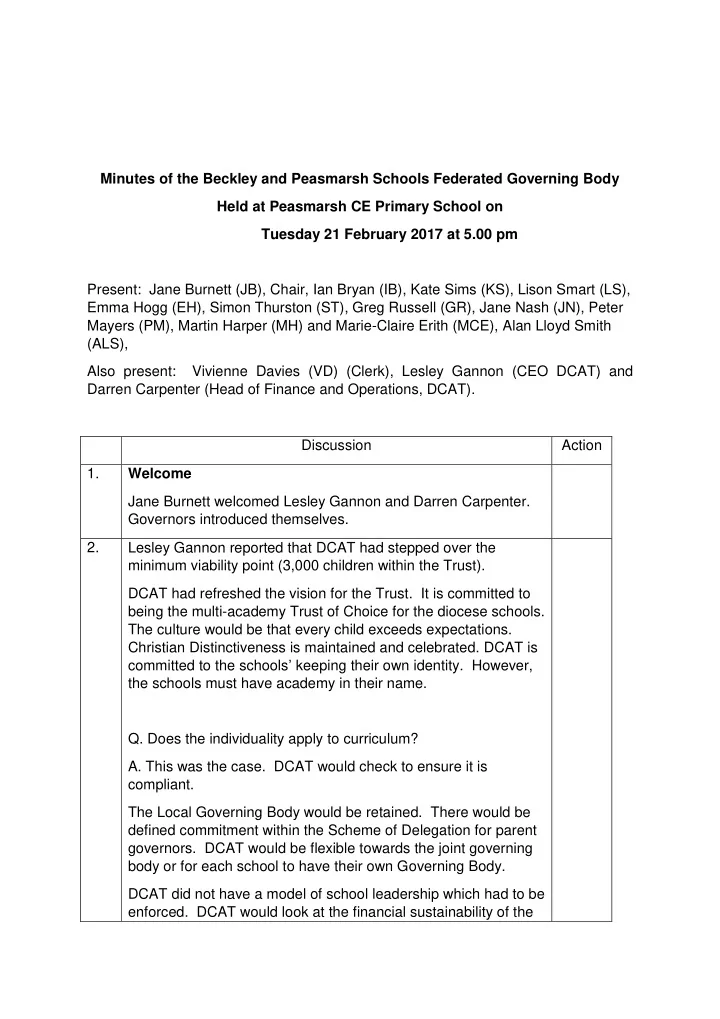
Minutes of the Beckley and Peasmarsh Schools Federated Governing Body Held at Peasmarsh CE Primary School on Tuesday 21 February 2017 at 5.00 pm Present: Jane Burnett (JB), Chair, Ian Bryan (IB), Kate Sims (KS), Lison Smart (LS), Emma Hogg


slide-1
SLIDE 1

Minutes of the Beckley and Peasmarsh Schools Federated Governing Body Held at Peasmarsh CE Primary School on Tuesday 21 February 2017 at 5.00 pm Present: Jane Burnett (JB), Chair, Ian Bryan (IB), Kate Sims (KS), Lison Smart (LS), Emma Hogg (EH), Simon Thurston (ST), Greg Russell (GR), Jane Nash (JN), Peter Mayers (PM), Martin Harper (MH) and Marie-Claire Erith (MCE), Alan Lloyd Smith (ALS), Also present: Vivienne Davies (VD) (Clerk), Lesley Gannon (CEO DCAT) and Darren Carpenter (Head of Finance and Operations, DCAT). Discussion Action 1. Welcome Jane Burnett welcomed Lesley Gannon and Darren Carpenter. Governors introduced themselves. 2. Lesley Gannon reported that DCAT had stepped over the minimum viability point (3,000 children within the Trust). DCAT had refreshed the vision for the Trust. It is committed to being the multi-academy Trust of Choice for the diocese schools. The culture would be that every child exceeds expectations. Christian Distinctiveness is maintained and celebrated. DCAT is committed to the schools’ keeping their own identity. However, the schools must have academy in their name.

  • Q. Does the individuality apply to curriculum?
  • A. This was the case. DCAT would check to ensure it is

compliant. The Local Governing Body would be retained. There would be defined commitment within the Scheme of Delegation for parent

  • governors. DCAT would be flexible towards the joint governing

body or for each school to have their own Governing Body. DCAT did not have a model of school leadership which had to be

  • enforced. DCAT would look at the financial sustainability of the
slide-2
SLIDE 2

current leadership structure. Every school is allocated a Group Executive Principal. They are not the Principal of the school. They operate more like an accountable school improvement partner. They work with the school leadership and the governing body.

  • Q. Governors asked how the current leadership worked in

relation to the Group Executive.

  • A. All schools had a headteacher. Two of the schools work with
  • ne group Executive Principal. The other school has a

dedicated Group Executive Principal. Where the school is currently paying for the consultant executive team the schools would no longer need this. Q, Governors asked if the LGB had a say in the appointment of the Executive Group Principal.

  • A. This was not the case. The LGB is accountable to the Group

Executive Principal who in turn is responsible to the board of directors.

  • Q. Does the Group Executive Principal get paid from the top

slice.

  • A. This was the case. This included 3 SIP visits a year.
  • Q. How would the HT performance management panel process

work.

  • A. On the Headteacher Performance Management Panel would

be a Chair of Governors and the Group Executive Principal. The Performance management of the other staff sits with the HT and the Local Governing Body.

  • Q. Is the Group Executive Principal held to account for finances

and teaching and learning.

  • A. There is a finance accountability route via Darren

Carpenter.

  • Q. How does the accountability change with the Local Governing

Body. There is a financial transition period as the Local Authority funding will take about 4 months to transfer over.

  • Q. How would the scheme of delegation work.
slide-3
SLIDE 3
  • A. For the first 12 months there will be minimum delegation,

maximum support from DCAT. The LGB would be expected to submit to the board a business plan setting out how they intend to use their money. If this is approved the school is facilitated and supported to spend. If the school needs to deviate from the plan in the first year they would need to seek authorisation from

  • DCAT. Should everything work to plan, schools move to

maximum delegation after 12 months. DCAT retain the right if there were issues to maintain the delegated financial function. Currently the schools send reports to the Local Authority. DCAT has live access to the school’s finances eliminating the need to report monthly.

  • Q. If ESCC were unhappy with a Governing Body they can

apply to the Secretary of state to disband the Governing Body. What would DCAT do in this situation?

  • A. DCAT appoints the governing body and can dismiss
  • Governors. Parent Governors would be elected and verified by

the Diocese. If DCAT is not happy with the performance of the GB they would dismiss Governors. The Governing Bodies are in the first instance appointed for 2 years. However following response from Local Governing bodies, DCAT had agreed to look at introducing a rolling programme of governors

  • Q. Does DCAT have a specific number of Governors in mind for

a Local Governing Body.

  • A. The Scheme of Delegation dictates how many Governors sit
  • n the Local Governing Body. The optimum number of

Governors was 11 Governors however DCAT is relatively flexible

  • n the number of Governors on the Local Governing Body.
  • Q. There are five schools in the Trust and DCAT is talking with
  • thers. Is there a strategic plan of how fast DCAT will expand?

Are there any schools which DCAT is not seeking to join them?

  • A. Because of the key vision, DCAT does not want to have to

say no to any school but DCAT may have to set conditions. The Office of the Regional Schools commissioner will dictate how many schools DCAT can take.

  • Q. How would the school investigate joining DCAT?
  • A. The first step is for Darren Carpenter to come out the school
slide-4
SLIDE 4

to look at the school’s finances. This would be an independent health check. Following on from this Darren Carpenter could then model the school’s finances as they would look like as an academy. This would provide Governors with information on how the school could look

  • financially. If these conversations progress this would form the

basis of the due diligence.

  • Q. How would DCAT integrate with the Governors. Would there

be a member from the Trust on the Local Governing Body?

  • A. The Group Executive Principal would be on the Local

Governing Body. There is an escalation process that goes through the school’s outcomes. At Key intervals in the year DCAT asks the Governing Body and the Executive Principal to RAG the outcomes. If an expectation is Red or Amber Red, DCAT would expect the issue to the discussed at the Local Governing Body. The Group Executive Principal would ensure any issues were discussed at LGB meetings.

  • Q. How would DCAT structure in the management.
  • A. It was proposed to develop local hubs with Chairs of
  • Governors. As more schools join it was hoped the Local

Governing Bodies would work in a hub with the Group Executive Principal.

  • Q. What about the TUPE process?
  • A. TUPE means that TUPE staff move over on existing terms

and conditions. DCAT pay national terms and conditions. Schools that come in would TUPE across. DCAT is signed and committed to a recognition agreement with the teaching unions. This includes support staff unions.

  • Q. Explain about the percentage of top-slice.
  • A. Schools pay between 5 and 6% but this is not 5 and 6% of

what the schools already get as ESCC already take a top-slice. Good Schools - 5% Schools in Special Measures - 6% Schools RI – pay 5% plus up to a maximum of 6% This is based on the last Ofsted judgement. Both Beckley and Peasmarsh are judged Good

slide-5
SLIDE 5
  • Q. What top-slice are schools currently paying East Sussex.
  • A. GAG – (General Annual Grant) is the bulk of the income. The

headline budget figure is already top-sliced. DCAT would look at the figures to give a comparative picture. In addition, schools are forced to buy into payroll and insurance. If DCAT is invited into school to look at financial modelling they would provide information. Generally local authorities top slice 8-12%.

  • Q. How does Special Needs Support work?
  • A. DCAT does not provide Special Needs support currently.

Most schools are buying support from the Local Authority. Hubs were starting to work together. Each school decides individually

  • n the purchase of services. DCAT had chosen to put most the

top slice into the Group Exec Principals to ensure the children were at the forefront.

  • Q. What happens about children with EHC plans?
  • A. GAG funding comes in 12 monthly amounts. The Pupil

Premium money comes quarterly. This gives rise to cash flow

  • issues. SEN top up funding is via the local authority and the

funding is paid monthly.

  • Q. Previously another school which had joined DCAT had to pay

tens of thousands of pounds out of the budget to ensure that teachers pensions schemes were maintained. Would this happen again?

  • A. As an employer, there is a significant jump in pensions
  • contributions. However, all the maintained schools are starting

to pay more for pensions.

  • Q. Hubs. The school wanted to maintain the rural Christian
  • Ethos. Would the school have to go to Hastings or would there

be a local rural Christian DCAT hub?

  • A. The school would not have to go to Hastings. No-one gains

from forcing schools into hubs. DCAT have an obligation to give schools the opportunity to join a hub. There are different challenges for different communities and there would be different

  • pportunities. DCAT would be looking to find reasonably close

schools to join a hub. Part of the core Christian mission is to support families within the Diocese. There is no reason why Beckley and Peasmarsh could not continue to work with local

slide-6
SLIDE 6

schools.

  • Q. How have the current DCAT schools measured their

success?

  • A. It is expected that All Saints will be judged Good. All schools

have performed above benchmark. The schools which had been with DCAT for a shorter period are already starting to see changes in staffing.

  • Q. Could staff be moved to another schools.
  • A. Legally because DCAT is one employer they could change

the place of work. However, DCAT does not intend to do this. DCAT wants to encourage staff to develop in leadership and experience other schools. If a school was to make a post redundant, DCAT would look for vacancies across the trust.

  • Q. Would the term dates be the same as East Sussex?
  • A. There would be no change.
  • Q. Is DCAT sponsored by anybody?
  • A. DCAT is the sponsor. The diocese of Chichester invested in

DCAT originally. DCAT is prohibited from making profit. As more schools come in more services will be provided for the 5%.

  • Q. Could schools use their own assessment system.
  • A. If schools had their own assessment system this could

continue.

  • Q. What happens about the ownership of the building.
  • A. The ownership remains with the diocese on a long lease to

the Trust. A system would be run within the Trust for maintenance of the buildings.

  • Q. What would happen if the school roll dropped?
  • A. This would depend on the circumstances. DCAT would be

looking at the situation and aim to work on parental engagement. If the budget did not sustain its outgoings savings would have to be sought. Before staff were made redundant other

  • pportunities would be considered.
  • Q. DCAT is a new tier of management? Expertise may deskill

some staff. How will the school take staff with them?

  • A. DCAT is not an additional layer. They are an alternative. The

funding comes from the top slice. Originally the diocese

slide-7
SLIDE 7

recognised that front loading would have to take place before the schools became self-sustaining. Initial investment had been made by the Diocese.

  • Q. What about members of skilled staff who move up the ladder.
  • A. DCAT has more opportunities to hold on to staff. There are
  • pportunities for teachers to obtain leadership opportunities.

Resources were in place to promote staff development.

  • Q. Governors asked about the changes since September. How

many schools proposed to the DCAT board had been turned down in the last year?

  • A. DCAT will only turn away a school if it is not financially viable.

Previously Peasmarsh was not financially viable. The position had now changed at Peasmarsh. It would now be unusual for the DCAT board to say no to a school joining them. DCAT would conduct a financial modelling health check a long time before decisions are made.

  • Q. How can Governors conduct due diligence on DCAT?
  • A. Financial information is published on the website.
  • Q. Would a financial health check be possible before the

Governing Body made a decision?

  • A. This would be possible.
  • Q. What are the benefits to the schools on joining DCAT.
  • A. There is increased opportunities for children, families, staff.

This is an opportunity to become part of the key Christian mission in maintaining Christian presence 5 Dates of Next Meeting Aquila Presentation – 14 March 2017– 5pm at Beckley School