
SLIDE 1
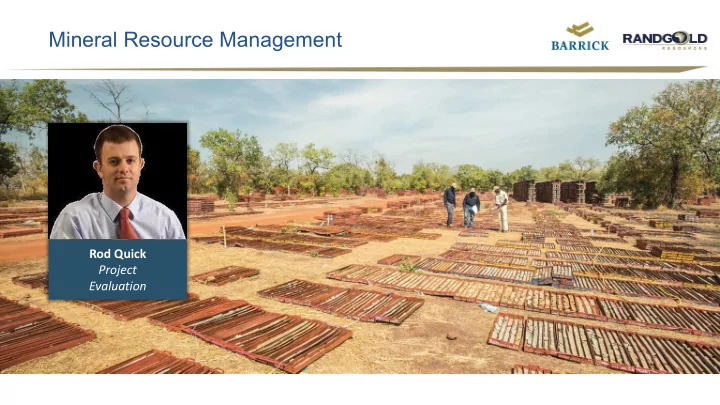
Mineral Resource Management Rod Quick Project Evaluation Mineral - - PowerPoint PPT Presentation
Mineral Resource Management Rod Quick Project Evaluation Mineral resource management at New Barrick Manage the orebody from gold in the ground to value for all stakeholders only possible through ownership of the orebody MRM are
First visit in 2006 identified significant mineralisation and alteration system with folding and plunging shoots in interesting rocks Used BIF, chert, and carbonaceous argillite markers and stratigraphic younging direction and changing orientation of bedding to model folding Pale coloured ankerite, and/or siderite, quartz, and sericite alteration is the widespread alteration assemblage. ACSA _A An overprint assemblage of texturally destructive siderite and pyrite with minor quartz. ACSA_B Disseminated magnetite within ACSA-A and B altered rocks can be used to map the extent of BIF horizons in the protolith. Principal lodes are hosted in vein and disseminated pyrite associated with the ACSA-B assemblage. Gold generally occurs as inclusions in both disseminated and vein pyrite, and small grains along the margins of pyrite. Curviplanar mineralized BIF extends:
around the hinges of the folds, locally along the limbs of the folds Only rarely extends along the axial surfaces of the folds,
The resulting lodes have complex shapes, but an overall northeast plunge parallel to the fold axes Understanding the controls to mineralisation led to efficient conversion of resource to reserve – within 1 year we doubled the reserve from 5.5Moz @ 4g/t to 10Moz @ 4.2g/t As of Dec 2017 we have added 6Moz @ 3.7g/t to the acquisition reserve.
5,100 5,200 5,300 5,400 5,500 5,600 5,700 5,800
1. This is a non-GAAP reporting measure with no standardized meaning under IFRS.
92koz @ 4.8g/t Ore reserve Delya Main (18km) 1.2Moz @ 3.4g/t Ore reserve 804koz @ 4.5g/t Ore reserve North Zone Central Zone Resource Bambaraya (18 km) 538Koz @ 2.9g/t Ore reserve Sofia (10.7km) Tina Central Zone Extensions Under evaluation KB & Kaviar Under evaluation Delya Strike Extents Under evaluation Resource
Gram.Metre Value +40 30 - 40 20 - 30 15 - 20 <15
L3DH159 4.8m @ 34.8g/t
Current depletion
200m
Notes: Target summary from diamond drilling at the spacing shown. There are insufficient exploration results to report a resource, and it is uncertain that further exploration will result in a resource estimate.
Target Summary: MZ1 Target (48 drill holes) MZ2 Target (18 drill holes)
Q4 drill limit
L3DH158 8.0m @ 11.05g/t L3DH154 9.7m @ 20.49g/t L3DH157 3.9m @ 0.97g/t L3DH155 4.7m @ 18.2g/t L3DH156 19.8m @ 4.39g/t L3DH153 7.3m @ 15.71g/t
Q4 Proposed Drilling Previous Drilling US$ 1000/oz pit shell US$ 1500/oz pit shell
Proposed ADGC Drilling High Priority Targets Conceptual Targets (New) Proposed Exploration Drilling
Purple Patch
YaDH92 12.3m @ 15.88g/t TW YDH280 3.8m @ 6.0g/t TW YDH281 4.3m @ 1.39g/t TW YDH282 11.4m @ 6.39g/t TW YaDH88 21.7m @ 8.83g/t TW YaDH86 17.3m @ 25.2g/t TW YaDH80 4.3m @ 32.21g/t TW YaDH68 8m @ 10.01g/t TW 1000m 100m 280m
Yalea North targets
Yalea Transfer Zone (15 drill holes) Size: 500m strike x 100m VD
Conversion and Exploration Target Summary: Yalea FW Panel (15 drill holes) Size: 1000m strike x 280m VD
Yalea Central Deep
Yalea Transfer Zone
Conversion Shoot target
500m
>8g/t 4 - 8g/t 4 – 3g/t 3 – 2g/t 2 - 0.7g/t Gold g/t
1. For additional detail regarding Turquoise Ridge, see the Technical Report on the Turquoise Ridge Mine, State of Nevada, U.S.A., dated March 19, 2018, and filed on SEDAR at www.sedar.com and EDGAR at www.sec.gov on March 23, 2018. 2. 75% Barrick owned 3. See Appendix B for additional details including assay results for the significant intercepts 4. Proven and Probable Reserves: 5.9Moz (11.8 Mt @ 15.6 g/t); Measured and Indicated Resources: 1.5 Moz (5.1 Mt @ 9.1 g/t). See Endnote #3
Getchell Fault Resource Conversion FWP Extension & BPE Projects
2P Reserves4 M&I Resource4
TS1804 TS1802
KCD Pushback 3 330koz $1000/oz design Sessenge open pit 300koz $1000/oz design KCD open pit PB#1 North 3000 Lode up plunge extension PB#2 1.9Mt @ 2g/t (100koz) UG – 2.1Mt @ 4.97g/t (335koz) Ave drill intersection 17.1m @ 11.2g/t 5000 Lode down plunge 7Mt @ 5.82g/t (1.36Moz) 9000 Lode up plunge extension Sessenge Link 3.7Mt @ 2.61g/t (345koz)
New assays intersection 8.5m @ 5.3g/t Drill holes planned
Phase 4 (109 RC and 8 DDH) drilling in $1200/oz pit shell completed at Kalimva and
Infill drilling confirms continuity with improved average intersection widths and grades than predicted by the previous model Results return 34% increase in grade and 19% increase in tonnes to deliver a 59% increase in ounces compared to previous model in a $1000/oz optimisation pit shell $1000/oz optimisation pit shell contains 5.6Mt at 3.1g/t for 559koz defined to a sufficient level to support an inferred resource
Lithology
Ikamva
$1200/oz pit
Kalimva
$1200/oz pit
Quartz feldspar porphyry Banded iron formation Metasediment 400m
Average recovery of 90% from BRT in fresh
KVRC0094 32m @ 6.59g/t incl 6m @ 28.19g/t KVDD0015 4.5m @ 5.13g/t and 39m @ 1.79g/t KVRC0113 10m @ 3.54g/t HG potential: down plunge target
Southern high grade domain Northern high grade domain
KALIMVA LONG SECTION LOOKING WNW
KVRC0076 22m @ 2.39g/t from 44m incl 6m @ 4.18 g/t KVRC0079 14m @ 3.59g/t from 46m incl 2m @ 20g/t KVRC0078 36m @ 2.24 g/t from 104m KVRC0094 32m @ 6.59g/t from 48m incl 8m @ 22.59g/t
100m
Drill Results from Q3 2018 Core Drill Hole 2 Azimuth Dip Interval (m) Width (m) 3 Au (g/t)
TS1803
789.9-814.9
TS1804
942.4-945.2
TS1804A
968.8-973.5
TS1804B
980.2-984
1. All significant intercepts calculated as being >6 m and >7.7 g/t or >3 m and >15.5 g/t 2. Nomenclature for drillholes (i.e., TS1802) is described by TS (i.e., Turquoise Ridge Surface) followed by the year (i.e., 18 for 2018) 3. True width of intercepts are uncertain at this stage The drilling results for the Turquoise Ridge property contained in this presentation have been prepared in accordance with National Instrument 43-101 – Standards of Disclosure for Mineral Projects. All drill hole assay information has been manually reviewed and approved by staff geologists and re-checked by the project manager. Sample preparation and analyses are conducted in an on site laboratory with Quality Assurance/Quality Control procedures performed by an independent laboratory. Procedures are employed to ensure security of samples during their delivery from the drill rig to the laboratory. The quality assurance procedures, data verification and assay protocols used in connection with drilling and sampling on the TRJV property conform to industry accepted quality control methods.