MILESTONES FOR THIS 6-MONTH REPORTING PHASE (SEPT 2018- FEB 2019) - - PowerPoint PPT Presentation

milestones for this 6 month reporting phase sept 2018 feb
SMART_READER_LITE
LIVE PREVIEW

MILESTONES FOR THIS 6-MONTH REPORTING PHASE (SEPT 2018- FEB 2019) - - PowerPoint PPT Presentation

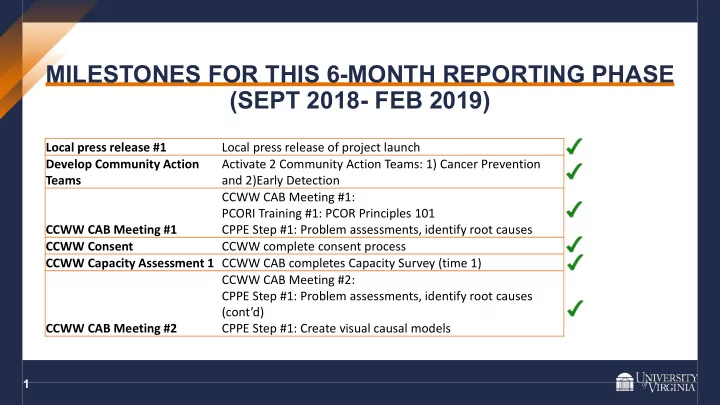
MILESTONES FOR THIS 6-MONTH REPORTING PHASE (SEPT 2018- FEB 2019) Local press release #1 Local press release of project launch Develop Community Action Activate 2 Community Action Teams: 1) Cancer Prevention Teams and 2)Early Detection CCWW


slide-1
SLIDE 1

1

MILESTONES FOR THIS 6-MONTH REPORTING PHASE (SEPT 2018- FEB 2019)

Local press release #1 Local press release of project launch Develop Community Action Teams Activate 2 Community Action Teams: 1) Cancer Prevention and 2)Early Detection CCWW CAB Meeting #1 CCWW CAB Meeting #1: PCORI Training #1: PCOR Principles 101 CPPE Step #1: Problem assessments, identify root causes CCWW Consent CCWW complete consent process CCWW Capacity Assessment 1 CCWW CAB completes Capacity Survey (time 1) CCWW CAB Meeting #2 CCWW CAB Meeting #2: CPPE Step #1: Problem assessments, identify root causes (cont’d) CPPE Step #1: Create visual causal models

slide-2
SLIDE 2

2

MILESTONES FOR THIS 6-MONTH REPORTING PHASE (MARCH 2019 - AUGUST 2019)

Website Launch Launch Website UVA PCOR training UVA PCOR training meeting CCWW CAB Meeting #3 CCWW CAB Meeting #3: CPPE Step #1: Create visual causal models, con't CPPE Step #1: Prioritization CPPE Step #2: Identification and selection of potential interventions CCWW CAB Meeting #4 CCWW CAB Meeting #4: PCOR training #2: Evidence synthesis on CPPE identified priorities CPPE Step #2: Identification and selection of potential interventions, con't CCWW Capacity Assessment 2 CCWW completes Capacity Survey (time 2) and qualitative interview Findings are disseminated back to CCWW CAB

slide-3
SLIDE 3

3

MILESTONES FOR NEXT 6-MONTH REPORTING PHASE (SEPT 2019 – FEBRUARY 2020)

CCWW CAB Meeting #5 CCWW CAB Meeting #5: PCOR training #3: Evidence synthesis and Expert Panel on CPPE identified priorities, con't OR Innovative Research Strategies and Opportunities in Rural Cancer Control CPPE Step #3: Planning CCWW CAB Meeting #6 CCWW CAB Meeting #6: PCOR training #4: PCOR Funding Opportunities and Study Designs CPPE Step #4: Proposal Development Website Update Website maintenance and dissemination of information (Sep 2019-Feb 2020)

Today!

slide-4
SLIDE 4

4

MILESTONES FOR 6-MONTH REPORTING PHASE (MARCH 2020 - AUGUST 2020)

CCWW CAB Meeting #7 CCWW CAB Meeting #7: PCOR training #5: Institutional Review Boards and Human Subjects Research (certification for those interested) CPPE Step #4: Proposal Development, con't CCWW Capacity Assessment 3 CCWW completes Capacity Survey (time 3) and qualitative interview Findings are disseminated back to CCWW CAB Website Update Website maintenance and dissemination of information (Mar-Aug 2020) Local press release and dissemination #2 Local press release of project accomplishments. Disseminate contextualized cancer control strategies and evaluation findings at local, State, and national levels

slide-5
SLIDE 5

5

  • State-wide Virginia Cancer Plan contextualize and prioritized

for our southwest VA region

  • Competitive grant proposals
  • Interventions and programs selected and adapted to meet our needs
  • Website
  • Increase awareness & collaboration
  • Training materials, specific to cancer control in Appalachia

What will or products be?

slide-6
SLIDE 6

Particiaptory Research Principles Patient- Centered Outcomes Research Training Series Comprehensive Participatory Planning & Evaluation Process

Step #1 Problem Assessment Step #2 Identification

  • f Potential

Interventions Step #3 Planning Step #4 Proposal Development Step #5 Monitoring and Evaluation

Patient-Centered Approach Comprehensive Participatory Planning and Evaluation (CPPE)

slide-7
SLIDE 7
slide-8
SLIDE 8

8

BUDGET HIGHLIGHTS ($198,000)

  • 7 community members compensated as consultants (~1 day per month

for both years 1 & 2)

  • 3 Co-Chair board members
  • 4 Community Action Team leaders
  • 3 UVA research team members, 3 outreach & engagement staff, 1

evaluation specialist (~1 day per month for both years 1 & 2)

  • $21,500 to support travel stipends and community members to attend

conferences

  • Website & meeting expenses
slide-9
SLIDE 9

Year 1 Capacity Findings

slide-10
SLIDE 10

Prevention Action Team

RECAP – OCTOBER 2019

slide-11
SLIDE 11
slide-12
SLIDE 12

Top 5 going into August Meeting

 TOBACCO -- Increase [evidence-based] educational programs to discourage use of all tobacco products and encourage the use of cessation services.  OBESITY -- Implement evidence-based engagement strategies to build support for lifestyle/behavior change.  OBESITY -- Increase reach for evidence-based supports for lifestyle/behavior change through collaborative networks, including youth-serving organizations (e.g., community health workers).  OBESITY -- Strengthen healthier food access and sales in retail venues and community venues (i.e. farmers markets) through increased availability of fruit and vegetables and more low/no sodium/sugar options, improved pricing, placement, and promotion.  HPV

  • - Provide education to Virginians (including parents, schools, communities, physicians and
  • ther healthcare providers) about the effectiveness of the HPV vaccination in preventing

HPV associated cancers AND provide education on HPV and HPV vaccination and/or provide connection to HPV resources.

slide-13
SLIDE 13

The 2 (maybe 3) Chosen Strategies

 TOBACCO -- Increase [evidence-based] educational programs to discourage use of all tobacco products and encourage the use of cessation services.  OBESITY -- Implement evidence-based engagement strategies to build support for lifestyle/behavior change.  OBESITY -- Increase reach for evidence-based supports for lifestyle/behavior change through collaborative networks, including youth-serving organizations (e.g., community health workers).  OBESITY -- Strengthen healthier food access and sales in retail venues and community venues (i.e. farmers markets) through increased availability of fruit and vegetables and more low/no sodium/sugar options, improved pricing, placement, and promotion.  HPV

  • - Provide education to Virginians (including parents, schools, communities, physicians and
  • ther healthcare providers) about the effectiveness of the HPV vaccination in preventing

HPV associated cancers AND provide education on HPV and HPV vaccination and/or provide connection to HPV resources.

slide-14
SLIDE 14

Early Detection Action Team

RECAP – OCTOBER 2019

slide-15
SLIDE 15
slide-16
SLIDE 16

Top 5 going into August Meeting

 Encourage physicians and other healthcare providers to use evidence-based practices to increase cancer screening rates (patient reminders, provider reminders, provider assessment and feedback).  Provide education to physicians, other healthcare providers, and the public about current national cancer screening guidelines for populations at high risk for cancer.  Provide education to physicians, other healthcare providers, and the public about available low and no cost cancer screening resources for low-income, under and uninsured populations.  Reduce barriers to screening among underserved populations through the use of patient navigation and other culturally competent outreach strategies.  Advocate for state and federal policies that improve access to health insurance and/or free or low-cost screenings.

slide-17
SLIDE 17

Top 2 Constructed / Chosen Strategies

 Encourage physicians and other healthcare providers to use evidence-based practices to increase cancer screening rates (patient reminders, provider reminders, provider assessment and feedback).  Provide education to physicians, other healthcare providers, and the public about current national cancer screening guidelines for populations at high risk for cancer.  Provide education to physicians, other healthcare providers, and the public about available low and no cost cancer screening resources for low-income, under and uninsured populations.  Reduce barriers to screening among underserved populations through the use of patient navigation and other culturally competent outreach strategies.  Advocate for state and federal policies that improve access to health insurance and/or free or low-cost screenings. Provide education and strategies to reduce barriers to cancer screenings to physicians,

  • ther healthcare providers, and the public

about low and no cost cancer screening resources for low income, under, and uninsured populations.

slide-18
SLIDE 18