Midterm 2 topics (in one slide) Machine-level code representation - - PDF document

midterm 2 topics in one slide
SMART_READER_LITE
LIVE PREVIEW

Midterm 2 topics (in one slide) Machine-level code representation - - PDF document

Midterm 2 topics (in one slide) Machine-level code representation Instructions, operands, flags Branches, conditions, and loops Procedures and calling conventions Arrays, structs, unions CSci 2021: Review Lecture 2 Buffer overflow attacks


slide-1
SLIDE 1

CSci 2021: Review Lecture 2

Stephen McCamant

University of Minnesota, Computer Science & Engineering
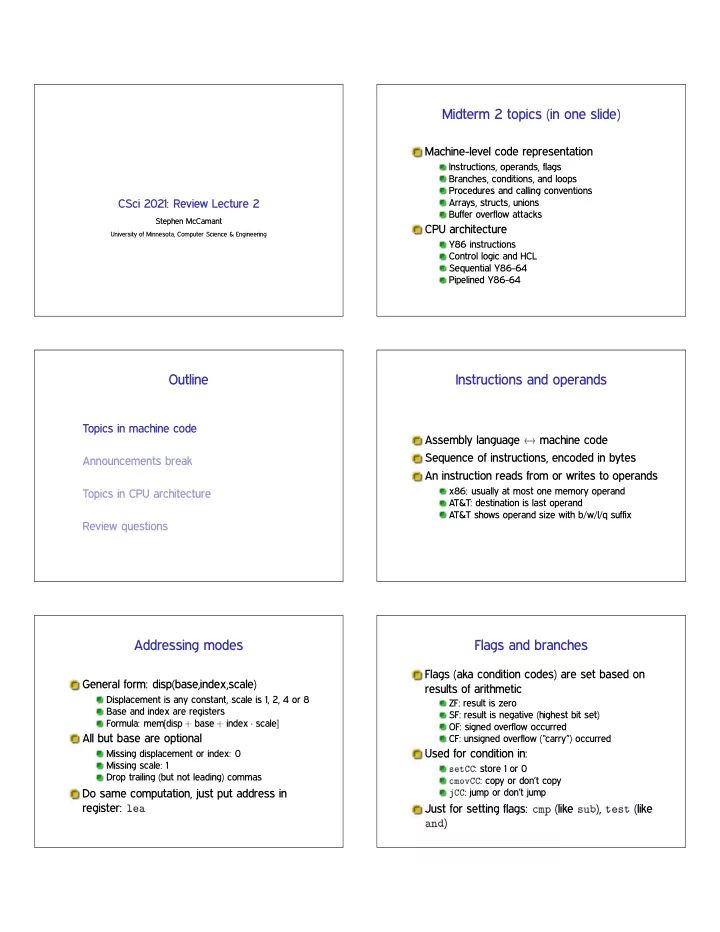
Midterm 2 topics (in one slide)

Machine-level code representation

Instructions, operands, flags Branches, conditions, and loops Procedures and calling conventions Arrays, structs, unions Buffer overflow attacks

CPU architecture

Y86 instructions Control logic and HCL Sequential Y86-64 Pipelined Y86-64

Outline

Topics in machine code Announcements break Topics in CPU architecture Review questions

Instructions and operands

Assembly language ✩ machine code Sequence of instructions, encoded in bytes An instruction reads from or writes to operands

x86: usually at most one memory operand AT&T: destination is last operand AT&T shows operand size with b/w/l/q suffix

Addressing modes

General form: disp(base,index,scale)

Displacement is any constant, scale is 1, 2, 4 or 8 Base and index are registers Formula: mem[disp ✰ base ✰ index ✁ scale]

All but base are optional

Missing displacement or index: 0 Missing scale: 1 Drop trailing (but not leading) commas

Do same computation, just put address in register: ❧❡❛

Flags and branches

Flags (aka condition codes) are set based on results of arithmetic

ZF: result is zero SF: result is negative (highest bit set) OF: signed overflow occurred CF: unsigned overflow (“carry”) occurred

Used for condition in:

s❡t❈❈: store 1 or 0 ❝♠♦✈❈❈: copy or don’t copy ❥❈❈: jump or don’t jump

Just for setting flags: ❝♠♣ (like s✉❜), t❡st (like ❛♥❞)

slide-2
SLIDE 2

Loops

Simplest structure: conditional jump “at the bottom”, like a C ❞♦-✇❤✐❧❡ C ✇❤✐❧❡ also checks at beginning C ❢♦r e.g. initializes a variable and updates it on each iteration Assembly most like C with ❣♦t♦

Stack and frames

“The” stack is used for data with a function lifetime ✪rs♣ points at the most recent in-use element (“top”) Convenient instructions: ♣✉s❤ and ♣♦♣ Section for one run of a function: stack frame

Calling conventions

Function arguments go in ✪r❞✐, ✪rs✐, ✪r❞①, ✪r❝①, ✪r✽, and ✪r✾ Return value is in ✪r❛① Handle that both caller and callee want to use registers Caller-saved: callee might modify, caller must save if using

✪r❛①, ✪r❞✐, . . . , ✪r✶✵, ✪r✶✶, flags

Callee-saved: caller might be using, callee must save before using

✪r❜①, ✪r✶✷, . . . , ✪r❜♣, (✪rs♣)

Arrays

Sequence of values of same size and type, next to each other Numbered starting from 0 in C To find location: start with base, add index times size C’s pointer arithmetic is basically the same

  • peration

Multi-dimensional array

Needs more multiplying

Array of pointers to arrays

Different, more flexible layout Each access needs more loads

Structs and unions

Struct groups objects of different types and sizes, in order Fields often accessed using displacement from a pointer Alignment requirements ✦ padding

Primitive values aligned to their size Pad between elements, when next needs more alignment Pad at end, to round off total size

Unions: “like structs where every offset is 0”

Used to save space if only one needed at a time Can also reveal storage details

Buffer overflows

Local arrays stored on the stack C compilers usually do not check limits of array accesses Too much buffer data can overwrite a return address

Changes what code will execute Various nefarious uses

Various partial defenses:

Randomize stack location Non-executable stack Stack canary checking

slide-3
SLIDE 3

Outline

Topics in machine code Announcements break Topics in CPU architecture Review questions

Online midterm: hardware

You should be virtually present on Zoom while doing the test on Canvas First choice: a computer with a webcam Second choice: a computer, and the Zoom app running on a smartphone If you won’t be able to do either of these, please contact me in advance

Online midterm: rules

You need to take the midterm live, starting at 3:35pm.

The midterm ends at 4:25pm, even if you started late

Still paper resources only

Open (paper) book, open (paper) notes, printouts No electronics, calculators, communicating with

  • ther students

If possible, stay at your computer for the whole exam

Check with the TA if you need to get up

If you finish early, check with the TA after submitting but before leaving Zoom

Outline

Topics in machine code Announcements break Topics in CPU architecture Review questions

Y86-64 instructions

Simplified subset of x86-64, simpler encoding 64-bit only, 15 registers Four kinds of moves, only one addressing mode Add, subtract, bitwise and, bitwise xor Conditional jump and move based on equality and signed comparison Call, return, push, pop Halt and two fatal errors, no exceptions

Logic design for control

Combinational circuits:

Compute a function of bits, no memory Acyclic network of AND, OR, and NOT gates Also includes word-sized comparison, multiplexors, and ALU

Stateful elements:

(Clocked) registers Random-access memory State updates occur on rising clock edge only

slide-4
SLIDE 4

Hardware design in HCL

Simple language for specifying control circuits Two types: Boolean and word Comparison and logic operators (no side-effects

  • r “short circuiting”)

Core construct: sequential conditional

❬❈✶ ✿ ❱✶❀ ❈✷ ✿ ❱✷❀ ✿ ✿ ✿ ✶ ✿ ❱♥❪ “Else” case written ✶

Sequential Y86-64

Whole state update function is one big combinational circuit Express behavior of each instruction using smaller computations Processing split into stages for organization:

Fetch, decode, execute, memory, write back, PC update

Simplest, but requires long cycle time (slow)

Pipelining basics

Split processing into stages, and work on multiple instructions at once Reduces cycle time and increases hardware utilization Pipeline registers hold data between stages Performance concerns: balanced stages, and not too many Correctness concerns: must have same final behavior

Pipelining techniques

Hazards: dependencies introduce danger of incorrect results Branch prediction: guesses result of conditional jumps Stalling: hold up instructions until data ready

Simple, but introduces a lot of delay Used for return instruction in Y86-64

Cancelling: kill incorrect instructions

Must happen before they have side-effects Used for branch mis-predictions

Forwarding: copy data to a different stage right as needed

Outline

Topics in machine code Announcements break Topics in CPU architecture Review questions

Calling conventions

According to the standard x86-64 calling convention, which of these registers would your function need to save before modifying it?

  • A. ✪r❞✐
  • B. ✪rs✐
  • C. ✪r✶✵
  • D. ✪r❜①
  • E. ✪r❛①
slide-5
SLIDE 5

x86-64 instructions

Which two instructions can be used to compare ✪r❛① to zero?

  • A. ❝♠♣ ✩✵✱ ✪r❛① and t❡st ✩✵✱ ✪r❛①
  • B. ❝♠♣ ✩✵✱ ✪r❛① and t❡st ✪r❛①✱ ✪r❛①
  • C. ❝♠♣ ✪r❛①✱ ✪r❛① and t❡st ✩✵✱ ✪r❛①
  • D. ❝♠♣ ✪r❛①✱ ✪r❛① and t❡st ✪r❛①✱ ✪r❛①

❢♦r loops

Which of these while loop patterns is equivalent to the loop ❢♦r ✭❆❀ ❇❀ ❈✮ ④ ❉❀ ⑥?

  • A. ❆❀ ✇❤✐❧❡ ✭❇ ✫✫ ❈✮ ④ ❉❀ ⑥
  • B. ❇❀ ✇❤✐❧❡ ✭❆✮ ④❉❀ ❈⑥
  • C. ❆❀ ✇❤✐❧❡ ✭❇✮ ④❈❀ ❉⑥
  • D. ❆❀ ✇❤✐❧❡ ✭❇✮ ④❈❀ ❉❀ ❈⑥
  • E. ❆❀ ✇❤✐❧❡ ✭❇✮ ④❉❀ ❈⑥

Structure padding

Because of padding, which of these str✉❝ts would not be the same size as the others?

  • A. str✉❝t ④ s❤♦rt s❀ ❧♦♥❣ ❧❀ ⑥
  • B. str✉❝t ④ ❢❧♦❛t ❢❀ ❞♦✉❜❧❡ ❞❀ ⑥
  • C. str✉❝t ④ ❝❤❛r ❝❀ ❧♦♥❣ ❧❀ ⑥
  • D. str✉❝t ④ ❧♦♥❣ ❧✶❀ ❧♦♥❣ ❧✷❀ ⑥
  • E. str✉❝t ④ ✐♥t ✐✶❀ ✐♥t ✐✷❀ ⑥

Y86-64 instructions

Which of these Y86-64 instructions is an indirect jump?

  • A. call
  • B. ret
  • C. jmp
  • D. jle
  • E. jne