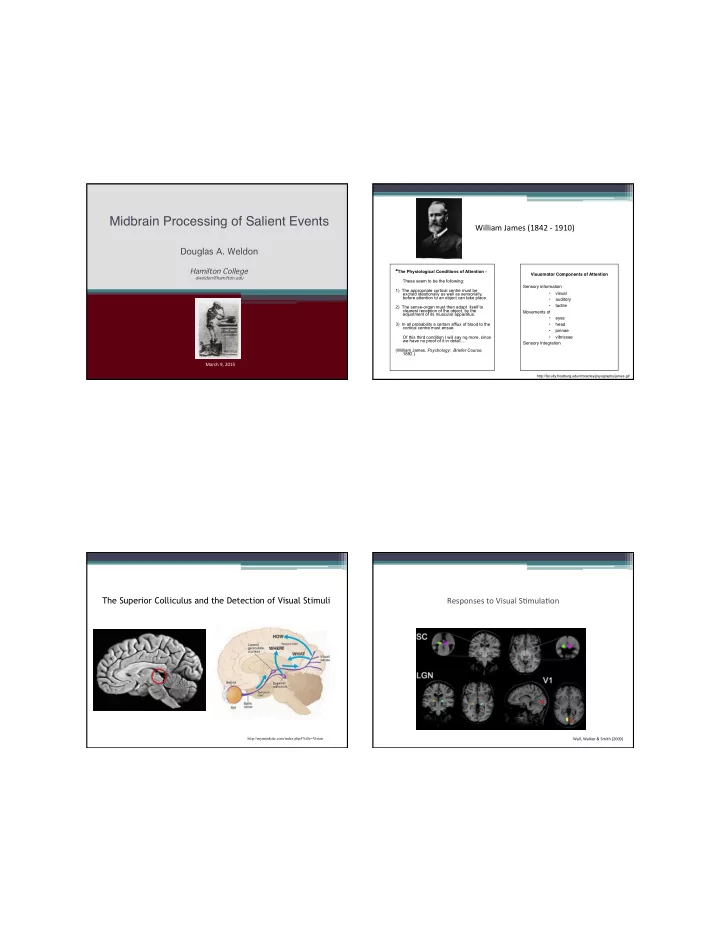
Midbrain Processing of Salient Events William James (1842 - - - PDF document

midbrain processing of salient events
SMART_READER_LITE
LIVE PREVIEW

Midbrain Processing of Salient Events William James (1842 - - - PDF document

Midbrain Processing of Salient Events William James (1842 - 1910) Douglas A. Weldon Hamilton College The Physiological Conditions of Attention - Visuomotor Components of Attention dweldon@hamilton.edu


slide-1
SLIDE 1

Midbrain Processing of Salient Events

March ¡9, ¡2015 ¡

Douglas A. Weldon

  • Hamilton College

dweldon@hamilton.edu “The Physiological Conditions of Attention - These seem to be the following: 1) The appropriate cortical centre must be excited ideationally as well as sensorially, before attention to an object can take place. 2) The sense-organ must then adapt itself to clearest reception of the object, by the adjustment of its muscular apparatus. 3) In all probability a certain afflux of blood to the cortical centre must ensue. Of this third condition I will say no more, since we have no proof of it in detail....” (William James, Psychology: Briefer Course, 1892.) Visuomotor Components of Attention Sensory information

  • visual
  • auditory
  • tactile

Movements of

  • eyes
  • head
  • pinnae
  • vibrissae

Sensory Integration

http://faculty.frostburg.edu/mbradley/psyography/james.gif

William ¡James ¡(1842 ¡-­‑ ¡1910) ¡ The Superior Colliculus and the Detection of Visual Stimuli

http://mymindsite.com/index.php5?title=Vision

Responses ¡to ¡Visual ¡SAmulaAon ¡

Wall, ¡Walker ¡& ¡Smith ¡(2009) ¡

slide-2
SLIDE 2

The Colliculus Makes It to the Small Screen! MulAsensory ¡IntegraAon ¡Occurs ¡in ¡the ¡ ¡ Deep ¡Layers ¡of ¡the ¡Superior ¡Colliculus ¡

from King (2004) Visual Cortex Somatosensory Cortex Auditory Cortex Somatosensory Afferents Auditory Afferents Retina Orientation Movements

MulAsensory ¡IntegraAon ¡Occurs ¡in ¡the ¡ ¡ Deep ¡Layers ¡of ¡the ¡Superior ¡Colliculus ¡

http://medicine.creighton.edu/medschool/ neuroatlas/lab/Lab5-6/10.html

Recording ¡Neuronal ¡AcAvity ¡in ¡Awake ¡Rats ¡

slide-3
SLIDE 3

Recording ¡Neuronal ¡AcAvity ¡in ¡Awake ¡Rats ¡ MulAmodal ¡IntegraAon ¡in ¡the ¡ ¡ Superior ¡Colliculus ¡of ¡Awake ¡Rats ¡ ¡ ¡

20 msec per division

Tactile Auditory Tactile & Auditory

20 msec per division 20 msec per division

Auditory

  • No. of Spikes
  • No. of Spikes
  • No. of Spikes

Somatosensory Somatosensory & Auditory Auditory 20 msec per division 20 msec per division

Sensory ¡Processing ¡Depends ¡on ¡the ¡Behavioral ¡Context ¡

Held in hand On platform Freely moving Weldon ¡& ¡Best ¡(1992) ¡

Time (100 msec per division) Time (100 msec per division) Time (100 msec per division) Time (100 msec per division) Number of Spikes Number of Spikes Number of Spikes Number of Spikes

Neuronal ¡Ac,vity ¡ ¡ Related ¡ ¡ to ¡Direc,on ¡of ¡Head ¡ ¡ Movements ¡

slide-4
SLIDE 4

Colliculus ¡Units ¡(45%) ¡Show ¡Reward-­‑Related ¡AcAvity ¡in ¡a ¡T-­‑Maze ¡Task ¡

Match

Weldon, ¡Edwards, ¡Green, ¡Arbouet, ¡& ¡ ¡Kocivar ¡ ¡ ¡(1998) ¡ ¡

Is ¡SC ¡AcAvity ¡in ¡the ¡Goal ¡Box ¡Due ¡to ¡ ¡ Motor ¡Movements ¡or ¡Sensory ¡SAmulaAon? ¡ ¡ ¡ ¡ SC ¡AcAvity ¡during ¡Reward ¡Retrieval ¡is ¡Not ¡Due ¡to ¡ ¡ the ¡ExecuAon ¡of ¡the ¡Movements ¡ ¡

Time (100 per division) Time (100 msec per division) Time (100 msec per division) Weldon, ¡DiNieri, ¡Silver, ¡Thomas, ¡& ¡Wright, ¡(2007) ¡ ¡

Responses ¡of ¡SC ¡Neurons ¡are ¡Not ¡Due ¡to ¡an ¡ ¡ Increase ¡in ¡Sensory ¡Responsiveness ¡

Weldon, ¡DiNieri, ¡Silver, ¡Thomas, ¡& ¡Wright, ¡(2007) ¡ ¡

slide-5
SLIDE 5

Some ¡Superior ¡Collicular ¡Cells ¡Code ¡for ¡Magnitude ¡of ¡Reward ¡

Weldon, ¡Pa^erson, ¡Colligan, ¡Nemeth, ¡& ¡Rizio ¡ ¡(2008) ¡ ¡

Some ¡SC ¡Cells ¡Show ¡AcAvity ¡That ¡Is ¡Correlated ¡with ¡Head ¡Movement ¡

Weldon, ¡Pa^erson, ¡Colligan, ¡Nemeth, ¡& ¡Rizio ¡ ¡(2008) ¡ ¡

Some ¡SC ¡Cells ¡Are ¡Inhibited ¡During ¡Food ¡Retrieval ¡

Weldon, ¡Pa^erson, ¡Colligan, ¡Nemeth, ¡& ¡Rizio ¡ ¡(2008) ¡ ¡

Some ¡Neurons ¡Code ¡for ¡ ¡ Magnitude ¡of ¡Liquid ¡Reward ¡

1 2 3 4 5 6 7 8 9 Left Right Side of Maze Number of APs 10% 2%

Average Amount Consumed 2 4 6 8 10 12 14 16 2% 10% % of Sucrose Amount Consumed (mL)

*

Pa^erson, ¡Colligan, ¡Nemeth, ¡Rizio ¡& ¡Weldon ¡ ¡(2006) ¡ ¡

slide-6
SLIDE 6

The ¡Superior ¡Colliculus ¡ParAcipates ¡with ¡Other ¡ Brain ¡Areas ¡During ¡Sensorimotor ¡IntegraAon ¡

http://www.ib.cnea.gov.ar/~redneu/2013/BOOKS/Principles%20of%20Neural %20Science%20-%20Kandel/gateway.ut.ovid.com/gw2/

  • vidweb.cgisidnjhkoalgmeho00dbookimagebookdb_7c_2fc~46.htm

Connections from the Caudate Nucleus Disinhibit Collicular Cells to Elicit Saccadic Eye Movements

Hikosaka, Kim, Yasuda & Yamamoto (2014)

Striatal ¡Cells ¡Facilitate ¡Collicular ¡Sensory ¡Responses ¡ ¡ Striatum

20 msec per division

  • No. of Spikes

Petrie ¡& ¡Weldon ¡(1990) ¡ ¡

http://what-when-how.com/neuroscience/the-basal-ganglia-motor-systems-part-1/

Collicular Connections to the Striatum Might Provide Short Latency Information Regarding Salient Stimuli

Redgrave & Gurney (2006)

slide-7
SLIDE 7

Conclusions ¡

1. Neurons in the superior colliculus are dynamically involved in visuomotor orientation. 2. Collicular sensory responsiveness changes as a function of the behavioral context.

  • 3. The presence and magnitude of reward affect collicular activity.
  • 4. For some neurons, reward correlates are independent of specific

movements or changes in sensory processing. 5. Thus, the superior colliculus is probably involved in processing of salient behavioral events, perhaps via connections with the striatum.

Collaborators ¡ ¡ Philip ¡J. ¡Best ¡ ¡ Sascha ¡I. ¡Arbouet ¡ Erica ¡A. ¡Colligan ¡ Jennifer ¡A. ¡DiNieri ¡ Robert ¡R. ¡Edwards ¡ Tamara ¡J. ¡Green ¡ Tamara ¡L. ¡Kocivar ¡ ChrisAna ¡L. ¡Nemeth ¡ ¡ ¡ ¡ Carlyn ¡A. ¡Pa^erson ¡ Jennifer ¡L. ¡Petrie ¡ Kimberly ¡M. ¡Preucil ¡ Avery ¡A. ¡Rizio ¡ Ma^hew ¡R. ¡Silver ¡ Aliscia ¡A. ¡Thomas ¡ Rebecca ¡E. ¡Wright ¡ ¡ ¡ ¡ ¡