MF 1 - IN-TEXT QUESTIONS 1. Which one of the following is least - - PDF document

mf 1 in text questions 1 which one of the following is
SMART_READER_LITE
LIVE PREVIEW

MF 1 - IN-TEXT QUESTIONS 1. Which one of the following is least - - PDF document

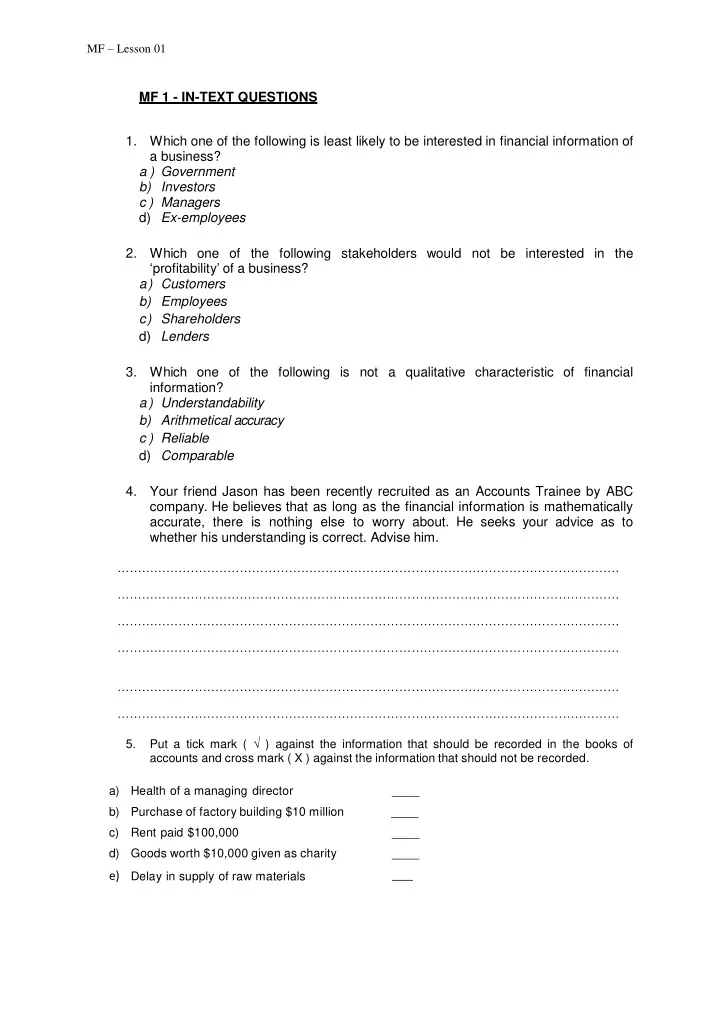
MF Lesson 01 MF 1 - IN-TEXT QUESTIONS 1. Which one of the following is least likely to be interested in financial information of a business? a ) Government b) Investors c ) Managers d) Ex-employees 2. Which one of the following


slide-1
SLIDE 1

MF – Lesson 01

MF 1 - IN-TEXT QUESTIONS

  • 1. Which one of the following is least likely to be interested in financial information of

a business? a ) Government b) Investors c ) Managers d) Ex-employees

  • 2. Which one of the following stakeholders would not be interested in the

‘profitability’ of a business? a) Customers b) Employees c) Shareholders d) Lenders

  • 3. Which one of the following is not a qualitative characteristic of financial

information? a ) Understandability b) Arithmetical accuracy c ) Reliable d) Comparable

  • 4. Your friend Jason has been recently recruited as an Accounts Trainee by ABC
  • company. He believes that as long as the financial information is mathematically

accurate, there is nothing else to worry about. He seeks your advice as to whether his understanding is correct. Advise him.

…………………………………………………………………………………………………………… …………………………………………………………………………………………………………… …………………………………………………………………………………………………………… …………………………………………………………………………………………………………… …………………………………………………………………………………………………………… …………………………………………………………………………………………………………… 5. Put a tick mark ( √ ) against the information that should be recorded in the books of accounts and cross mark ( X ) against the information that should not be recorded. a) Health of a managing director ____ b) Purchase of factory building $10 million ____ c) Rent paid $100,000 ____ d) Goods worth $10,000 given as charity ____

e) Delay in supply of raw materials

slide-2
SLIDE 2

MF – Lesson 01 6. Which of the following statements is incorrect? a) Assets - Capital = Liabilities b) Liabilities + Assets = Capital c) Liabilities + Capital = Assets d) Assets - Liabilities = Capital 7. Which of the following is not an asset? a) Buildings b) Debtors c) Bank overdraft d) Cash balance 8. Which of the following is a liability? a) Motor Vehicles b) Machinery c) Trade Creditors d) Cash at Bank 9. Which of the following is a current asset? a) Buildings b) Machinery c) Inventory d) Vehicles

  • 10. Which of the following is a non-current liability?

a) Creditors b) Long-term loan c) Bank overdraft d) Tax payable

  • 11. Which one of the following statements is true?

a) Income statement shows the financial strength of a company and the balance sheets shows the financial performance of a company. b) Income statement shows the financial position of the company and the balance sheet shows the financial performance of the company. c) Income statement shows the financial performance of the company and the balance sheet shows the financial position of the company. d) Income statement shows the trading strength of the company and the balance sheet shows the trading ability of the company.

  • 12. A business has the following items in it:
  • Owners equity $600,000
  • Total liabilities $1,400,000
  • Assets ?

What is the value of the assets in this business? a) $600,000 b) $800,000 c) $1,400,000 d) $2,000,000 e) None of the above.

  • 13. A business has the following items in it:
  • Land $1,000,000
  • Machinery $20,000
  • Cash $10,000
  • Debt $0
  • Equity ?

What is the value of equity? a) $1,000,000 b) $1,020,000 c) $1,010,000 d) $1,030,000 e) None of the above.

slide-3
SLIDE 3

MF – Lesson 01

  • 14. Briefly explain the ‘book-keeping processes.

……………………………………………………………………………………………………………… ……………………………………………………………………………………………………………… ……………………………………………………………………………………………………………… ……………………………………………………………………………………………………………… ……………………………………………………………………………………………………………… ……………………………………………………………………………………………………………… ………………………………………………………………………………………………………………

  • 15. Briefly explain the following terms and give examples in the context of a garment

manufacturing company. a) Assets …………………………………………………………………………………………………… …………………………………………………………………………………………………… …………………………………………………………………………………………………… b) Non-current assets …………………………………………………………………………………………………… …………………………………………………………………………………………………… c) Liabilities …………………………………………………………………………………………………… …………………………………………………………………………………………………… …………………………………………………………………………………………………… d) Current liabilities …………………………………………………………………………………………………… …………………………………………………………………………………………………… e) Shareholders’ funds …………………………………………………………………………………………………… …………………………………………………………………………………………………… ……………………………………………………………………………………………………