Methods in the Field Oak, Eucalyptus, and Singing Birds Surveys - - PDF document

methods in the field
SMART_READER_LITE
LIVE PREVIEW

Methods in the Field Oak, Eucalyptus, and Singing Birds Surveys - - PDF document

Methods in the Field Oak, Eucalyptus, and Singing Birds Surveys of lots in Fall and Spring of 2003 and Spring of 2004 Walk slowly length of Or the effects of exotic versus native transect (~10 forest cover on abundance, minutes)


slide-1
SLIDE 1

Oak, Eucalyptus, and Singing Birds

Or the effects of exotic versus native forest cover on abundance, composition, diversity, and evenness of avian species

Diana Kiyo Wakimoto, UC Santa Cruz

Purpose of this Study

  • Determine the abundance and species

diversity of birds in both eucalyptus and

  • ak groves
  • Use this information to form a preliminary

assessment of eucalyptus for bird habitat

  • Use results as an impetus for further

population/banding studies

Why use Birds as an Indicator Species?

  • Birds are part of a large, diverse taxonomic
  • rder
  • Easy to count both by ear and by sight
  • Birds are charismatic megafauna= people

are interested in what happens to them

  • Birds are cool!

Microsoft clipart

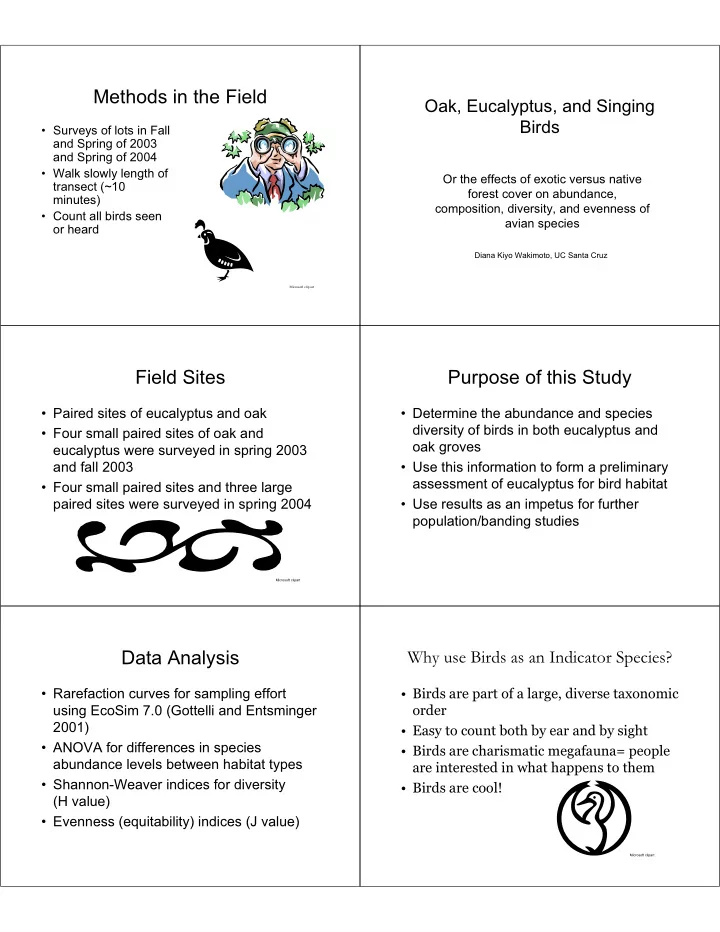
Methods in the Field

  • Surveys of lots in Fall

and Spring of 2003 and Spring of 2004

  • Walk slowly length of

transect (~10 minutes)

  • Count all birds seen
  • r heard

Microsoft clip art

Field Sites

  • Paired sites of eucalyptus and oak
  • Four small paired sites of oak and

eucalyptus were surveyed in spring 2003 and fall 2003

  • Four small paired sites and three large

paired sites were surveyed in spring 2004

Microsoft clipart

Data Analysis

  • Rarefaction curves for sampling effort

using EcoSim 7.0 (Gottelli and Entsminger 2001)

  • ANOVA for differences in species

abundance levels between habitat types

  • Shannon-Weaver indices for diversity

(H value)

  • Evenness (equitability) indices (J value)
slide-2
SLIDE 2

Rarefaction Curve Spring 2004- Small lots

5 10 15 20 25 30 35 1 19 37 49 67 79 97 109 127 144 174 204 234 eucalyptus

  • ak

lower 95% upper 95%

Sampling effort sufficient to determine composition of woodlots

20 40 60 80 100 120 Number of Individuals eucalyptus

  • ak

2.5 5 7.5 10 12.5 15 17.5 20 22.5 Number of Individuals eucalyptus

  • ak

5 10 15 20 25 30 35 40 Number of Species eucalyptus

  • ak

50 100 150 200 250 300 350 400

Number of Individuals

eucalyptus

  • ak

Overall Number of Species Abundance per plot Richness per plot Total Abundance

.5 1 1.5 2 2.5 3

Diversity Index

eucalyptus

  • ak

.1 .2 .3 .4 .5 .6 .7 .8 .9

Evenness Index

eucalyptus

  • ak

Diversity Indices (H) Evenness Indices (J)

None of the overall results are statistically significant (P> 0.05)

Summary Results- Spring 2003

Eucalyptus

Abundance: 430 Richness: 37 species Shannon-Weaver: 2.93 Evenness: 0.812

Oak

Abundance: 473 Richness: 38 species Shannon-Weaver: 3.03 Evenness: 0.831

slide-3
SLIDE 3

Spring 2003- Results of ANOVA

Oak

Song Sparrow Spotted Towhee Bewick’s wren Bushtit

Eucalyptus

European starling Allen’s hummingbird

Microsoft clipart

Summary Results for Fall 2003

Eucalyptus

Abundance: 125 Richness: 22 species Shannon-Weaver: 2.44 Evenness: 0.788

Oak

Abundance: 101 Richness: 18 species Shannon-Weaver: 2.36 Evenness: 0.816

Fall 2003- ANOVA Results

2 4 6 8 10 Abundance eucalyptus

  • ak

Eucalyptus

European Starlings

Microsoft clipart

Summary Results Spring 2004 Small Tracts

Eucalyptus

Abundance- 257 Richness- 32 species Shannon-Weaver- 2.75 Evenness- 0.793

Oak

Abundance- 145 Richness- 22 species Shannon-Weaver- 2.59 Evenness- 0.838

Spring 2004 (small tracts) ANOVA results Eucalyptus

Total abundance Pacific-slope flycatcher European starlings

Microsoft clipart

Summary Results for Large Tracts Spring 2004

Eucalyptus

Abundance: 135 Richness: 23 species Shannon-Weaver: 2.73 Evenness: 0.870

Oak

Abundance: 129 Richness: 26 species Shannon-Weaver: 2.64 Evenness: 0.810

slide-4
SLIDE 4

Spring 2004 (large tracts) ANOVA results Eucalyptus

California quail house finch

Microsoft clipart Microsoft clipart www.gos.org/meetings/ cedw-20010706.jpg www.ktsweb.com/tweeters/ images/Bewicks_Wren.jpg

Bewick’s Wren Cedar Waxwing

Effect of size and woodlot type on abundance per plot

P= 0.0110

10 20 30 40 50 60 70 80

Number of Individuals

large small

Size

  • ak

eucalyptus

Effects of size and woodlot type on Total abundance

50 100 150 200 250 300

Number of Individuals

large small

Size

  • ak

eucalyptus

P= <0.0001

Bewick’s Wren Effects of Woodlot and Season

2 4 6 8 10 12

Number of Individuals

fall spring

Season

  • ak

eucalyptus

P= 0.0273

European Starling Woodlot & Season effects

5 10 15 20 25 30 35

Number of Individuals

fall spring

  • ak

eucalyptus

P= 0.0508 Season

slide-5
SLIDE 5

Species only found in one type of woodlot (not statistically significant but interesting)

  • Found only in eucalyptus: American kestrel,

sharp-shinned hawk, tree swallow, Northern mockingbird, cedar waxwing, red-winged blackbird

  • Found only in oak: red-shouldered hawk,

yellow-rumped warbler, ruby-crowned kinglet, golden-crowned sparrow, house finch

  • Results from pooling all seasons and woodlots

So what do we know from this

  • bservational study?
  • Both oak and eucalyptus are utilized by

many species of birds

  • Abundance values and H values are often

higher in eucalyptus, but oak has higher J values

  • The two woodlot types share many of the

same species, although there are some significant differences

Anecdotal observations about eucalyptus tracts

Big Sur Ornithological Lab reports gumming at the base

  • f the bill on yellow-rumped

warblers PRBO reports catching fewer birds in mist-nets set in eucalyptus than expected by chance alone

Microsoft clipart

Areas for further research

  • Need to do banding and population

studies to determine if the habitats are source/sinks

  • Look at landscape-level dynamics
  • Experimental studies, manipulations

Microsoft clipart

Conclusions

  • Eucalyptus are not dead-zones for birds
  • Eucalyptus have equivalent species

richness, diversity and evenness to oak

  • This study is a starting point

for more research on the topic

  • f eucalyptus effects and

management

Microsoft clipart

Acknowledgements

  • ESNERR for support of this research
  • Kerstin Wasson for being my senior thesis

advisor

  • Dan Doak for help with statistics
  • Susie Fork, Todd Newberry, and Monika

Rohrer for help with fieldwork

Microsoft Clipart

slide-6
SLIDE 6

Microsoft clipart