Methane emissions from the 2015 Aliso Canyon blowout in Los Angeles, - - PowerPoint PPT Presentation

methane emissions from the 2015 aliso canyon blowout in
SMART_READER_LITE
LIVE PREVIEW

Methane emissions from the 2015 Aliso Canyon blowout in Los Angeles, - - PowerPoint PPT Presentation

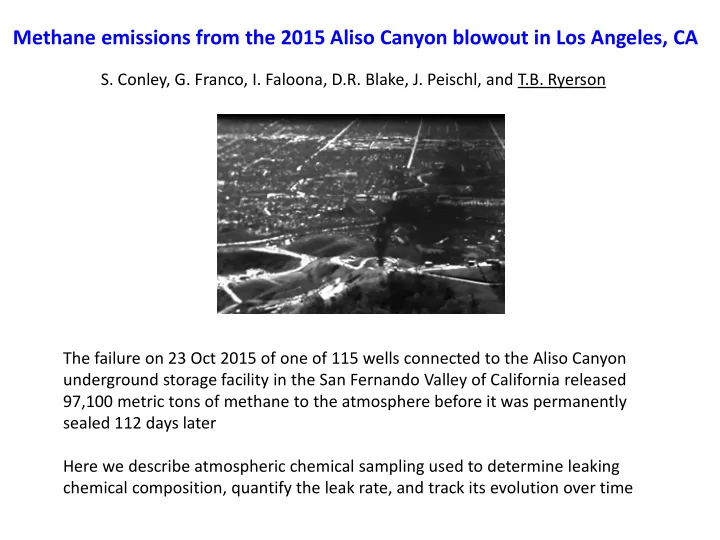
Methane emissions from the 2015 Aliso Canyon blowout in Los Angeles, CA S. Conley, G. Franco, I. Faloona, D.R. Blake, J. Peischl, and T.B. Ryerson The failure on 23 Oct 2015 of one of 115 wells connected to the Aliso Canyon underground storage


slide-1
SLIDE 1

Methane emissions from the 2015 Aliso Canyon blowout in Los Angeles, CA

  • S. Conley, G. Franco, I. Faloona, D.R. Blake, J. Peischl, and T.B. Ryerson

The failure on 23 Oct 2015 of one of 115 wells connected to the Aliso Canyon underground storage facility in the San Fernando Valley of California released 97,100 metric tons of methane to the atmosphere before it was permanently sealed 112 days later Here we describe atmospheric chemical sampling used to determine leaking chemical composition, quantify the leak rate, and track its evolution over time

slide-2
SLIDE 2

Methane emissions from the 2015 Aliso Canyon blowout in Los Angeles, CA

Molar enhancement ratios from UCI WAS canisters taken ~6 weeks apart:

  • define chemical composition of leaking Aliso Canyon gas and oil
  • are consistent with reports of “oily sheens” in affected areas downwind
  • suggest leaking chemical composition was constant over time
  • provide a means to estimate benzene levels from methane observations

Chemical composition from whole-air sampling enhancement ratios relative to methane

slide-3
SLIDE 3

Scientific Aviation Mooney TLS aircraft

Methane emissions from the 2015 Aliso Canyon blowout in Los Angeles, CA

Mass fluxes were calculated from 13 flights for all horizontal crosswind transects downwind of the leak site Two separate instruments measured methane, and one measured ethane, every 30 m along track

slide-4
SLIDE 4

Methane and ethane measured continuously aboard the aircraft

Benzene and odorant calculated from known, or assumed, ERs relative to methane

  • Plume consistent with a single point source

centered on the SS-25 wellpad within ±100m

  • Rules out any substantial contribution from
  • ther local wells or upwind sites
  • Exceptionally restricted airspace access

(terrain, traffic, TFRs…) dictated an agile aircraft with FAA clearance for 60m above ground

  • Repeated transects at 34.295° latitude show

the aircraft captured the full horizontal extent

  • f the point source plume on each flight

10 Nov 2015 flight example

Methane emissions from the 2015 Aliso Canyon blowout in Los Angeles, CA

slide-5
SLIDE 5

Methane emissions from the 2015 Aliso Canyon blowout in Los Angeles, CA

Methane and ethane measured continuously aboard the aircraft

Benzene and odorant calculated from known, or assumed, ERs relative to methane

10 Nov 2015 flight example

wind

North-south topographical cross section at the SS-25 well longitude Aircraft altitude (grey line) scaled by chemical data for CH4 > 3 ppm

  • Repeated transects at 34.295° latitude show the

aircraft captured the full vertical extent of the point source plume on each flight

  • simultaneous NOAA mobile van CH4, CO2, N2O,

CO, and wind vector measurements at the surface directly below the aircraft on 11 January 2016 show negligible concentration gradients below lowest aircraft flight altitude

  • integrating horizontal fluxes in the vertical

provides a direct, accurate measurement of Aliso Canyon gas leak rate, with known uncertainties

slide-6
SLIDE 6

Methane emissions from the 2015 Aliso Canyon blowout in Los Angeles, CA

  • The airborne data show that

97,100 metric tons of methane were released to the atmosphere (only 3% of the total volume!)

  • Derived flow rate is highly

correlated with reservoir pressure, which was monitored continuously by SoCalGas throughout the leak

  • These data provide robust

constraints on flow rate for the majority of the event

  • These data further provide a

“prior” estimate for inverse model studies using ground-based, airborne, or orbital sensors

slide-7
SLIDE 7

Aliso Canyon in perspective

  • Equal to the annually-averaged leak

rate from all other CH4 sources in the Los Angeles Basin combined (Peischl et

al., JGR, 2013)

  • Largest single-point accidental CH4

release in U.S. history

  • Significant on the scale of California

emissions reduction efforts mandated under the Global Warming Solutions Act of 2006 (AB32)

  • “Mitigation of the climate effect” of

Aliso Canyon methane, as promised by SoCalGas, will take a substantial effort

slide-8
SLIDE 8
  • The climate impact of Aliso Canyon

CH4 is dwarfed by routine emissions from oil & gas, agriculture, & landfills

  • The climate impact of CH4 emissions

(aside from its SLCF role) is dwarfed by routine emissions of CO2

  • Avoiding future natural gas blowouts

is good, but their complete absence won’t address any major climate issue

  • ther

landfills coal mining livestock & agriculture energy sector

U.S. EPA inventory data

U.S. total CH4 emissions AR5 radiative forcing

COP21 agreements include specific requirements for the Parties to account for anthropogenic GHG emissions with “accuracy and completeness” Suggests a robust and complementary observational and analysis system is needed to quantify emissions across a breadth of spatial and temporal scales

Aliso Canyon in bigger perspective

slide-9
SLIDE 9

GHG emissions monitoring and attribution requires a continuum of data

Targeted mobile

  • bservations

Point and area source snapshots; incident response

Long-term surface

  • bservations

Area, regional, and global source monitoring Research aircraft NOAA cooperative sampling network Mobile laboratories Megacities Carbon Project

(Los Angeles, CA)

INFLUX

(Indianapolis, IN)

Long-term column

  • bservations

Area, regional, and global source monitoring TCCON NASA OCO-2 JAXA/NIES/MOE GOSAT