Message of the Chairman, Committee on Transportation Re: Meeting - - PDF document

message of the chairman committee on transportation re
SMART_READER_LITE
LIVE PREVIEW

Message of the Chairman, Committee on Transportation Re: Meeting - - PDF document

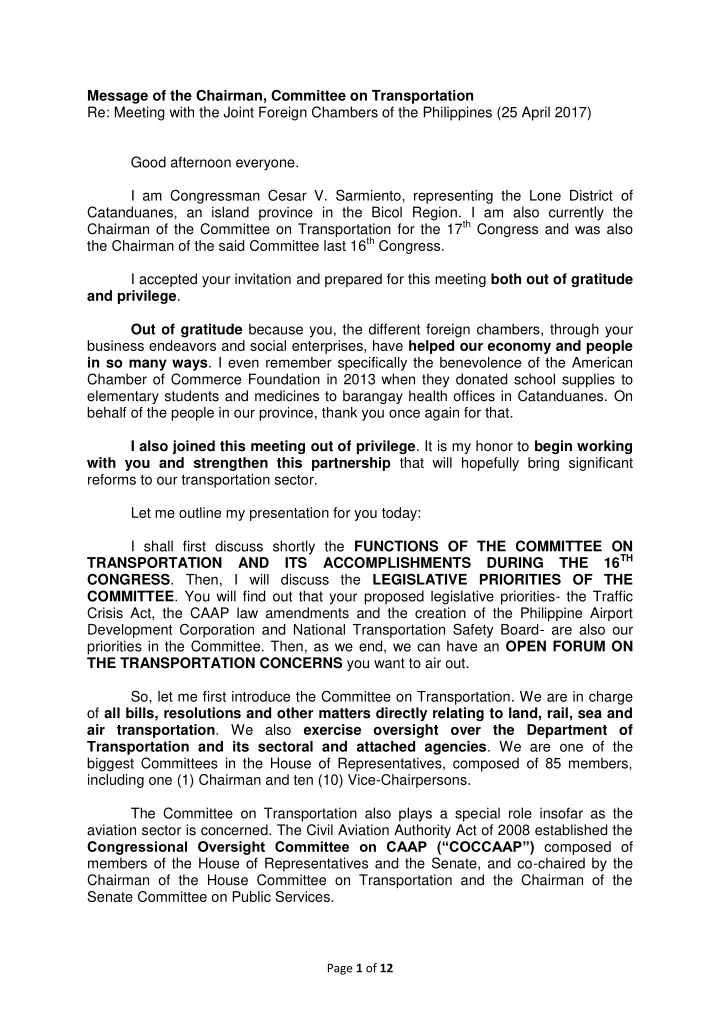
Message of the Chairman, Committee on Transportation Re: Meeting with the Joint Foreign Chambers of the Philippines (25 April 2017) Good afternoon everyone. I am Congressman Cesar V. Sarmiento, representing the Lone District of Catanduanes, an


slide-1
SLIDE 1

Page 1 of 12

Message of the Chairman, Committee on Transportation Re: Meeting with the Joint Foreign Chambers of the Philippines (25 April 2017) Good afternoon everyone. I am Congressman Cesar V. Sarmiento, representing the Lone District of Catanduanes, an island province in the Bicol Region. I am also currently the Chairman of the Committee on Transportation for the 17th Congress and was also the Chairman of the said Committee last 16th Congress. I accepted your invitation and prepared for this meeting both out of gratitude and privilege. Out of gratitude because you, the different foreign chambers, through your business endeavors and social enterprises, have helped our economy and people in so many ways. I even remember specifically the benevolence of the American Chamber of Commerce Foundation in 2013 when they donated school supplies to elementary students and medicines to barangay health offices in Catanduanes. On behalf of the people in our province, thank you once again for that. I also joined this meeting out of privilege. It is my honor to begin working with you and strengthen this partnership that will hopefully bring significant reforms to our transportation sector. Let me outline my presentation for you today: I shall first discuss shortly the FUNCTIONS OF THE COMMITTEE ON TRANSPORTATION AND ITS ACCOMPLISHMENTS DURING THE 16TH

  • CONGRESS. Then, I will discuss the LEGISLATIVE PRIORITIES OF THE
  • COMMITTEE. You will find out that your proposed legislative priorities- the Traffic

Crisis Act, the CAAP law amendments and the creation of the Philippine Airport Development Corporation and National Transportation Safety Board- are also our priorities in the Committee. Then, as we end, we can have an OPEN FORUM ON THE TRANSPORTATION CONCERNS you want to air out. So, let me first introduce the Committee on Transportation. We are in charge

  • f all bills, resolutions and other matters directly relating to land, rail, sea and

air transportation. We also exercise oversight over the Department of Transportation and its sectoral and attached agencies. We are one of the biggest Committees in the House of Representatives, composed of 85 members, including one (1) Chairman and ten (10) Vice-Chairpersons. The Committee on Transportation also plays a special role insofar as the aviation sector is concerned. The Civil Aviation Authority Act of 2008 established the Congressional Oversight Committee on CAAP (“COCCAAP”) composed of members of the House of Representatives and the Senate, and co-chaired by the Chairman of the House Committee on Transportation and the Chairman of the Senate Committee on Public Services.

slide-2
SLIDE 2

Page 2 of 12

The COCCAAP ensures the proper implementation of the charter and programs of CAAP and reviews its collection performance and its use of collected fund. On the legislation aspect of our job, I can say that we were very productive. During the 16th Congress when I first became the Chairman of the Committee, we were able to facilitate the passage of six (6) major laws: 1) Republic Act No. 10635 (MARINA Single Maritime Administration Law); 2) Republic Act No. 10638 (Charter Extension of the Philippine National Railways); 3) Republic Act No. 10666 (Children on Motorcycle Safety Act); 4) Republic Act No. 10668 (Co-Loading Act); 5) Republic Act No. 10913 (Anti-Distracted Driving Act); and 6) Republic Act No. 10916 (Road Speed Limiter Act). During the end of the 16th Congress, the Committee also launched the first- ever Transportation Policy Framework entitled, “Larga Pinas” with the intention

  • f guiding the future Committee on Transportation and future transport officials. The

book details: 1) The accomplishments of the Committee during the 16th Congress through our law-making and oversight functions; 2) The issues

  • bserved

by the Committee in all modes

  • f

transportation- land, rail, maritime and aviation; and 3) The Committee’s policy recommendations to address these issues. Based on the lessons that it had gained, the Committee on Transportation has come up with the ideal transport system which can be described in four (4) key words- sustainable, organized, predictable and safe or “SOPS.” The motivation to establish a SOPS transport system in the Philippines guides all or our actions and priorities in the Committee on Transportation.

  • ---PAUSE---

At the end of this meeting as well, we also plan to give each one of you a copy of our Larga Pinas book. We will surely make a second or updated version of this before the 17th Congress ends.

slide-3
SLIDE 3

Page 3 of 12

Let me now go to the meat of our discussion- the Committee’s legislative priorities. Committee’s legislative priorities for the 17th Congress Let me start with the Traffic Crisis Act. For you to appreciate this bill and better understand how the Committee approaches the issue on land transportation in general or what is going on in our minds, allow me to first share to you what we found out as “An Inconvenient Truth“ in our transportation sector. What is the inconvenient truth? The “inconvenient truth” is that the Philippine transport system, rather than focusing on doing what it ought to do- which is to move people and goods- is being maintained and operated in a particular manner and to a great extent, to sustain the livelihood of people. Taking it further, it appears that the land transport system is designed not with the prime objective of transporting but to be a palliative solution to poverty. For example: Our land transport system does not prioritize sustainable mass transit which leaves less carbon footprint but instead maintains outdated and inefficient forms of transport which can only carry a few passengers so that the

  • perators and drivers get to keep their jobs. Our land transport system does not also

seek to determine the optimal number of public vehicles on the road but encourages new forms of transport so that more people would have livelihood but at the expense

  • f congesting our roads.

It must be stressed that this observation does not seek to discredit the role of the transport system as a source of livelihood. After all, operating a public transport vehicle or being a driver is a noble profession and the transport system presents various opportunities. Instead, the Committee has come to this conclusion to put things in perspective and to finally expressly state this painful truth which we should at least try to address if we are serious in solving the chaos we are in. And the Committee will try to correct the status quo through HOUSE BILL 4334 OR THE TRAFFIC CRISIS ACT. MAKIISA. MAKISAMA. MAGKAISA (loosely translate is ACT AS ONE, COOPERATE and UNIFY). This bill was crafted with the end view of providing an urgent, immediate, and comprehensive response to the traffic crisis, primarily by harmonizing

  • verlapping and conflicting laws such as the Local Government Code and the

respective charters of the transportation agencies. This measure seeks to simply use the plenary powers of Congress to enact a responsive law on the traffic crisis. Addressing the traffic crisis would entail a lot of changes and sacrifices; hence, the phrase “Makiisa. Makisama. Magkaisa.” which is a call to all- including the Joint Foreign Chambers- to collectively set aside personal interests for the sake

  • f the general welfare of the people and economy.
slide-4
SLIDE 4

Page 4 of 12

Let me run you through some key provisions: a) Coverage & Duration. The Traffic Crisis Act is limited to the land traffic congestion and gridlock in Metropolitan Manila, Metropolitan Cebu and Davao City. In our 12 hearings, we found out that there is a traffic crisis on our roads but not in our ports and airports. The existing mandates

  • f our maritime and aviation agencies can already address capacity issues

in our ports and airports. While focus is given to the three major metropolitan areas, similar systems and mechanisms, however, may also be implemented in other cities and municipalities which are suffering from a land traffic crisis. For the duration, the law will be in effect for three (3) years unless sooner withdrawn by Congress. But to make further reforms or to prevent a future traffic crisis, the provisions covering reorganization, harmonized or unified traffic laws, route rationalization and preparation and updating of the Traffic Management Plan shall have continuous application. b) Traffic Chief. The Secretary of Transportation is designated as the de

  • fficio Traffic Chief who shall have power of control and supervision over

land transportation agencies including the MMDA, the Cebu Council headed by a Cebu Coordinator who is an alter ego of the Traffic Chief, and the Davao Administrator. The MMDA, Cebu Council and Davao Administrator, with the approval of the Traffic Chief, shall set policies as the sole, centralized authority for land-based traffic in their respective areas. c) Traffic Management Plan. The Traffic Chief shall, in consultation with the MMDA, Cebu Council or Davao Administrator, and the affected private stakeholders, formulate a separate Traffic Management Plan or TMP for each of the Metropolitan Areas. The TMP must sufficiently detail the concrete steps to be taken to immediately and effectively alleviate the traffic crisis in a measurable/quantifiable manner, including eighteen (18) minimum components such as the organizational structure of covered agencies, route rationalization, establishment of friendship routes, promotion of sustainable transport, traffic flow and volume reduction schemes, clearing of sidewalks, development of Clark, designation of PUV terminals, etc. d) Route Rationalization & Support Mechanism. As a direct answer to the inconvenient truth we have earlier stated, we have provided for in the bill the route rationalization of PUVs to determine the size, type, and number of PUVs appropriate to a particular route's measured capacity.

slide-5
SLIDE 5

Page 5 of 12

The rationalization of routes will pave the way for the appropriate type and

  • ptimal number of mass transport vehicles in every area or route. But it will

also have serious consequences. The Committee on Transportation is the first in recognizing that there is a crisis within the traffic crisis- the “displacement crisis.” This pertains to the drivers and employees of PUVs who will be displaced because of traffic-related measures. In the event of such massive loss of employment of our transport workers, we have provided for a support mechanism or assistance such as Conditional Cash Transfer, Separation pay for those who will be displaced, training courses by TESDA for those affected employees, coordination between DOLE and POEA for active job search here or abroad, scholarship for legal dependents of affected employees and compensation equivalent to three (3) months for those affected. PUV operators whose franchise is revoked, shortened or reduced shall be compensated and may avail of the financial assistance from the Development Bank of the Philippines to enable them to modernize their units. e) Quality of Drivers and Vehicles. Since the usual congestion and accidents we have in our roads are caused by unskilled drivers and unsafe vehicles, we also provided solutions to these fundamental issues in the bill. Under the bill, all professional drivers of PUVs shall undergo testing and examination starting January 1, 2018. The test will be specifically designed to the type of vehicle the driver intends to operate. Only the drivers who pass the new test will be given a new professional driver’s license. On the other hand, to ensure the roadworthiness of our vehicles, we provided for the LTO to conduct roadworthiness testing of all PUVs within 90 days from the effectivity of the bill. The LTO shall work with established vehicle manufacturers to determine and conduct the appropriate roadworthiness test. f) Development Clearance. The Traffic Chief is also empowered to pass upon and approve or disapprove all plans, programs, and projects proposed by local government units, government offices/agencies within the Metropolitan Areas, the DPWH, public corporations, and private persons or enterprises. This is with the end goal of ensuring compliance to the Traffic Impact Plan and the requirements of the National Building Code and of preventing adverse effects to the traffic flow in the metropolitan areas. Such approval by the Traffic Chief shall take the form of a Development Permit that shall be issued prior to any land development and shall be in lieu of all other permits such as those issued by the MMDA and LGUs,

slide-6
SLIDE 6

Page 6 of 12

except the Environmental Compliance Certificate issued by the Department of Environment and Natural Resources/Environmental Management Bureau.. Before I go any further, let me emphasize that what I shared so far to you may not cost the government a single centavo, except of course the support mechanism for displaced transport workers. More importantly, the simple or easily-implementable solutions such as harmonizing conflicting laws by creating a centralized land-based traffic authority, the formulation of concrete steps under the Traffic Management Plan, the rationalization

  • f our PUV routes, ensuring the skills of our drivers and roadworthiness of our

vehicles and streamlining the clearance or permit process will have immediate and far-reaching implications in our transportation sector even without the big- ticket transportation projects which usually take years to complete. The last key provision is precisely about that- how do we deal now with the priority projects. g) Priority Projects. Under the bill, the traffic crisis is declared and recognized as an emergency case, thereby expanding the coverage of Emergency Case, as defined in Section 53 of Republic Act No. 9184 or the Government Procurement Reform Act and Section 53.2 of its Implementing Rules and Regulations. As a result, the President, through the Traffic Chief, is now authorized, during the effective period of the Traffic Crisis Act and without prejudice to the use of other available procurement methods under RA 9184, to enter into negotiated contracts for Priority Projects. Such authority, however, is subject to the following requirements and conditions:

  • The Priority Projects must be aimed at immediately and effectively

alleviating the Traffic Crisis, thereby promoting public interest;

  • The terms and conditions of the Priority Projects must be advantageous

to the Government; and

  • The Traffic Chief must submit a list of Priority Projects to the Joint

Congressional Oversight Committee together with their respective description, the budgetary estimates, identification of necessary ROWs, and other salient features, within ninety (90) days from the effective date

  • f the Traffic Crisis Act.

Please take note. This particular process is provided in the bill since, to date, the DOTr, despite demands, has yet to present to the Committee on Transportation or to the House of Representatives a list of projects that will immediately address the traffic crisis.

slide-7
SLIDE 7

Page 7 of 12

We do not have a monopoly of great ideas but this is our idea. This idea is a result of the hearings, ocular inspections, analysis and coordination we had. This is what we think this country needs right now. House Bill 4334 had been approved by the Committee on Transportation and is currently pending with the Committee on Appropriations for their comments on the budget provision for the Priority Projects. We have already requested the Committee

  • n Appropriations to conduct a Joint hearing in May 2017 so that we can pass the

Traffic Crisis Act as soon as possible.

  • --PAUSE---

Now let us go to the two bills relative to our aviation sector. First is the CAAP CHARTER AMENDMENTS. The Civil Aviation Authority of the Philippines or CAAP was created in 2008 by virtue of Republic Act No. 9497 with the task of promoting, developing and regulating the civil aviation system. It was a response, among others, to the downgrading of the Philippines by the US Federal Aviation Authority (FAA) to Category 2 safety status. With the reforms implemented by CAAP, the International Civil Aviation Authority (ICAO) delisted the Philippines in February 2013 from its list of states with unresolved safety issues. Subsequently, in July of the same year, the European Union also lifted its ban on Philippine carriers. Finally, in April 2014, the Category 1 safety rating of the US FAA was regained. Notwithstanding the foregoing gains, we will be filing this bill to further address the still perceived deficiencies in the regulation, supervision, and management of the Philippine civil aviation industry and to strengthen CAAP as the country’s designated civil aviation authority. As COCCAAP, we see the need to sustain, not just the gains we achieved, but primarily the institution we have and correct the current systems that compromise the independence of CAAP. For instance, because of the irregularities and efficiencies committed by government corporations in general, the Governance Commission for GOCCs was created in 2011. But this setup effectively undermined the fiscal independence envisioned for CAAP in its original charter. The following are the key provisions of the bill on CAAP Charter Amendments: a) Removal of the airport operations function from CAAP to a separate Government Corporation. Once the airport operation function is removed from CAAP and transferred to another corporation (i.e. the Philippine Airport Development Corporation), CAAP can now concentrate its resources on its regulatory functions to ensure that the Philippine civil aviation shall attain the highest level of security and safety. This is consistent with the Standards and Recommended Practices set by the ICAO, US FAA and European Union.

slide-8
SLIDE 8

Page 8 of 12

b) Transfer of the Civil Aeronautics Board (CAB) to CAAP. This is intended to streamline and consolidate the functions of the two agencies making CAAP the sole aviation authority responsible for implementing policies on civil aviation in order to ensure safe, economical, and efficient air travel. This will improve the business processes such as issuance of permits or submission of reports requiring the involvement of both CAB and CAAP considering the improved interaction brought about by the integration. c) Transfer of the Aircraft Accident Investigation and Inquiry Board. The determination of cause for aviation accidents is normally entrusted to a government agency different from the Civil Aviation Authority. This is the usual global practice. Combining analysis for probable cause with safety regulation and enforcement within the same governmental organization results to a conflict of interest. Hence, this present function of CAAP will be transferred either to the Department of Transportation or a specific body to be created for investigation purposes such as the National Transportation Safety Board. d) Enhanced independence or autonomy. The bill on CAAP law amendments aims to achieve this through:

  • Enhanced fiscal autonomy intended to minimize difficulties in

securing prompt concurrence

  • f

budget allocations and expenditures.

  • Restoration of term of the Director General (DG) to four years.

Restoring the DG’s term of office to 4 years as provided for in the CAAP law is consistent with the intent to insulate the agency from the constantly changing political climate in the Executive Department. The mandate to cause the restructuring of the civil aviation system, the promotion, development and regulation of the technical, operational, safety, and aviation security functions can hardly be realized under a DG who has no security of tenure.

  • Inclusion of private sector appointees. The private sector appointees

will serve to give the Board the sufficient point of view needed to formulate policies, craft rules and implement regulations, as far as the private carriers and operators are concerned. This is likewise in response to the call for CAAP to consult closely with the private sector.

  • Exemption of CAAP from the Salary Standardization Law (SSL).

The qualifications and functions performed by CAAP directors, officers, and employees especially, the Air Traffic Controllers, are highly technical in nature and different from the qualifications and functions of

  • ther “government employees.” However, Filipino aviation professionals

are lured to work abroad with the prospect of higher. This leaves us with a shortage of aviation professionals. With this exemption from the SSL, Filipino aviation professionals and aviation safety professionals may get

slide-9
SLIDE 9

Page 9 of 12

higher pay and will be encouraged to stay and work here in the Philippines. Another important legislation that should be passed alongside the CAAP Charter Amendments is the creation of the PHILIPPINE AIRPORT DEVELOPMENT CORPORATION or PADC. We will be filing this bill in line with the current Administration’s thrust to streamline government services and, as earlier stated, to enable CAAP to focus on its regulatory functions. Our draft bill aims to create the PADC as the sole entity which will undertake all manner of business and development projects for the establishment of a reliable and more efficient airport industry, especially for the construction, maintenance and operation of airports all over the country. To allow it to exercise its functions effectively, it is necessary to abolish the Manila International Airport Authority, the Mactan-Cebu International Airport Authority and the Clark International Airport Corporation. But this is done without prejudice to any concession rights already granted. The following are the key provisions. a) All existing public airport facilities including all equipment which are necessary for the operation of air navigation, shall be transferred to the Corporation. However, the operational control of all equipment necessary for the

  • peration of radio, aids to air navigation, airways communication,

approach control office, and area control center, shall be retained by the CAAP. b) The powers of the Corporation shall be exercised by and vested in a Board of Directors composed of a Chairperson, a Vice-Chairperson and nine (9) members. c) The Corporation shall have fiscal autonomy. d) The Philippine Airport Development Corporation’s Fund is established, which shall be drawn against:

  • All revenues from the aeronautical and allied services operated or

rendered by the Corporation;

  • Such sums as may be remitted by foreign entities;
  • Proceeds from sales of assets;
  • Interests which may be earned on investments or on idle cash by

the Corporation; and

slide-10
SLIDE 10

Page 10 of 12

  • Drawings upon the capital surplus of the Corporation.

e) An Airport Security Service is also created to ensure the protection and safety against acts of unlawful interference perpetrated on the ground. Hence, the security function of screening passengers, baggage and cargo, and training and employment of security screening personnel of the Office for Transportation Security will be transferred to the Airport Security Service. With these two (2) bills on aviation- CAAP Charter Amendments and Philippine Airport Development Corporation, there will surely be a lot of direct and indirect positive changes in our aviation sector in the near future.

  • --PAUSE---

Lastly, we have the bills creating the NATIONAL TRANSPORTATION SAFETY BOARD/PHILIPPINE TRANSPORTATION SAFETY BOARD (i.e. House Bill 190, 1725, 2731, 3116 and 5042). These bills aim to create a National Transportation Safety Board which will be an independent and impartial body with the following primary functions: a) Conduct of thorough and unbiased investigations of transportation accidents; and b) Issuance of safety recommendations to ensure implementation of safety standards by or to encourage a “safety consciousness” among regulatory agencies and public utilities. The creation of such separate body will remove any existing bias or conflict of interest in a situation where the regulators, which may have been negligent in the performance of their duties, are the ones conducting the investigations of accidents. The common provisions among the five bills include the following: a) The National Transportation Safety Board shall be attached to the Office of the President and composed of five (5) full-time members, including a Chairman and Vice-Chairman. (Note: One bill, HB 3116 provides that there will be 7 members.) b) The members of the Board shall have extensive training and experience in the respective fields of land, rail, maritime and air transportation and must have adequate knowledge in investigation, analysis and evaluation of transportation accidents, particularly in the field

  • f

accident reconstruction, safety engineering

  • r

transportation safety.

slide-11
SLIDE 11

Page 11 of 12

c) The Board shall have an Executive Director and shall establish and maintain staffed bureaus or offices to investigate and report accidents in the different modes of transportation, including pipeline systems. d) No part of any investigation of the Board shall be admitted as evidence or used in any suit or action for damages. Moreover, the Board shall have immunity from suits arising from its investigation, pronouncements and findings. What is now the status of this bill? These five bills are pending with the Committee on Government Reorganization. The Committee on Transportation presently only has secondary jurisdiction. Hence, it cannot take the lead in the conduct of Committee hearings. So we recently requested a change in the referral of the bill so that the Committee on Transportation can already take it up come in May 2017. The creation of this body is very timely in view of recent accidents such as the LeoMarick Trans Bus accident in Nueva Ecija, killing at least 34 people. We cannot and should not wait anymore to waste more innocent lives. Shortly, before I end, I just want to share that the Committee on Transportation also has other legislative priorities like: a) Creation of the Philippine Ports Development Corporation. b) Institutionalization of the Air Passenger Bill of Rights. c) Promotion of Sustainable Transport (Promotion of Walking and Bicycle Use and Establishment of Bikeways and Walkways); and d) Mandating the Use of Child Restraints/Child Car Seats in Vehicles. On other hand, relative to our implementation of reforms through our oversight functions, the Committee is prioritizing the monitoring and supervision of the following concerns, among others: a) Utilization of Clark and Sangley; b) Promotion of Road Safety; and c) Development of RORO System. I hope that I was able to report clearly on these legislative priorities of the House Committee on Transportation. Again, it will be an honor if we could work together to facilitate the passage and efficient implementation of these bills. One final note, if you may: Let me just state that being on my third and last term now as a Congressman and as Chairman of the Committee on Transportation, I have all the more the resolve to do everything to leave behind legacies in our transportation sector.

slide-12
SLIDE 12

Page 12 of 12

I am therefore one with you in really effecting change in our day-to-day transportation experience. Thank you.