Message from by the election of a very talented, energetic - - PDF document

message from
SMART_READER_LITE
LIVE PREVIEW

Message from by the election of a very talented, energetic - - PDF document

www.tegova.org July 2014 Journal of the Recognised European Valuer Issue No. 8 TEGoVA General Assembly Elects New Chairman and Board 2 300 Recognised European Valuers Raise Status of Valuation Profession Work commenced on European


slide-1
SLIDE 1

TEGoVA's Spring Assembly in Oslo on 16th May broke all previous records with 80 delegates in attendance from 26 countries The main business of the event, hosted by the Norwegian Valuers and Surveyors Association (NTF) was voting for a new TEGoVA Board for the next 3 years. The result was the election

  • f new Chairman Krzysztof

Grzesik, of the Polish Federation of Valuers' Associations who declared his priority to be assisting governments in developing reliable national valuation standards for mortgage lending based on European Valuation Standards (EVS) as specifjed by the EU Mortgage Credit Directive and favoured by the European Central Bank. The other members elected to the TEGoVA Board were Silvia Cappelli (ASSOVIB – Association of Property Valuation Companies for the Banking Sector; Italy), Jean-François Drouets (AFREXIM – French Association of Property Valuation Companies), Wolfgang Kälberer (vdp – Association of German Pfandbrief Banks), Danijela Ilić (NAVS – National Association of Valuers of Serbia), Roger Messenger (IRRV – Institute of Revenues Rating and Valuation; UK) Konstantinos Pallis (AVAG – Association of Greek Valuers) and Adrian Vascu (ANEVAR – National Association

  • f Romanian Valuers).

Of note also was the launch of a timely Information Paper on "Valuation Certainty and Market Risk" and the announcement by John Hockey, Chairman of the European Standards Board, of work having commenced

  • n the next edition of European Valuation

Standards to be launched in Brussels in May

  • 2016. The TEGoVA Chairman also awarded

certifjcates to 300 new Recognised European Valuers taking the total to over 2 300 in 14 countries. •

TEGoVA General Assembly Elects New Chairman and Board – 2 300 Recognised European Valuers Raise Status of Valuation Profession – Work commenced on European Valuation Standards 2016

www.tegova.org July 2014 Issue No. 8

Journal of the Recognised European Valuer

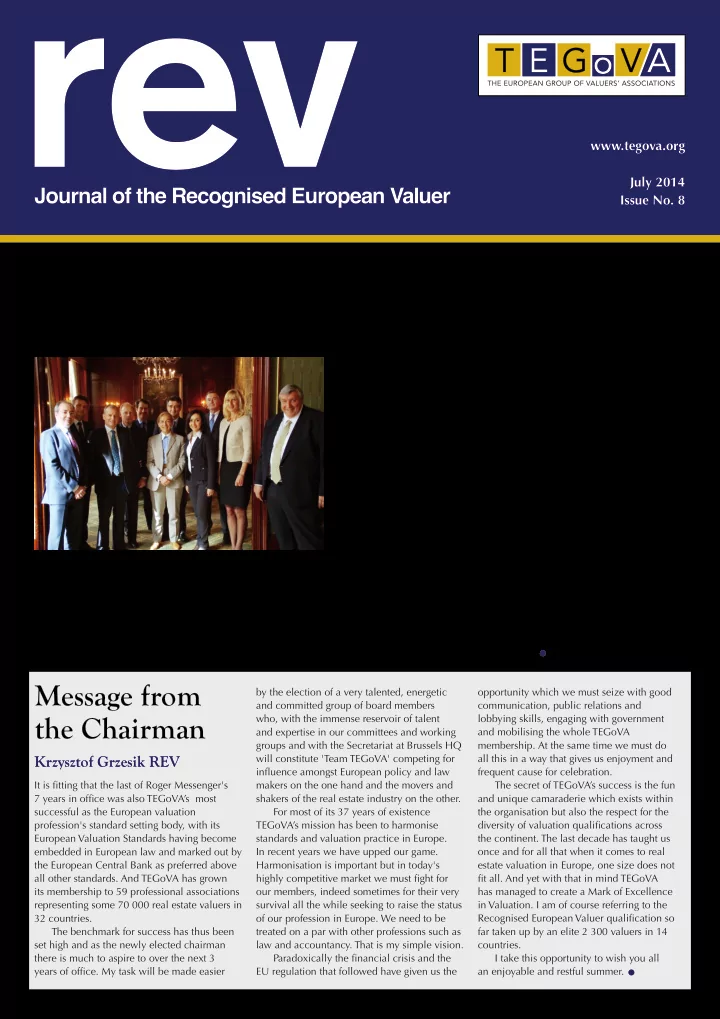
New TEGoVA Board and Secretariat: From left to right: Konstantinos Pallis, Adrian Vascu (Treasurer), Krzysztof Grzesik (Chairman), Michael MacBrien, Jean-François Drouets, Gabriela Cuper, François Isnard (Managing Director), Sillvia Cappelli, Wofgang Kälberer, Danijela Ilić, Roger Messenger (Vice Chairman)

Message from the Chairman

Krzysztof Grzesik REV

It is fjtting that the last of Roger Messenger's 7 years in offjce was also TEGoVA’s most successful as the European valuation profession's standard setting body, with its European Valuation Standards having become embedded in European law and marked out by the European Central Bank as preferred above all other standards. And TEGoVA has grown its membership to 59 professional associations representing some 70 000 real estate valuers in 32 countries. The benchmark for success has thus been set high and as the newly elected chairman there is much to aspire to over the next 3 years of offjce. My task will be made easier by the election of a very talented, energetic and committed group of board members who, with the immense reservoir of talent and expertise in our committees and working groups and with the Secretariat at Brussels HQ will constitute 'Team TEGoVA' competing for infmuence amongst European policy and law makers on the one hand and the movers and shakers of the real estate industry on the other. For most of its 37 years of existence TEGoVA’s mission has been to harmonise standards and valuation practice in Europe. In recent years we have upped our game. Harmonisation is important but in today's highly competitive market we must fjght for

  • ur members, indeed sometimes for their very

survival all the while seeking to raise the status

  • f our profession in Europe. We need to be

treated on a par with other professions such as law and accountancy. That is my simple vision. Paradoxically the fjnancial crisis and the EU regulation that followed have given us the

  • pportunity which we must seize with good

communication, public relations and lobbying skills, engaging with government and mobilising the whole TEGoVA

  • membership. At the same time we must do

all this in a way that gives us enjoyment and frequent cause for celebration. The secret of TEGoVA’s success is the fun and unique camaraderie which exists within the organisation but also the respect for the diversity of valuation qualifjcations across the continent. The last decade has taught us

  • nce and for all that when it comes to real

estate valuation in Europe, one size does not fjt all. And yet with that in mind TEGoVA has managed to create a Mark of Excellence in Valuation. I am of course referring to the Recognised European Valuer qualifjcation so far taken up by an elite 2 300 valuers in 14 countries. I take this opportunity to wish you all an enjoyable and restful summer. •

slide-2
SLIDE 2

The title conjures up a military operation: people, screens, communication, movement,

  • decision. That’s not inappropriate for ‘Team

TEGoVA’. Here in Brussels in our period headquarters building TEGoVA energy fmows in and out. It fmows in from TEGoVA’s 59 member associations and its Board, committees and working groups, 2 300 REVs, EU and national property press, EU think tanks, EU construction and property lobbies, the European Central Bank and the European Banking Authority, the European Commission and Members of the European Parliament, their assistants and staff, members of The Committee

  • f the Regions, of the European Economic and

Social Committee, and ministries from national governments in Europe and beyond, and from academia and research institutes all over the world. The energy fmows back out to all these people and groups, mostly via circuits connecting them with TEGoVA’s Board, experts and members. Like a War Room, to the

  • utsider it seems chaotic, but it’s simply the

highly organised instrument by which TEGoVA pursues its basic purpose: to be Europe’s standard and qualifjcation setter, to irrigate EU policy with valuation experience and to help the EU service the valuation profession. It’s a purpose and now a very real duty because success has made TEGoVA the European reference for valuation. The Secretariat helps design TEGoVA policy, develops strategies for its delivery and is the main interface with the EU authorities. The immense strength of TEGoVA is that decisions

  • n TEGoVA policy are not restricted to a few;

all members who want to, can be involved. Making that involvement a real possibility is a key part of what we do, managing the workfmow, including developing with IT experts, and then using, the increasingly sophisticated software needed to service 2 300 REVs. TEGoVA Meetings and conferences have become mass events with ever increasing attendance and impact. The key is the collaboration between the Secretariat and the organising member associations, from the earliest discussions long before the event to the programme templated and micromanaged by us, to the follow-through and quality control as the event actually takes place. We respond to the individual questions and concerns, problems and needs of TEGoVA’s 59 members and their members. As the organisation grows, it is important that all members know that they have direct access to TEGoVA and will get a prompt response. We are the link between all those different kinds of people who together take TEGoVA forward: the outside interests, the service providers, the Board and the many other members who give generously of their time. •

From the Operations Room

By François Isnard, Managing Director, TEGoVA

John Hockey, Chairman EVSB

Valuation Certainty and Market Risk

By John Hockey REV, Chairman European Valuation Standards Board

“Where the market for the property being valued is affected by uncertainty and this is relevant to the valuation, the valuer should proceed with caution and comment on the issue to the client.” EVS5 As valuers we understand that uncertainty might arise from market circumstances, lack

  • f evidence, defjciencies in the valuation or

differences in professional opinion. We need to understand how valuers and clients can work together more effectively to improve valuation certainty by offering a qualitative view of market risk to the value of property. To assist a proper understanding of the prevailing issues, the European Valuation Standards Board (EVSB) has recently published an Information Paper (IP3) – Valuation Certainty and Market Risk – a Review. The paper provides an in-depth examination of the market risks and the challenges for those acting in the market place and includes examples of lessons learnt from the fjnancial crisis. A valuation that complies with the requirements of EVS will be soundly based, thoroughly prepared and reveal relevant issues of judgment on which opinions may legitimately differ. The security of the valuation depends on the valuer’s application

  • f professional skills to clear instructions and

good evidence, acting in accordance with

  • EVS. The better the evidence and the more

professional the appraisal, the more secure the valuation should be. The potential certainty

  • f a valuation is challenged where markets

are non-existent, dormant, thin or volatile. In such circumstances valuations are best accompanied by descriptive commentary on the issues to assist the client’s understanding

  • f the fjgure given or perhaps some form of

sensitivity analysis. At its most basic, a valuation report is a transfer of risk in the market place. Someone wanting to take a decision over a property wishes to do so with a clearer view as to its

  • value. Clarity will enable determination of the

extent or scale of the risk that can properly be transferred between the client and the

  • valuer. That calls for understanding about the

role of each party and agreement as to the expectations each has of the other so that there is a mutual and positive understanding between them. It is important that the valuer understand the interests, needs and concerns

  • f the client and that the client understand

how best to use the valuer. That calls for a relationship between them in which each is

  • pen with the other. The valuer may need

to help the client to be explicit as to what is reasonably required and to what purpose the report will be put – that helps frame the

  • instruction. The valuer, possibly aware of key

matters not mentioned by the client, has to be sensitive to this and, as necessary, seek clarifjcation to ensure that a professional and useful service is provided. The professional valuer brings his skill, experience and objectivity to the instruction and accepts responsibility for it. It is for the client to decide how to act on the valuation – for example, whether or not to lend, purchase

  • r sell, and, if lending, on what loan to value

ratio, for what term and on what conditions. Where the client is, for example, a professional investor or a lending institution it seems proper to expect that they have their own risk management procedures. However, the valuer may be able to advise on any potential uncertainty as to the valuation and the reasons for that, and also, as an informed observer

  • f the market, offer a description of possible

future risks. This service may offer additional value to the client in its decision making

  • n the basis that such views are essentially

speculative judgments of the unknown. EVS3 requires the valuer to show professional skill, knowledge and competence appropriate to the type and scale of valuation and must disclose any factor which could compromise an objective assessment. The more signifjcant the issues, the more the report should cover the valuer’s methodology, the approach(es) taken to the valuation, the discussion and weighting of arguments. Such a report is an explanation of the valuer’s thought

  • processes. It may be helpful to consider the

European Mortgage Federation’s risk criteria reproduced in Part 3 of EVS 2012, which can at least alert the client or lender to particular points. The latest date that the valuer can report the market value is the date the valuation is

  • signed. Knowledge of the future is beyond his
slide-3
SLIDE 3

professional skills. The valuer can provide a commentary giving a context for that value but, in doing so can only comment usefully

  • n relevant current market conditions. That

commentary may convey some sense of the contemporary understanding of the state of the economic cycle or other economic trends bearing on the position of the property in the market. Where useful, the report might consider the sensitivity of the valuation to identifjed reasonable changes in the market or other

  • conditions. That could be by testing the

assumptions on which the valuation depends. For example, what might be the position should demand markedly reduce or increase? In what circumstances might it be impossible to sell the property? This appraisal is likely to be better expressed descriptively with a qualitative view rather than attempting to quantify the risks in question. The complex and interactive nature of real property markets suggests that a simple quantitative assessment is unlikely to be illuminating – and so more likely to be misleading. Perhaps especially where there are concerns about shorter term market risk, a client might extend the terms of engagement enabling an additional opinion

  • n the basis of a specifjc assumption about

market conditions. Nonetheless, the valuer’s conclusion will be his professional opinion as to the value at the date in question expressed as a single value. It is then for the client to use both the opinion and the advisory report in its risk management decisions, which are its commercial

  • judgments. The valuer cannot serve as an

expert witness on the future and so cannot be expected to accept any liability for views expressed about future trends if these views are not borne out by subsequent events. The Information Paper – IP3 – Valuation Certainty and Market Risk – a Review can be downloaded from the EVS section of the TEGoVA website – www.tegova.org. • The announcement by TEGoVA of its intention to publish an updated edition of European Valuation Standards in 2016 reminds me of the time when I represented the Polish Federation of Valuers’ Associations at a TEGoVoFA meeting in Dublin some 20 years ago. We then also deliberated on updating European Valuation Standards and I wonder whether we should not revisit the standards of that time to gain inspiration for the future. A case in point concerns the section

  • n depreciated replacement cost (DRC).

EVS 2012, EVS 2 paragraph 9.2 defjnes DRC as “… the current cost of replacing an existing asset with a notional equivalent asset making appropriate adjustments for physical, functional and technical obsolescence”. Paragraph 9.3.2 states that “… it is generally regarded as an approach to valuation leading to market value” Whist the standards do caution that this is not a “safe proposition” this has only added to the confusion. Is depreciated replacement cost a stand alone basis of value or is it as suggested by the standards merely another method of arriving at market value? It would appear that in this respect the standards are guilty of creating an

  • xymoron.

Surely if there is no market data it is logical to assume that you cannot determine the market value. Whilst indeed the replacement value could be used as a substitute for market value if the law and the situation allows for it, such basis cannot be mistaken for market

  • value. An analysis of the history of economic

thought on the theory of value and price points clearly to two basic categories of value namely market value and replacement cost. In this connection I would recommend a return to the

  • riginal "Guidelines for the valuation of fjxed

assets" published by TEGoVA’s predecessor TEGoVoFA in 1988. Paragraph 1 titled “Basis of valuation – land and buildings” states “There are two recognised bases for valuation of land and buildings, namely: market value and replacement cost” The guidelines further cautioned against adopting any other bases

  • f measurement besides the market value

and replacement cost. Whilst on the question of bases of value

  • ther than market value I believe that it is a

mistake to identify such types of value having regard to the purpose of valuation. There are many valuation purposes and it is not appropriate every time to seek a particular type of value having regard to that purpose. These so called non market values are not mutually exclusive. For example, market value is used to determine mortgage lending value and the replacement cost to determine the insurance value. •

Back to the Future! The Nature of Depreciated Replacement Cost and Valuation Bases Other than Market Value

By Professor Mieczysław Prystupa, Warsaw University of Technology

Professor Mieczysław Prystupa

Spotlight on AFREXIM

By Jean-Francois Drouets REV, President of AFREXIM, New TEGoVA Board Member

The French Association of Property Valuation Companies (AFREXIM), was founded in 1995. The 10 members of AFREXIM engage

  • ver 300 individual experts. The fjrms are

amongst the top real estate valuation fjrms in France. The member fjrms are obliged to ensure that at least 75% of turnover comes from valuation work, to be independent from brokers and clients and to respect ethical rules

  • f professional behaviour and both national

and internationally recognised standards. They must also pass a professional inspection once a year undertaken by two board members. All of these obligations enable AFREXIM to guarantee the skill, quality, ethical behaviour and independence of its members. AFREXIM engages in dialogue with various regulatory authorities in connection with the application of standards and the implementation of European directives. It also cooperates with most of the other main

  • rganizations which seek to improve the

quality of real estate valuation and standards, for example with the Application Committee

  • f Expertise in Real Estate Valuation, the French

Federation of Valuation Experts (FFEE) and the

  • ther French association members of TEGoVA

which cooperate under the TEGoVA France

  • umbrella. Having been established for almost

20 years, AFREXIM has become one of the top real estate valuation associations in France. •

Jeremy Moody awarded for distinguished service to the valuation profession

At TEGoVA's General Assembly on 16 May, Jeremy Moody, Member

  • f the European

Valuation Standards Board and Secretary and Adviser of the Central Association of Agricultural Valuers (CAAV), was awarded the title of Honorary Recognised European Valuer honouring his signifjcant contribution to the valuation profession in Europe. •

Jeremy Moody REV

slide-4
SLIDE 4

Heavy rain which hit the western Balkans on 13th May 2014 had by the 16th May caused the worst fmoods since records began 120 years ago. Overfmowing rivers burst their banks with water fmowing into towns and villages. Landslides buried many houses and half a million people in Serbia, Bosnia and Croatia were forced out of their homes. States of emergency were declared in parts of Bosnia and Serbia and several weeks later the affected areas are still suffering from faulty sewage, contaminated drinking water, lack of electrical power and continuing landslides. The EBRD has estimated the total fmood damage in Serbia at close to 2 billion euros

  • f which 40% is damage to agricultural
  • land. Over 2 000 public, industrial and

infrastructural facilities were fmooded, 3 500 roads were destroyed and a further 1 800 are at risk. The Kolubara coal mine which supplies Serbia’s largest power plant (Nikola Tesla), has suffered damage estimated at over 100 million euro. It seems that fmoods can occur suddenly when everything on the surface appears to be in perfect order, and we become witnesses to how just a little more rain than usual can fmood extensive parts of towns. In many countries work has been undertaken to erect fmood barriers or levees in an attempt to halt water; however a breach in one part of the levee leads to the fmooding of the whole of an unprepared area. According to the data provided from EM-DAT The International Disaster Database, the number of natural disasters has increased rapidly between 1900 and 2011, and even more dramatically over the last decade. Storms and fmoods now constitute the main risks of damage in Europe. All this should serve as a reminder that Directive 2007/60/EC on the assessment and management of fmood risks requires Member States to assess all water courses and coast lines for fmooding risk, to map out and identify the areas most at risk and to take adequate and coordinated measures to reduce such risk. Indeed fmood risk maps should have been drawn up by 2013 followed by fmood prevention plans by 2015. Heavy rainfall and fmooding not only raise questions about the effects of climate change on the environment but also issues

  • f real estate valuation and insurance. In

this connection valuers should follow the appropriate principles set out in the European Valuation Standards. Clearly in the future more real estate will fall into the 'at risk' category and valuers will be called upon to include appropriate information on damage assessment in their valuation reports as well as on the likelihood and frequency of future fmooding having regard to national data and GIS land use maps. •

First Recognised European Valuers in the Netherlands

By Patricia Dieben and Rogier Spoel, VBO Makelaar

Last month the fjrst fjve real estate valuers in the Netherlands became Recognised European

  • Valuers. They received their REV certifjcates

from Roger Messenger, Vice-Chairman of TEGoVA, and Hans van der Ploeg, Managing Director, VBO Makelaar. The ceremony at the annual real estate exhibition Provada in Amsterdam was witnessed by more than 100 guests, including real estate valuers, bankers, accountants and asset managers attending the launch of TEGoVA’s European Valuation Standards (EVS) in the Netherlands. Hans van der Ploeg opened the meeting by underlining the importance of the European Valuation Standards to Dutch bankers, investors, valuers and the local valuation market in general. Currently, the National Bank and the Authority for the Financial Markets and Real Estate Sector in the Netherlands are together paving the way towards further standardisation of the valuation of commercial real estate, focusing

  • n professionalism, uniformity and integrity.

In this connection Roger Messenger emphasised the role of the European Union and the importance of European Valuation Standards as the dominant standards in Europe, indeed the standards preferred above all others by the European Central Bank in its ongoing stress testing of European banks (Asset Quality Review). Roger Messenger also raised concerns about the role of auditors involved in the process of real estate valuation for fjnancial reporting purposes. Although their validating role is of great importance, he said that their expertise should be separated from the valuation process itself. Another speaker, Tom Berkhout, Professor of Real Estate at Nyenrode Business University, underlined the user friendliness of European Valuation Standards compared to other standards.Together with VBO Makelaar, Professor Berkhout has developed an education programme to help valuers prepare for REV status. The programme will focus on both theoretical knowledge and practical applications arising out of European Valuation Standards including aspects of integrity and transparency. •

Serbia Alert: Valuation of Flood-affected Properties

By Danijela Ilić REV, President NAVS and New TEGoVA Board Member

Roger Messenger, TEGoVA Vice Chairman, awards the fjrst REV Certifjcates in the Netherlands

EVS-compliant Valuation Guidelines Assist in Bank

  • f Italy’s Asset Quality

Review

By Silvia Cappelli, new Member

  • f TEGoVA Board

The signatories, including TEGoVA members ASSOVIB and CNGeGL, to a Memorandum

  • f Understanding of 2010 (as amended in

2011) with the Italian Banking Association, have declared that the contents of so called “guidelines for property assessment as guarantees for credit exposure” comply with TEGoVA’s European Valuation Standards (EVS 2012). The latter are referred to in recital 26 and article 19 of the Mortgage Credit Directive as well as in the European Central Bank’s Asset Quality Review (AQR) – Phase 2 Manual. The EVS-compliant guidelines have therefore assisted Italian banks in fulfjlling the ECB’s requirements relating to property valuation during the AQR performed by the Bank of Italy whilst evaluating mortgage portfolios. The guidelines seek to achieve market transparency and effjcient valuation processes through the adoption of internationally recognized standards and methodology and are also a response to the principles of prudent supervision set out in the Bank of Italy’s Supervisory Instructions concerned with the implementation of the EU Directive

  • n banking supervision 2006/48 known as

the Capital Requirements Directive, since replaced by Directive 2013/36/EU on access to the activity of credit institutions and the prudential supervision of credit institutions and investment fjrms (CRD IV). Another triumph for TEGoVA and its Member Associations! •