
SLIDE 1
MESA
COMMUNITY DESIGN GUIDELINES AND STANDARDS
Meeting 3, July 1, 2014
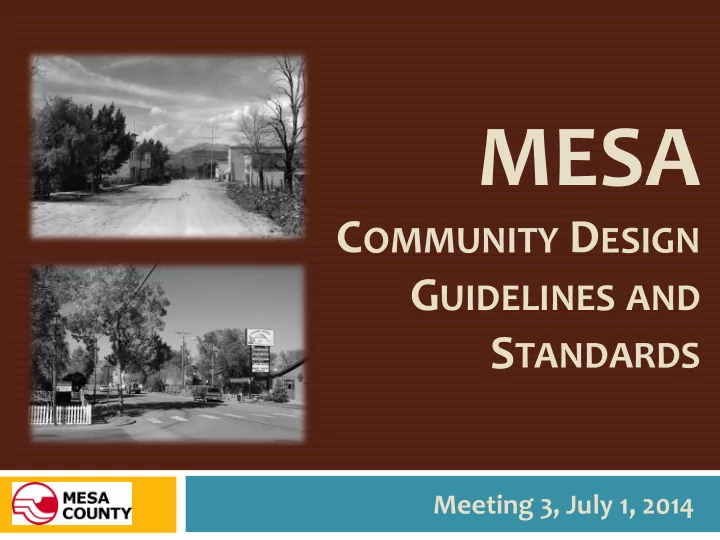
MESA C OMMUNITY D ESIGN G UIDELINES AND S TANDARDS Meeting 3, July - - PowerPoint PPT Presentation
MESA C OMMUNITY D ESIGN G UIDELINES AND S TANDARDS Meeting 3, July 1, 2014 Agenda 1. Purpose/Overview 2. May and June meeting recap 3. Existing Development Standards 4. Development & Design Options 5. Discussion Lot sizes,
Meeting 3, July 1, 2014
1. Purpose/Overview 2. May and June meeting recap 3. Existing Development Standards 4. Development & Design Options 5. Discussion
Lot sizes, setbacks, height, uses and other standards
Workshop 1, 5/14 – Community Character
Walking Tour
Workshop 2, 6/3 – Development
Standards
Workshop 3, 7/1 – Development
Standards; Design Guidelines & Standards
Workshop 4, 8/5 – Review Draft
Mesa/Powderhorn Plan 2012
Land Use Action 1.A: Work with
area residents to update and implement the Village of Mesa Overlay District and the Design Standards
Appendix 1: Mesa Rural Community
Design Guidelines
Village of Mesa Overlay Purpose (Land
Development Code Section 4.4.3)
Further the goals and polices of the Mesa County
Master plan
Encourage urban development where adequate
services already exist
Simplify the development process in the Overlay
District
Recognize the Mesa Sanitation District as the logical
growth boundaries for the Mesa rural Community
Strengthen the existing village character of Mesa
Village of Mesa Overlay -
Development Standards
Land Development Code Section 4.4.3
Density, Uses, Setbacks, Height
Design Guidelines & Standards
Appendix to the Land Development Code
Circulation, Site Design, Building Design, Signs
Existing 257 acres 106 parcels 52 dwellings 24,666 s.f. commercial
floor area
Population approx. 100 Potential Build-out 410-425 dwelling units
(0.5 acre/d.u. avg.)
128,000 s.f. commercial
floor area
Population approx. 945
What’s important to the Community?
From the May Community Character Workshop:
“Keep Mesa as it is.” Stick with development
similar to what’s already there
Less/no new restrictions Sidewalks, streetlights
Road
From the June Development Standards meeting:
How Are the Guidelines and Standards Implemented?
Single-family and two-family
development are exempt from the Design Guidelines & Standards.
New development and major
redevelopment must use the Design Standards
Development is encouraged to use the
Design Guidelines.
Property owners can opt-in to
use the Village of Mesa Overlay zoning
Current zoning:
30% VMO 15% PUD 8% B-1 47% AFT
Consider a bulk rezone
Village of Mesa Overlay (VMO) - current
Residential Density – (average lot size) 1
dwelling unit per 2,500 s.f.
Businesses – 2,500 s.f. minimum lot area Building height 35’ or 2 stories
General store is 30’ tall
Setbacks
Front – 10’ Side – zero Rear – 10’
See also Ch. 8, Signs, and Section 7.2, Landscaping
Village of Mesa Overlay (VMO) - current
Uses
No manufactured home parks along Hwy 65 or KE
Road
RV parks allowed along Hwy 65 and KE Road Mix of both business and residential uses allowed
Refer to B-2 zoning district for allowed uses
Higher density helps support
financially sustainable infrastructure
Historic Mesa townsite – 2,500 s.f.
lots (25’x100’)
American Legion and new sandwich
shop are on 2,500 s.f. lots
Mesa Rural Community – 257
acres, 105 parcels = 2.5 acres average
Core developed area: 40-lot
sample
Smallest: American Legion –
2,572 s.f.
Largest: Mesa Creek Center –
25,821 s.f. (.59 acres)
Average: 11,235 s.f. (.25 acres)
What does this mean?
Keep current overlay standards (2,500 s.f. residential
average lot size) and accept what may happen
OR
Change overlay to reduce density (larger average lot
size) so future development is similar to existing
One density for the entire rural community Two or more densities retaining 2,500 s.f. in the core
area/original plat and larger average lot size (reduced density) for the remainder
2,500 s.f. minimum lot size with max. 4
units/acre OR
Core area – 2,500 s.f. minimum lot size;
remainder ¼ acre minimum lot size OR
¼-acre minimum lot size, entire rural
community
Define where
densities should occur
Core area? Corridor?
All areas – Residential uses allowed Fronting Highway 65 and KE Road plus original
townsite:
Commercial, residential & mixed use allowed Refer to Mixed Use Commercial zoning district for
permitted uses
OR
Refer to B-1 zoning district for permitted uses
Maximum building size?
Typical commercial – 2,000-2,500 s.f. General Store – 4,500 s.f. (2 stories) Wagon Wheel – 10,500 s.f. Community Center – 10,000 s.f.
Parking –exemption for first 2,500 s.f. of building
area?
Setbacks – 10’ min./max. 20’ fronting on Hwy 65?
Accessory buildings – 3’ side?
Village of Mesa Overlay: Western style
Wood facades Front porches Gables Non-reflective roofs
Mesa/Powderhorn Plan Appendix 1.A
Architecture Lighting Roads Signage Utilities Water
Simple & straightforward Provides a connection to agricultural roots Rectangular in form 1 or 2 stories tall Gabled or hipped roof; false fronts Wood and stone Porches are essential, creating an inviting appearance Bay windows and similar features Decorative elements are limited, not ornate, and
highlight features like windows, doors and cornices
Design Guidelines & Standards Outline
Intent Mesa Design Character Design Theme & Style: Western Applicability Guidelines & Standards
Circulation Site Design Building Design Signs
The intent is to ensure a continuance of design styles and patterns already found in Mesa
Lot size Density Scale Setbacks Uses Parking Uniform for all of Mesa? Different for Highway 65
frontage?
KE Road?
What are the appropriate development standards for Mesa?
Landscaping Pedestrians & bikes Parking lots Screening Screening Lighting Outdoor spaces Building size and
shape
Roof design Front porches, bays,
dormers, etc.
Materials Signs
What are the appropriate design guidelines & standards for Mesa?
Tuesday, August 5, 6:30 – Draft Development
Standards and Design Guidelines & Standards All information is available on-line:
http://www.mesacounty.us/MesaDesignStandards.aspx mclrange@mesacounty.us