Mental Health Commission improvements which might be made in light - - PDF document

mental health commission
SMART_READER_LITE
LIVE PREVIEW

Mental Health Commission improvements which might be made in light - - PDF document

Outline Introduction European Human Rights in the Mental Mental Health Act 2001 Health Act 2001 and Criminal Law (Insanity) Act 2006 the Criminal Law (Insanity) Act 2006 Darius Whelan Mental Health and Human Rights Seminar


slide-1
SLIDE 1

1

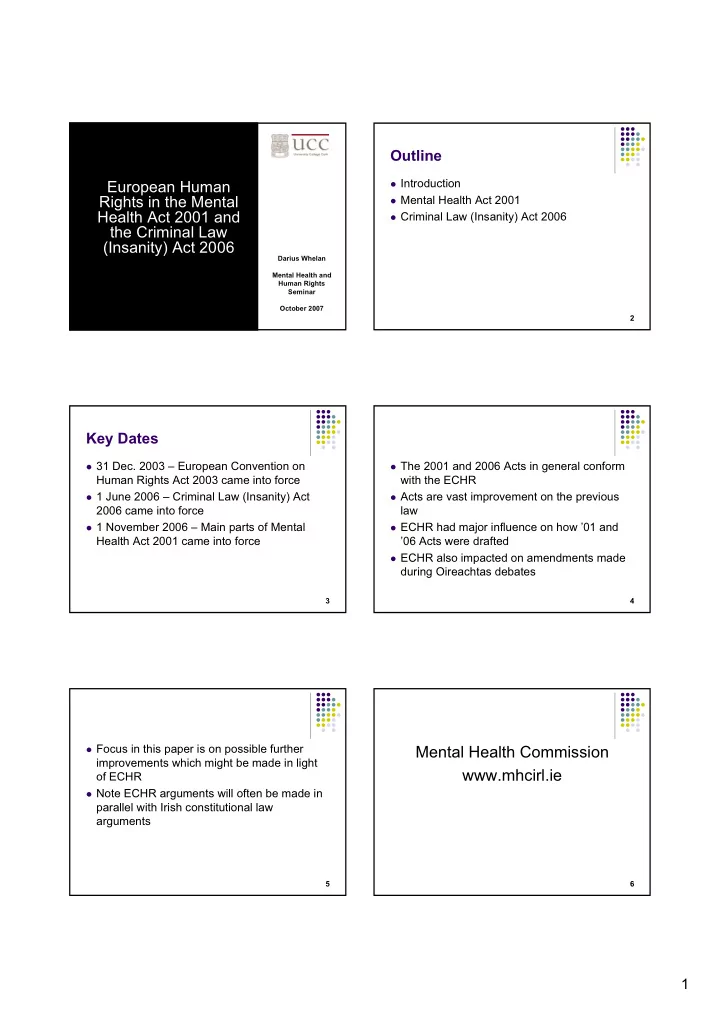
European Human Rights in the Mental Health Act 2001 and the Criminal Law (Insanity) Act 2006

Darius Whelan Mental Health and Human Rights Seminar October 2007

2

Outline

Introduction Mental Health Act 2001 Criminal Law (Insanity) Act 2006 3

Key Dates

31 Dec. 2003 – European Convention on

Human Rights Act 2003 came into force

1 June 2006 – Criminal Law (Insanity) Act

2006 came into force

1 November 2006 – Main parts of Mental

Health Act 2001 came into force

4 The 2001 and 2006 Acts in general conform

with the ECHR

Acts are vast improvement on the previous

law

ECHR had major influence on how ’01 and

’06 Acts were drafted

ECHR also impacted on amendments made

during Oireachtas debates

5 Focus in this paper is on possible further

improvements which might be made in light

  • f ECHR

Note ECHR arguments will often be made in

parallel with Irish constitutional law arguments

6

Mental Health Commission www.mhcirl.ie

slide-2
SLIDE 2

2

8

Mental Health (Criminal Law) Review Board www.mhclrb.ie

Mental Health Act 2001

11 Right to liberty. No one to be deprived of

liberty save in following cases and in accordance with procedure prescribed by law [art.5(1)]

One case: lawful detention of “person of

unsound mind” [art. 5(1)(e)]

Right to information on “arrest” [art.5(2)] Right to take proceedings for decision on

lawfulness of detention [art.5(4)]

Article 5 ECHR

12

Winterwerp v Netherlands (1979)

Decision to detain must be based on finding

  • f a true mental disorder determined by
  • bjective medical expertise

Mental disorder must be of kind or degree

warranting compulsory confinement and

Validity of continued confinement must be

based on the persistence of the disorder

slide-3
SLIDE 3

3

13

De Facto Detention

Voluntary Patient who

does not have capacity to consent to admission,

and/or

wishes to leave centre but fears re-grading as

involuntary patient

14

“Bournewood Gap”

R v Community and Mental Health NHS

Trust, ex parte L. (1998)

House of Lords: De Facto Detention justified by

common law doctrine of necessity

H.L. v United Kingdom (2004)

European Court of HR: Detention of this kind

breaches Article 5

16 Reform of law needed in Ireland to deal with

“Bournewood gap”

17 See also Irish case: H. v Russell (2007)

Relevant period where a patient was, apparently,

a “voluntary” patient was not in substance voluntary

Detention held to be unlawful

18

Speed of Tribunal Reviews

Reviews must be within 21 days of admission

  • r renewal order

As regards first review, this may not be

“speedy” enough to satisfy ECHR

L.R. v France (2002) – 24 days too long

slide-4
SLIDE 4

4

19 Note views of Dept of H & C, 2007:

Tribunal hearings should take place at earliest

possible opportunity

14-day time period for second consultant’s report

should be reduced

20

Frequency of Reviews

While automatic reviews are desirable, they

do not necessarily fully comply with Article 5

“The detainee’s access to the judge should

not depend on the good will of the detaining authority.”

Rakevich v Russia (2003)

21

Definition of “unsound mind”

ECHR has not defined “unsound mind” Irish case: R. v Byrne and Flynn (2007)

S.3(1)(a) – serious likelihood of immediate and

serious harm to self/ others – envisages a high level of probability

“Harm” – physical and mental injury are included “Serious” – Infliction of minor physical injury to

person themselves could be regarded as not serious

22

Scope of Review

Tribunal has limited powers – only two main

choices: confirm or revoke order

Arguable that Tribunals need to have more

extensive powers, e.g. to order conditional discharge; defer discharge until place available

23 UK: Postponing Release until suitable place

in community available

Johnson v UK (1997)

  • J. no longer had a mental disorder

Discharge must not be unreasonably delayed

24

Burden of Proof

Act is silent about burden of proof at Tribunal

stage

On appeal to Circuit Court: Burden of proof

  • n patient

Unclear whether this complies with ECHR

R v MHRT, N. & E. London, ex parte H. (2001) Is an appeal stage different from first instance

stage?

Delcourt v Belgium (1970) – Appeal courts should

comply with Art. 6

slide-5
SLIDE 5

5

25

Impartiality

Patient appears to be only party to Tribunal

hearing

Normal triangular model of Tribunal has not

been established

Tribunals need to take care in questioning

patient not to act as if “against” patient

26

Independence of executive

Minister appoints Mental Health Commission

based on criteria in s.35

Commission appoints Tribunal members

under s.48

27

Article 6

Fair and public hearing within reasonable

time by independent and impartial Tribunal

Applies to determination of civil rights Right to liberty is civil right

Aerts v Belgium (1998)

Equality of arms, reasons for decisions,

reasonable time, etc.

Right to participate effectively 28 A v Refugee Appeals Tribunal (2006) Arguably selected previous decisions of

Mental Health Tribunals need to be made available

29 Restriction on right of access to court S.260 Mental Treatment Act 1945 ECHR upheld English equivalent –

Ashingdane v UK (1985)

Blehein v Minister for Health and Children

(2004)

Where does Blehein leave s.73 Mental

Health Act 2001?

30

Article 3

Freedom from inhuman or degrading

treatment

No successful case in Europe yet Possible challenges can be envisaged

slide-6
SLIDE 6

6

Criminal Law (Insanity) Act 2006

32

Article 5

No need for psychiatric report for 14-day

detention for assessment [s.4(6) + s.5(3)]

Can be extended up to 6 months in insanity cases

after consultation with psychiatrist [s.5(3)(b)]

Keys: This may breach Winterwerp principles 33 Ní Raifeartaigh:

Courts should interpret s.4(6) in Convention-

compliant fashion

34 Lack of clarity re personality disorders Minister McDowell: “It may or may not be

that [s.8 of the 2001 Act] is a tacit admission that mental disorder could include a personality disorder and, therefore, section 8 was necessary to take it out of that realm. Alternatively, the whole Act could be read as stating mental disorder under the 2001 Act was not intended to cover personality disorder.”

(176 Seanad Debates 259.) 35 Lack of clarity may breach requirement in art.

5 ECHR that detention be “in accordance with procedure prescribed by law”

36

Reviews

Initial detention involves judicial decision and

therefore review not needed

Subsequent reviews at least every 6 months Human Rights Commission suggested 3

months

Period of time from application for review by

patient to date of review – “as soon as may be” – s.13(8) + (9)

slide-7
SLIDE 7

7

37

Procedures

Minister must consent to procedures of

Review Board [s.12(6)]

Criticised as Ministerial “veto” 38

Powers of Courts and Review Board

More extensive than Mental Health Tribunals But different powers for different categories of

case -

Unfit for trial cases: court may order out-patient

treatment – s.4(5)

Insanity cases: court does not have this power –

s.5(2)

39

Information

No statutory right to information for patient

Contrast Mental Health Act 2001

Care must be taken to comply with

requirement of information on “arrest”

40

Impartiality

Only three members of Review Board have

been appointed

How will RB deal with situation where

member of RB has had previous dealings with patient?

What if successful Judicial Review? No

alternative members available to re-hear case

41

Transfers from Prison

Aerts v Belgium (1998)

Court can have regard to nature of treatment

available in prison

In Mr A’s case, detention in prison breached Art. 5

as he had a mental disorder

Contrast Bizzotto v Greece (1996)

42

Independence of executive

Minister appoints Review Board members.

Very few criteria in Act for appointment

National Disability Authority feared this

breached ECHR

Mental Health Commission:

Questions about independence could be raised Could be unfair that composition of RBs would

vary

slide-8
SLIDE 8

8

43

Article 6

A v Refugee Appeals Tribunal See earlier slide under Mental Health Act 44

References

www.irishlaw.org/mentalhealth/oct07paper/

slide-9
SLIDE 9
  • Page 1 of 3

European HR Standards in MH Act 2001 and CL(I) Act 2006 31/10/2007 http://www.ucc.ie/law/irishlaw/mentalhealth/oct07paper/

slide-10
SLIDE 10
  • Page 2 of 3

European HR Standards in MH Act 2001 and CL(I) Act 2006 31/10/2007 http://www.ucc.ie/law/irishlaw/mentalhealth/oct07paper/