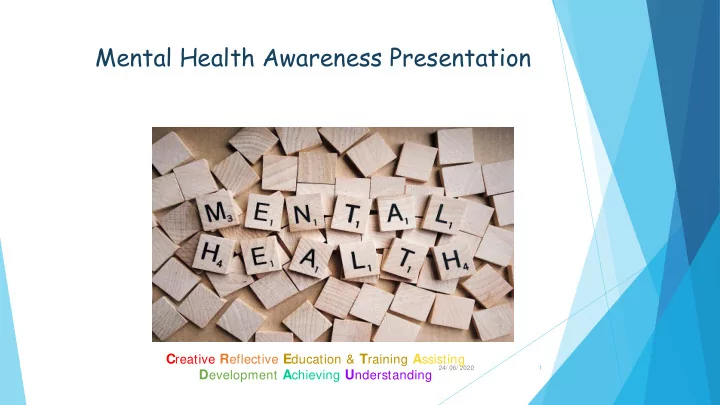
Mental Health Awareness Presentation C reative R eflective E ducation - - PowerPoint PPT Presentation

mental health awareness presentation
SMART_READER_LITE
LIVE PREVIEW

Mental Health Awareness Presentation C reative R eflective E ducation - - PowerPoint PPT Presentation

Mental Health Awareness Presentation C reative R eflective E ducation & T raining A ssisting 24/ 06/ 2020 1 D evelopment A chieving U nderstanding Define Mental Health Mental Ill Health Describe what is Stress and the impact it may have


slide-1
SLIDE 1

Mental Health Awareness Presentation

24/ 06/ 2020 1

Creative Reflective Education & Training Assisting Development Achieving Understanding
slide-2
SLIDE 2

Workshop Aims:

Define Mental Health – Mental Ill Health Describe what is Stress and the impact it may have Describe the impact that Anxiety/Depression is having on people going back to work How to promote Mental Wellbeing in the workplace and look after your own Mental Wellbeing. How to support/signpost Staff to various

  • rganisations

24/ 06/ 2020 2

slide-3
SLIDE 3

Prevalence in the UK

  • Mental Health in the UK costs the economy
  • approx. 19 billion a year
  • Mental illness is the largest single cause of

disability in the UK and the range of mental health conditions can make this challenging

  • Almost 16 million workdays were lost in the

UK last year due to poor mental health

24/ 06/ 2020 3

slide-4
SLIDE 4

Prevalence in Wales

 The overall cost of mental health

problems in Wales is an estimated £7.2 billion a year.

 53% of Welsh women suffer from low

level mental health problems.

 Self harm a significant problem in Wales,

as a result there are 6,000 emergency admissions to hospital per year

24/ 06/ 2020 4

slide-5
SLIDE 5

Defining mental health

“Mental health is a state of well

being in which the individual realises his or her own abilities, can cope with the normal stresses of life, can work productively and fruitfully and is able to contribute to his or her

  • wn community

Mental illnesses are health conditions involving changes in emotion, thinking or behaviour (or a combination of these). Mental illnesses are associated with distress and/or problems functioning in social, work or family activities.

24/ 06/ 2020 5

Defining mental ill health

slide-6
SLIDE 6

Definition of mental Health

“Mental health influences how we think and feel about ourselves

and others, and how we interpret events. It affects our capacity to learn, to communicate and to form, sustain and end relationships. It also influences our ability to cope with change, transition and life events, such as: having a baby, moving to a new house, experiencing bereavement”.

Friedl, 2004

24/ 06/ 2020 6

slide-7
SLIDE 7

Umbrella Term

24/ 06/ 2020 7

Mental Health

slide-8
SLIDE 8

HEALTHY REACTI NG I NJURED I LL

  • Calm and steady
  • Normal fluctuations in

mood

  • Fit
  • Fed
  • Rested
  • In control physically,

mentally, emotionally

  • Performing well
  • Behaving ethically and

morally

  • Socially active
  • Sense of humour
  • Relaxing and recreating
  • Confident in self and
  • thers
  • Easily agitated
  • Angered
  • Frustrated and tired
  • Difficulty focusing
  • Decreased interest in

activities

  • Nervous
  • Impatient
  • Unusual sadness
  • Difficultly sleeping
  • Vigilance
  • Problems with daily

functioning at home, work

  • r school
  • Persistent anxiety and

sadness

  • Angry reactions
  • Noticeable fatigue
  • Poor concentration
  • Inability to enjoy activities
  • Excessive distrust and

resentment

  • Sleep disturbance
  • Hyper vigilance
  • Persistent physical symptoms

(aches and pains)

  • Severe deterioration in daily

functioning in home, work or school

  • Excessive anxiety, fatigue

and sadness

  • Regular panic attacks
  • Angry outbursts
  • Sever memory lapses
  • Cannot concentrate
  • Cannot perform daily

routine

  • Significant sleep

disturbances4loss of control

  • Avoiding or withdrawal
  • Significant change in

behaviour

  • Indications of suicidal

thoughts, intensions

  • Symptoms get worse over

time instead of better

Mental Health Continuum

24/ 06/ 2020 8

slide-9
SLIDE 9

24/ 06/ 2020 9

Minimal Mental Health Maximum Mental Health Minimal Mental Illness/ Disorder/ Problem Maximum Mental Illness/ Disorder/ Problem

No illness or disorder and positive mental health

  • No fixed state

Adapted from K Tudor Mental Health Promotion: Paradigms and Practice.

Has a diagnosable mental illness and has poor mental health No diagnosable illness

  • r disorder but has poor

mental health Has a serious, diagnosable illness but copes well and has positive mental health

slide-10
SLIDE 10

Mental health is too

  • ften ignored

Right now : 1 in 4 people will experience

mental health problems*

1 in 6 workers are

experiencing depression, anxiety

  • r stress.

24/ 06/ 2020 10

slide-11
SLIDE 11

6/ 24/ 2020 11

slide-12
SLIDE 12

6/ 24/ 2020 12

slide-13
SLIDE 13

Stress

24/ 06/ 2020 13

The degree to which you feel overwhelmed or unable to cope as a result

  • f pressures that are

unmanageable. (Covid 19)

slide-14
SLIDE 14

Stress

Stress is not a psychiatric diagnosis, but it's closely related to your mental health as:

 Stress can be the cause mental health problems

and make existing problems worse. For example, if you often struggle to manage feelings of stress, you might develop a mental health problem like anxiety or depression.

 Mental health problems can cause stress. You

might find coping with the day-to-day symptoms

  • f your mental health problem, as well as

potentially needing to manage medication, heath care appointments or treatments, can become extra sources of stress.

 Stress can impact on how you feel Physically

24/ 06/ 2020 14

slide-15
SLIDE 15

Covid 19

24/ 06/ 2020 15

slide-16
SLIDE 16

Fear

Fear is one of the most powerful emotions it can have a very strong effect on our minds and body for example, if we are caught in a dangerous situation or if we are being attacked

24/ 06/ 2020 16

slide-17
SLIDE 17

 Fear is something that we consider is a bad thing and makes us

make bad decisions.

 Fear Is also a good thing because It is the response to our

survival, which keeps us safe and alive.

 Anxiety and adrenalin are connected to the feeling of fear. If

we were not able to feel fear, we would be killed by a tiger when we were cavemen, but fear keeps us from doing dangerous

  • things. Fear makes us think before we take action.

Fear is not reasonable when it keeps us from doing what we want

  • r following our dreams. It gets in our way and stop us from taking

action

24/ 06/ 2020 17

slide-18
SLIDE 18

Anxiety

24/ 06/ 2020 18

The term anxiety refers to feelings of worry, nervousness, apprehension, or fear commonly experienced by people when faced with something they view as challenging.

slide-19
SLIDE 19

Difference between Anxiety and GAD

 Short-term Anxiety Everyone - even those that don't

have anxiety - can get anxiety when confronted with a situation that causes nervousness. People get anxious

  • n first dates, before tests, when they have a meeting

with their boss; anxiety is an incredibly normal experience, but one that is disruptive nonetheless.

 Generalized Anxiety Disorder (GAD) When someone

has GAD, their fight or flight system is firing all throughout the day at low levels, and occasionally can pick up at random times. This may cause shaking to

  • ccur for what seems to be no reason.

 You're most likely to be diagnosed with GAD if you

have had symptoms for 6 months or more

24/ 06/ 2020 19

slide-20
SLIDE 20

Panic Attacks

A panic attacks create a feeling of

sudden and intense anxiety.

Panic attacks can also have physical

symptoms, including shaking, feeling disorientated, nausea, rapid, irregular heartbeats, dry mouth, breathlessness, sweating and dizziness

6/ 24/ 2020 20

slide-21
SLIDE 21

24/ 06/ 2020

Difference between Panic attack and Panic disorder

21

It is also possible to experience panic attacks during a stressful life event then never experience them again. For example, a person who is a victim of a crime or experiences a natural disaster – COVID 19 may have a panic attack during that event. To be diagnosed with panic disorder, a person would need to have recurrent and unexpected panic attacks

slide-22
SLIDE 22

24/ 06/ 2020

Typical co-occurring conditions can include:

22

Depression S

  • cial Anxiety

disorder Generalized anxiety disorder S pecific phobia - Obsessive- compulsive disorder (OCD) Post-traumatic stress disorder(PTS D)

slide-23
SLIDE 23

Depression

24/ 06/ 2020 23

Depression is a common mental disorder, characterized by persistent sadness and a loss of interest in activities that you normally enjoy, accompanied by an inability to carry

  • ut daily activities,
slide-24
SLIDE 24

Depression

 Statistics  Causes  Common types of

depression

 Psychological

symptoms

 Physical symptoms

24/ 06/ 2020 24

slide-25
SLIDE 25

Some common types of Depression

 Dysthymia  Depressive Episode  Bipolar Disorder  Postnatal Depression  Seasonal Affective Disorder (SAD)

24/ 06/ 2020 25

Depression

slide-26
SLIDE 26

Statistics

 Depression affects 1 in 10 people during their

lifetime

 3 million people are diagnosed in the UK

( this exceeds the amount of people living in Wales)

 Women are twice as likely as men to develop

depression

 A depressive episode last about 6-8 months on

average

 Working days lost in the UK due to depression is

approximately 9.8 million

24/ 06/ 2020 26

slide-27
SLIDE 27

Black dog

24/ 06/ 2020 27

slide-28
SLIDE 28

Providing appropriate support

24/ 06/ 2020 28

slide-29
SLIDE 29

Recovery

24/ 06/ 2020 29

Recovery is about building a meaningful and satisfying life, whether there are recurring or

  • ngoing symptoms or mental health problems.

The key themes of recovery are: Agency-gaining a sense of control over one's life and one's illness.

slide-30
SLIDE 30

Self Care /Self Assessment Self care

24/ 06/ 2020 30

slide-31
SLIDE 31

Workshop Aims:

Define Mental Health – Mental Ill Health Describe what is Stress and the impact it may have Describe the impact that Anxiety/Depression is having on people going back to work How to promote Mental Wellbeing in the workplace and look after your own Mental Wellbeing. How to support/signpost Staff to various

  • rganisations

24/ 06/ 2020 31