Mendelian Genetics & and is intended for the non-commercial use - - PDF document

mendelian genetics
SMART_READER_LITE
LIVE PREVIEW

Mendelian Genetics & and is intended for the non-commercial use - - PDF document

Slide 1 / 47 Slide 2 / 47 New Jersey Center for Teaching and Learning Progressive Science Initiative This material is made freely available at www.njctl.org Mendelian Genetics & and is intended for the non-commercial use of students and


slide-1
SLIDE 1

Slide 1 / 47

This material is made freely available at www.njctl.org and is intended for the non-commercial use of students and teachers. These materials may not be used for any commercial purpose without the written permission of the owners. NJCTL maintains its website for the convenience of teachers who wish to make their work available to other teachers, participate in a virtual professional learning community, and/or provide access to course materials to parents, students and others.

Click to go to website: www.njctl.org New Jersey Center for Teaching and Learning Progressive Science Initiative

Slide 2 / 47

www.njctl.org

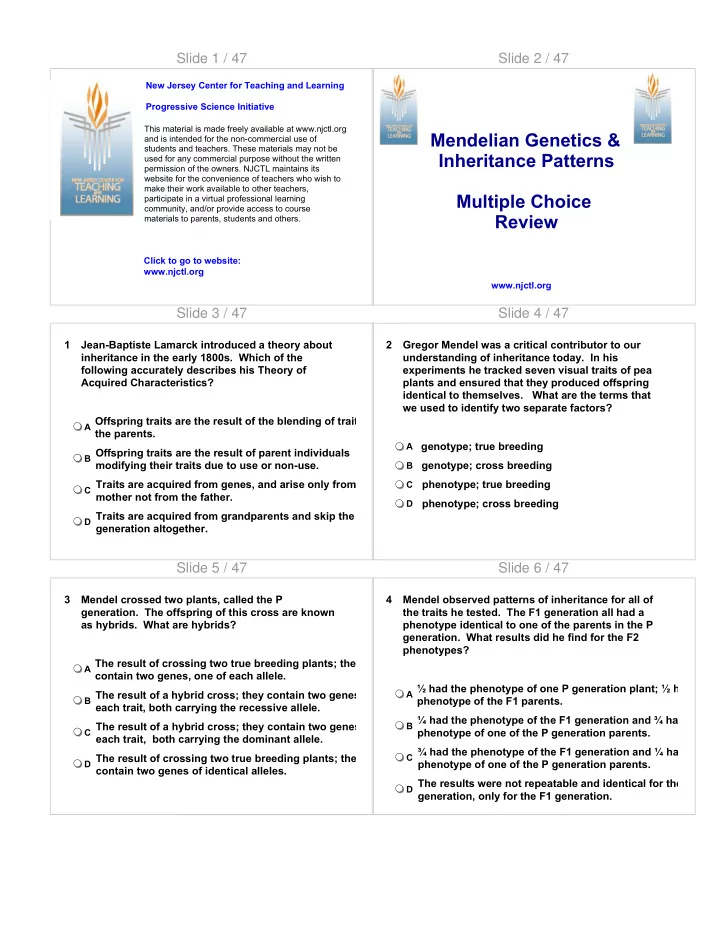
Mendelian Genetics & Inheritance Patterns Multiple Choice Review

Slide 3 / 47

1 Jean-Baptiste Lamarck introduced a theory about inheritance in the early 1800s. Which of the following accurately describes his Theory of Acquired Characteristics?

A Offspring traits are the result of the blending of traits from

the parents.

B Offspring traits are the result of parent individuals

modifying their traits due to use or non-use.

C Traits are acquired from genes, and arise only from the

mother not from the father.

D Traits are acquired from grandparents and skip the parent

generation altogether.

Slide 4 / 47

2 Gregor Mendel was a critical contributor to our understanding of inheritance today. In his experiments he tracked seven visual traits of pea plants and ensured that they produced offspring identical to themselves. What are the terms that we used to identify two separate factors?

A genotype; true breeding B

genotype; cross breeding

C

phenotype; true breeding

D

phenotype; cross breeding

Slide 5 / 47

3 Mendel crossed two plants, called the P

  • generation. The offspring of this cross are known

as hybrids. What are hybrids?

A The result of crossing two true breeding plants; they

contain two genes, one of each allele.

B The result of a hybrid cross; they contain two genes for

each trait, both carrying the recessive allele.

C The result of a hybrid cross; they contain two genes for

each trait, both carrying the dominant allele.

D The result of crossing two true breeding plants; they

contain two genes of identical alleles.

Slide 6 / 47

4 Mendel observed patterns of inheritance for all of the traits he tested. The F1 generation all had a phenotype identical to one of the parents in the P

  • generation. What results did he find for the F2

phenotypes?

A ½ had the phenotype of one P generation plant; ½ had the

phenotype of the F1 parents.

B ¼ had the phenotype of the F1 generation and ¾ had the

phenotype of one of the P generation parents.

C ¾ had the phenotype of the F1 generation and ¼ had the

phenotype of one of the P generation parents.

D The results were not repeatable and identical for the F2

generation, only for the F1 generation.

slide-2
SLIDE 2

Slide 7 / 47

5 Which of the following statements best describes

  • ne aspect of the chromosomal theory of

inheritance, posited after Mendel’s time?

A Chromosomes account for all of the phenotypic traits

found in every organism.

B The hereditary factors from Mendel’s experiments are

actually single chromosomes.

C Chromosomes can be found within alleles, accounting for

different phenotypic traits.

D The hereditary factors from Mendel’s experiments are

actually genes located on chromosomes.

Slide 8 / 47

Below is a Punnett square showing a cross between two parents. Use this information to respond to the next five questions.

P generation: BB x bb Complete dominance: B = black rat b = white rat

Slide 9 / 47

6 Referring to the Punnett square above, which of the following accurately represents the phenotypic and genotypic ratios of the F1 generation?

A Phenotypic ratio 100% white, genotypic ratio 100% Bb. B Genotypic ratio 100% black, phenotypic ratio 100% Bb C Phenotypic ratio 100% black, genotypic ration 100% Bb D Phenotypic ratio 50% black, 50% white, genotypic ratio

100% Bb

Slide 10 / 47

7 Using the information in the Punnett square above, how would we refer to the parents and the

  • ffspring?

A One parent homozygous, one is heterozygous, the

  • ffspring are homozygous

B One parent is homozygous dominant, one parent is

homozygous recessive, the offspring are heterozygous

C

One parent is homozygous dominant , one parent is heterozygous recessive, the offspring are homozygous dominant

D One parent is heterozygous dominant, one is heterozygous

recessive, the offspring are heterozygous dominant

Slide 11 / 47

8 If we were to cross the offspring in the Punnett square above (known as the F1 generation) what will be the genotypic and phenotypic ratios of the F2 generation?

A Phenotypic ratio 3:1; genotypic ratio 1:2:1 B Phenotypic ratio 1:2:1, genotypic ration 3:1 C Phenotypic ratio 3:1, genotypic ration 3:1 D Phenotypic ratio 1:2:1, genotypic ration 1:2:1

Slide 12 / 47

9 Mendel used dihybrid crosses in an effort to uncover more information about inheritance

  • patterns. From this he developed two laws of
  • inheritance. Which of the following accurately

described the law of segregation?

A This law states that alleles, on different chromosomes, will

be inherited independently of one another.

B This law states that gametes each carry only one allele for

a trait, to be combined when fertilization occurs.

C This law states that gametes carry two alleles for each trait

to ensure adequate inheritance by offspring.

D This law states that alleles, on the same chromosome, will

be inherited independently of one another.

slide-3
SLIDE 3

Slide 13 / 47

10 What is considered to be incomplete dominance?

A When the phenotype of the hybrid is the same as for the

homozygous recessive.

B When the phenotype of the hybrid is the same as for the

homozygous dominant.

C When the phenotype of the hybrid shows an in-between

phenotype of the two parents.

D Then the phenotype of the homozygous dominant shows

an in-between phenotype of the two parents.

Slide 14 / 47

A cross occurs between a black homozygous mouse and a white homozygous mouse. They produce gray offspring. Use this scenario to respond to the next three questions:

Slide 15 / 47

11 What type of dominance is reflected in the scenario above?

A codominance B

incomplete dominance

C

complete dominance

D

blending of genes

Slide 16 / 47

12 What are the percentage probabilities for the genotype and phenotype of the offspring?

A 100% black; 100% Bb B

100% gray; 100% bb

C

100% white; 75% Bb, 25% bb

D

100% gray; 100% Bb

Slide 17 / 47

13 Referring to the mouse scenario noted above, what is the percentage phenotypic probability if we cross two gray mice from the F1 generation?

A 100% black B

75%gray; 25% white

C

25% black; 50% gray; 25% white

D

50% black; 50% white

Slide 18 / 47

14 A cross occurs between a chicken with white feathers and a chicken with black feathers. This results in offspring with some black feathers and some white feathers. What type of inheritance is this?

A incomplete dominance B

complete dominance

C

codominance

D

blended dominance

slide-4
SLIDE 4

Slide 19 / 47

15 Sickle cell disease is the result of one gene

  • abnormality. When two recessive alleles occur,

sickle cell disease is inherited. The disease results in mis-shaped hemoglobin. What type of molecule is hemoglobin?

A protein B

carbohydrate

C

lipid

D

RNA

Slide 20 / 47

16 Polygenic inheritance refers to which of the following conditions of inheritance?

A When one allele affects more than one trait. B When multiple alleles affect one trait. C When multiple alleles affect multiple traits. D When one allele dominates another allele.

Slide 21 / 47

17 A group of individuals have lived for generations

  • n an island. Their average height is 5 feet 2
  • inches. Eventually, ships stop by the islands

bringing more fruits, vegetables and meats to their diet and more food overall. While the islanders continue to marry islanders and produce children, over generations the average height of the islander population reaches 5 feet 6

  • inches. What was most likely the main factor in

this change?

A changes and mutations in the genes within the island

population of islanders

B changes in nutrition that affected the phenotype, fully

expressing the genotype

C an influx of new genes from the incoming human

population

D the effect of medications brought by the ships stopping at

the island

Slide 22 / 47

A man who is a carrier for cystic fibrosis marries a woman who is a carrier for cystic fibrosis. Respond to the next three questions based upon this scenario.

Slide 23 / 47

18 What is the percentage probability that this couple will have a child with cystic fibrosis?

A 50% B

100%

C

75%

D

25%

Slide 24 / 47

19 What is the percentage probability that they will have a child who is a carrier?

A 50% B

100%

C

75%

D

25%

slide-5
SLIDE 5

Slide 25 / 47

20 The couple in the above scenario has four

  • children. How many of their children will have

cystic fibrosis?

A one B two C it could be none to all of their children D it depends whether they are male or female

Slide 26 / 47

21 Issues with inbreeding often occur with dog breeds, such as German shepherds. How can we best describe inbreeding?

A successive breeding with individuals from a variety of

populations

B successive breeding with individuals from within one

population

C breeding between different breeds to produce new breeds D breeding the same set of parents more than once

Slide 27 / 47

22 How does inbreeding increase the probabilities of recessive disorders?

A Carriers have an increased chance of reproducing

together to produce a homozygous recessive condition.

B Homozygous recessive individuals are more likely to live

an reproduce when based within strong families.

C Spontaneous mutations are increased when closely

related organisms reproduce successively

D

The probability that individuals who are homozygous recessive increase as the heterozygous conditions increase

Slide 28 / 47

23 What is true about the majority of sex-linked disorders in humans?

A Females have a high probability of inheriting sex linked

disorders

B Males have a higher probability of inheriting sex linked

disorders

C Gender does not play a role in the probability of inheriting

a sex linked disorder

D Females have a higher probability of inheriting recessive

sex linked disorders.

Slide 29 / 47

Use the information and the Punnett square below to respond to the next three questions:

Hemophilia is an X linked recessive disorder

y

Slide 30 / 47

24 What are the chances that this couple will have a child with the hemophilia?

A 75% B

50%

C

25%

D

0%

slide-6
SLIDE 6

Slide 31 / 47

25 The mother undergoes amniocentesis during her pregnancy, and is told that the child she is carrying is a boy. What are the chances that her son will have hemophilia?

A 75% B

50%

C

25%

D

0%

Slide 32 / 47

26 The mother has a second pregnancy four years

  • later. She is told that her baby will be a girl. What

are the chances that her daughter will be have hemophilia?

A 75% B

50%

C

25%

D

0%

Slide 33 / 47

27 Which of the following is accurate about an X- linked trait?

A There is a 50% chance that a son inherits an X-linked trait

from his father

B There is a 25% chance that a son inherits an X-linked trait

from his father

C There is 0% chance that a son inherits an X-linked trait

from his father

D There is an 80% chance that a son inherits an X-linked trait

from his father

Slide 34 / 47

28 Prenatal or fetal tests can be performed that can provide information about the genetic make-up. Which of the following is based upon family history to estimate probabilities of genetic disorders?

A amniocentesis B

pedigrees

C

chorionic villus sampling

D

fetoscopy

Slide 35 / 47

Use the pedigree shown below to answer the next two questions:

1. 2. 3. 4.

http://faculty.clintoncc.suny.edu/faculty/michael.gregory/ files/bio%20101/Bio%20101%20Laboratory/Pedigree%20Analysis/PEDIGREE.HTM

Slide 36 / 47

29 Given the information provided in the pedigree above, what can we determine about the trait seen in the darkened circles and squares?

A The trait is autosomal dominant B

The trait is autosomal recessive

C

The trait is x-linked dominant

D

The trait is x-linked recessive

slide-7
SLIDE 7

Slide 37 / 47

30 What are the genotypes of the parents in level 1, in the above pedigree?

A mother is homozygous dominant, father is homozygous

recessive

B mother is homozygous recessive, father is homozygous

dominant

C mother is homozygous recessive, father is heterozygous D mother is heterozygous, father is homozygous dominant

Slide 38 / 47

31 What determines “maleness” in humans?

A An extra Y chromosome, resulting in YY B A single X chromosome, resulting in XO C A single Y chromosome, regardless of number of X

chromosomes.

D A single X chromosome, regardless of the presence of any

Y chromosomes.

Slide 39 / 47

32 What does the term autosomal refer to?

A The non XY chromosomes found in an organism B The XY chromosomes found in an organism C The dominant homozygous trait D The recessive homozygous trait

Slide 40 / 47

33 Which of the following accurately describes the relationship between a dominant and a recessive allele?

A The dominant allele physically alters the recessive allele

so that it cannot be expressed

B The dominant allele blends with the recessive allele to

produce an in-between trait

C The dominant allele is expressed however the recessive

allele is unaltered.

D The dominant allele is more common in the species

population than the recessive.

Slide 41 / 47

34 What type of organisms (for the trait of flower color) are shown crossed in the image below?

A false breeding plants B

heterozygous plants

C

self-breeding plants

D

true breeding plants

http://cubocube.com/dashboard.php?a=1181&b=1259&c=103

Slide 42 / 47

35 The probability of an event, such as inheriting a recessive allele, is ½. The probability of inheriting a second recessive allele is ½ . What, then, is the probability of inheriting two recessive alleles?

A 1/2 B

1/4

C

1/8

D

1/10

slide-8
SLIDE 8

Slide 43 / 47

36 Consider a dihybrid cross between two rabbits LlBb x LlBb. What are the phenotypic ratios of the

  • ffspring? (L = long ears l = short ears; B = black

b = white)

A 12 Long Black: 4 short white B 9 Long white: 3 Long Black: 3 short Black: 1 short white C 9 Long Black; 3 Long white: 3 short Black: 1 short white D 12 short Black: 4 Long Black

Slide 44 / 47

37 Blood type in humans is the result of multiple

  • alleles. Blood type is also an example of which

type of inheritance pattern?

A Complete dominance B

Incomplete dominance

C

Co-dominance

D

X-linked inheritance

Slide 45 / 47

38 A female who is AO (iA, iO) mates with a male who is BO (iB, iO). What possible blood types can their children inherit?

A Types, A, AB, B and O B

Types AB and O

C

Types A and B

D

Types A, B and O

Slide 46 / 47

39 Before having children, a couple prepares a pedigree of their family for one particular autosomal dominant disorder. They chart all of their relatives back three generations. From this information, can they determine whether or not they will have a child with the disorder?

A It is possible, but not guaranteed. B Yes, they can absolutely tell from this information C No, it is not possible with this type of disorder. D Yes, they can know with certainty.

Slide 47 / 47

40 What is meant by the term pleiotropy?

A When a single allele affects a single phenotype B When a single allele affects multiple phenotypes C When multiple alleles affect multiple phenotypes D When multiple alleles affect a single phenotype