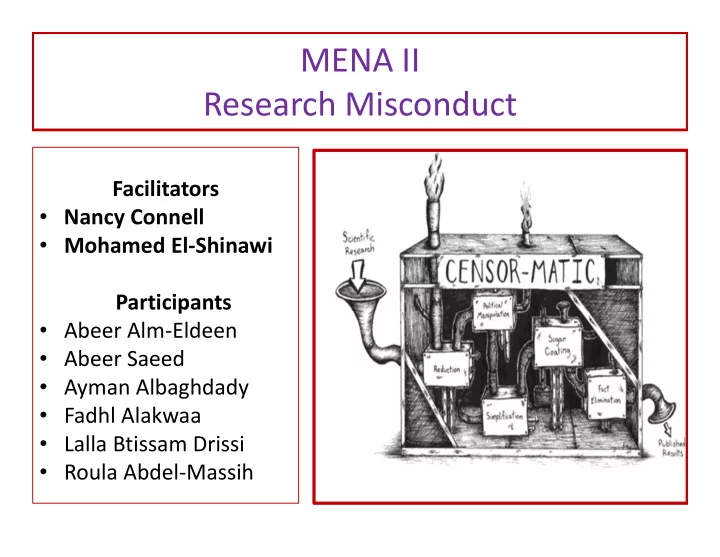
MENA II Research Misconduct Facilitators Nancy Connell Mohamed El - - PowerPoint PPT Presentation

mena ii research misconduct
SMART_READER_LITE
LIVE PREVIEW

MENA II Research Misconduct Facilitators Nancy Connell Mohamed El - - PowerPoint PPT Presentation

MENA II Research Misconduct Facilitators Nancy Connell Mohamed El Shinawi Participants Abeer Alm Eldeen Abeer Saeed Ayman Albaghdady Fadhl Alakwaa Lalla Btissam Drissi Roula Abdel Massih Context


slide-1
SLIDE 1

MENA II Research Misconduct

Facilitators

  • Nancy Connell
  • Mohamed El‐Shinawi

Participants

  • Abeer Alm‐Eldeen
  • Abeer Saeed
  • Ayman Albaghdady
  • Fadhl Alakwaa
  • Lalla Btissam Drissi
  • Roula Abdel‐Massih
slide-2
SLIDE 2

Context

  • Target group: Postgraduate students

–Prior to starting their research

  • Duration: 14 hours course: (2

hours/session)

  • Methodology: Lectures, group

discussion, case‐studies, role‐play

  • Assessment: Pre‐test, post‐test,

periodic and summative assessment.

slide-3
SLIDE 3

Contents

  • 1. Learning Goals
  • 2. Learning Objectives
  • 3. Pre‐test
  • 4. Lecture
  • 5. Post‐test
  • 6. Homework
  • 7. Periodic Assessment
  • 8. Final Assessment
slide-4
SLIDE 4

Learning Goal

  • Expose students to

responsible conduct

  • f research.
slide-5
SLIDE 5

Learning Objectives

  • 1. Define responsible conduct of research.
  • 2. Identify the different forms of research

misconduct.

  • 3. Compare or analyze the differences between

fabrication, falsification, and plagiarism.

  • 4. Analyze

case studies

  • f

fabrication, falsification, and plagiarism.

  • 5. Develop methods to avoid

misconduct behavior.

slide-6
SLIDE 6

Pre‐test

  • In your opinion what are the measures that

should be taken if a researcher commits minor falsification:

  • A. The researcher should be prohibited from

receiving grants for life

  • B. Prohibited from receiving grants for 5 years
  • C. Warn the researcher and give him another

chance

  • D. Termination of the work contract
  • E. Jail time and monetary penalty
slide-7
SLIDE 7

Lecture 5 Falsification

slide-8
SLIDE 8

Responsible Conduct in Research

  • Research Misconduct

is: fabrication, falsification, or plagiarism in: ‐ proposing, ‐ performing, or ‐reviewing research, ‐ or in reporting research results.

slide-9
SLIDE 9

Falsification

  • Is manipulating

‐ research materials, ‐ equipment, ‐ or processes,

  • or changing,
  • or omitting data or

results

  • such that the research is

not accurately represented in the research record.

slide-10
SLIDE 10

Activity Role Play about Falsification

slide-11
SLIDE 11

Examples

slide-12
SLIDE 12

Examples

Manipulation of research materials, equipment or process

slide-13
SLIDE 13

Examples

changing

slide-14
SLIDE 14

Examples

Omitting data or results

slide-15
SLIDE 15

Examples

http://undsci.berkeley.edu/article/socialsideofscience_06

slide-16
SLIDE 16

Post‐test

  • In your opinion what are the measures that

should be taken if a researcher commits minor falsification:

  • A. The researcher should be prohibited from

receiving grants for life

  • B. Prohibited from receiving grants for 5 years
  • C. Warn the researcher and give him another

chance

  • D. Termination of the work contract
  • E. Jail time and monetary penalty
slide-17
SLIDE 17

Homework!!!

Why do researchers commit falsification? Who can detect falsifications? and How? To whom should falsification be reported? Who is/are accountable of the falsification? ‐ researcher ‐ supervisor / mentor ‐ jury of thesis arbitration ‐ committee of research center/site

slide-18
SLIDE 18

Acknowledgement

  • Special thanks to:

Nancy Connell and Mohamed El‐Shinawi.

  • We are very grateful to MENA II staff:

Lida, Alastair, James, Clarissa, Jay, Elizabeth, Susan, M. El‐Fahham, Mona, M. Elhadidy, Huda, Samira, Yusra and all our colleagues. Special thanks to our movie director: Jay

slide-19
SLIDE 19
slide-20
SLIDE 20
slide-21
SLIDE 21

Post‐Test

  • Why should we be concerned about data

falsification?

  • a. Influences research and clinical practice.
  • b. Patients are put at risk by flawed research.
  • c. Retracted work goes on being cited
  • d. Waste of resources, human, and financial.
  • e. Damages public trust in research/science.
slide-22
SLIDE 22
  • "Tian‐Shing Lee, M.D., Joslin Diabetes Center, Harvard Medical

School. An investigation conducted by Harvard found that Dr. Lee, a former post‐doctoral fellow at the Joslin Diabetes Center, fabricated and falsified data in research on diabetes supported by the National Eye

  • Institute. Primary data was missing for almost half of the figures

and tables in a series of published papers and manuscripts prepared by Dr. Lee.

  • In your opinion what are the measures that should be taken:
  • a. The researcher should be prohibited from receiving grants for life
  • b. Prohibited from receiving grants for 5 years
  • c. Warn the researcher and give him another chance
  • d. Termination of the work contract
  • e. Jail time and monetary penalty

https://explorable.com/scientific‐falsification

slide-23
SLIDE 23

Implications of Falsification

  • Legally
  • Ethically
  • Scientifically
  • Financially
  • Publications
  • Work licenses
  • Reputation
slide-24
SLIDE 24
  • What do you think the mentor had to do:
  • a. Quit from the study.
  • b. Falsify the data with the student.

c. Discuss the subject with the supervisor.

  • d. Advise the student to repeat the experiment again.
  • e. Report to the high authority.
slide-25
SLIDE 25
slide-26
SLIDE 26
slide-27
SLIDE 27