Memory Questions? ! What is main memory? CSCI [4|6]730 ! How does - - PDF document

memory questions
SMART_READER_LITE
LIVE PREVIEW

Memory Questions? ! What is main memory? CSCI [4|6]730 ! How does - - PDF document

Memory Questions? ! What is main memory? CSCI [4|6]730 ! How does multiple processes share memory Operating Systems space? Key is how do they refer to memory addresses? ! What is static and dynamic allocation? Main Memory ! What is


slide-1
SLIDE 1

Maria Hybinette, UGA

CSCI [4|6]730 Operating Systems

Main Memory

Maria Hybinette, UGA

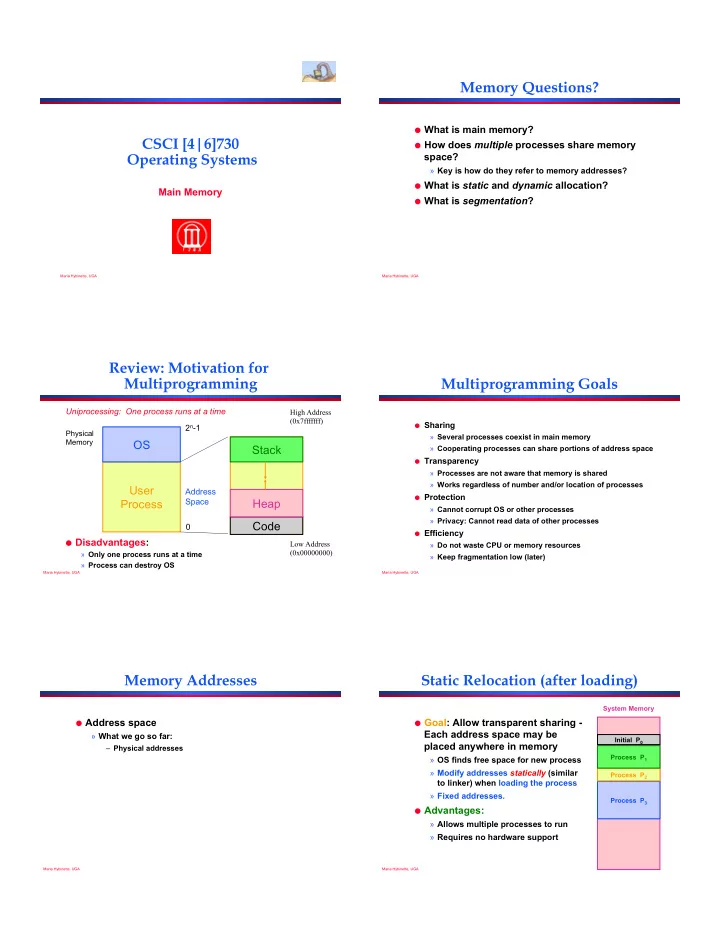
Memory Questions?

! What is main memory? ! How does multiple processes share memory

space?

» Key is how do they refer to memory addresses?

! What is static and dynamic allocation? ! What is segmentation?

Maria Hybinette, UGA

Review: Motivation for Multiprogramming

! Disadvantages: » Only one process runs at a time » Process can destroy OS

User Process OS

Physical Memory

2n-1

Stack Code Heap

Address Space Uniprocessing: One process runs at a time

Low Address (0x00000000) High Address (0x7fffffff)

Maria Hybinette, UGA

Multiprogramming Goals

! Sharing

» Several processes coexist in main memory » Cooperating processes can share portions of address space

! Transparency

» Processes are not aware that memory is shared » Works regardless of number and/or location of processes

! Protection

» Cannot corrupt OS or other processes » Privacy: Cannot read data of other processes

! Efficiency

» Do not waste CPU or memory resources » Keep fragmentation low (later)

Maria Hybinette, UGA

Memory Addresses

! Address space

» What we go so far:

– Physical addresses

Maria Hybinette, UGA

Static Relocation (after loading)

! Goal: Allow transparent sharing -

Each address space may be placed anywhere in memory

» OS finds free space for new process » Modify addresses statically (similar to linker) when loading the process » Fixed addresses.

! Advantages:

» Allows multiple processes to run » Requires no hardware support

Initial P0 Process P3 Process P2 Process P1 System Memory

slide-2
SLIDE 2

Maria Hybinette, UGA

Static Reallocation

! Disadvantages:

» No protection

– Process can destroy OS or other processes – No privacy

» Address space must be allocated contiguously

– Allocate space for worst-case stack and heap – Processes may not grow

» Cannot move process after they are placed or loaded (static addresses) » Fragmentation (later)

Initial P0 Process P3 Process P2 Process P1 System Memory Process P4

Maria Hybinette, UGA

Dynamic Relocation

! Goal: Protect processes from one another ! Requires hardware support

» Memory Management Unit (MMU)

! MMU dynamically changes process address at every

memory reference (compute address on-the-fly)

» Process generates logical or virtual addresses » Memory hardware uses physical or real addresses

CPU MMU Memory

Process runs here OS can control MMU Logical address Physical address

Maria Hybinette, UGA

Hardware Support for Dynamic Relocation

! Two operating modes

» Privileged (protected, kernel) mode: OS runs

– When enter OS (trap, system calls, interrupts, exceptions) – Allows certain instructions to be executed

! Can manipulate contents of MMU

– Allows OS to access all of physical memory

» User mode: User processes run

– Perform translation of logical address to physical address ! MMU contains base and bounds registers

» base: start location for address space (physical address) » bounds: size limit of address space (memory span)

Maria Hybinette, UGA

10

Implementation of Dynamic Relocation

! Translation on every memory access of user process

» MMU compares logical address to bounds register

– if logical address is greater, then generate error

» MMU adds base register to logical address to form physical address

mode ! = ! user?" <" bounds?"

logical address

base! bounds! mode! +! base! Registers:"

no " yes " no " error physical address

32 bits" 1 bit"

Maria Hybinette, UGA

Example of Dynamic Relocation

! What are the physical addresses for the following 16-

bit logical addresses (HEX: highest F:1111)?

! Process 1: base: 0x4320, bounds: 0x2220 (in HEX)

  • » 0x0000:

» 0x1110: » 0x3000:

! Process 2: base: 0x8540, bounds: 0x3330

» 0x0000: » 0x1110: » 0x3000:

! Operating System

» 0x0000: » 0x5FFF:

Maria Hybinette, UGA

12

Managing Processes with Base and Bounds

! Context-switch

» Add base and bounds registers to PCB » Steps:

  • 1. Change to privileged mode
  • 2. Save base and bounds registers of old process
  • 3. Load base and bounds registers of new process
  • 4. Change to user mode and jump to new process

! What if don’t change base and bounds registers when

switch?

! Protection requirement

» User process cannot change base and bounds registers » User process cannot change to privileged mode

slide-3
SLIDE 3

Maria Hybinette, UGA

13

Base and Bounds Discussion

! Advantages

» Provides protection (both read and write) across address spaces » Supports dynamic relocation

– Can move address spaces – Why might you want to do this?

» Simple, inexpensive: Few registers, little logic in MMU » Fast: Add and compare can be done in parallel

! Disadvantages

» Each process must be allocated contiguously in physical memory

– Must allocate memory that may not be used by process

» No partial sharing: Cannot share limited parts of address space

Operating System Process Process Process

" 30004 " 42094 " 30004 " 12090 "

base " bound "

Maria Hybinette, UGA

14

Segmentation

! Divide address space into

logical segments

» Each segment corresponds to logical entity in address space

– code, stack, heap ! Each segment can

independently:

» be placed separately in physical memory » grow and shrink » be protected (separate read/write/execute protection bits)

subroutine" stack" symbol" table " table" main " program" heap"

heap" main " program" subroutine" symbol " table" Physical Address Space Logical Address Space stacj"

Maria Hybinette, UGA

15

Segmented Addressing

! How does process designate a particular

segment?

» Use part of logical address

– Top bits of logical address select segment – Low bits of logical address select offset within segment

Maria Hybinette, UGA

16

Segmentation Implementation

! MMU contains Segment Table (per process)

» Each segment has own base and bounds, protection bits » Example: 14 bit logical address, 4 segments

Segment Base Bounds R W 0x2000 0x06ff 1 0 1 0x0000 0x04ff 1 0 2 0x3000 0x0fff 1 1 3 0x1000 0x0fff 0 0

! Translate logical addresses ! physical addresses: » 0x0240: 0th segment 240 internal address within segment ! what address? » 0x1108: » 0x265c: » 0x3002:

Maria Hybinette, UGA

17

Discussion of Segmentation

! Advantages

» Enables sparse allocation of address space

– Stack and heap can grow independently – Heap: If no data on free list, dynamic memory allocator requests more from OS (e.g., UNIX: malloc calls sbrk()) – Stack: OS recognizes reference outside legal segment, extends stack implicitly

» Different protection for different segments

– Read-only status for code

» Enables sharing of selected segments » Supports dynamic relocation of each segment

! Disadvantages

» Each segment must be allocated contiguously

– May not have sufficient physical memory for large segments

Maria Hybinette, UGA

18

When to Bind Physical & Logical Addresses

! Compile time: If memory location

known a priori, absolute code can be generated; must recompile code if starting location changes

! Load time: Must generate

relocatable code if memory location is not known at compile time

! Execution time: Binding delayed

until run time if the process can be moved during its execution from

  • ne memory segment to another.

Need hardware support for address maps (e.g., base and limit registers)

Compiler or Assembler System " Library" Load" module" Object " Module" Other" Object" Modules" Linkage editor loader In-memory Binary Memory image System " Library" Source" Program"

slide-4
SLIDE 4

Maria Hybinette, UGA

19

Motivation for Dynamic Memory

! Why do processes need dynamic allocation of memory?

» Do not know amount of memory needed at compile time » Must be pessimistic when allocate memory statically

– Allocate enough for worst possible case – Storage is used inefficiently ! Recursive procedures

» Do not know how many times procedure will be nested

! Complex data structures: lists and trees

» struct my_t *p = (struct my_t *)malloc(sizeof(struct my_t));

! Two types of dynamic allocation » Stack » Heap

Maria Hybinette, UGA

20

Stack Organization

! Definition: Memory is freed in opposite order from allocation

alloc(A); alloc(B); alloc(C); free(C); alloc(D); free(D); free(B); free(A); ! Implementation: Pointer separates allocated and freed

space

» Allocate: Increment pointer » Free: Decrement pointer

Maria Hybinette, UGA

21

Stack Discussion

OS uses stack for procedure call frames (local variables)

! Advantages

» Keeps all free space contiguous (and keep order of calls) » Simple to implement » Efficient at run time

! Disadvantages

» Not appropriate for all data structures

main() { int A = 0; maria(A); printf(“A: %d\n”, A); } void maria( int Z ) { int A = 2; Z = 5; printf(“A: %d Z: %d\n”, A, Z); }

Maria Hybinette, UGA

22

Heap Organization

! Definition: Allocate from any random

location

» Memory consists of allocated areas and free areas (holes) » Order of allocation and free is unpredictable

! Advantage

» Works for all data structures

! Disadvantages

» Allocation can be slow » End up with small chunks of free space

– fragmentation Alloc Alloc Alloc Alloc Alloc Alloc 16 bytes 24 bytes 20 bytes 16 bytes 8 bytes 12 bytes Alloc 16 bytes! Alloc 32 bytes

Maria Hybinette, UGA

23

Fragmentation

! Definition: Free memory that is too

small to be usefully allocated

» External: Visible to allocator » Internal: Visible to requester (e.g., if must allocate at some granularity)

! Goal: Minimize fragmentation

» Few holes, each hole is large » Free space is contiguous

! Stack

» All free space is contiguous » No fragmentation

! Heap

» How to allocate to minimize fragmentation?

Alloc Alloc Alloc Alloc Alloc

Internal within block

Maria Hybinette, UGA

24

Heap Implementation: Free List

! Data structure: free list

» A circular linked list of free blocks, tracks memory not in use » Header in each block

– size of block – ptr to next block in list ! void *Allocate( x bytes )

» Choose block large enough for request (>= x bytes) » Keep remainder of free block on free list » Update list pointers and size variable » Return pointer to allocated memory

! Free( ptr )

» Add block back to free list » Merge (coalesce) adjacent blocks in free list, update ptrs and size variables user data size p (addressed returned)

slide-5
SLIDE 5

Maria Hybinette, UGA

25

Heap Allocation Policies

! Best fit

» Search entire list for each allocation » Choose free block that most closely matches size of request » Optimization: Stop searching if see exact (close) match

! First fit

» Version 1:

– Allocate first block that is large enough

» Version 2:

– Rotating first fit (or “Next fit”):

! Variant of first fit, remember place in list ! Start with next free block each time

! Worst fit

» Allocate largest block to request (most leftover space)

Maria Hybinette, UGA

26

Heap Allocation Examples

Scenario: Two free blocks of size 20 and 15 bytes

! Allocation stream: 10, 20

» Best » First » Worst

! Allocation stream: 8, 12, 12

» Best » First » Worst

Maria Hybinette, UGA

27

Comparison of Allocation Strategies

! No optimal algorithm

» Fragmentation highly dependent on workload

! Best fit

» Tends to leave some (very large holes) and some very small holes

– Can’t use very small holes easily ! First fit

» Tends to leave “average” sized holes » Advantage: Faster than best fit » Next fit used often in practice

! Uses a ‘Modified’ Buddy allocation Scheme (Linux)

» Minimizes external fragmentation » Disadvantage: Internal fragmentation when not 2^n request

Maria Hybinette, UGA

28

Simple Buddy Allocation

! Fast, simple allocation for blocks of 2n bytes [Knuth68] ! void *Allocate ( k bytes )

» Raise allocation request to nearest (next highest) s = 2n

– 63K allocates a 64K block – 65K allocates a 128K block – 31K allocates a 32K block

» Search free list for appropriate size (near s)

– Recursively divide larger free blocks until find block of size s – “Buddy” block remains free ! Free( ptr )

» Mark blocks as as free » Recursively coalesce block with buddy, if buddy is free

– May coalesce lazily (later, in background) to avoid overhead

Maria Hybinette, UGA

29

Buddy Algorithm

!

Toy Example: Assume there is initially 64K bytes of memory and the first request is for 5K bytes

1. Round up request to nearest s=2n K ! so we need a s= 8K bytes and search for a block of that size

– Divide 64K block chunk into half (again, again and again) until desired block size and return to caller (shaded area)

2. Suppose second request is for 8 then return remaining free chunk to be used 3. Third request is for 4 -- split block again and again and return to caller 4. Fourth and last allocated 8 chunk is released and returned 5. Finally the other is released and coalesced

32 32 64 32 32 32 32 32 32 32 16 16 16 8 8 1 2 2 2 3 16 8 4 4 5 6 Allocated

Maria Hybinette, UGA

30

Buddy Implementation

! IF holes in free list is of power of 2 in size

then very easy to implement

» A buddy’s hole is the exclusive OR of the hole size and starting address of hole.

! Example:

» Blocks of size 4 could start at addresses:

– 0, 4, 8, 12, 16, 20,

Starting & Old New 0 ! 4 0000000 0000100 4 4 4 ! 4 0000100 0000000 8 8 ! 4 0001000 0001100 12 12 12 ! 4 0001100 0001000 8 16 16 ! 4 0010000 20 20 ! 4 0010100

slide-6
SLIDE 6

Maria Hybinette, UGA

31

Memory Allocation (K&R)

! How are malloc(), free()

implemented?

! Data structure: Circular list of

free chunks

» Header for each element of free list

– pointer to next free block – size of block ! Malloc: first-fit (next-fit) with splitting (large chunks) ! Free: coalescing with adjacent chunks if they are free ! Disadvantage:

» Fragmentation of memory due to first-fit (next-fit) strategy » Linear time to scan list during malloc and free

in use in use

Maria Hybinette, UGA

32

Improvements

! Placement: reducing fragmentation

» Deciding which free chuck to use » Use best fit or good fit

– Example: malloc(8) returns 8 byte block instead of 20 byte block ! Splitting: only split when saving is

big enough: malloc(14) allocate the entire block.

! Coalescing: defer coalescing ! Performance:

» Doubly - linked list in use in use 20 8 50

Maria Hybinette, UGA

33

Memory Allocation in Practice (improved)

! How are malloc(), free() implemented? ! Data structure: Free lists

» Header for each element of free list

– pointer to next free block – size of block – magic number

! consistency checking

! Two free lists

» One organized by size (binning)

– Separate list for each popular, small size (e.g., 1 KB) -- range of sizes -- fewer bins – Allocation is fast, no external fragmentation

» Second is sorted by address

– Use next fit to search appropriately – Free blocks shuffled between two lists

512 32 24 16

Maria Hybinette, UGA

34

Modified Buddy Algorithm

! Linux uses buddy system with the additional of having a

cache of pointers to free memory (a slab index array):

» the first element is the head of a list of blocks of size ‘unit 1’, » the second element is a list of blocks of size ‘unit 2’ » the third element is a list of blocks of size ‘unit 3’, !

! Each index contains only slabs of a specific size

» And they are linked together as linked list (which in turn links to the next free element (so the slabs themselves may not be contiguous)

Cache Sz1 Cache Dsc Sz2 Cache Dsc Sz3 Slab Slab

Maria Hybinette, UGA

35

Paging

! Goal: Eliminate external fragmentation ! Idea: Divide memory into fixed-sized pages

» Page Size: 2n, Example: A page size of 4KB » Physical page: page frame » Logical page: page

Physical View (frames)

Process 1 Process 2 Process 3

Logical View (pages)

Maria Hybinette, UGA

36

Translation of Page Addresses

! How to translate logical address to physical

address:

» High-order bits of address designate page number » Low-order bits of address designate offset within page

page number frame number in physical memory page offset page offset

Logical address Physical address

32 bits

page table

20 bits 12 bits

slide-7
SLIDE 7

Maria Hybinette, UGA

37

Paging Hardware

Maria Hybinette, UGA

38

Page Table Implementation

! Page table per process

» Page table entry (PTE) for each virtual page number (vpn)

– frame number or physical page number (ppn) – R/W protection bits ! Simple vpn ! ppn mapping:

» No bounds checking, no addition » Simply table lookup and bit substitution

! How many entries in table? ! Track page table base in PCB, change on context-switch

Maria Hybinette, UGA

39

Page Table Example

! What are contents of page table for

process 3?

Physical View (frames)

Process 3

frame R W 2 1 1 6 1 1 1 1 3 0 0 12 1 1 15 1 1

15 14 13 12 11 10 09 08 07 06 05 04 03 02 00 01

page table base

Maria Hybinette, UGA

40

Page Table: Example 2

32-byte (8 pages) addressable memory and 4-byte pages

Maria Hybinette, UGA

41

Advantages of Paging

! No external fragmentation

» Any page can be placed in any frame in physical memory » Fast to allocate and free

– Alloc: No searching for suitable free space – Free: Doesn’t have to coalesce with adjacent free space – Just use bitmap to show free/allocated page frames ! Simple to swap-out portions of memory to disk

» Page size matches disk block size » Can run process when some pages are on disk » Add “present” bit to page table entry (PTE)

! Enables sharing of portions of address space

» To share a page, have PTE point to same frame

Maria Hybinette, UGA

42

Disadvantages of Paging

! Internal fragmentation: Page size may not match size

needed by process

» Wasted memory grows with larger pages » large vs small page size

! Additional memory reference to look up in page table --

> Very inefficient

» Page table must be stored in memory » MMU stores only base address of page table

! Storage for page tables may be substantial

» Simple page table: Requires PTE for all pages in address space

– Entry needed even if page not allocated

» Problematic with dynamic stack and heap within address space

slide-8
SLIDE 8

Maria Hybinette, UGA

43

Combine Paging and Segmentation

! Goal: More efficient support for sparse address spaces ! Idea:

» Divide address space into segments (code, heap, stack)

– Segments can be variable length

» Divide each segment into fixed-sized pages

! Logical address divided into three portions: System 370 page offset (12 bits) page number (18 bits) seg # (4 bits) ! Implementation

» Each segment has a page table » Each segment track base (physical address) and bounds of page table (number of PTEs)

Maria Hybinette, UGA

44

Example of Paging and Segmentation

Example of Paging and Segmentation

seg

  • base

bounds R W 1400 5 1 0 1 6300 400 0 0 2 4300 1100 1 1 3 1100 5 1 1 ... 0x01f 0x011 0x003 0x02a 0x013 ... 0x00c 0x007 0x004 0x00b 0x006 ...

1100 1400

Maria Hybinette, UGA

45

Advantages of Paging and Segmentation

! Advantages of Segments

» Supports sparse address spaces

– Decreases size of page tables – If segment not used, not need for page table ! Advantages of Pages

» No external fragmentation » Segments can grow without any reshuffling » Can run process when some pages are swapped to disk

! Advantages of Both

» Increases flexibility of sharing

– Share either single page or entire segment

Maria Hybinette, UGA

46

Disadvantages of Paging and Segmentation

! Overhead of accessing memory

» Page tables reside in main memory » Overhead reference for every real memory reference

! Large page tables

» Must allocate page tables contiguously » More problematic with more address bits » Page table size

– Assume 2 bits for segment, 18 bits for page number, 12 bits for offset

Maria Hybinette, UGA

47

A = 1234

Disadvantages of Paging and Segmentation

! Overhead of accessing memory

» Page tables reside in main memory » Overhead reference for every real memory reference

! Large page tables

» Must allocate page tables contiguously » More problematic with more address bits » Page table size (32 bit address):

– Logical address space: 232 – Assume page size is 4 KB, 4,096 -> 212 – Page table has 232/212 entries = 2 20

! 1,048,576 Entries ! Each entry is 4 bytes

» 4MB for EACH page table

&777 Variable A 777

Maria Hybinette, UGA

48 ! 4 MB page tables

» Contagious in memory?

– Divide the page tables into smaller pieced – Idea is to page the page table hierarchically

! Assume 2 levels for a start.

slide-9
SLIDE 9

Maria Hybinette, UGA

49

Hierarchical Paging: Page the Page Tables

! Problem: Large logical address space 232 - 264 ! Goal: Allow page tables to be allocated non-contiguously ! Approach: Page the page tables (4K page size 4,096 is 212)

» Creates multiple levels of page tables » Only allocate page tables for pages in use (allows)

  • uter page

(10 bits) inner page (10 bits) page offset (12 bits) 32-bit address:

base of pt

Maria Hybinette, UGA

50

Example: Two Level Page Table

! A logical address (on 32-bit

machine with 4K page size) is divided into:

» a page number consisting of 20 bits » a page offset consisting of 12 bits

! Since the page table is paged, the

page number is further divided into:

» a 10-bit page number » a 10-bit page offset

! Thus, a logical address is as

follows:

» where p1 is an index into the outer page table, and p2 is the displacement within the page of the

  • uter page table

page number page offset p2 d 10

  • 10
  • 12
  • p1

p2

  • Maria Hybinette, UGA

51

Address-Translation Scheme

Maria Hybinette, UGA

52

Page the Page Tables (Homework)

! How should logical address be structured?

» How many bits for each paging level?

! Calculate such that page table fits within a

page (A Page Table Entry = PTE)

» Goal: PTE size * number PTE = page size » Assume PTE size = 4 bytes; page size = 4KB

2^2 * number PTE = 2^12

  • -> number PTE = 2^10

! # bits for selecting inner page = 10 (see earlier slides) ! Apply recursively throughout logical address

! Will assign homework through different layers of addressing all the way to disk

Maria Hybinette, UGA

53

Other Observation

! Accessing a memory location requires two

accesses in main memory.

– One to access the page table (which is in main memory)

! A contiguous lookup table.

– Another one that access the memory location)

! Anywhere in memory

! Problem: Expensive! Can we do better?

Maria Hybinette, UGA

54

Translation Look-Aside Buffer (TLB)

! Goal: Avoid page table lookups in main memory (i.e.,

a total of two memory accesses)

! Idea: Hardware cache of recent page translations

» Typical size: 64 - 2K entries » Index by segment + vpn --> ppn

! Why does this work?

» process references few unique pages in time interval » spatial, temporal locality

! On each memory reference, check TLB for translation

» If present (hit): use ppn and append page offset » Else (miss): Use segment and page tables to get ppn

– Update TLB for next access (replace some entry) ! How does page size impact TLB performance? (food

for thought).

slide-10
SLIDE 10

Maria Hybinette, UGA

55

Paging Hardware With TLB

Maria Hybinette, UGA

56

Effective Access Time

! Associative Lookup (TLB) = " time unit (small

fraction of the time to go to main memory)

» Assume memory cycle time is 1 microsecond » Hit ratio – percentage of times that a page number is found in the associative registers; ratio related to number of associative registers » Hit ratio = # (alpha) » Effective Access Time (EAT)

EAT = (1 + ") # + (2 + ")(1 – #) = 2 + " – #

Maria Hybinette, UGA

57

What Page Size? Page Size Trade-offs

! Internal Fragmentation

» Smaller the page size the less the internal fragmentation

! Number of pages

» The smaller the pages the greater the

  • f

pages » Larger Page tables

! Page size and page faults

» Larger page size implies (less or more) page faults.