SLIDE 1 1
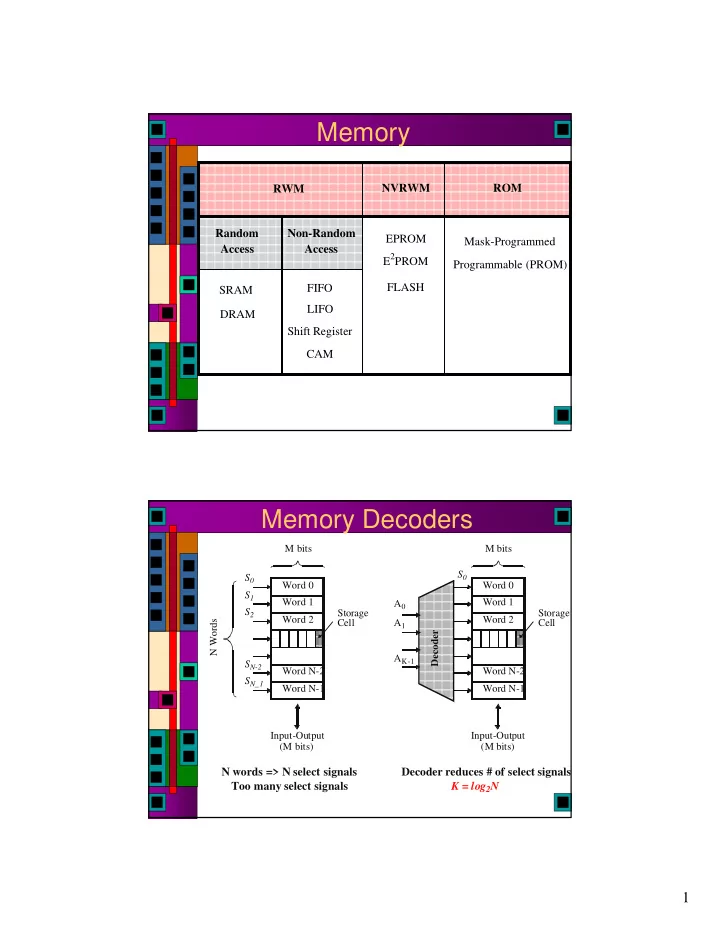
Memory
RWM NVRWM ROM EPROM E2PROM FLASH Random Access Non-Random Access SRAM DRAM Mask-Programmed Programmable (PROM) FIFO Shift Register CAM LIFO
Memory Decoders
Word 0 Word 1 Word 2 Word N-1 Word N-2 Input-Output S0 S1 S2 SN-2 SN_1 (M bits) Storage Cell M bits N Words Word 0 Word 1 Word 2 Word N-1 Word N-2 Input-Output (M bits) Storage Cell M bits Decoder A0 A1 AK-1 S0
N words => N select signals Too many select signals Decoder reduces # of select signals K = log2N
SLIDE 2 2
Array-Structured Memory
Input-Output (M bits) Row Decoder AK AK+1 AL-1 2L-K Column Decoder Bit Line Word Line A0 AK-1 Storage Cell Sense Amplifiers / Drivers M.2K
Problem: ASPECT RATIO or HEIGHT >> WIDTH
Amplify swing to rail-to-rail amplitude Selects appropriate word
Array Decoding
SLIDE 3 3
Hierarchical Memory Arrays
Global Data Bus Row Address Column Address Block Address Block Selector Global Amplifier/Driver I/O Control Circuitry Advantages:
- 1. Shorter wires within blocks
- 2. Block address activates only 1 block => power savings
Memory Timing Definitions
READ WRITE DATA Read Access Read Access Read Cycle Data Valid Data Written Write Access Write Cycle
SLIDE 4 4
Memory Timing Approaches
Address Bus RAS CAS RAS-CAS timing Address Bus Address Address transition initiates memory operation
DRAM Timing SRAM Timing
Row Address Column Address
MSB LSB
Multiplexed Adressing Self-timed
Example: HM6264 8kx8 SRAM
SLIDE 5
5
HM6264 Interface Function Table
SLIDE 6
6
Timing Read Cycle 1
SLIDE 7
7
Read Cycle 1
85ns min 85ns max 85ns max 85ns max 10ns min 10ns min 5ns min 45ns max 10ns min 30ns min 30ns min 30ns min
Read Cycle 2
SLIDE 8
8
Read Cycle 2
85ns max 10ns min 10ns min
Write Timing
SLIDE 9
9
Write Cycle Write Cycle
85ns min 75ns min 0ns min 75ns min 0ns min 55ns min 0ns min, 30ns max 40ns min 0ns min
SLIDE 10 10
What Does All This Mean
For a read:
If you assert CS1, CS2, address, and OE all at the same time, it will be max 85ns before valid data are available at chip outputs
For a write:
You can assert CS1, CS2, address, data, and WE all at the same time if you want to You need to wait 55ns from WE edge, or 75ns from CS1/CS2 edge for write to have happened
R/W Memories In General
- STATIC (SRAM)
- DYNAMIC (DRAM)
Data stored as long as supply is applied Large (6 transistors/cell) Fast Differential Periodic refresh required Small (1-3 transistors/cell) Slower Single Ended
SLIDE 11
11
SRAM Circuits SRAM Cell, Transistors
SLIDE 12 12
SRAM, Resistive Pullups Array-Structured Memory
Input-Output (M bits) Row Decoder AK AK+1 AL-1 2L-K Column Decoder Bit Line Word Line A0 AK-1 Storage Cell Sense Amplifiers / Drivers M.2K
Problem: ASPECT RATIO or HEIGHT >> WIDTH
Amplify swing to rail-to-rail amplitude Selects appropriate word
SLIDE 13
13
Memory Column
Each column has all the support circuits
Reading the Bit
Single-ended read using an inverter Dynamic pre-charge on the bit lines
P-types pull bit lines high
SLIDE 14
14
Reading the Bit 2
Single-ended read using an inverter Dynamic pre-charge on the bit lines
Note the N-types used as pull-ups
Reading the Bit 3
Differential read using sense amp Static N-type pullup on the bit lines
SLIDE 15
15
Read Waveforms Sense Amp
SLIDE 16
16
Sense Amp Transistors Column Organization
SLIDE 17
17
Write Circuits Write Circuit Simulation
SLIDE 18 18
Analog Sim, Circuit
VDD Q Q M1 M3 M4 M2 M5 BL WL BL M6
Analog Analysis, Write
VDD Q = 1 Q = 0 M1 M4 M5 BL = 1 WL BL = 0 M6 VDD
kn M6
,
VDD VTn – ( ) VDD 2
2
8
⎝ ⎠ ⎛ ⎞ kp M4
,
VDD VTp – ( ) VDD 2
2
8
⎝ ⎠ ⎛ ⎞ = kn M5
,
2
2
VDD 2
⎠ ⎛ ⎞ – ⎝ ⎠ ⎛ ⎞
2
kn M1
,
VDD VTn – ( ) VDD 2
2
8
⎝ ⎠ ⎛ ⎞ =
(W/L)n,M5 ≥ 10 (W/L)n,M1 (W/L)n,M6 ≥ 0.33 (W/L)p,M4
SLIDE 19 19
Analog Analysis, Read
VDD Q = 1 Q = 0 M1 M4 M5 BL WL BL M6 VDD VDD VDD Cbit Cbit kn M5
,
2
2
VDD 2
⎠ ⎛ ⎞ – ⎝ ⎠ ⎛ ⎞
2
kn M1
,
VDD VTn – ( ) VDD 2
2
8
⎝ ⎠ ⎛ ⎞ =
(W/L)n,M5 ≤ 10 (W/L)n,M1 (supercedes read constraint)
6T SRAM Layout
SLIDE 20
20
Another 6T SRAM Layout SRAM bit from makemem (v1)
SLIDE 21 21
SRAM bit from makemem (v2) Array-Structured Memory
Input-Output (M bits) Row Decoder AK AK+1 AL-1 2L-K Column Decoder Bit Line Word Line A0 AK-1 Storage Cell Sense Amplifiers / Drivers M.2K
Problem: ASPECT RATIO or HEIGHT >> WIDTH
Amplify swing to rail-to-rail amplitude Selects appropriate word
SLIDE 22
22
Row Decoders
Select exactly one of the memory rows
Simple versions are just gates
Row Decoder Gates
Standard gates Or, pseudo-nmos gates with static pull up
Easier to make large fan-in NOR
SLIDE 23
23
Pre-decode Row Decoder
Multiple levels of decoding can be more efficient layout
Pre-decode Row Decoder
Other circuit tricks for building row decoders…
SLIDE 24 24
Array-Structured Memory
Input-Output (M bits) Row Decoder AK AK+1 AL-1 2L-K Column Decoder Bit Line Word Line A0 AK-1 Storage Cell Sense Amplifiers / Drivers M.2K
Problem: ASPECT RATIO or HEIGHT >> WIDTH
Amplify swing to rail-to-rail amplitude Selects appropriate word
Array-Structured Memory
SLIDE 25
25
Sharing Sense Amps Sense Amp Mux
SLIDE 26
26
Sense Amp Mux Decoded Column Decode
SLIDE 27
27
Improving Speed, Power Multi-Port Memory
Very common to require multiple read ports
Think about a register file, for example
SLIDE 28
28
Multi-Port Register
Re1 Re0
Slightly larger cell, but with single-ended read – makes a great register file
Register File
Slightly larger cell, but with single-ended read – makes a great register file
SLIDE 29
29
Dynamic RAM
Get rid of the pull-ups!
Store info on capacitors Means that stored information leaks away
Dynamic RAM…
Once you agree to use a capacitor for charge storage there are other ways to build this…
SLIDE 30 30
3T DRAM Circuit
M2 M1 BL1 WWL BL2 M3 RWL CS X WWL RWL X BL1 BL2 VDD-VT ΔV VDD VDD-VT
No constraints on device ratios Reads are non-destructive Value stored at node X when writing a “1” = VWWL-VTn
3T DRAM Layout
BL2 BL1 WWL RWL M1 M2 M3 GND
SLIDE 31
31
1 T DRAM Circuit 2-T (1-T) DRAM layout
Note the increased gate size of the storage transistor
Increases the capacitance
SLIDE 32 32
1T DRAM Observations
1T DRAM requires a sense amplifier for each bit line, due to charge redistribution read-out. DRAM memory cells are single ended in contrast to SRAM cells. The read-out of the 1T DRAM cell is destructive; read and refresh operations are necessary for correct operation. Unlike 3T cell, 1T cell requires presence of an extra capacitance that must be explicitly included in the design. When writing a “1” into a DRAM cell, a threshold voltage is lost. This charge loss can be circumvented by bootstrapping the word lines to a higher value than VDD.
1T DRAM Read/Write
CS M1 BL WL CBL WL X BL VDD−VT VDD/2 VDD
GND Write "1" Read "1" sensing VDD/2 ΔV VBL VPRE – VBIT VPRE – ( ) CS CS CBL +
=
Write: CS is charged or discharged by asserting WL and BL. Read: Charge redistribution takes places between bit line and storage capacitance Voltage swing is small; typically around 250 mV.
SLIDE 33
33
1T DRAM Cell
“Folded bit line”
Array of DRAM Cells
“Folded Bit Line”
SLIDE 34
34
Reading a 1T DRAM Cell
Charge Sharing
DRAM Sense Amp
SLIDE 35
35
Photo of 1T DRAM Advanced DRAM Cells
Trench Capacitor Try to get more capacitance per unit area…
SLIDE 36 36
Examples of Advanced DRAMs
Cell Plate Si Capacitor Insulator Storage Node Poly 2nd Field Oxide Refilling Poly Si Substrate
Trench Cell Stacked-capacitor Cell
Capacitor dielectric layer Cell plate Word line Insulating Layer Isolation Transfer gate Storage electrode
Memory Timing Approaches
Address Bus RAS CAS RAS-CAS timing Address Bus Address Address transition initiates memory operation
DRAM Timing SRAM Timing
Row Address Column Address
MSB LSB
Multiplexed Adressing Self-timed
SLIDE 37
37
DRAM Interface Extended Data Out Page Mode
SLIDE 38
38
Comments on Timing Architectural Issues
SLIDE 39
39
SDRAM - Use CAS for Bursts DDR SDRAM
Double Data Rate
SLIDE 40
40
DRAM Timing RAMBUS DRAM (RDRAM)
SLIDE 41
41
RDRAM Bandwidth Maximum Bandwidth
SLIDE 42
42
Normal Bus for DRAM DIMMs RDRAM Bus
SLIDE 43
43
Deep Pipelining - High Latency RDRAM Addressing
SLIDE 44
44
Row Activate Command RDRAM System Arch
SLIDE 45
45
RDRAM Internal Arch Regular DRAM
SLIDE 46
46
Single Bank DRAM Multi-Bank DRAM
SLIDE 47
47
Peak Bandwidth ROM
SLIDE 48
48
ROM
WL[0] WL[1] WL[2] WL[3] BL[0] BL[1] BL[2] BL[3] GND GND VDD Pull-up devices
ROM
SLIDE 49 49
ROM ROM Layout
Metal1 on top of diffusion Basic cell 10 λ x 7 λ 2 λ WL[0] WL[1] WL[2] WL[3] GND (diffusion) Metal1 Polysilicon
Only 1 layer (contact mask) is used to program memory array Programming of the memory can be delayed to one of last process steps
SLIDE 50 50
ROM Layout Precharged ROM
WL[0] WL[1] WL[2] WL[3] BL[0] BL[1] BL[2] BL[3] GND GND VDD Precharge devices φpre
PMOS precharge device can be made as large as necessary, but clock driver becomes harder to design.
SLIDE 51
51
Precharged ROM Other Memory Cells
SLIDE 52 52
Non-Volatile ROM
EPROM
Erasable Programmable ROM
EEPROM
Electrically Erasable Programmable ROM
Flash EEPROM
Electrically Erasable Programmable ROM that is erased in large chunks
All these devices rely on trapping charge
EPROM
Source Drain Gate Floating gate tox tox Substrate n+ n+
p
(a) Device cross-section S D G (b) Schematic symbol
SLIDE 53 53
Programming EPROM
Higher Vth (around 7v) means that 5v Vgs no longer turns on the transistor SiO2 is an excellent insulator
Trapped charge can stay for years
D S 20 V 20 V D S 0 V 0 V 10 V→ 5 V −5 V D S 5 V 5 V −2.5 V
Avalanche injection. Removing programming voltage leaves charge trapped. Programming results in higher VT.
Erasing an EPROM
Erase by shining UV light through window in the package
UV radiation makes oxide slightly conductive Erasure is slow - from seconds to minutes depending on UV intensity Also the erase/program cycles are limited (around 1000), mainly as a result of the UV erasing
But, EPROMs are simple and dense
SLIDE 54 54
EEPROM
Thin oxide allows erasing in-system
Fowler-Nordheim Tunneling
Source Drain Gate Floating gate Substrate n+ n+ 10 nm 20-30 nm
(a) Flotox transistor
VGD I
(b) Fowler-Nordheim I-V characteristic
10 V −10 V p BL WL VDD
(c) EEPROM cell during a read operation
Floating Gate Tunneling Oxide transistor
EEPROM
Two transistors instead of one
The second keeps you from removing too much charge during erasure
Bigger and not as dense as EPROM But, more erase/program cycles
On the order of 105 Eventually you get permanently trapped charge in the SiO2
SLIDE 55 55
Flash EEPROM
Essentially the same as EEPROM
But, large regions erased at once Means you can monitor the voltages and don’t need the extra access transistor
n+ drain n+ source p-substrate Control gate Floating gate programming erasure Thin tunneling oxide
Flash EEPROM
SLIDE 56
56
Realistic PROM Devices Content Addressable Mem
Asks the question: Are there are any locations that hold this value?
Used for tag memories in associative caches Or translation lookaside buffers Or other pattern matching applications
SLIDE 57
57
Content Addressable Mem
Add the Match line
Essentially a distributed NOR gate
Content Addressable Mem
SLIDE 58 58
Programmable Logic Array
x0 x1 x2 f0 f1
AND PLANE OR PLANE
x0x1 x2
Product Terms
PLA
Still useful for random combinational logic
Standard cell ASIC tools may be replacing them
They can generate dense AND-OR circuits
SLIDE 59 59
Pseudo-Static PLA Circuit
f0 f1 GND GND VDD GND x0 x0 x1 x1 x2 x2 GND GND GND GND VDD AND-PLANE OR-PLANE
Dynamic PLA
f0 f1 GND VDD φOR x0 x0 x1 x1 x2 x2 GND VDD AND-PLANE OR-PLANE φAND φOR φAND
SLIDE 60 60
PLA Layout
VDD GND φ And-Plane Or-Plane f0 f1 x0 x0 x1 x1 x2 x2 Pull-up devices Pull-up devices
PLA vs. ROM
Programmable Logic Array structured approach to random logic “two level logic implementation” NOR-NOR (product of sums) NAND-NAND (sum of products) IDENTICAL TO ROM! Main difference ROM: fully populated PLA: one element per minterm Note: Importance of PLA’s has drastically reduced
- 1. slow
- 2. better software techniques (mutli-level logic
synthesis)
SLIDE 61
61
FPGAs
Field Programmable Gate Arrays
Array of P-type and N-type transistors Sources and drains connected to
Power and ground Metal
Map gate structures to sea of gates Less expensive – only modify metal masks