Memory Hierarchy & Caching Use several levels of faster and - - PowerPoint PPT Presentation

memory hierarchy caching
SMART_READER_LITE
LIVE PREVIEW

Memory Hierarchy & Caching Use several levels of faster and - - PowerPoint PPT Presentation

7a.1 7a.2 Memory Hierarchy & Caching Use several levels of faster and faster memory to hide delay of upper levels EE 457 Unit 7a Unit of Transfer: Word, Half, or Byte (LW, LH, LB or SW, SH, SB) Registers L1 Cache ~ 1ns Cache and


slide-1
SLIDE 1

7a.1

EE 457 Unit 7a

Cache and Memory Hierarchy

7a.2

Memory Hierarchy & Caching

  • Use several levels of faster and faster memory to hide delay of

upper levels

Secondary Storage ~1-10 ms Main Memory ~ 100 ns L2 Cache ~ 10ns L1 Cache ~ 1ns Registers

Unit of Transfer: Cache block/line

1-8 words (Take advantage of spatial locality)

Unit of Transfer: Page

4KB-64KB words (Take advantage of spatial locality)

Unit of Transfer: Word, Half, or Byte

(LW, LH, LB or SW, SH, SB)

7a.3

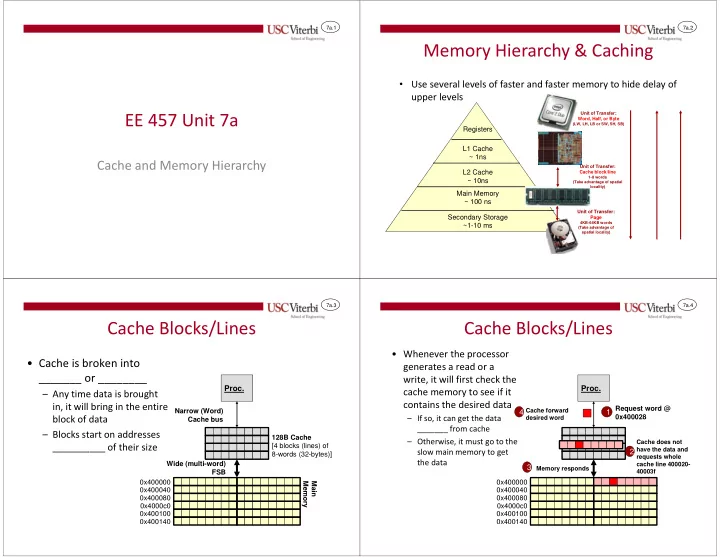
Cache Blocks/Lines

0x400000 0x400040 0x400080 0x4000c0 128B Cache [4 blocks (lines) of 8-words (32-bytes)]

Proc.

Main Memory 0x400100 0x400140 Wide (multi-word) FSB Narrow (Word) Cache bus

  • Cache is broken into

_______ or ________

– Any time data is brought in, it will bring in the entire block of data – Blocks start on addresses __________ of their size

7a.4

Cache Blocks/Lines

0x400000 0x400040 0x400080 0x4000c0

Proc.

0x400100 0x400140

  • Whenever the processor

generates a read or a write, it will first check the cache memory to see if it contains the desired data

– If so, it can get the data _______ from cache – Otherwise, it must go to the slow main memory to get the data

Request word @ 0x400028

1

Cache does not have the data and requests whole cache line 400020- 40003f

2 3 Memory responds 4 Cache forward

desired word

slide-2
SLIDE 2

7a.5

Cache & Virtual Memory

  • Exploits the Principle of Locality

– Allows us to implement a hierarchy of memories: cache, MM, second storage – Temporal Locality: If an item is reference it will tend to be _____________________

  • Examples: ________, ___________________, setting a variable

and then reusing it many times

– Spatial Locality: If an item is referenced items whose _________________ will tend to be referenced soon

  • Examples: ___________ and ______________

7a.6

Cache Definitions

  • Cache _____ = Desired data is in cache
  • Cache _____ = Desired data is not present in cache
  • When a cache ________ occurs, a new block is brought from MM into

cache

– _____________: First load the word requested by the CPU and forward it to the CPU, while continuing to bring in the remainder of the block – _______________: First load entire block into cache, then forward requested word to CPU

  • On a ___________ we may choose to not bring in the MM block since

writes exhibit less locality of reference compared to reads

  • When CPU writes to cache, we may use one of two policies:

– __________________________: Every write updates both cache and MM copies to keep them in sync. (i.e. coherent) – ____________: Let the CPU keep writing to cache at fast rate, not updating

  • MM. Only copy the block back to MM when it needs to be replaced or flushed

7a.7

Write Back Cache

0x400000 0x400040 0x400080 0x4000c0

Proc.

0x400100 0x400140

  • On write-hit
  • Update only cached copy
  • Processor can continue

quickly (e.g. 10 ns)

  • Later when block is evicted,

entire block is written back (because bookkeeping is kept on a per block basis)

  • Ex: 8 words @ 100 ns

per word for writing mem. = 800 ns

Write word (hit)

1

Cache updates value & signals processor to continue

2 5 On eviction, entire

block written back

3 4

7a.8

Write Through Cache

0x400000 0x400040 0x400080 0x4000c0

Proc.

0x400100 0x400140

  • On write-hit
  • Update both cached and

main memory version

  • Processor may have to wait

for memory to complete (e.g. 100 ns)

  • Later when block is evicted,

no writeback is needed

Write word (hit)

1

Cache and memory copies are updated

2 3 On eviction, entire

block written back

slide-3
SLIDE 3

7a.9

Cache Definitions

  • Mapping Function: The correspondence between MM blocks

and cache block frames is specified by means of a mapping function

– – –

  • Replacement Algorithm: How do we decide which of the

current cache blocks is removed to create space for a new block

– –

7a.10

Fully Associative Cache Example

  • Cache Mapping Example:

– Fully Associative – MM = 128 words – Cache Size = 32 words – Block Size = 8 words

  • Fully Associative

mapping allows a MM block to be placed (associate with) ____ ____ cache block

  • To determine hit/miss we

have to search ______________

0000 0001 0010 0011 Data 0100 0101 0110 0111 1000 1001 1010 1011 1100 1101 1110 1111 000-111 000-111 000-111 000-111 000-111 000-111 000-111 000-111 000-111 000-111 000-111 000-111 000-111 000-111 000-111 000-111 000-111 1 1 1 Data 000-111 1 1 Data 000-111 1 1 Data 000-111 1 1 1 1 1 1 1 CPU Address Tag Word Cache Tag V Main Memory Processor Core Logic Word Word data corresponding to address 1111000-1111111 Processor Die

= = = =

7a.11

Implementation Info

  • Tags: Associated with each cache block frame, we have a TAG

to identify its ________________________

  • Valid bit: An additional bit is maintained to indicate that

whether the TAG is valid (meaning it contains the TAG of an actual block)

– Initially when you turn power on the cache is empty and all valid bits are turned to ‘0’ (invalid)

  • _________: This bit associated with the TAG indicates when

the block was modified (got dirtied) during its stay in the cache and thus needs to written back to MM (used only with the write-back cache policy)

7a.12

Fully Associative Hit Logic

  • Cache Mapping Example:

– Fully Associative, MM = 128 words (27), Cache Size = 32 (25) words, Block Size = (23) words

  • Number of blocks in MM = _________________
  • Block ID = ____________
  • Number of Cache Block Frames = ____________

– Store ____ Tags of 4-bits + 1 valid bit – Need 4 _________________ each of _______

  • CAM (Content Addressable Memory) is a special memory

structure to store the tag+valid bits that takes the place of these comparators but is too expensive

slide-4
SLIDE 4

7a.13

Fully Associative Does Not Scale

  • If 80386 used Fully Associative Cache Mapping :

– Fully Associative, MM = 4GB (232), Cache Size = 64KB (216), Block Size = (16=24) bytes = 4 words

  • Number of blocks in MM = _______________
  • Block ID = _______
  • Number of Cache Block Frames = _________________

– Store _______ Tags of 28-bits + 1 valid bit – Need _______ Comparators each of 29 bits

________________________

7a.14

Fully Associative Address Scheme

  • A[1:0] unused => /BE3…/BE0
  • Word bits = _____________
  • Tag = Remaining bits

7a.15

Direct Mapping Cache Example

  • Limit each MM block to

__________ location in cache

  • Cache Mapping Example:

– Direct Mapping – MM = 128 words – Cache Size = 32 words – Block Size = 8 words

  • Each MM block i maps to

Cache frame ________

– N = # of cache frames – Tag identifies which group that colored block belongs

00 00 00 01 00 10 00 11 Data 01 00 01 01 01 10 01 11 10 00 10 01 10 10 10 11 11 00 11 01 11 10 11 11 000-111 000-111 000-111 000-111 000-111 000-111 000-111 000-111 000-111 000-111 000-111 000-111 000-111 000-111 000-111 000-111 000-111 1 1 1 Data 000-111 1 1 Data 000-111 1 1 Data 000-111 1 1 1 1 1 1 CPU Address Tag Word Cache Tag V Main Memory Processor Core Logic Word __________ that each map to different cache blocks but share the same tag Processor Die CBLK Tag Word BLK

Member Analogy

7a.16

Direct Mapping Address Usage

  • Cache Mapping Example:

– Direct Mapping, MM = 128 words (27), Cache Size = 32 (25) words, Block Size = (23) words

  • Number of blocks in MM = 27 / 23 = 24
  • Block ID = 4 bits
  • Number of Cache Block Frames = 25 / 23 = 22 = 4

– Number of "colors“ => ____ Number of Block field Bits

  • _______________ = 4 Groups of blocks

– 2 Tag Bits

Tag Word CBLK 2

3

2 Block ID=4

slide-5
SLIDE 5

7a.17 Processor Core Logic

Direct Mapping Hit Logic

  • Direct Mapping Example:

– MM = 128 words, Cache Size = 32 words, Block Size = 8 words

  • Block field addresses tag RAM and compares stored tag with tag of desired address

00 00 00 01 00 10 00 11 01 00 01 01 01 10 01 11 10 00 10 01 10 10 10 11 11 00 11 01 11 10 11 11 000-111 000-111 000-111 000-111 000-111 000-111 000-111 000-111 000-111 000-111 000-111 000-111 000-111 000-111 000-111 000-111 1 1 1 1 1 1 1 1 1 1 1 1 1 CPU Address Tag Word _______________ RAM Tag V Main Memory CBLK _________ RAM 00000 00111 01000 01111 10000 10111 11000 11111 … … … …

Addr Addr Data

=

1 1 1 1 1 7a.18

Direct Mapping Address Usage

  • If 80386 used Direct Cache Mapping :

– MM = 4GB (232), Cache Size = 64KB (216), Block Size = (16=24) bytes = 4 words

  • Number of blocks in MM = 232 / 24 = 228
  • Number of Cache Block Frames = 216 / 24 = 212 = 4096

– Number of "colors“ => ______ Block field bits

  • __________________ Groups of blocks

– 16 Tag Field Bits

Tag CBLK Block ID=28 Byte

2

Word

2

7a.19

Tag and Data RAM

  • 80386 Direct Mapped Cache Organization

CBLK 16 12 Block ID=28 Byte

2 2

64KB Cache Data RAM Cache Tag RAM (4K x 17)

Addr Addr Data

=

Tag 1

Valid

CBLK Word Hit or Miss

16KB Mem 16KB Mem 16KB Mem 16KB Mem /BE3 /BE2 /BE1 /BE0

Key Idea: Direct Mapped = 1 Lookup/Comparison to determine a hit/miss 7a.20

Direct Mapping Address Usage

  • Divide MM and Cache into equal size blocks of __ words

– M main memory blocks, N cache blocks – Log2(B) word field bits

  • A block in caches is often called a cache block/line frame since

it can hold many possible MM blocks over time

  • For direct mapping, if you have N cache frames, then define N

“colors/patterns”

– _____________ block field bits

  • Repeatedly paint MM blocks with those N colors in round-

robin fashion

  • _________ groups will form

– Log2(______) tag field bits

slide-6
SLIDE 6

7a.21

Direct Mapping Datapath

  • How many TAG RAM’s?

– Is that answer dependent on address field sizes?

  • How many entries in the TAG

RAM?

  • How many bits wide is each entry

in the TAG RAM?

  • How many DATA RAM’s?

– What size is the address field?

1 1 1 1 Tag Word CBLK 7a.22

Alternate Direct Mapping Scheme

  • Can you “color” (i.e.

map) the blocks of main memory in a different order?

  • Use _________ as

BLK field or _________ bits

  • Which is more

desirable or does it not really matter?

00 01 10 11 BLK 00 00 01 10 11 00 01 10 11 00 01 10 11

000 111

BLK 01 BLK 10 BLK 11 Cache Main Memory Mapping A Word

Member Analogy

00 Main Memory Mapping B 00 00 00 01 01 01 01 10 10 10 10 11 11 11 11 Word

Member Analogy

0000 0001 0010 0011 0100 0101 0110 0111 1000 1001 1010 1011 1100 1101 1110 1111 0000 0001 0010 0011 0100 0101 0110 0111 1000 1001 1010 1011 1100 1101 1110 1111 000 111 000 111 000 111 000 111 000 111 000 111 000 111 000 111 000 111 000 111 000 111 000 111 000 111 000 111 000 111 000 111 000 111 000 111 000 111 000 111 000 111 000 111 000 111 000 111 000 111 000 111 000 111 000 111 000 111 000 111 000 111

7a.23

Single or Parallel RAM’s

  • Is it cheaper to have

– (1) 2KB RAM – (2) 1KB RAM’s

  • Area wise a 2KB RAM ___________________
  • For tag and data RAMs it would be more economical

to use fewer, big RAM’s

  • However, consider need for parallel access

RAM RAM RAM Only one item at a time Two items accessed in parallel 7a.24

Set-Associative Mapping Example

  • Cache Mapping

Example:

– Direct Mapping – MM = 128 words – Cache Size = 32 words – Block Size = 8 words

  • Each MM block i maps

to Cache frame ________

– S = # of sets (______ of cache frames) – Tag identifies which group that colored block belongs to

000 0 000 1 001 0 001 1 Data 010 0 010 1 011 0 011 1 100 0 100 1 101 0 101 1 110 0 110 1 111 0 111 1 1 Data 1 Data 1 Data 1 1 1 1 1 CPU Address Tag Word Cache Tag V Main Memory Processor Core Logic Word Group of blocks that each map to different cache blocks but share the same tag Processor Die

Set

Tag Word Set Grp

Member

Color

Analogy

1

Set 1 Set 0 000 111 000 111 000 111 000 111 000 111 000 111 000 111 000 111 000 111 000 111 000 111 000 111 000 111 000 111 000 111 000 111 000 111 000 111 000 111 000 111 Grp 0 Grp 2 Grp 3 Grp 4 Grp 5 Grp 6 Grp 7 Grp 1

Way 0 Way 1 Way 0 Way 1

slide-7
SLIDE 7

7a.25

Set-Associative Datapath

Data 1 1 Data 1 Data 1 1 Data 1 1 Cache Tag V Word 1 1 1

Set 1 Set 0 000 111 000 111 000 111 000 111

Way 0 Way 1 Way 0 Way 1

Way-0 Cache Tag RAM

Addr Data

Data Data Data Data

Way 0 Way 1 Way 0 Way 1

1 1 1 1 1 1 1 1 1 1

Set 3 Set 2 000 111 000 111 000 111 000 111

N=8 Total Cache Blocks 4 Sets with 2-ways each Way-0 Data RAM

Addr Data 000 111 000 111 000 111 000 111

Way-1 Cache Tag RAM

Addr Data

Way-1 Data RAM

Addr Data 000 111 000 111 000 111 000 111 Set 0 Set 1 Set 2 Set 3

7a.26

Set-Associative Datapath

Way-0 Cache Tag RAM

Addr Data

N=8 Total Cache Blocks 4 Sets with 2-ways each Way-0 Data RAM

Addr Data 000 111 000 111 000 111 000 111

Way-1 Cache Tag RAM

Addr Data

Way-1 Data RAM

Addr Data 000 111 000 111 000 111 000 111

=

1 1 1 1 Tag Word

Set

CPU Address 1

=

1

Valid

1

Valid

Word

Set

Hit or Miss Hit or Miss Word

Set

7a.27

Set-Associative Mapping Address Usage

  • Define K = ______________________
  • If you have N total cache frames, then define number of sets,

S, = _________________________________

  • Define S colors/patterns

– Log2(S) = Log2(_____) set field bits

  • Repeatedly paint MM blocks with those S colors in round-

robin fashion

  • _______ groups will form

– Log2(____) tag field bits

7a.28

Set-Associative Mapping Datapath

  • How many TAG RAM’s?
  • How many entries in the TAG

RAM?

  • Place tags from different sets that

belong to ‘Way 0’ in one tag ram, ‘Way 1’ in another, etc.

  • How many DATA RAM’s?

– What size is the address field?

1 1 1 1 Tag Word

SET

Key Idea: K-Ways => K comparators

(What is a 1-way Set Associative Mapping)

slide-8
SLIDE 8

7a.29

K-Way Set Associative Mapping

  • If 80386 used K-Way Set-Associative Mapping:

– MM = 4GB (232), Cache Size = 64KB (216), Block Size = (16=24) bytes = 4 words

  • Number of blocks in MM = 232 / 24 = 228
  • Number of Cache Block Frames = 216 / 24 = 212 = 4096
  • Set Associativity/Ways (K) = 2 Blocks/Set

– Number of "colors“ => 212/2 = 211Sets => 11 Set field bits

  • 228 / 211 = 217 = 128K Groups of blocks

– 17 Tag Field Bits

Tag Set 17 11 Block ID=28 Byte

2

Word

2

7a.30

Tag RAM Organizations

  • 80386 2-Way Set-Associative Cache Organization

Set 17 11 Block ID=28

2 2

Cache Tag RAM (2K x 18)

Addr Data

=

Tag 1

Valid

Hit or Miss Set Cache Tag RAM (2K x 18)

Addr Data

=

Hit or Miss Tag 1

Valid

7a.31

Data RAM Organizations

  • 80386 2-Way Set-Associative Cache Organization

17 11 Block ID=28 Byte

2 2

32KB Cache Data RAM

Addr

SET Word

8KB Mem 8KB Mem 8KB Mem 8KB Mem /BE3 /BE2 /BE1 /BE0

32KB Cache Data RAM

Addr 8KB Mem 8KB Mem 8KB Mem 8KB Mem /BE3 /BE2 /BE1 /BE0

SET Word 7a.32

Set Associative Example

  • Suppose the cache size is 212 blocks
  • What is the set size?
  • If the set associativity can be changed,

– What is the smallest set size?

  • Maximum # of sets =
  • Largest Set Field=_________ Smallest Tag=
  • _______________ Mapping

– What is the largest set size?

  • Minimum # of sets =
  • Smallest Set Field=_______ , Largest Tag=
  • _______________ Mapping

Tag Set 18 10 Byte

2

Word

2

slide-9
SLIDE 9

7a.33

LIBRARY ANALOGY

7a.34

Mapping Functions

  • A mapping function determines the correspondence

between MM blocks and cache block frames

  • 3 Schemes

– Fully Associative – Direct Mapping – Set-Associative

  • Really just 1 scheme

– Fully Associative = N-way Set Associative – Direct Mapping = 1-way Set Associative

7a.35

Library  Memory

  • Compare MM to a large

library

  • Compare cache to your

dorm room book shelf

  • “Address” of a book =

10-digit ISBN number

  • Assume library has a

location on the shelf for all 1010 possible books

MM

Block

Cache

Block Frame

Doheny Library

ISBN 10-digit 1010 = 10 billion

Dorm Room Shelf

Room for 1000 books

7a.36

Book Addressing

  • Addresses are not

stored in memory (only data)

  • Assume library has a

location on the shelf for all 1010 possible books

  • No need to print ISBN
  • n the book if each

book has a location (find a book by going to its slot using ISBN as index)

MM

Block

Cache

Block Frame

Doheny Library

ISBN 10-digit 1010 = 10 billion

Dorm Room Shelf

Room for 1000 books

slide-10
SLIDE 10

7a.37

Fully Associative Analogy

  • Cache stores full Block-ID as

a TAG to identify that block

  • When we check a book out

and take it to our dorm room shelf…

– Let’s allow it to be put in any free slot on the shelf – We need to keep the entire ISBN number as a TAG

  • To find a book with a given

ISBN on our shelf, we must look through them all

MM

Block

Cache

Block Frame

Doheny Library

ISBN 10-digit 1010 = 10 billion

Dorm Room Shelf

Room for 1000 books

7a.38

Direct Mapping Analogy

  • Cache uses block field to identify the slot

in the cache and then stores remainder as TAG to identify that block from others that also map to that slot

  • Assume we number the slots on our

book shelf from 0 to 999

  • When we check a book out and take it to
  • ur dorm room shelf we can…

– Use last 3-digits of ISBN to pick the slot to store it – If another book is their, take it back to Doheny library (evict it) – Store upper 7 digits to identify this book from others that end with the same 3- digits

  • To find a book with a given ISBN on our

shelf, we use the last 3-digits to choose which slot to look in and then compare the upper 7-digits

MM

Block

Cache

N Block Frames

Doheny Library

ISBN 10-digit 1010 = 10 billion

Dorm Room Shelf

Room for 1000 books ISBN 0123456789 Slot 789 on

  • ur shelf

(0123456789) mod 1000 = 789 Tag

7a.39

Set Associative Mapping Analogy

  • Cache blocks are divided into groups known as
  • sets. Each MM block is mapped to a particular

set but can be anywhere in the set (i.e. all TAGS in the set must be compared)

  • Assume our bookshelf is 10 shelves with room

for 100 books each

  • When we check a book out and take it to our

dorm room shelf we can…

– Use last 1-digit of ISBN to pick the shelf but store the book anywhere on the shelf where there is an empty slot – Only if the shelf is full do we have to pick a book to take back to Doheny library (evict it) – Store upper 9 digits to identify this book from

  • thers that end with the same 1-digit
  • To find a book with a given ISBN on our shelf,

we use the last 1-digits to choose which shelf to look in and then compare upper 9-digits with those of all the books on the shelf

MM

Block

Cache

N Block Frames

Doheny Library

ISBN 10-digit 1010 = 10 billion

Dorm Room Shelf

10 shelves of 100 books each ISBN 0123456789 Shelf 9 is chosen (0123456789) mod 10 = 9 Tag
7a.40

Set Associative Mapping Analogy

  • Can we confidently say,

– We can bring in any (10/100/other) book(s) – We can bring in (10/100/other) consecutive book(s)

  • Library analogy:

– 10 sets each with 100 slots = 100-way set associative cache

MM

Block

Cache

N Block Frames

Doheny Library

ISBN 10-digit 1010 = 10 billion

Dorm Room Shelf

10 shelves of 100 books each ISBN 0123456789 Shelf 9 is chosen (0123456789) mod 10 = 9 Tag