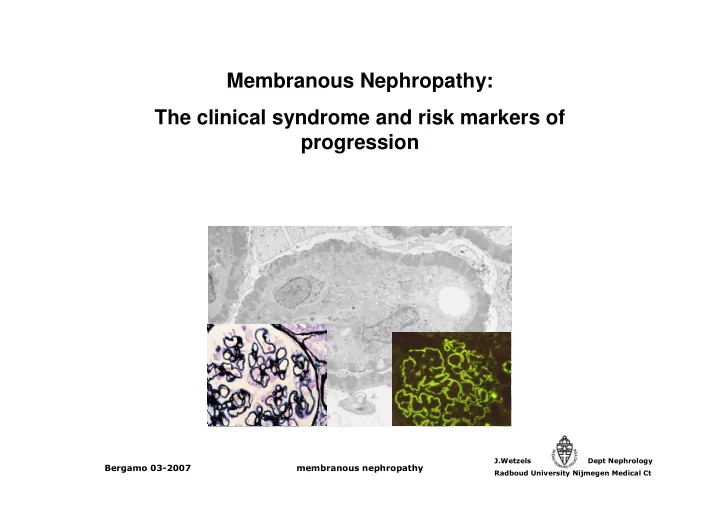
Membranous Nephropathy: The clinical syndrome and risk markers of - - PowerPoint PPT Presentation

membranous nephropathy the clinical syndrome and risk
SMART_READER_LITE
LIVE PREVIEW

Membranous Nephropathy: The clinical syndrome and risk markers of - - PowerPoint PPT Presentation

Membranous Nephropathy: The clinical syndrome and risk markers of progression


slide-1
SLIDE 1
  • ! "# $ %

Membranous Nephropathy: The clinical syndrome and risk markers of progression

slide-2
SLIDE 2
  • ! "# $ %

Membranous nephropathy: key notes

  • Most common cause of the nephrotic syndrome
  • Idiopathic vs secondary MN

– Malignancy a cause in the elderly

  • Natural history

– Unchanged despite more aggressive conservative therapy – Progressive renal failure in 40-50% of patients

  • Immunosuppressive therapy

– Improves outcome

  • Risk markers

– Allow accurate prediction of prognosis

  • MN may recur after Renal Transplantation

– Recurrences more likely in LRD transplantation

slide-3
SLIDE 3
  • ! "# $ %

incidence of primary glomerulopathies

5 10 15 20 25 30 France Spain Italy Netherlands incidence (N/million) IgAN MGN FSGS

Membranous nephropathy: incidence

Deegens et al 2006

slide-4
SLIDE 4
  • ! "# $ %

10 20 30 40 MGN FSGS MCN IgA Amyloid MPGN SLE

Patients (%)

van Paassen 2004

Membranous nephropathy: most common cause of nephrotic syndrome in a caucasian population

Epidemiology of non-nephrotic MN? biopsy bias, never nephrotic good prognosis

slide-5
SLIDE 5
  • ! "# $ %

idiopathic SLE Drugs (gold, NSAID

penicillamine)

malignancy

  • ther

Membranous Nephropathy: secondary causes

80.9% 6.1% 7.8% 3% 3.1%

N = 658

Noël 1979 Donadio 1988 McTier 1986 Hay 1992 Murphy 1988 Stirling 1998

slide-6
SLIDE 6
  • ! "# $ %

Membranous nephropathy: increased risk of malignancy

Adapted from Lefaucheur 2006

Malignancies in MN

5 10 15 20 25 30 35 18-54 55-64 >65

Age group Malignancies (%)

Men Women

Malignancies in MN

2 4 6 8 10 12 14 18-54 55-64 >65

Age group Standardized incidence ratio

slide-7
SLIDE 7
  • ! "# $ %

How to recognize malignancy-associated MN? Pathology?

  • IgG1 IgG4 staining
  • glomerular mononuclear cell count

Evaluation of patient?

slide-8
SLIDE 8
  • ! "# $ %

Clinical syndrome

  • Inborn error

age 50 yrs

  • Auto-immunity

men innate no other AID induced remitting-relapsing early relapse after Tx

  • Planted antigen

early relapse after Tx

slide-9
SLIDE 9
  • ! "# $ %

Renal Function Deterioration (%, corrected) 10 20 30 40 50 60 70

D a v i s

  • n

M c T i e r D

  • n

a d i

  • C

a t t r a n C a m e r

  • n

P

  • n

t i c e l l i S c h i e p a t t i Z u c h e l l i P

  • n

t i c e l l i D u r i n

Nephrotic MN: natural history in 1980 - 1995

Adapted from DuBuf et al 2005

slide-10
SLIDE 10
  • ! "# $ %

7 (10%) Severely nephrotic 27 (38%) Renal failure 35 (51%) Stable renal function: Overall course in 69 patients

membranous nephropathy: no improvement in natural history in the last decade

  • P. DuBuf et al QJM 2004;97:353

P.DuBuf et al AmJKD 2005;46:1012

ACE-inhibition does not improve outcome

slide-11
SLIDE 11
  • ! "# $ %

Membranous nephropathy High risk patients can be identified with reasonable accuracy

slide-12
SLIDE 12
  • ! "# $ %
  • Genetic factors
  • Age
  • Histology
  • Hypertension
  • Renal function >
  • Proteinuria: duration and severity
  • Urinary excretion of IgG
  • Urinary excretion of ß2-microglobulin

membranous nephropathy

identification of high risk patients

slide-13
SLIDE 13
  • ! "# $ %

Uß2m2 UIgG Combined Proteinuria1 Uα1m Specificity 88 % 82 % 94 % 88 % 88 % Sensitivity 83 % 84 % 79 % 66 % 84 %

  • 1. Data from Cattran 2. Threshold values:

Uß2m > 500 ng/min. UIgG > 230 mg/day. Uα1m > 40 µg/min Combined = Uß2m > 500 ng/min and UIgG > 230 mg/day

Membranous nephropathy:risk prediction

slide-14
SLIDE 14
  • ! "# $ %

Membranous nephropathy:risk prediction

Branten et al 2005

slide-15
SLIDE 15
  • ! "# $ %

100 100 80 60 40 20 Renal Survival (%) Follow Up (months) 80 60 40 20

UIgG < 230 mg / Day UIgG > 230 mg / Day

Membranous nephropathy:risk prediction

slide-16
SLIDE 16
  • ! "# $ %

Membranous nephropathy: recurrence after transplantation

  • 120

108 96 84 72 60 48 36 24 12

  • 1,0

,8 ,6 ,4 ,2 0,0

LRD: 61% Cadaveric 23%

slide-17
SLIDE 17
  • ! "# $ %

Recurrent MGN << de novo MGN Recurrence rate: 32% Onset of recurrence: 12 months (range 3 –38 months) Risk factors: LRD transplantation (5/8 vs 2/13) Graft failure due to recurrence: 20-40% Treatment?? no evidence

UMC Nijmegen 2003

Membranous nephropathy: recurrence after transplantation

slide-18
SLIDE 18
  • ! "# $ %

Membranous nephropathy Can we make a difference?

slide-19
SLIDE 19
  • ! "# $ %
  • nijmegen

MGN as cause of ESRD

20 40 60 80 100 120 140 160 1991-1995 1996-2000 2001-2005 Patiënts (%) Nijmegen Netherlands

Treatment guidelines affect the incidence of ESRD

1991: introduction of treatment guidelines in the Nijmegen area

slide-20
SLIDE 20
  • ! "# $ %

Membranous nephropathy Thank you for your attention

slide-21
SLIDE 21
  • ! "# $ %

Membranous nephropathy Natural history

slide-22
SLIDE 22
  • ! "# $ %

Chlorambucil is effective in MN..

Ponticelli et al Kidney Int 1995

RENAL SURVIVAL IN TREATED AND UNTREATED PATIENTS

TREATED UNTREATED

slide-23
SLIDE 23
  • ! "# $ %

..also when used in high-risk patients

Torres et al Kidney Int 2002:61: 219-227

$$ $

Renal survival (%)

slide-24
SLIDE 24
  • ! "# $ %

20 40 60 80 100 120 140 20 40 60 80 100

Treatment Group Historic Controls Time (months) Alive without dialysis (%)

Cyclophosphamide is also effective..

  • P. DuBuf et al NDT 2004:19: 1142-1148
slide-25
SLIDE 25
  • ! "# $ %

cyclophosphamide is more effective than chlorambucil

39 (43%) 52 (57%) 91 Chlorambucil 17 (17%) 85 (83% 102 Cyclophosphamide Renal function stable/improved deteriorated Patients (N)

DuBuf et al AJKD 2005; 46:1012-1029

Cyclophosphamide vs chlorambucil in patients with MN and CRF

slide-26
SLIDE 26
  • ! "# $ %

Alternative immunosuppressive agents in MN.. Ciclosporin Tacrolimus Mycophenolate Rituximab ACTH Have been used, with short-term efficacy, few long- term data..

slide-27
SLIDE 27
  • ! "# $ %

Conclusion: efficacy of MMF may depend on dose and concomitant use of prednisone

Mycophenolate in membranous nephropathy

DuBuf et al AJKD 2005; 46:1012-1029

# &

##'() * (+,- .& ##' *

slide-28
SLIDE 28
  • ! "# $ %

Treatment of Membranous Nephropathy Q: which is the preferred regimen/cytotoxic drug?

slide-29
SLIDE 29
  • ! "# $ %

Treatment of membranous nephropathy

Chlorambucil vs cyclophosphamide

Ponticellli etal JASN 1998

slide-30
SLIDE 30
  • ! "# $ %

Time (months) Cumulative incidence of remission (%)

10 20 30 40 50 60 25 50 75 100

cyclophosphamide chlorambucil

p<0.02

Branten et al QJM 1998; 91: 359 - 366

Treatment of membranous nephropathy

Chlorambucil vs cyclophosphamide

slide-31
SLIDE 31
  • ! "# $ %

20 40 60 80 100 120 140 20 40 60 80 100

partial and complete remissions complete remissions Time (months) Remissions (%)

  • P. DuBuf et al NDT 2004:19: 1142-1148

Cyclophosphamide in membranous nephropathy

slide-32
SLIDE 32
  • ! "# $ %

Treatment of membranous nephropathy

Chlorambucil vs cyclophosphamide 15 (18%) 9 (11%) 82 Chlorambucil 43 (41%) 25 (25%) 102 Cyclophosphamide Remissions complete partial Patients (N)

DuBuf et al AJKD 2005; 46:1012-1029

Cyclophosphamide vs chlorambucil in patients with MN and CRF

slide-33
SLIDE 33
  • ! "# $ %

Membranous nephropathy recurrence after transplantation

slide-34
SLIDE 34
  • ! "# $ %

Prognostic factors in membranous nephropathy

Proteinuria Progressive Stable Odds Sens Spec > 8 g/d > 6 months 31 16 13.7 66 88 < 8 g/d < 6 months 17 120

slide-35
SLIDE 35
  • ! "# $ %

Membranous nephropathy Incidence

slide-36
SLIDE 36
  • ! "# $ %

Chlorambucil in membranous nephropathy

Cumulative incidence of remissions of proteinuria in treated and untreated patients

Ponticelli et al Kidney Int 1995

TREATED UNTREATED

slide-37
SLIDE 37
  • ! "# $ %

Membranous nephropathy Membranous nephropathy and malignancy

slide-38
SLIDE 38
  • ! "# $ %

Age (yrs) Male patients Female patients Malignancy (%) SIR Malignancy (%) SIR 18 – 54 2.3 10.2 2.1 9.5 55 – 64 9.5 8.6 9.1 13 >= 65 28.9 10 17.9 13.2

Membranous nephropathy: increased risk of malignancy

SIR = standardized incidence ratio; data from Lefaucheur 2006

slide-39
SLIDE 39
  • ! "# $ %
  • nijmegen

MGN as cause of ESRD

20 40 60 80 100 120 140 160 1991-1995 1996-2000 2001-2005 Patiënts (%) Nijmegen Netherlands

Cyclophosphamide decreases the incidence of ESRD

1991: introduction of cyclophosphamide in the treatment

  • f MGN in the Nijmegen area

Limited use of immunosuppressive therapy in other parts of the Netherlands