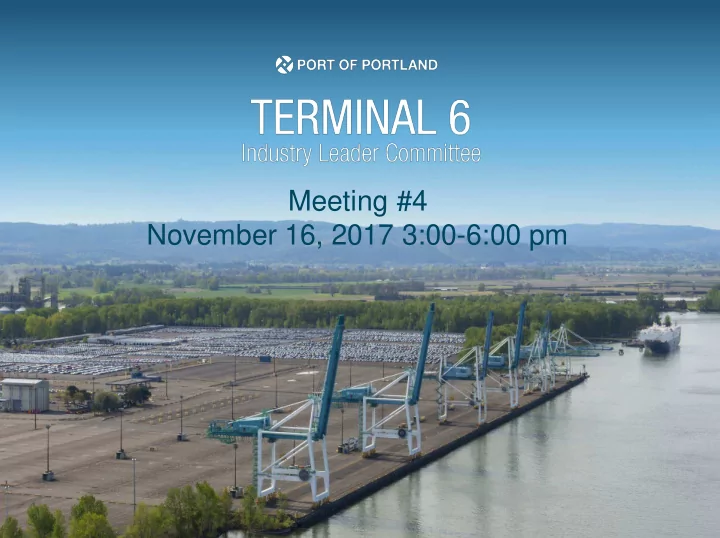
Meeting #4 November 16, 2017 3:00-6:00 pm Welcome Meeting 3 Recap - - PowerPoint PPT Presentation

meeting 4 november 16 2017 3 00 6 00 pm welcome
SMART_READER_LITE
LIVE PREVIEW

Meeting #4 November 16, 2017 3:00-6:00 pm Welcome Meeting 3 Recap - - PowerPoint PPT Presentation

Meeting #4 November 16, 2017 3:00-6:00 pm Welcome Meeting 3 Recap - Meeting Summary Review Committee approval Review of November 16 th Agenda Financial Analysis (Task 6) and Alternatives Analysis (Task 5) Review of Committee


slide-1
SLIDE 1

Meeting #4 November 16, 2017 3:00-6:00 pm

slide-2
SLIDE 2

Welcome

  • Meeting 3 Recap - Meeting Summary Review

– Committee approval

  • Review of November 16th Agenda

Financial Analysis (Task 6) and Alternatives Analysis (Task 5)

  • Review of Committee Charge and Purpose

Charge: Provide industry knowledge and guidance to the Port of Portland leadership on the Port’s future role in container shipping at Terminal 6 and a sustainable business model for managing and developing the container business.

2

slide-3
SLIDE 3

Business Study Tasks and Findings

Task 1: Industry Analysis Task 2: Market Analysis Task 3: T6 SWOT Task 4: Operating Models Task 5: Alternatives Analysis Task 6: Financial Analysis

3

slide-4
SLIDE 4

Terminal 6 Overall Business Strategy

www.Advisian.com / Slide 4

4

slide-5
SLIDE 5

Terminal 6 Business Updates

  • Swire Shipping Service
  • Intermodal
  • Carrier Targets

5

slide-6
SLIDE 6

www.advisian.com

Port of Portland T6 Business Strategy

Task 6 – Financial Analysis

Nolan Gimpel, Project Manager, Advisian Jim Daly, Tangent Services Rob Schultz, Port of Portland November 16, 2017

slide-7
SLIDE 7

Financial Performance Key Drivers

Volume

  • Container

Moves to/from Vessels

Pricing

  • Per Box

Charges to Carriers

Productivity

  • Labor Hours

per Move

7

slide-8
SLIDE 8

Volume and Net Income

8

slide-9
SLIDE 9

Productivity

  • Modeling based on 2006-09 productivity levels
  • Terminal 6 productivity at or near West Coast productivity

averages during that period

9

slide-10
SLIDE 10

Pricing

  • Pricing in model based on 2006-09 levels
  • Adjusted to current dollars using ILWU/PMA contract and CPI increases
  • Model input: $335 per vessel move charge to carriers
  • Combined throughput and wharfage charge
  • Total terminal operating revenue per vessel move: $384
  • Throughput and wharfage plus other terminal revenues

10

slide-11
SLIDE 11

Revenue & Operating Expense

Operating expense increases exceeded price increases during the last decade of Port operations

11

slide-12
SLIDE 12

Cash Investments

Advisian / 12

12

slide-13
SLIDE 13

Operating Revenue

Throughput 76% Wharfage 11%

  • Misc. Services

7% Deadtime Labor 5% Other 1%

13

slide-14
SLIDE 14

Operating Expense

Based on 100,000 vessel moves and $51.0 million of operating expense.

14

slide-15
SLIDE 15

Financial Model

  • Base Assumptions

– Productivity at 2006-09 levels – Prices at 2006-09 levels, adjusted for inflation – Support Services capped at $3M/year – Depreciation increases with activity; $4M/year to start, capped at $6M – Port “semi-operate” model (previous MTC set up)

  • “Dedicated” Terminal Alternative

– Entire terminal is used to support container vessel operations

  • “Mixed Use” Terminal Alternative

– Terminal use is split between containers, intermodal, & breakbulk

  • perations

– Container footprint reduced to about 50% - 60% of terminal – Certain terminal expenses are “shared” by the different operations

15

slide-16
SLIDE 16

($20) ($15) ($10) ($5) $0 $5 $10 $15 $20

  • 50,000

100,000 150,000 200,000 250,000 300,000 Millions Vessel Moves

Dedicated Mixed Use

Model Results – Net Income

Mixed Use Breakeven: 168,000 Vessel Moves Dedicated Breakeven: 197,000 Vessel Moves

16

slide-17
SLIDE 17

Sensitivity Analysis - Pricing

17

155 105 197 148 268 221

Dedicated Mixed Use

Increase Price 10% No Change from Base Decrease Price 10%

Annual Vessel Moves (000s) Needed to Breakeven

slide-18
SLIDE 18

Terminal 6 Volumes vs. Breakeven

150 185 174 168 156 149 163 156 141 172 182 111 100 145 149 121 98 109 115 99 102 61 2

1994 1995 1996 1997 1998 1999 2000 2001 2002 2003 2004 2005 2006 2007 2008 2009 2010 2011 2012 2013 2014 2015 2016

Dedicated Terminal Breakeven = 197 Mixed Use Terminal Breakeven = 148* 40% Market Share = 109 Thousands of Vessel Moves

18

*Corrected amount. Previously listed as 168.

slide-19
SLIDE 19

Summary

  • Volume/scale the key to profitability
  • Prices must be set at “sustainable” levels and match

expense growth

  • Prices failed to keep pace with expenses from 2002 - 2009
  • Productivity must meet or exceed coastwide

standards

  • Especially important in low volume situations
  • “Mixed Use” of the terminal will improve financial

performance

  • But losses are likely unavoidable if box volumes remain

low

19

slide-20
SLIDE 20

Committee Engagement

  • Clarifying questions?
  • Anything missing?
  • Any areas of concern?
  • What are the key takeaways from this analysis?

20

slide-21
SLIDE 21

Break

21

slide-22
SLIDE 22

www.advisian.com

Port of Portland T6 Business Strategy

Task 5 – Alternatives Analysis

Nolan Gimpel, Project Manager, Advisian November 16, 2017

slide-23
SLIDE 23

Alternatives Key Elements

  • Cost and location
  • Alliances/Carrier decisions
  • Relatively small volume
  • Asian cargo represents 90% of Portland

volumes

  • Carriers participate in Portland cargo

today

  • Reputation

23

slide-24
SLIDE 24

Alternatives

  • Short Sea Shipping
  • Rail Service
  • Trucking Service
  • Equipment Pooling Service
  • Bulk Container Option
  • Niche Container Service
  • Mixed Use Terminal

Advisian / 24 24

slide-25
SLIDE 25

Short Sea Shipping

  • Vessel has been designed but not

built.

  • A specific short sea shipping vessel

(not barge) is used.

  • Transhipment via Vancouver, BC is

most viable.

  • Additional handling makes this

alternative cost prohibitive.

25

slide-26
SLIDE 26

Rail Service

  • Using rail to transport containers from

Terminal 6 to Seattle/Tacoma via the adjacent BNSF intermodal yard facility.

  • Terminal 6 would share a gate with BNSF

and utilize the presence of the railroad to

  • ffset costs.
  • NW Container has been providing this

type of service for many years using Union Pacific.

  • This option is a viable potential alternative

particularly during a start-up operation.

26

slide-27
SLIDE 27

Trucking Service

  • Operating as a drop-off point for truck

delivery to Seattle/Tacoma terminals.

  • Alternative would add considerable cost

and is unlikely to appeal to a broad sector

  • f the market.

27

slide-28
SLIDE 28

Equipment Pooling Service

  • Having the terminal store, maintain and

dispatch/receive container, and or chassis, for use by shippers and logistics providers in the Portland-metro area.

  • Many private services are available.
  • Viability is improved when used in

conjunction with rail feeder service especially during start-up.

28

slide-29
SLIDE 29

Bulk Container Option

  • Bringing bulk material (normally mining or

agriculture products) typically transported by railcar or truck to a marine terminal to be loaded into a bulk carrier vessel in a special container.

  • The container arrives by rail or truck and is stored

in container stacks versus bulk material piles on the terminal.

  • Container is lifted by existing gantry crane and

container is lowered into the bulk carrier vessel where the container’s content is then dumped into the hold, eliminating the need for a bulk ship loader.

  • Cost of transportation is reduced, storage issues
  • f space and contamination are eliminated and air

quality emissions typically associated with bulk materials is also eliminated.

  • While this is a very viable option, it does not

provide market access to local importer and exporters.

29

slide-30
SLIDE 30

Niche Container Service

  • Niche carriers typically do not operate

Asia-US direct service.

  • Volume is likely to be small.
  • Service could be infrequent (not

weekly).

  • Service would be viable for start-up
  • perations.
  • Viable if done in conjunction with
  • ther alternatives to serve regional

importers and exporters.

30

slide-31
SLIDE 31

Mixed Use Terminal

  • Terminal is mixed use of container,

intermodal and breakbulk.

  • Some terminal operating expenses are

shared by the different operations.

  • Offsets some of the fixed costs and
  • verhead of the container operation.

31

slide-32
SLIDE 32

Summary

  • Without further detailed analysis of
  • perational alternatives, leaving the

terminal idle costs the Port significant dollars each year.

  • While none of the alternatives work as a

stand alone solution, alternatives need to be combined or mixed to be viable.

  • The Port needs to generate profits from a

combination of a mixed use terminal, container bulk handling operation and BNSF rail service operations in order to subsidize the start-up of container

  • perations with a niche carrier.

32

slide-33
SLIDE 33

Tying It All Together: Committee Engagement Exercises

33

slide-34
SLIDE 34

Alternatives Analysis Preference Exercise

1.

Of the existing alternatives that have been presented, which do you prefer and why?

2.

Are there other alternatives that we have not discussed that have greater potential? What are they and why should they be pursued.

34

slide-35
SLIDE 35

Consultant Guidance for December 21 Meeting

Thinking about everything you’ve learned to date as a member of this committee, what are the key questions or topics that should be addressed as part of the consultant recommendations/conclusions that will be presented at the December 21 meeting?

35

slide-36
SLIDE 36

Confidence in Terminal 6 Strategy

What is your confidence level that there is a sustainable business model for the Port in container shipping at Terminal 6?

36

slide-37
SLIDE 37

Next Meeting and Evaluations

December 21, 2017 3-6 pm Consultant Recommendation and Committee Guidance

37

slide-38
SLIDE 38

Business Study Questions

  • Portland Terminal 6’s future role in container shipping?
  • Value proposition of Terminal 6 to container carriers and prospective

container terminal operators?

  • Opportunity for Terminal 6 to provide efficient market access for

cargo shippers?

  • Niche for Terminal 6 in the direct trans‐ocean container service

market?

  • Feasibility of Terminal 6 as a feeder facility to other West Coast

terminals, either as a complement or an alternative to direct trans‐ocean carrier service?

  • Financially sustainable operating models that maximize business
  • pportunity at the terminal while providing effective service to

shippers and carriers?

38

slide-39
SLIDE 39

Business Study Tasks and Findings

Task 1: Industry Analysis Task 2: Market Analysis Task 3: T6 SWOT Task 4: Operating Models Task 5: Alternatives Analysis Task 6: Financial Analysis

  • Bigger, deeper

draft ships

  • Consolidation
  • Rationalizaton
  • Terminals
  • Vessels
  • Alliances
  • Excess capacity
  • Expanded order

book

  • Increasing

competition

  • Asia key

import/ export market

  • Reasonable

market size

  • Cargo now

moves over

  • ther

gateways and did so even with direct service

  • S: Terminal

facility, container market

  • W: Pilotage

costs, reputation repair

  • O:

Congestion at other ports, niche market

  • T: Empty

terminals in Seattle and Tacoma

  • Short term:
  • Semi-
  • perating

port

  • Operating

port

  • Longer term:
  • Landlord

port

  • Concession

port

  • Short term:
  • Niche carrier
  • Reduced

footprint container terminal with mixed use

  • Intermodal

container service

  • Long term:
  • Attract a

transpacific carrier

  • High volumes

required

  • Rate increase

– inflation adj.

  • Labor

productivity

  • Mixed use

terminal approach more sustainable

  • Financial gap

and business case challenges

39