
SLIDE 1
1
EE1001 Introduction to Electrical Engineering
Medical Device Engineering
Greg Carpenter, Dan Landherr Electrical Engineers Boston Scientific Corp.
- St. Paul, MN
20 Oct. 2015
2
EE1001, 20 Oct. 2015
Medical Device Engineering Greg Carpenter, Dan Landherr Electrical - - PDF document
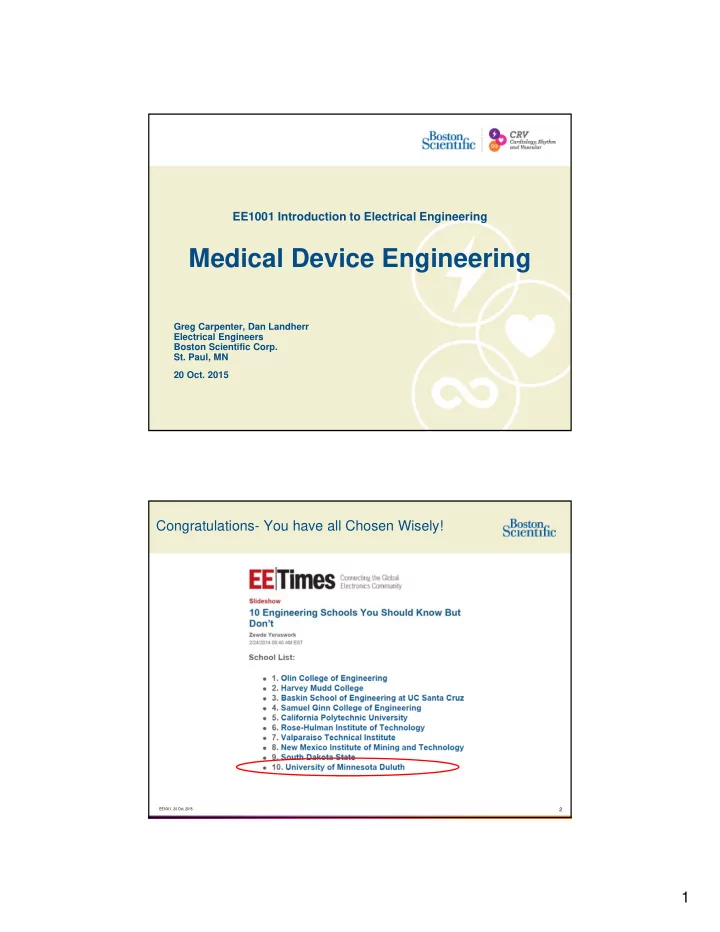
EE1001 Introduction to Electrical Engineering Medical Device Engineering Greg Carpenter, Dan Landherr Electrical Engineers Boston Scientific Corp. St. Paul, MN 20 Oct. 2015 Congratulations- You have all Chosen Wisely! EE1001, 20 Oct. 2015 2
EE1001 Introduction to Electrical Engineering
Greg Carpenter, Dan Landherr Electrical Engineers Boston Scientific Corp.
20 Oct. 2015
2
EE1001, 20 Oct. 2015
3
EE1001, 20 Oct. 2015
46- The first written document on medical electricity, Scribonius Largus recommended the use of torpedo fish for curing headaches and gouty arthritis. The electric fish remained the only means of producing electricity for electrotherapeutic experiments until the seventeenth century. 1781- The first documented experiment in neuromuscular electric stimulation by Luigi Galvani, professor of anatomy at the University of Bologna. His assistant accidentally touched the femoral nerve of a dissected frog with a scalpel at the same time sparks discharged in a nearby machine and muscular contractions occurred. 1872- T. Green described cardio-respiratory resuscitation using a battery of up to 200 cells generating about 300 volts. He applied this voltage between the neck and lower left ribs successfully on five patients who suffered sudden respiratory arrest and were without a pulse. 1887- The electrocardiogram (ECG) signals from electric activity of the human heart first measured by Augustus Waller. 1899- The first report on cardiac defibrillation by Jean Prevost and Frédéric Battelli. They found low-voltage electric shocks induced ventricular fibrillation whereas high-voltage shocks would defibrillate a fibrillating heart in animal experiments. 1930s- Modern ventricular defibrillation started with the work of William Kouwenhoven and his colleagues who used 60 Hz current to defibrillate a dog heart. 1947- The first human defibrillation was accomplished by Beck and his colleagues. 1952- Modern cardiac pacing started when Paul Zoll performed pacing for a duration of 20 min. 1958- Furman & Schwedel succeeded in supporting a patient for 96 days with cardiac pacing. 1958- First implantation of cardiac pacemaker from engineer Rune Elmqvist at Karolinska Institute in Stockholm by surgeon Åke Senning. [Note development of the implantable pacemaker made possible by the invention of the transistor in 1948.] 1980- The first Implanted Cardiac Defibrillator (ICD) developed by Mirowski was implanted at Johns Hopkins Hospital.
History adapted from web version of Malmivuo and Plonsey, “Bioelectromagnetism,” 1995. 4
EE1001, 20 Oct. 2015
Stents Embolic Protection Balloons Catheters / Guidewires Ultrasound Imaging Lithotripsy Systems Stone Retrieval Enteral Feeding Embolics Biopsy Systems Pacemakers / ICDs Detachable Coils Ablation Peripheral Dilatation Neurostimulation
Portfolio of more than 13,000 products!
5
EE1001, 20 Oct. 2015
Remote Patient Management system
Brady + Tachy + CRT Leads Brady + Tachy Leads Brady Leads
Pacemaker Systems
Cardiac Arrest - Implantable Cardioverter Defibrillators (ICD) Systems
Cardiac Resynchronization Therapy (CRT) and Patient Management Systems
CRT-D ICD Pacemaker
6
EE1001, 20 Oct. 2015
Remote Patient Management system
Brady + Tachy + CRT Leads Brady + Tachy Leads Brady Leads
Pacemaker Systems
Cardiac Arrest - Implantable Cardioverter Defibrillators (ICD) Systems
Cardiac Resynchronization Therapy (CRT) and Patient Management Systems
CRT-D ICD Pacemaker
NYC autopsy: Heart problems caused Shay's Olympic trials death [HCM]
18 March 2008 NEW YORK (AP) - Elite runner Ryan Shay died of an irregular heartbeat due to an enlarged heart after collapsing during the U.S. men's marathon Olympic trials, the New York City medical examiner said…About 125 athletes under 35 involved in organized sports die of sudden death in the United States each year.
Sweet 16, the girl who died 8 times as a baby 25 June 2008
(The Daily Express ) - …born with defective arteries and a hole in her heart. She 'died' eight times on the operating table during a five-hour procedure to try to repair her heart. But after life-saving surgery to install a pacemaker at 14 weeks…revolutionary technology has allowed Kirsty, now 15, to lead a normal healthy life without the need for a heart transplant.
109-year-old Boston Scientific Ingenio patient sets record as oldest pacemaker recipient 2012
7
EE1001, 20 Oct. 2015
Remote Patient Management system
Brady + Tachy + CRT Leads Brady + Tachy Leads Brady Leads
Pacemaker Systems
Cardiac Arrest - Implantable Cardioverter Defibrillators (ICD) Systems
Cardiac Resynchronization Therapy (CRT) and Patient Management Systems
CRT-D ICD Pacemaker
NYC autopsy: Heart problems caused Shay's Olympic trials death [HCM]
18 March 2008 NEW YORK (AP) - Elite runner Ryan Shay died of an irregular heartbeat due to an enlarged heart after collapsing during the U.S. men's marathon Olympic trials, the New York City medical examiner said…About 125 athletes under 35 involved in organized sports die of sudden death in the United States each year.
Sweet 16, the girl who died 8 times as a baby 25 June 2008
(The Daily Express ) - …born with defective arteries and a hole in her heart. She 'died' eight times on the operating table during a five-hour procedure to try to repair her heart. But after life-saving surgery to install a pacemaker at 14 weeks…revolutionary technology has allowed Kirsty, now 15, to lead a normal healthy life without the need for a heart transplant.
109-year-old Boston Scientific Ingenio patient sets record as oldest pacemaker recipient 2012
8
EE1001, 20 Oct. 2015
Pacemaker ICD CRT
9
EE1001, 20 Oct. 2015
10
EE1001, 20 Oct. 2015
Math/Science/Engineering fundamentals are essential…but also need:
Verbal/written communications Project management Problem solving Test & Measurement Programming languages and design tools PCB Design Statistics
1Adapted from “7 More Things Colleges Should Teach EEs,” Lou Frenzel– Electronic Design Blog, 8/25/13
“people going into the sciences…frequently had hands-on experience as hobbyists and tinkerers.”
“…the field is so vast now that it is perhaps naive to suppose that one should be ready to do useful work upon graduation.” “I was so mad, frustrated, and confused as to how academia has cheated me the 5 years I spent doing…mathematical analysis on circuit diagrams.” “The degree means the engineer has the fundamental skills, ability, and confidence to learn how to do something and do it right and in a timely manner.”
11
EE1001, 20 Oct. 2015
Math/Science/Engineering fundamentals are essential…but also need:
Verbal/written communications Project management Problem solving Test & Measurement Programming languages and design tools PCB Design Statistics
1Adapted from “7 More Things Colleges Should Teach EEs,” Lou Frenzel– Electronic Design Blog, 8/25/13
“people going into the sciences…frequently had hands-on experience as hobbyists and tinkerers.”
“…the field is so vast now that it is perhaps naive to suppose that one should be ready to do useful work upon graduation.” “I was so mad, frustrated, and confused as to how academia has cheated me the 5 years I spent doing…mathematical analysis on circuit diagrams.” “The degree means the engineer has the fundamental skills, ability, and confidence to learn how to do something and do it right and in a timely manner.”
12
EE1001, 20 Oct. 2015
Math/Science/Engineering fundamentals are essential…but also need:
Verbal/written communications Project management Problem solving Test & Measurement Programming languages and design tools PCB Design Statistics
1Adapted from “7 More Things Colleges Should Teach EEs,” Lou Frenzel– Electronic Design Blog, 8/25/13
“people going into the sciences…frequently had hands-on experience as hobbyists and tinkerers.”
“…the field is so vast now that it is perhaps naive to suppose that one should be ready to do useful work upon graduation.” “I was so mad, frustrated, and confused as to how academia has cheated me the 5 years I spent doing…mathematical analysis on circuit diagrams.” “The degree means the engineer has the fundamental skills, ability, and confidence to learn how to do something and do it right and in a timely manner.”
13
EE1001, 20 Oct. 2015
Contrary to what you learn in class, the bulk of your day will NOT be solving circuit equations
documentation, training, etc.
The delight of engineering: Pages of calculations predicting a result, the prediction turns out to be true, and when built it works!1
used to having very few good days
Design calculations and simulations are “necessary but insufficient” conditions1
An engineer's job is not done once the simulation runs
If a design does not work on paper, then it is irresponsible to expect that it will work in practice1
1Adapted from “Perceptions and realities,” Peter Hiscocks -- EDN, 9/14/2006
"Imagination is more important than knowledge" Albert Einstein
14
EE1001, 20 Oct. 2015
15
EE1001, 20 Oct. 2015
16
EE1001, 20 Oct. 2015
Integrity= Doing what’s right every time…even when no one is looking Your work & personal ethics are paramount
– It will come back to haunt both you and your customers – For medical or high-reliability designs, someone’s life can depend on your judgment call – Inevitably will not be enough time to do it right the first time, but always plenty of time to do it over again
Just say no to gifts, tickets, etc. from vendors and do not encourage this behavior by your own companies
Maintain a customer focus
17
EE1001, 20 Oct. 2015
Engineers are professionals like doctors and (sorry to say) lawyers
– One FTE costs your employer ~$200K/year no matter what the level (your pay check is only part of this number!) – Consulting fees of $100 to $250/hr are typical
– Expect to work anywhere from 40-60 hours/week – Expect to work at home as well as the office – The hours you work are not usually considered- your performance is judged on your accomplishments
still need to complete your work even if gone – 2 weeks paid vacation/year 1st year – 3 weeks ~5th year
– Lower 48 states, Alaska, Germany, Spain, France, Switzerland, Taiwan, China, Japan, Australia, Sweden, Argentina, England, Ireland, Israel, Belgium, Netherlands, Portugal, Italy, Canada, India, Iceland 2007 EDN Workweek Length
18
EE1001, 20 Oct. 2015
Engineers are professionals like doctors and (sorry to say) lawyers
– One FTE costs your employer ~$200K/year no matter what the level (your pay check is only part of this number!) – Consulting fees of $100 to $250/hr are typical
– Expect to work anywhere from 40-60 hours/week – Expect to work at home as well as the office – The hours you work are not usually considered- your performance is judged on your accomplishments
still need to complete your work even if gone – 2 weeks paid vacation/year 1st year – 3 weeks ~5th year
– Lower 48 states, Alaska, Germany, Spain, France, Switzerland, Taiwan, China, Japan, Australia, Sweden, Argentina, England, Ireland, Israel, Belgium, Netherlands, Portugal, Italy, Canada, India, Iceland 2007 EDN Workweek Length
19
EE1001, 20 Oct. 2015
Defining / Identifying a problem is more difficult than solving a problem Don’t make solutions more complex than the original problem
Double check your work and don’t be offended when others do
– In our business it saves lives – Finding issues early is ALWAYS better than seeing the consequences magnified later
all over the world
Not everything you work on will become a product Design your products to be unconditionally safe
20
EE1001, 20 Oct. 2015
Defining / Identifying a problem is more difficult than solving a problem Don’t make solutions more complex than the original problem
Double check your work and don’t be offended when others do
– In our business it saves lives – Finding issues early is ALWAYS better than seeing the consequences magnified later
all over the world
Not everything you work on will become a product Design your products to be unconditionally safe
Vets install pacemaker in search-and-rescue dog 23 May 2008 COLUMBIA, Mo. (AP) - After years of helping authorities look for murder victims
and survivors of natural disasters, a search-and-rescue dog named Molly has been rescued herself. Surgeons at the University of Missouri College of Veterinary Medicine on Thursday installed a pacemaker in the 5-year-old chocolate Labrador retriever's heart. She needed the surgery after being diagnosed with a complete electrical heart blockage.
21
EE1001, 20 Oct. 2015
Defining / Identifying a problem is more difficult than solving a problem Don’t make solutions more complex than the original problem
Double check your work and don’t be offended when others do
– In our business it saves lives – Finding issues early is ALWAYS better than seeing the consequences magnified later
all over the world
Not everything you work on will become a product Design your products to be unconditionally safe
Vets install pacemaker in search-and-rescue dog 23 May 2008 COLUMBIA, Mo. (AP) - After years of helping authorities look for murder victims
and survivors of natural disasters, a search-and-rescue dog named Molly has been rescued herself. Surgeons at the University of Missouri College of Veterinary Medicine on Thursday installed a pacemaker in the 5-year-old chocolate Labrador retriever's heart. She needed the surgery after being diagnosed with a complete electrical heart blockage.
22
EE1001, 20 Oct. 2015
– Risk of totally new invention vs. modification of previous design – Cost, Time, Resources – The available resource capabilities – Complexity vs. reliability – Previous experience
23
EE1001, 20 Oct. 2015
– Risk of totally new invention vs. modification of previous design – Cost, Time, Resources – The available resource capabilities – Complexity vs. reliability – Previous experience
24
EE1001, 20 Oct. 2015
– >60% of employers valued Emotional Intelligence higher than IQ – More likely to stay calm under pressure, Know how to resolve conflict effectively, Empathetic to their team members and react accordingly, Lead by example, Make more thoughtful business decisions – Valued traits: Admit/learn from mistakes, Keep emotions in check, Listen more than talk, Take criticism well, Show grace under pressure
– You will typically be a member of a multi-disciplined team and will need to present your ideas and requirements to others – It is normal to “trade-off” requirements and specifications in order to come to an acceptable design solution
– Among students, teachers will help you find a job when you graduate – Cross-functionally outside your team exposes you to other career path possibilities
company’s idiosyncrasies, help you broaden or deepen your technical knowledge
25
EE1001, 20 Oct. 2015
– >60% of employers valued Emotional Intelligence higher than IQ – More likely to stay calm under pressure, Know how to resolve conflict effectively, Empathetic to their team members and react accordingly, Lead by example, Make more thoughtful business decisions – Valued traits: Admit/learn from mistakes, Keep emotions in check, Listen more than talk, Take criticism well, Show grace under pressure
– You will typically be a member of a multi-disciplined team and will need to present your ideas and requirements to others – It is normal to “trade-off” requirements and specifications in order to come to an acceptable design solution
– Among students, teachers will help you find a job when you graduate – Cross-functionally outside your team exposes you to other career path possibilities
company’s idiosyncrasies, help you broaden or deepen your technical knowledge
26
EE1001, 20 Oct. 2015
When defining a product today, the expected technologies available when its launched must be factored in
before starting production
Most companies have entire departments who plan product “portfolios”
next 10 or more years in medical industry
Products are often staged 1-2 yrs apart Its common for 4-5 generations of products to be in development at one time
27
EE1001, 20 Oct. 2015
– The bigger the company, usually the longer it takes
Example:
1-2 yrs in definition of product, pre-clinicals 2-3 yrs in design, testing 1 yrs in regulatory/clinical approval 3-5 yrs in production 5-10 yrs in support 10 - 20 year time before any product is ever “done”
So…always write everything down and never throw anything away - you may need it 10 - 20 years from now!
28
EE1001, 20 Oct. 2015
Keeping complete documentation is important
dates…not just a clever idea
0 years Record of Invention +2 months Decision to Patent +6 months Draft Application +1 year Patent granted +5 years – Takes ~5 years from idea to a successful patent grant – “You know your idea is good when others take credit for it”
Medical devices require significant traceability
Not enough to do the work- must be able to prove you have done it and document it so it can be repeated
Boston Scientific has more than 15,000 patents
29
EE1001, 20 Oct. 2015
Your engineering education impacts the rest of your life
You’re a geek, but that’s OK! (according to US Department of Commerce, 2011)
You’ll find getting a big paycheck will not make you happy in the long run
What makes people get out of bed in the morning is a job which is:
30
EE1001, 20 Oct. 2015
Stay in school- it’s a jungle out there!
1986 Rodney Dangerfield, “Back To School”
Your engineering education impacts the rest of your life
You’re a geek, but that’s OK! (according to US Department of Commerce, 2011)
You’ll find getting a big paycheck will not make you happy in the long run
What makes people get out of bed in the morning is a job which is:
31
EE1001, 20 Oct. 2015
– Learn more = Earn more! – Examples are MS/PhD degrees, trade shows, seminars, MBA, conferences like IEEE, SPIE
trained workforce
goes according to plan
– IEEE Spectrum, IEEE Circuits & Systems, IEEE Trans on Circuits & Systems I, IEEE Eng. in Medicine & Biology, IEEE Trans on Biomedical Eng., IEEE JSSC, EDN, Electronic Design, RF Design, Microwave Journal, SPIE Optical Engineering, SPIE Journal of Biomedical Optics, Photonics Spectra – “Fields & Waves in Communication Electronics,” Ramo; “Signals & Systems,” Ziemer/Tranter; “Design of CMOS RFICs,” Lee; “Analog IC Design,” Johns & Martin – www.RFCafe.com, www.hp.woodshot.com, ieeexplore.ieee.org
32
EE1001, 20 Oct. 2015
– Learn more = Earn more! – Examples are MS/PhD degrees, trade shows, seminars, MBA, conferences like IEEE, SPIE
trained workforce
goes according to plan
– IEEE Spectrum, IEEE Circuits & Systems, IEEE Trans on Circuits & Systems I, IEEE Eng. in Medicine & Biology, IEEE Trans on Biomedical Eng., IEEE JSSC, EDN, Electronic Design, RF Design, Microwave Journal, SPIE Optical Engineering, SPIE Journal of Biomedical Optics, Photonics Spectra – “Fields & Waves in Communication Electronics,” Ramo; “Signals & Systems,” Ziemer/Tranter; “Design of CMOS RFICs,” Lee; “Analog IC Design,” Johns & Martin – www.RFCafe.com, www.hp.woodshot.com, ieeexplore.ieee.org
33
EE1001, 20 Oct. 2015
2007 EDN Salary Increase
34
EE1001, 20 Oct. 2015
Electronic Design Magazine 2011 Annual Salary Survey Report
35
EE1001, 20 Oct. 2015
Electronic Design Magazine 2011 Annual Salary Survey Report 36
EE1001, 20 Oct. 2015
2011-2012 PayScale College Salary Report, downloaded 8/2011
BSEE degrees are top earners!
37
EE1001, 20 Oct. 2015
2011-2012 PayScale College Salary Report, downloaded 8/2011 38
EE1001, 20 Oct. 2015
2011-2012 PayScale College Salary Report, downloaded 8/2011
39
EE1001, 20 Oct. 2015
“Technology is dominated by 2 types of people: Those who manage what they do not understand and Those who understand what they do not manage.”
Putt’s Law and the Successful Technocrat, A. Putt, 1981
* See end of presentation for more details…
40
EE1001, 20 Oct. 2015
* See end of presentation for more details…
41
EE1001, 20 Oct. 2015
interest
42
EE1001, 20 Oct. 2015
reaching sound conclusions, and taking appropriate actions
43
EE1001, 20 Oct. 2015
44
EE1001, 20 Oct. 2015
http://www.bostonscientific.com/en-US/careers/students.html
46
EE1001, 20 Oct. 2015
47
EE1001, 20 Oct. 2015
Key Engineer Responsibilities
analysis techniques, and technologies.
used are determined by approved procedures and standards.
management tool.
actions.
48
EE1001, 20 Oct. 2015
JOB CODE / TITLE: Engineer, Electronic LEVEL: Entry/Associate
JOB SKILLS
basic understanding of specified functional area, or an equivalent combination of education and work experience.
system environment. Failure to adequately perform tasks can result in noncompliance with governmental regulations.
routine problems. Works on problems of limited scope. Minimal independent decision making.
supervisor on prioritization of tasks.
to achieve results can normally be overcome without serious effect on schedules and programs.
49
EE1001, 20 Oct. 2015
JOB CODE / TITLE: Engineer, Electronic LEVEL: Intermediate JOB SKILLS
combination of education and work experience.
and procedures. General understanding of business unit/group function. Will perform this job in a quality system
identifiable factors. Exercises judgment within defined procedures and practices to determine appropriate action. Has a broad knowledge of technical alternatives and an understanding of their impact on the systems environment.
network of resources to facilitate completion of tasks. May lead a project team of moderate scope. Provides guidance to less experienced staff. Acts as a mentor to lower level individual contributors. Influence exerted at peer level and
Failure to achieve results or erroneous decisions or recommendations may cause delays in program schedules and may result in the allocation of additional resources.
soundness of technical judgment, overall adequacy and accuracy.
employees; may be asked to evaluate performance of and assist in career development planning for subordinates.
50
EE1001, 20 Oct. 2015
As a electrical engineer, you could work in a variety of departments on these types of projects: Analog or digital design, Logic synthesis, Simulation of low-power CMOS ASICs for implantable pacemakers and defibrillators Your development tasks may require you to: Design analog and digital test hardware, develop software test programs, participate in the development and enhancement
Electrical Engineering Roles
Product Development Team Member- Performs system integration testing, works with hardware, firmware, and software to understand the root cause of failures and recommend corrective design changes Manufacturing Process Engineer- Provides engineering support for a pacemaker and defibrillator manufacturing process, drives electrical test and design revisions to enhance manufacturability and product performance Advanced Manufacturing Engineer- Evaluates corrective action to improve yields for all products Reliability Engineer- Identifies potential product failure mechanisms, develops methods to assure failure mechanisms are eliminated or prevented in current products and future designs Research Engineer- Designs systems and devices for acquiring data, signal processing, and therapy control; responsible for areas such as sensing amplifier, automatic gain control, A/D, D/A, control systems, microprocessor implementation and interfacing, telemetry, and simulation
51
EE1001, 20 Oct. 2015
PURPOSE STATEMENT- Responsible for providing electrical and electronic engineering support and expertise in the definition, design, development and test of products. KEY RESPONSIBILITIES- Designs, develops, debugs, modifies, and tests electrical circuits and systems by using current tools, analysis techniques, and technologies. Documents electrical development by writing documents, reports, memos, and change requests. Methods used are determined by approved procedures and standards. Tracks electrical development effort by creating and maintaining records in the approved tracking management tool. Analyzes, evaluates, verifies, requirements, circuits, and systems by using engineering practices. Investigates, researches, selects electronic circuits, components, tools, equipment and practices.
52
EE1001, 20 Oct. 2015
Biomedical engineers identify new sensors or algorithms to improve current therapy and to treat new patient indications. As a biomedical engineer, you will also generate clinical and preclinical protocols and collect and analyze acquired physiologic signals. A solid knowledge
are a big asset in this job Biomedical Engineering Roles Advanced Technology Engineer:
Performs research aimed at directly transferable concepts to new products May develop polymers, metals, and coatings May participate in the development of mechanical test methods and modeling capabilities, as well as biomechanics studies aimed at determining the in-vivo conditions under which devices
Applied Research Engineer:
Performs fundamental research directed at cardiac arrhythmia detections and therapy Handles many projects including sensing algorithms, waveforms, sensors, electrodes, and modeling
53
EE1001, 20 Oct. 2015
PURPOSE STATEMENT- Responsible for providing engineering support in the creation and the development of new medical device products (invasive and non-invasive). KEY RESPONSIBILITIES- Researches, develops, designs, and evaluates mechanical and electro- mechanical materials, components, assemblies, processes and/or equipment. Conducts feasibility studies to verify capability and functionality. Develops new concepts from initial design to market
property (patents). Maintains detailed documentation throughout all phases of research and
activities to support development.
54
EE1001, 20 Oct. 2015
As a software engineer, you will:
Develop fault-tolerant, real-time, mission-critical embedded software for implantable pacemakers and defibrillators Develop graphical user interface software for external medical instrumentation
Your development tasks may require you to:
Develop new and enhance existing software products Analyze and resolve system and software issues Develop and improve R&D software tools, processes, procedures, techniques, and methodologies throughout the software life cycle Work with OOA OOD tools to develop reusable feature components Work with various dedicated teams to develop new techniques and gather feedback to improve them
Your verification duties may be to:
Verify software Prepare plans Analyze requirements Develop test protocols and test code Debug and execute the tests and analyze test results
Your test system duties may require you to:
Maintain software Troubleshoot systems and software enhancements to the test tool systems Work with dedicated product development teams to develop new advanced test tool systems
55
EE1001, 20 Oct. 2015
PURPOSE STATEMENT- Develops software systems, applications, firmware, and/or provides software systems testing and validation in support of R&D and/or Manufacturing Process Engineering. Performs any of the following: Applications: Responsible for analyzing, designing, programming, debugging, and modification of local, network/internet-related computer programs for commercial or end user applications (i.e. materials management, financial management, HRIS, or desktop applications products). May interface with users to define system requirements and/or necessary modifications. Product Applications: Responsible for analyzing, designing, programming, debugging, and modification of real-time applications. Requires knowledge of real-time operating systems and software. Work often involves knowledge of modeling and simulation software. May interface with users to define system requirements and/or necessary modifications. Firmware: Responsible for the analysis, design, programming, debugging and modification of firmware applications. Work often involves analog and digital hardware and software operating systems. Position requires knowledge and exposure to hardware design. Internal Systems: Responsible for designing, developing, troubleshooting and debugging software programs for internal technical end users. May include software tools, utilities, databases and internet-related tools, etc. Position requires knowledge of hardware compatibility and/or hardware design. Programmers who are developing applications for technical end users should be matched here. Systems Verification: Responsible for developing, applying and maintaining quality standards for software products. KEY RESPONSIBILITIES- Designs, develops, debugs, modifies, tests software programs by using current programming languages, methodologies and technologies. Documents software development and/or test development by writing documents, reports, memos, and change requests. Methods used are determined by approved procedures and standards. Tracks software development effort by creating and maintaining records in the approved tracking management tool. Analyzes, evaluates, verifies requirements, software and systems by using software engineering practices. Investigates, researches, selects software designs, operating systems and/or practices. Continuously improves process and work methodologies by interfacing with peers/cross-functional groups and analyzing activities to improve workflow and work processes.
56
EE1001, 20 Oct. 2015
PURPOSE STATEMENT- Provides support to the Manufacturing organization to facilitate efficient operations within the production area, to optimize existing processes, and to ensure that production goals are met. Monitors performance of equipment, machines and tools and corrects equipment problems or process parameters that produce non-conforming products, low yields or product quality issues. Interfaces with Quality and Research and Development organizations to integrate new products or processes into the existing manufacturing area. KEY RESPONSIBILITIES- Initiates and completes technical activities leading to new or improved products or process, for current programs, next generation programs and to meet strategic goals and objectives of the company. Prepares reports, publishes, and makes presentations to communicate findings. Analyzes and solves problems from basic engineering principles, theories and concepts through to a wide range of complex and advanced problems which require novel and new innovative approaches or a major breakthrough in technology. Understands engineering principles theories, concepts, practices and techniques. Develops knowledge in a field to become a recognized leader or authority in an area of specialization and applies this knowledge in leadership roles in the company. Incorporates business policies and procedures into task completion. Understands the business needs of the company, and has knowledge of the customer needs of our business. Understands the business cycle and foresight of emerging technologies trends. Cultivates internal and external network of resources to complete tasks. Serves has a resource in the selection
the projects. Mentors employees by sharing technical expertise and providing feedback and guidance. Interacts cross functionally and with internal and external customers. Serves as a consultant for engineering or scientific interpretations and advice on significant matters. Acts as a spokesperson to customers on business unit current and future capabilities.
57
EE1001, 20 Oct. 2015
PURPOSE STATEMENT- Provide Process/Quality Engineering support to manufacturing, helping to ensure delivery of highest quality product to the customer. Provide Process/Quality Engineering support to product development teams, helping to ensure development of highest quality new products. KEY RESPONSIBILITIES- Learns to identify Manufacturing process defects (scrap, nonconforming material, customer complaints) by dispositioning non-conforming material, assisting in identification of primary root causes and understanding corrective and preventative actions. May be responsible for working with process owner to bound product stops and document release criteria. Gains understanding of product quality plans, documents and systems by reviewing product specifications, quality specifications, and working with quality systems. May be responsible for learning risk analyses and FMEAs. Learns Process Monitoring Systems by becoming familiar with systems applications and critical process steps; and through familiarization with methods used to reduce process variation. Becomes familiar with Product/Process improvement efforts by understanding current quality metric data and learning the various analysis methods used to enhance sustaining product design and new product development. Learns Quality Tools & Training Materials by gaining knowledge of prevalent tools used and by reviewing & utilizing available training materials.
58
EE1001, 20 Oct. 2015
For more info: www.BostonScientific.com
Greg P. Carpenter, Boston Scientific Corporation, St. Paul, MN, USA Greg Carpenter (BS ’87) is an electrical engineer with over 25 years of m edical industry experience. He is a research fellow at Boston Scientific Corporation since 2001. His current research interests include MRI compatibility of implanted devices, implanted and near patient sensors, energy harvesting and wireless telem etry design for m edical system s. He has done research, design, and product development for various medical diagnostic instrumentation platforms including blood glucose and coagulation m onitoring. He holds 10 patents, has 1 publication and is a member of IEEE and ISMRM. Daniel Landherr, Boston Scientific Corporation, St. Paul, MN, USA Daniel Landherr (UMD BECE ’98) is an electrical engineer with 17 years of industry experience. He has served in a variety of m edical device quality, operations and design roles since 2003 and currently is a Principal RF Design Engineer at Boston Scientific Corporation. His current projects include various wireless telem etry designs for both implantable and near patient medical devices. He previously worked as a design/ developm ent engineer for Em erson Process Managem ent and IBM. He is a FIRST LEGO League coach, FIRST Tech Challenge judge and a member of IEEE.