MEDIA HISTORIES 1850-2050 Winter 2018 DESMA 8 Media History Week 8 - - PowerPoint PPT Presentation

media histories 1850 2050
SMART_READER_LITE
LIVE PREVIEW

MEDIA HISTORIES 1850-2050 Winter 2018 DESMA 8 Media History Week 8 - - PowerPoint PPT Presentation

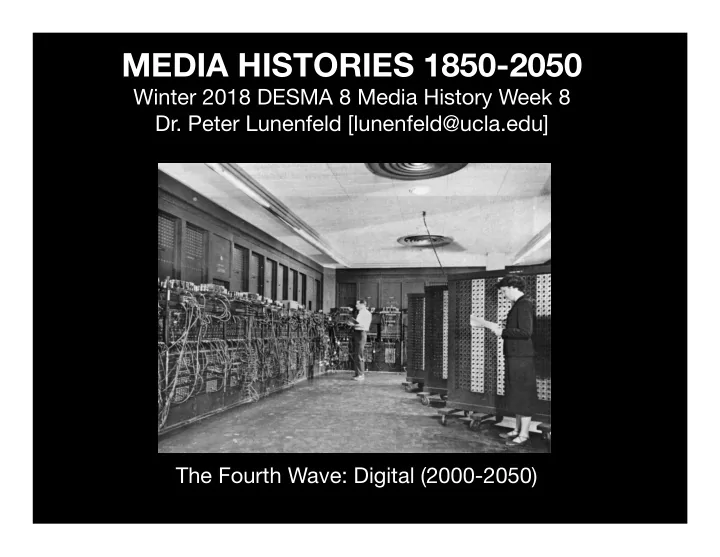
MEDIA HISTORIES 1850-2050 Winter 2018 DESMA 8 Media History Week 8 Dr. Peter Lunenfeld [lunenfeld@ucla.edu] The Fourth Wave: Digital (2000-2050) The Fourth Wave: Digital (2000-2050) The computer is the first media machine that serves as the mode

slide-1
SLIDE 1

MEDIA HISTORIES 1850-2050

Winter 2018 DESMA 8 Media History Week 8

  • Dr. Peter Lunenfeld [lunenfeld@ucla.edu]

The Fourth Wave: Digital (2000-2050)

slide-2
SLIDE 2

The Fourth Wave: Digital (2000-2050) The computer is the first media machine that serves as the mode of produc@on (you can make stuff), the means of distribu@on (you can upload stuff to the network), the site of recep@on (you can download stuff and interact with it), and the locus of praise and cri@que (you can talk about the stuff you have downloaded or uploaded). This culture machine inaugurates the fourth wave of op@cal media.

slide-3
SLIDE 3

And now we need to go back to see if there are prehistories of computing [A great reference for this is the ACM’s timeline of he history

  • f computing, which you can find at

http://www.computer.org/cms/Computer.org/Publications/ timeline.pdf among other places on the Web]

slide-4
SLIDE 4

People have been building calculating machines for millenia. Here an ancient Chinese abacus above an ancient Roman one

slide-5
SLIDE 5

This is the German philosopher Gottfried Liebniz’ Step Reckoner first built in 1673, which did multiplication by repeated addition and shifting. Though he was interested in binary numbers, this machine used decimals.

slide-6
SLIDE 6

The Livre de priers manufacured in Lyon by A. Roux between1886-87 A silk book, woven, not printed…

slide-7
SLIDE 7

The French Jacquard looms were programmable weaving machines, using punchcards for intructions

slide-8
SLIDE 8
slide-9
SLIDE 9
slide-10
SLIDE 10
slide-11
SLIDE 11

Charles Babbage and the Difference Engine #2 (orig. plans 1823-42, reconstruction 1991)

slide-12
SLIDE 12
slide-13
SLIDE 13

Lady Ada Byron, “the Enchantress of Numbers,” as Babbage called her, the patron saint of programmers

slide-14
SLIDE 14

Konrad Zuse was a 20th century computer pioneer from Germany best known for the Z3 (1941), the first functional program-controlled Turing-complete computer. Zuse’s machines read their instructions from celluoid filmstrips

slide-15
SLIDE 15

“The pretence of modern media to create simulations of sensible reality is… cancelled; media are reduced to their original condition as information carrier, nothing less, nothing more… The iconic code of cinema is discarded in favour of the more efficient binary one. Cinema becomes a slave to the computer.” Lev Manovich on Zeus’s use of celluloid filmstock as a medium for computing

slide-16
SLIDE 16

"The idea behind digital computers may be explained by saying that these machines are intended to carry out any operations which could be done by a human computer." Alan Turing (1912-1954) He formalized our ideas about “computation” and “algorithms” and proposed the famous Turing Test for artificial intelligence

slide-17
SLIDE 17

Turing proposed a universal machine that functioned as a stored program computer; in this set-up, the programs, or software, could be swapped and modified, improved and abandoned, just as the hardware could and would be. But, in combination, hardware and software have become ever more adept at simulating

  • ther machines.

Here then is the origin of the dream: a quest for universality and creative potential.

slide-18
SLIDE 18

The Imitation Game: the reduction of complexity to biography

slide-19
SLIDE 19

ENIAC (1946) - Electronic Numerical Integrator And Computer Americans Presper J. Ekhert and John Mauchy, developed ENIAC, the room sized machine at the U of Pennsylvania that is really the first computer that we can recognize today.

slide-20
SLIDE 20

Life was simple before World War II. After that we had systems.

slide-21
SLIDE 21

Generations: Tales of the Computer as Culture MAchine

slide-22
SLIDE 22

Vanavar Bush The Patriarchs J.C.R. Licklider

slide-23
SLIDE 23

The Patriarchs: Vannevar Bush and J.C.R. Licklider The world has arrived at an age of cheap complex devices of great reliability; and something is bound to come of it. —Vannevar Bush People tend to overestimate what can be done in one year and underestimate what can be done in five to ten years. —J.C.R. Licklider

slide-24
SLIDE 24

Bush’s Memex The Patriarchs

slide-25
SLIDE 25

Two Men Named Watson

The Plutocrats

slide-26
SLIDE 26

The Plutocrats: Two Men Named Thomas J. Watson Think. —Thomas J. Watson Sr. Our future is unlimited. —Thomas J. Watson Jr.

slide-27
SLIDE 27

Douglas Engelbart The Aquarians Alan Kay

slide-28
SLIDE 28

The Aquarians: Douglas Engelbart and Alan Kay In 20 or 30 years, you’ll be able to hold in your hand as much computing knowledge as exists now in the whole city, or even the whole world. —Douglas Engelbart It’s not the technology that lives. It’s the dream that lives. —Alan Kay

slide-29
SLIDE 29

Bill Gates The Hustlers Steve Jobs

slide-30
SLIDE 30

The Hustlers: Steve Jobs and Bill Gates Who can afford to do professional work for nothing? —Bill Gates, 1976 Real artists ship. —Steve Jobs, 1983

slide-31
SLIDE 31

Tim Berners-Lee The Hosts Linus Torvalds

slide-32
SLIDE 32

The Hosts: Tim Berners-Lee and Linus Torvalds You affect the world by what you browse. —Tim Berners-Lee Software is like sex: it’s better when it’s free. —Linus Torvalds

slide-33
SLIDE 33

Larry Page and Sergey Brin (Google, Founded 1998) The Searchers

slide-34
SLIDE 34

MEDIA HISTORIES 1850-2050

Winter 2018 DESMA 8 Media History

  • Dr. Peter Lunenfeld [lunenfeld@ucla.edu]

The Fourth Wave: Digital (2000-2050) Part 2

slide-35
SLIDE 35

Fourth Wave: Digital 2 
 In the fourth wave, rather than early, high, or post, the networked computer and its digital relations produce and consume a unimodernism.

slide-36
SLIDE 36

Our moment is unimodern in the sense that it makes modernism in all its variants universal via networks and broadcasts, uniform in their effect if not affect, and unitary in terms of their existing as strings of code. In the unimodern era, as bits, on-line and in databases, a photo is a painting is an

  • pera is a pop single.
slide-37
SLIDE 37

The unimodern culture machine produces vast databases of texts, images, sounds, and other media. Downloading mindfully from this enormity, much less uploading to it in any meaningful way, requires the development of new habits. Liz Larner Untitled, 2001

slide-38
SLIDE 38

Unimodernism describes the ways in which modernism in all its variants and historical strains comes together with the networked cultures of electronic unimedia. Unimodernism assumes that which we archived as early modern fervor, high modern sophistication, and postmodern pastiche will now co-exist co-temporaneously in global networks, accessed at the whim of the downloader and deployed as the user sees fit to be uploaded yet again in an ever-increasing blur of style churn.

slide-39
SLIDE 39

While industrial machines popped a hundred years ago, information has emerged as the key figure for this new

  • century. There are historical parallels

between the emergence of the machine aesthetic in the first decades of the twentieth century and the nascent aesthetics of a digitized, unimodern culture in the twenty-first. The second half of the nineteenth century developed a market economy that produced and consumed machines. The early decades of the twentieth century saw artists, architects, and designers responding to this fever of material production by figuring the machine in their art, architecture, and design. The second half

  • f the twentieth century, in turn, became

an ever-accelerating feedback loop of information. Giacomo Balla Dynamism of a Dog on a Leash (1912)

slide-40
SLIDE 40

Thus, we should not be surprised that the past few years have seen our culture machines producing information-based art, architecture, design, and media; a digitized, interconnected society produces objects and systems that deal with software, databases, and the invisible flows of communications technology and computing

  • algorithms. The great-grandchildren of those obsessed with

Victoriana in the 1920s may look back with bemusement on their forebears’ archaic tastes, but they are the ones flocking to modernist emporiums like the Conran Shop and Design Within Reach to purchase the highest expressions of the machine age at the very moment that the info- aesthetic is on us. Umberto Boccioni, Unique Forms of Continuity in Space (1911)

slide-41
SLIDE 41

Walker Evans Modern Sherrie Levine Postmodern

slide-42
SLIDE 42
slide-43
SLIDE 43
slide-44
SLIDE 44
slide-45
SLIDE 45

Walker Evans Modern Sherrie Levine Postmodern Michael Mandiberg Unimodern

slide-46
SLIDE 46

One way to develop these habits

  • f mind is to think in terms of

figure and ground relationships. Gestalt psychology’s figure/ground experiments were provocative: the drawing that can be either a vase or two faces in profile; the rabbit that’s a duck that’s a rabbit; the old woman who is a young woman who is an old woman. When you look at an image, the figure is what is supposed to have the definite shape, the prominent contour.

slide-47
SLIDE 47

The dynamic between figure and ground is akin to a paradigm shift, but it is less about the singular figure exploding the system through invention than the collective recognition of things that were already present although not central to the culture’s perception of itself.

slide-48
SLIDE 48

If we accept that the digital computer is our culture machine, we can understand the ways in which information has popped to the forefront

  • f our consciousness by using figure/ground relationships to analyze

how electronic databases have transformed our expectation of stylistic “progress” and warped our cultural memory. Aaron Koblin, Flight Patterns (2006)

slide-49
SLIDE 49

Aaron Koblin and Chris Milk, coordinators, (2010)

http://www.thejohnnycashproject.com/

slide-50
SLIDE 50

http://www.thejohnnycashproject.com/

slide-51
SLIDE 51

Games: Pac-Man, introduced 1980

slide-52
SLIDE 52

http://www.polygon.com/2012/10/24/3550510/ video-remix-a-brief-history-of-video-games

slide-53
SLIDE 53


 downloading


slide-54
SLIDE 54


 uploading


slide-55
SLIDE 55


 web 2.0
 1% upload
 10% comment
 90% download only

slide-56
SLIDE 56
slide-57
SLIDE 57

Edward Lorenz and the Strange Attractor

slide-58
SLIDE 58

Social Media Icons, circa 2017