
SLIDE 1
s t a t i s t i c s o f o n e v a r i a b l e
MDM4U: Mathematics of Data Management
Measures of Spread (Part 1)
Quartiles and Percentiles MDM4U: Data Management
Slide 1/14
s t a t i s t i c s o f o n e v a r i a b l e
Measures of Spread
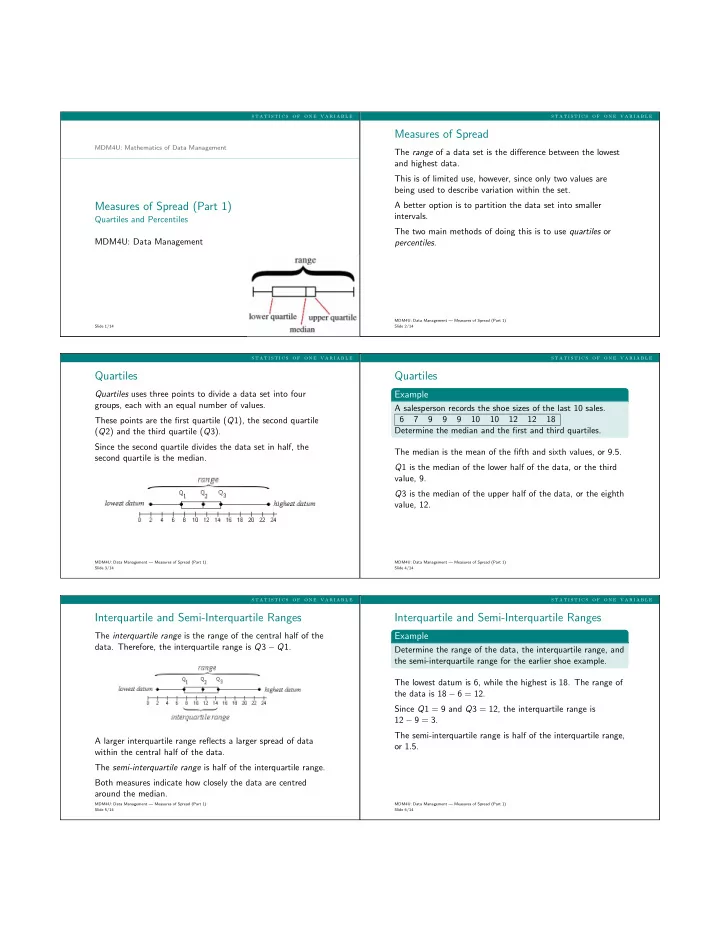
The range of a data set is the difference between the lowest and highest data. This is of limited use, however, since only two values are being used to describe variation within the set. A better option is to partition the data set into smaller intervals. The two main methods of doing this is to use quartiles or percentiles.
MDM4U: Data Management — Measures of Spread (Part 1) Slide 2/14
s t a t i s t i c s o f o n e v a r i a b l e
Quartiles
Quartiles uses three points to divide a data set into four groups, each with an equal number of values. These points are the first quartile (Q1), the second quartile (Q2) and the third quartile (Q3). Since the second quartile divides the data set in half, the second quartile is the median.
MDM4U: Data Management — Measures of Spread (Part 1) Slide 3/14
s t a t i s t i c s o f o n e v a r i a b l e
Quartiles
Example
A salesperson records the shoe sizes of the last 10 sales. 6 7 9 9 9 10 10 12 12 18 Determine the median and the first and third quartiles. The median is the mean of the fifth and sixth values, or 9.5. Q1 is the median of the lower half of the data, or the third value, 9. Q3 is the median of the upper half of the data, or the eighth value, 12.
MDM4U: Data Management — Measures of Spread (Part 1) Slide 4/14
s t a t i s t i c s o f o n e v a r i a b l e
Interquartile and Semi-Interquartile Ranges
The interquartile range is the range of the central half of the
- data. Therefore, the interquartile range is Q3 − Q1.
A larger interquartile range reflects a larger spread of data within the central half of the data. The semi-interquartile range is half of the interquartile range. Both measures indicate how closely the data are centred around the median.
MDM4U: Data Management — Measures of Spread (Part 1) Slide 5/14
s t a t i s t i c s o f o n e v a r i a b l e
Interquartile and Semi-Interquartile Ranges
Example
Determine the range of the data, the interquartile range, and the semi-interquartile range for the earlier shoe example. The lowest datum is 6, while the highest is 18. The range of the data is 18 − 6 = 12. Since Q1 = 9 and Q3 = 12, the interquartile range is 12 − 9 = 3. The semi-interquartile range is half of the interquartile range,
- r 1.5.
MDM4U: Data Management — Measures of Spread (Part 1) Slide 6/14