Measurement of western U.S. baseline ozone from the surface to the - - PowerPoint PPT Presentation

measurement of western u s baseline ozone from the
SMART_READER_LITE
LIVE PREVIEW

Measurement of western U.S. baseline ozone from the surface to the - - PowerPoint PPT Presentation

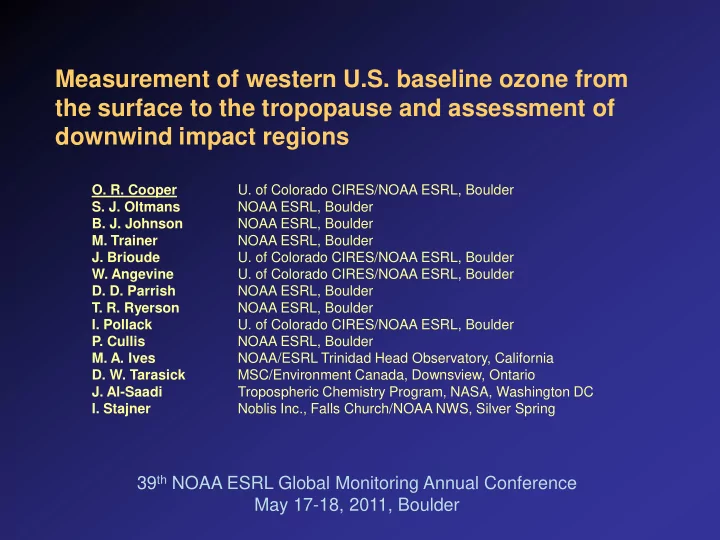
Measurement of western U.S. baseline ozone from the surface to the tropopause and assessment of downwind impact regions O. R. Cooper U. of Colorado CIRES/NOAA ESRL, Boulder S. J. Oltmans NOAA ESRL, Boulder B. J. Johnson NOAA ESRL, Boulder


slide-1
SLIDE 1

Measurement of western U.S. baseline ozone from the surface to the tropopause and assessment of downwind impact regions

  • O. R. Cooper
  • U. of Colorado CIRES/NOAA ESRL, Boulder
  • S. J. Oltmans

NOAA ESRL, Boulder

  • B. J. Johnson

NOAA ESRL, Boulder

  • M. Trainer

NOAA ESRL, Boulder

  • J. Brioude
  • U. of Colorado CIRES/NOAA ESRL, Boulder
  • W. Angevine
  • U. of Colorado CIRES/NOAA ESRL, Boulder
  • D. D. Parrish

NOAA ESRL, Boulder

  • T. R. Ryerson

NOAA ESRL, Boulder

  • I. Pollack
  • U. of Colorado CIRES/NOAA ESRL, Boulder
  • P. Cullis

NOAA ESRL, Boulder

  • M. A. Ives

NOAA/ESRL Trinidad Head Observatory, California

  • D. W. Tarasick

MSC/Environment Canada, Downsview, Ontario

  • J. Al-Saadi

Tropospheric Chemistry Program, NASA, Washington DC

  • I. Stajner

Noblis Inc., Falls Church/NOAA NWS, Silver Spring

39th NOAA ESRL Global Monitoring Annual Conference May 17-18, 2011, Boulder

slide-2
SLIDE 2

Tropospheric ozone monitoring in western North America

Routine in situ ozone measurements from Earth’s surface to the tropopause are made at only 5

  • zonesonde sites in western North America

Only Trinidad Head on the west coast is representative of baseline ozone. baseline ozone - ozone measured at a location with no recent influence from local pollution sources [WMO GAW definition].

Science Questions:

1) Is Trinidad Head representative of baseline ozone at

  • ther coastal sites?

2) What are the anthropogenic NOx emission sources associated with baseline ozone? 3) Once baseline ozone comes ashore, where does it go?

slide-3
SLIDE 3

IONS ozonesonde networks

(Intercontinental Chemical Transport Experiment Ozonesonde Network Study) Experiment Season Location Reference

IONS - 2004 Summer eastern

  • N. America
  • A. M. Thompson et al., JGR

2007 IONS - 2006 Spring Central

  • N. America
  • A. M. Thompson et al, ACP

2008 IONS - 2006 Summer Central

  • N. America
  • O. R. Cooper et al., JGR 2007

ARCIONS - 2008 Spring/ Summer northern

  • N. America
  • S. J. Oltmans et al., Atmos
  • Environ. 2010

IONS - 2010 Late spring western

  • N. America
slide-4
SLIDE 4

IONS-2010 ozonesonde network

Near daily ozonesondes were launched from 7 sites between May 10 - June 19, 2010. A total of 230 sondes were launched, the most in any western North America field campaign aimed at quantifying baseline ozone. Funding, operations and support provided by: NOAA ESRL Health of the Atmosphere Program NASA Tropospheric Chemistry Program

  • U. S. Navy

Environment Canada NOAA National Weather Service National Park Service California State Parks Naval Postgraduate School (Monterey) Federal Aviation Administration

slide-5
SLIDE 5

FLEXPART Lagrangian Particle Dispersion Model

FLEXPART was used to identify air mass sources and receptor regions associated with each ozone measurement Wind fields: GFS global 0.5º x 0.5º resolution, 26 vertical levels WRF western USA, 12 km resolution, 40 vertical levels

  • ne retroplume and one forward plume were calculated every 200 m

along every ozonesonde profile The quantity of a 20-day passive anthropogenic NOx tracer transported to the ozonesonde measurement locations was calculated

EDGAR 2005 anthropogenic NOx emission inventory with University of Delaware 2001 international shipping NOx emissions (J. Corbett)

slide-6
SLIDE 6

Comparison of 4 inland sites to Trinidad Head of mass of ozone (DU/km) from 0 - 6 km a.s.l. KE = 0% SP = -7% BL = +2% BO = +6%

slide-7
SLIDE 7

+15% +11% +4%

Percent difference in total mass of ozone in the lowest km, for southern sites compared to Trinidad Head.

slide-8
SLIDE 8

Baseline ozone determined by removing all measurements with a 5-day North America NOx tracer > 440 pptv. Change in baseline ozone is calculated in units of DU km-1.

  • 7% +2% +3% +4%
slide-9
SLIDE 9
slide-10
SLIDE 10
slide-11
SLIDE 11
  • T. Head
  • Pt. Reyes
  • Pt. Sur

San Nicolas Is.

California’s coastal topography affects ozone transport:

Coastal mountains impede the transport of marine boundary layer air into California at Trinidad Head and

  • Pt. Sur [Parrish et al., 2010].

Relatively low topography allows air at Pt. Reyes to enter the Central Valley in the vicinity of The Carquinez Strait [Bao et al., 2008].

Bao, J.-W. et al. (2008), Observed and WRF- simulated low-level winds in a high-ozone episode during the Central California Ozone Study, J. Applied Met. Clim., 47, 2372-2394. Parrish, D. et al. (2010), Impact of transported background ozone inflow on summertime air quality in a California ozone exceedance area,

  • Atmos. Chem. Phys., 10, 10093-10109.
slide-12
SLIDE 12
slide-13
SLIDE 13

~19% ~18% ~3% ~34% ~19%

slide-14
SLIDE 14
slide-15
SLIDE 15
slide-16
SLIDE 16
slide-17
SLIDE 17
slide-18
SLIDE 18

Comparison of 4 inland sites to Trinidad Head of mass of ozone (mPa/km) from 0 - 2 km a.g.l. KE = +14% SP = -5% BL = +4% BO = +26%

slide-19
SLIDE 19
  • 9% +2% +4%

Percent difference in total mass of

  • zone per km (0-8 km), for southern

sites compared to Trinidad Head.

slide-20
SLIDE 20
slide-21
SLIDE 21
slide-22
SLIDE 22
slide-23
SLIDE 23
slide-24
SLIDE 24
slide-25
SLIDE 25
slide-26
SLIDE 26
slide-27
SLIDE 27
slide-28
SLIDE 28
slide-29
SLIDE 29