MEASUREMENT OF SURFACE ENERGY OF RECYCLED CARBON FIBRES USING A - - PDF document

measurement of surface energy of recycled carbon fibres
SMART_READER_LITE
LIVE PREVIEW

MEASUREMENT OF SURFACE ENERGY OF RECYCLED CARBON FIBRES USING A - - PDF document

18 TH INTERNATIONAL CONFERENCE ON COMPOSITE MATERIALS MEASUREMENT OF SURFACE ENERGY OF RECYCLED CARBON FIBRES USING A CAPILLARY INTRUSION METHOD Guozhan Jiang, Stephen J Pickering Division of Materials, Mechanics and Structures, University of


slide-1
SLIDE 1

18TH INTERNATIONAL CONFERENCE ON COMPOSITE MATERIALS

  • 1. Introduction

Recycling carbon fibre from carbon fibre reinforced polymer composites (CFRP) has been investigated for almost 20 years driven by landfill legislation, the potential market for recycled fibre and the desire for sustainable manufacturing processes and products. Also, increasing growth in the use of CFRP in aircraft [1] and even automobiles to improve fuel economy makes the recycling very attractive. Recently, commercial companies have emerged to recycle carbon fibres, such as Recycling Carbon Fibre Ltd (RCF Ltd, UK) and Materials Innovation Technologies (US). The methodology for carbon fibre recycling is to remove the matrix thermoset polymer in the form of small molecules, leaving carbon fibre. To date, there are generally three routes, pyrolysis of the CFRP in the absence of oxygen and then oxidation of the char to release carbon fibre [2], thermo-oxidative processing of CFRP in a fluidised bed to convert thermoset matrix polymer into gaseous products and to blow out the released carbon fibre [3], solvolysis

  • f the thermoset matrix in nitric acid [4] or

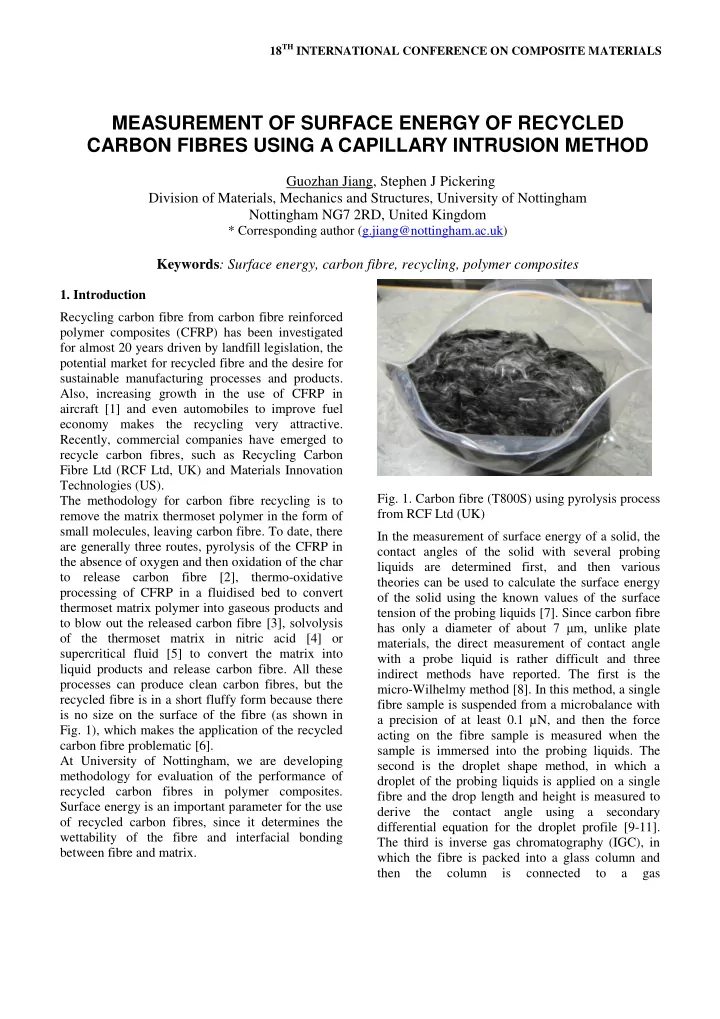
supercritical fluid [5] to convert the matrix into liquid products and release carbon fibre. All these processes can produce clean carbon fibres, but the recycled fibre is in a short fluffy form because there is no size on the surface of the fibre (as shown in

  • Fig. 1), which makes the application of the recycled

carbon fibre problematic [6]. At University of Nottingham, we are developing methodology for evaluation of the performance of recycled carbon fibres in polymer composites. Surface energy is an important parameter for the use

  • f recycled carbon fibres, since it determines the

wettability of the fibre and interfacial bonding between fibre and matrix.

  • Fig. 1. Carbon fibre (T800S) using pyrolysis process

from RCF Ltd (UK) In the measurement of surface energy of a solid, the contact angles of the solid with several probing liquids are determined first, and then various theories can be used to calculate the surface energy

  • f the solid using the known values of the surface

tension of the probing liquids [7]. Since carbon fibre has only a diameter of about 7 μm, unlike plate materials, the direct measurement of contact angle with a probe liquid is rather difficult and three indirect methods have reported. The first is the micro-Wilhelmy method [8]. In this method, a single fibre sample is suspended from a microbalance with a precision of at least 0.1 µN, and then the force acting on the fibre sample is measured when the sample is immersed into the probing liquids. The second is the droplet shape method, in which a droplet of the probing liquids is applied on a single fibre and the drop length and height is measured to derive the contact angle using a secondary differential equation for the droplet profile [9-11]. The third is inverse gas chromatography (IGC), in which the fibre is packed into a glass column and then the column is connected to a gas

MEASUREMENT OF SURFACE ENERGY OF RECYCLED CARBON FIBRES USING A CAPILLARY INTRUSION METHOD

Guozhan Jiang, Stephen J Pickering Division of Materials, Mechanics and Structures, University of Nottingham Nottingham NG7 2RD, United Kingdom

* Corresponding author (g.jiang@nottingham.ac.uk)

Keywords: Surface energy, carbon fibre, recycling, polymer composites

slide-2
SLIDE 2

chromatograph to measure the residence time of probe liquids so that the surface energy can be calculated [12]. The first two methods involve single fibres and the measurement

  • f

its diameter. Due to the heterogeneity and irregular shape of carbon fibres, an assumption of circular profile is often used for calculation of the contact angles. Furthermore, expensive instruments such as gas chromatograph or microbalance have to be used. To this end, a capillary intrusion method has been developed to measure the contact angle of recycled carbon fibres with probing liquids. The capillary intrusion method has widely been used for measuring the contact angles of powder solids with liquids using a modified Washburn method [13]. In this technique, a cylindrical tube is filled with the powder to form a bed, and then the probing liquid rises along the capillary between the particles. The relationship between the mass of the adsorbed liquid (m) and the intrusion time (t) is shown in Eq.1. [14]

t c m              cos

2 2

(1) Where ρ is the density, γ is the surface tension and η is the viscosity of the liquid, θ is the contact angle of the liquid with the solid, and c an equivalent of capillary radius. For recycled carbon fibre, it is difficult to form a bed with the same c each time, which is essential for the capillary intrusion method, due to its fluffy form. We report here a method to overcome this difficulty and then to measure the surface energy of recycled carbon fibres.

  • 2. Experimental

2.1 Materials Three types of carbon fibre were used in this work: recycled T800S (RCF Ltd) recycled using pyrolysis route, recycled T600S recycled using thermo-

  • xidative route in a fluidised bed. A virgin T700SC-

12000-50C with known surface energy reported in the literature was also used in order to compare the capillary intrusion method used in this work with

  • ther methods. Virgin T800S was not used because
  • f its unavailability.

Four probing liquids (with known surface tension) were used: n-heptane (used as a complete wetting liquid, θ = 0o); ethylene glycol, formamide, and distilled water. The first three liquids were from Sigma-Aldrich without further purification. 2.2 Method The fluffy recycled carbon fibre (Fig. 1) was first dispersed uniformly in glycerol using a kitchen

  • blender. A wet-laid process was then used to

transform it into a random mat with an areal density

  • f about 200 g/m2, as shown in Fig. 2.

Fig.2. A random mat made from recycled carbon fibre (recycled T800S from RCF Ltd) A piece of 40 x 85 mm was cut as testing sample for sorption experiment. The sample was clamped between two 5 mm thick stainless-steel plates with a 2 mm thick spacer, as illustrated in Fig. 3. A picture

  • f the measurement set-up is shown in Fig.4.
  • Fig. 3. Experimental set up for the measurement
slide-3
SLIDE 3

Fig.4. A picture of the set-up for capillary intrusion method for measurement of surface energy of recycled carbon fibre in a fume cupboard The bath of probing liquid was placed on one end of a steel plate, which was on the top of a lab jack. The

  • ther end of the plate was balanced using a metal
  • block. The metal plate was inserted into a cylinder

through a window on its side. The cylinder was placed on a balance, which was connected to a computer to record the mass-time data. The sample was suspended from the top of the cylinder into the bath just above its liquid surface. The bath was then raised until the bottom of the sample just contacted the liquid surface and the liquid began to rise up along the sample due to the capillary force. Raw data were collected automatically at a rate of one point per second. The square of the mass of the probe liquid (m2) was then plotted against time (t). Linear regression analysis was used to obtain the slope for the straight part of the curve. The slope of the curve in the first 10-30 seconds was used to determine the constant “c” using n-heptane and the constant was then used to calculate the contact angle “θ” from the slopes of the other probe liquids. Three samples were repeated for each probing

  • liquid. The average of three slopes was used to give

the constant “c” or contact angle “θ”. After measuring the contact angles of the probing liquids with the carbon fibres, Eq. 2 [14] was used to calculate the surface energy by plotting

γL(1+cosθ)/(2γL

d)0.5 against (γL p)0.5/(γL d)0.5 [15].

The slope was the polar component (γs

p), and the

intercept on y axis was the dispersion component (γs

d) of the surface energy of the carbon fibre. d s d L P L p s d L L

                  2 ) cos 1 (

(2) In the equation, γ is the surface energy, and subscript L liquid, s solid, and the superscript p polar component and d dispersion component of surface

  • energy. The dispersion component is due to the

Lifshitz-van der Waals interactions, i.e. interactions between two completely apolar compounds, while the polar component is due to electron acceptor- electron donor interactions, i.e. acid-base interactions [13].

  • 3. Results and discussion

The key step for the use of the capillary intrusion method to determine the contact angle between fluffy recycled carbon fibre with probing liquids is to determine the “c” constant in Eq. 1. This is usually conducted by using a liquid with very low surface tension such as alkanes, assuming that contact angle “θ” is equal to zero. In the experiments with other probing liquids, the same “c” was

  • assumed. For a powder sample, it can be poured into

a tube and then tapping the same times using a standard instrument to get the same “c” for each probe liquid. However, for fluffy fibres, it is impossible to get the same “c” using this method. In order to get the same “c”, the fluffy fibre was first transformed into a random mat. Each time, the same size of the mat was cut from the whole piece and then clamped between two steel plates with a 2 mm

  • spacer. To maintain the reproducibility of the

constant “c”, the spacer was necessary. Otherwise the thickness would change during liquid uptake. It was found that a bath with wide diameter was better to keep the least change of liquid level during liquid

  • uptake. Another factor to be considered is the

thickness of the sample. It was shown that the uptake

  • f

the viscous liquid had a low reproducibility when the sample thickness was less than 1 mm. Therefore, the mat was made with an areal density of 200 g/m2 and clamped between two steel plates and a 2 mm thick spacer. The method was first used to measure the surface energy of T700SC carbon fibre. The fibre was cut to 3 mm in length and dispersed using the blender and transformed into a random mat. The plot for calculating surface energy is shown in Fig. 5, and the result for T700SC is shown in Table 1 with a

slide-4
SLIDE 4

comparison with the literature reported values, which was measured using micro-Wilhelmy method and IGC method respectively. Fig.5. The plot for T700SC fibre to calculate the surface energy using Eq. 2 Table 1. Contact angles and surface energy of T700SC-12000-50C fibre obtained in this work and literature values. This work micro- Wilhelmy [16] IGC [17] Contact angle ( o ) Formamide 48.1 EG 32.4 Water 73.5 69.4 Surface energy (mJ/m2) γs

d 35.6

31.7 32.7 γs

p 7.1

10.3 16.6 γs 42.7 42.0 49.3 It can be seen from Table 1 that the capillary intrusion method is comparable with the micro- Wilhelmy method. However, the value was lower than that obtained from IGC method. Both the micro-Wilhelmy method and the capillary intrusion method use the capillary force, but the IGC method uses an acceptor-donor principle. This may be the main reason for the difference. The method was then used to measure the two recycled carbon fibres. The plots for calculating surface energy are shown in Figs. 6 and 7 respectively for RCF fibre and fluidised bed fibre. The results for surface energy are listed in Table 2 for the two different carbon fibres. The surface energies of the two recycled carbon fibres are similar at 46 mJ/m2. This may be because both recycling processes involve an oxidation stage in air.

  • Fig. 6. The plot for RCF recycled carbon fibre to

calculate the surface energy using Eq. 2

  • Fig. 7. The plot for fluid bed recycled carbon fibre to

calculate the surface energy using Eq. 2 Table 2. Contact angles and surface energy of recycled carbon fibres. RCF fibre Fluid bed fibre Contact angle ( o ) Formamide 37.3 30.1 EG 28.8 25.0 Water 55.7 54.2 Surface energy (mJ/m2) γs

d 22.0

25.0 γs

p 23.8

22.8 γs 45.8 47.8

slide-5
SLIDE 5

The virgin carbon fibre after surface treatment has a surface energy of 35-50 mJ/m2. It can thus be seen that the recycled carbon fibre has a comparable surface energy as that of virgin carbon fibre. This indicates that no further surface treatment may be needed for the use of the recycled carbon fibre from pyrolysis or thermo-oxidative process.

  • 4. Conclusions

In this work, the capillary intrusion method was developed to measure the surface energy of fluffy recycled carbon fibres. By transforming the fluffy recycled carbon fibre into a uniform random mat, a constant “c” parameter can be achieved, which is the key step for the use of capillary intrusion method. The measured surface energies of the recycled carbon fibres from both pyrolysis and thermo-

  • xidative process in a fluidised bed have similar

values of about 46 mJ/m2. Acknowledgement Funding for this research is gratefully acknowledged from the Engineering and Physical Sciences Research Council (UK) through the Nottingham Innovative Manufacturing Research Centre (NIMRC). The support of Recycled Carbon Fibre Ltd, Technical Fibre Products Ltd, the Boeing Company and EXA Technology is also acknowledged. References [1]

  • K. Lu "The future of metals", Science, Vol.

328 pp 319-320, 2010. [2]

  • L. O. Meyer and K. Schulte "CFRP-Recycling

Following a Pyrolysis Route: Process Optimization and Potentials". Journal of Composite Materials, Vol 43, pp 1121-1133, 2009. [3]

  • G. Jiang, W. H. Wong, S. J. Pickering, C. D.

Rudd and G. S. Walker " Study of a fluidised bed process for recycling carbon fibre from polymer composite", in Proceedings of 7th World Congress for Chemical Engineering, , Glasgow, UK, Paper No. O22, 2005. [4]

  • W. Dang, M. Kubouchi, T. Maruyama, H.

Sembokuya and K. Tsuda " Decomposition of GFRP in nitric acid and hydrogen peroxide solution for chemical recycling". Progress in Rubber, Plastics and Recycling Technology,

  • Vol. 18, pp 49-67, 2002.

[5]

  • G. Jiang, S. J. Pickering, E. H. Lester and N.
  • A. Warrior " Decomposition of epoxy resin in

supercritical isopropanol". Industry and Engineering Chemistry Research, Vol. 49, pp 4535-4541, 2010. [6]

  • S. J. Pickering " Recycling technologies for

thermoset composite materials-current status". Composites: Part A, Vol. 37, pp 1206-1215, 2006. [7]

  • E. Chibowski and R. Perea-Carpio "Problems
  • f contact angle and solid surface free energy

determination". Advances in Colloid and Interface Science, Vol. 98, pp 245-264, 2002. [8]

  • B. Miller, L. S. Penn and S. Hedvat "Wetting

force measurement on single fibres". Colloids and Surfaces, Vol. 6 , pp 49-61, 1983. [9]

  • B. J. Carroll "The accurate measurement of

contact angle, phase contact areas, drop volume, and Laplace excess pressure in drop-

  • n-fiber systems". Journal of Colloid and

Interface Science, Vol. 57, pp 488- 495, 1976. [10] J.-I. Yamaki and Y. Katayama " New method

  • f

determining contact angle between monofilament and liquid". Journal of Applied Polymer Science, Vol.19, 2897-2909, 1975. [11] N. Dumitrascu and C. Borcia "Determining the contact angle between liquids and cylindrical surfaces". Journal of Colloid and Interface Science, Vol. 294, pp 418-422, 2006. [12] M. Nardin, H. Balard and E. Papirer "Surface characteristics of commercial carbon fibres determined by inverse gas chromatography". Carbon, Vol. 2, pp 43-48, 1990. [13] C. J. van Oss "Interfacial Forces in Aqueous Media". Marcel Dekker, New York, 1994. [14] Z. Persin, K. Stana-Kleinschek, M. Sfiligoj- Smole and T. Kreze "Determing the surface free energy of cellulose materials with the powder contact angle method". Textile Research Journal, Vol. 74, pp 55-62, 2001. [15] F. Hoecker and J. Karger-Kocsis " Surface energetics of carbon fibers and its effects on the mechanical performance

  • f

CF/EP composites". Journal of Applied Polymer Science, Vol.59, pp 139-153, 1996. [16] F. Zhao and Y. Huang "Grafting of polyhedral

  • ligomeric silsesquioxanes on a carbon fiber
slide-6
SLIDE 6

surface: Novel coupling agents for fiber/polymer matrix composites", Journal of Materials Chemistry, Vol. 21, 3695-3703, 2011. [17] Z. Dai, F. Shi, B. Zhang, Li and Z. Zhang " Effect of sizing on carbon fiber surface properties and fibers/epoxy interfacial adhesion". Applied Surface Science, Vol. 257, pp 6980-6985, 2011.