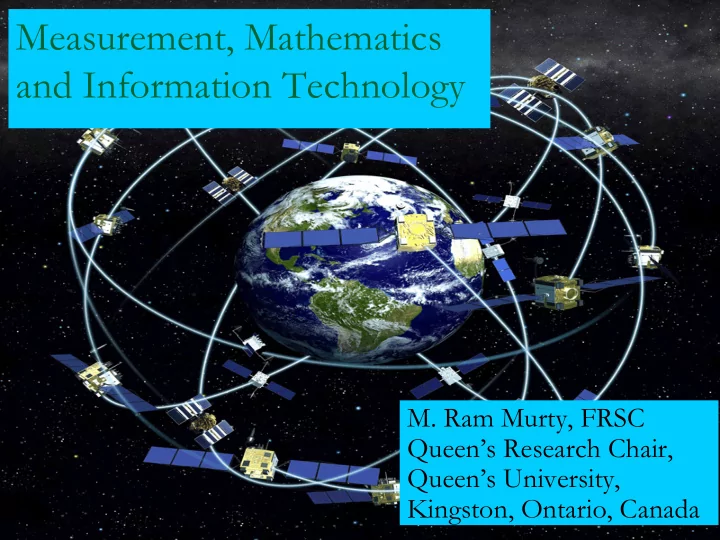
Measurement, Mathematics and Information Technology M. Ram Murty, - - PowerPoint PPT Presentation

measurement mathematics
SMART_READER_LITE
LIVE PREVIEW

Measurement, Mathematics and Information Technology M. Ram Murty, - - PowerPoint PPT Presentation

Measurement, Mathematics and Information Technology M. Ram Murty, FRSC Queens Research Chair, Queens University, Kingston, Ontario, Canada Can we measure everything? Not everything that can be counted counts, and not everything


slide-1
SLIDE 1

Measurement, Mathematics and Information Technology

  • M. Ram Murty, FRSC

Queen’s Research Chair, Queen’s University, Kingston, Ontario, Canada

slide-2
SLIDE 2

Can we measure everything?

 “Not everything that

can be counted counts, and not everything that counts can be counted.”

Albert Einstein (1879-1955) However, some understanding emerges through measurement.

slide-3
SLIDE 3

Here is a quote from an article in the New York Times:

 “With the measurement system all but finalized, why are

controversies over measurement still surfacing? Why are we still stymied when trying to measure intelligence, schools, welfare and happiness?” -NY Times, October 2011.

 The article goes on to say that there are two ways of

measurement, one is “ontic” and the other “ontological.”

 The ontic way is what we are all familiar with, measuring things

according to a scale. It is mathematical.

 The ontological way is more philosophical and we understand

through inquiry, reflection and meditation.

slide-4
SLIDE 4

The dangers of confusing the two methods

 Here is what Wikipedia says about him.  He was an English Victorian progressive, polymath,

psychologist, anthropologist, eugenicist, tropical explorer, geographer, inventor, meteorologist, proto- geneticist, psychometrician, and statistician. He was knighted in 1909.

Let us look at the case of Francis Galton.

  • F. Galton (1822-1911)
slide-5
SLIDE 5

The creation of eugenics

 Inspired by Darwin’s 1859 theory of evolution, Galton proposed

a theory of how to create a master race by measuring intelligence

  • f races.

 In 1869, his book “Hereditary Genius” posited that human

intelligence was inherited directly and diluted by “poor” breeding.

 “The natural ability of which this book treats is such as a modern

European possesses in a much greater average share than men of the lower races.”

 There is a straight line between Galton’s method of measuring

intelligence to Hitler’s views of a master race. Galton’s views also led to the horrible idea of IQ.

 Thus, we must know what can be measured and what cannot.

slide-6
SLIDE 6

Everyday uses of measurement

 By measuring time, we are able to co-ordinate our daily activities.  By measuring temperature, we can dress appropriately.  By measuring cost, we can shop for the best deal.  By measuring wind speeds and atmospheric currents, we can

prepare for natural disasters.

 By measuring distance, we can plan our travel accordingly.  All of these are “ontic” uses of measurement and all of them are

invaluable in our daily life. These measurements have and continue to have a profound effect on civilizations.

 But they all need some basic knowledge of numbers.

slide-7
SLIDE 7

However, there are many things that can be measured the “ontic” way.

Many civilizations had a number system to count.

Where does our decimal number system come from?

India.

More precisely, the decimal system goes back more than 1500 years to central India.

In 7th century India, Brahmagupta wrote the first book that describes the rules of arithmetic using zero.

This is by using numbers. A portion of a dedication tablet in a rock-cut Vishnu temple in Gwalior built in 876 AD. The number 270 seen in the inscription features the oldest extant zero in India

slide-8
SLIDE 8

The number 270

slide-9
SLIDE 9

Gwalior

 The rock inscription is part of the Vishnu temple is

Gwalior.

 The Chinese and Babylonian civilizations had a

place value number system. But it was the Indians that started to treat zero as a number.

The origins of “zero” have been traced back to early Hinduism , Buddhism and Jainism where the concept of “nothingness” is equated with “nirvana” or the transcendental state.

slide-10
SLIDE 10

The Vishnu Temple

 The defacement of the face probably occurred in

the Mughal period (15th century).

slide-11
SLIDE 11

Some more numbers on the temple walls

slide-12
SLIDE 12

Some more …

slide-13
SLIDE 13

Evolution of our number system

 Notice the similarity between the Gwalior system

and our modern system of numerals.

slide-14
SLIDE 14

The migration of the number system

 The familiar operations of numbers was developed by

Brahmagupta around 600 CE.

 The number system then went to the middle east through Arab

traders in the 8th century.

 Al-Khwarizmi wrote a book in 825 CE titled, “On the

calculation with Hindu numerals”.

 The modern word “algorithm” comes from Al-Khwarizmi’s

name.

 In 1202, Fibonacci took the number system from the Arabs and

introduced in Europe but was not widely used until 1482, when printing came into vogue.

 This event animated the development of modern mathematics.

slide-15
SLIDE 15

What is mathematics?

slide-16
SLIDE 16

Mathematics as the language of science

 “Nature’s great book is written

in the language of mathematics”. - Galileo

Galileo (1564-1642) “Mathematics is the queen of science and number theory is the queen of mathematics.” – C.F. Gauss C.F. Gauss (1777-1855)

slide-17
SLIDE 17

The unreasonable effectiveness of mathematics

 Mathematics is now being applied to

diverse fields of learning never imagined with remarkable success.

 In this talk, we will highlight some

examples of this phenomenon.

Eugene Wigner (1902-1995)

slide-18
SLIDE 18

Three examples of measurement

 We will discuss the

mathematics behind:

position importance shape

slide-19
SLIDE 19

Who am I?

 This is the

fundamental existential question and belongs in the realm of philosophy.

 GPS is concerned with

the question “Where am I?” not as a philosophical question but as question in

  • geography. What is my

geographical position?

slide-20
SLIDE 20

The world without GPS

slide-21
SLIDE 21

The world with GPS

slide-22
SLIDE 22

GPS: Satellites and Receivers

 Each satellite

sends signals indicating its position and time.

slide-23
SLIDE 23

Satellites and signals

 Each satellite of the network sends a signal indicating

its position and the time of the transmission of the signal.

 Since signals travel at the speed of light, the receiver can

determine the radial distance of the satellite from the receiver based on the time it took to receive the signal since each receiver also has a clock.

 Many think that the receivers transmit information to

the satellites, whereas in reality, it is the other way around.

 The receiver then uses basic math to determine its

position.

slide-24
SLIDE 24

Spheres

 If the receiver is R units away from satellite A, then

the receiver lies on a sphere of radius R centered at A.

 A suitably positioned second satellite B can be used

to determine another sphere, and the intersection of these two spheres determines a circle.

 A third satellite can be used to narrow the position

to two points, and finally, a fourth, not coplanar with the other three, can be used to pinpoint the position of the receiver.

slide-25
SLIDE 25

Satellites in orbit

 This is an animation of 24

GPS satellites with 4 satellites in each of 6

  • rbits. It shows how

many satellites are visible at any given time. This ensures redundancy to ensure accuracy.

slide-26
SLIDE 26

The mathematics of GPS

 The intersection of two

spheres is either empty or a circle.

 The circle will intersect a

third sphere in at most two points.

 This geometric fact is the

basis of GPS since other factors can be used to eliminate one of the two points as being an irrelevant solution to the problem.

slide-27
SLIDE 27

Equations for spheres

 Each satellite determines a radial distance to the

  • receiver. Using Euclidean co-ordinates, let us

denote the position of the receiver by (x,y,z) (which is unknown) and the position of the first satellite by (a1, b1, c1) (which is known) and the radial distance by r1. Then:

slide-28
SLIDE 28

A second satellite

 A second satellite sends a signal to the receiver and

determines another radial distance r2. If the center

  • f the second satellite is (a2 , b2 , c2 ) then the

unknown co-ordinates (x,y,z) lie on the sphere:

Similarly from a third satellite:

slide-29
SLIDE 29

Solving three equations in three unknowns

This is not a linear system. However, if we subtract the third from the first and the second from the first, we get two linear

  • equations. Thus, our system is now of the form:

The first two equations determine x and y in terms of z via Cramer’s rule in linear algebra. These are then plugged into the third giving us a quadratic equation in z. This gives two solutions for x,y,z but only one

  • f these corresponds to a point on the surface of the earth, which determines

the position of the receiver uniquely. 14/

slide-30
SLIDE 30

How Google works

 Google has become

indispensable that many don’t realize the non-trivial mathematics behinds its workings.

 The essential idea comes from

a theorem of Frobenius and Perron dealing with Markov chains.

Georg Frobenius (1849-1917)

  • O. Perron (1880-1975)

A.A. Markov (1856-1922)

slide-31
SLIDE 31
slide-32
SLIDE 32
slide-33
SLIDE 33
slide-34
SLIDE 34
slide-35
SLIDE 35

From: gomath.com/geometry/ellipse.php

slide-36
SLIDE 36

Metric mishap causes loss of Mars orbiter (Sept. 30, 1999)

slide-37
SLIDE 37

The limitations of Google!

slide-38
SLIDE 38

The web at a glance

Query-independent PageRank Algorithm

slide-39
SLIDE 39

The web is a directed graph

 The nodes or vertices are the web pages.  The edges are the links coming into the page

and going out of the page.

This graph has more than 10 billion vertices and it is growing every second!

slide-40
SLIDE 40

The PageRank Algorithm

 PageRank Axiom:

A webpage is important if it is pointed to by other important pages.

 The algorithm was

patented in 2001.

Sergey Brin and Larry Page

slide-41
SLIDE 41

Example

 C has a higher

rank than E, even though there are fewer links to C since the one link to C comes from an “important” page.

slide-42
SLIDE 42
slide-43
SLIDE 43

Mathematical formulation

 Let r(J) be the “rank”

  • f page J.

 Then r(K) satisfies

the equation r(K)= ΣJ→K r(J)/deg+(J), where deg+(J) is the

  • utdegree of J.

12

slide-44
SLIDE 44

Matrix multiplication

Factoid: The word “matrix” comes from the Sanskrit word “matr” which is the root word for “mother”. It was coined by Herman Grassman who was both a Sanskrit scholar and a mathematician.

  • H. Grassman

(1809-1877)

slide-45
SLIDE 45

The web and Markov chains

 Let puv be the

probability of reaching node u from node v.

 For example, pAB=1/2

and pAC=1/3 and pAE=0.

Notice the columns add up to 1. Thus, (1 1 1 1 1)P=(1 1 1 1 1). Pt has eigenvalue 1 P is called the transition matrix.

slide-46
SLIDE 46

Markov process

If a web user is on page C, where will she be after one click? After 2 clicks? … After n clicks?

A.A. Markov (1856-1922) After n steps, Pnp0.

slide-47
SLIDE 47

Eigenvalues and eigenvectors

 A vector v is called an eigenvector of a matrix

P if Pv = λv for some number λ.

 The number λ is called an eigenvalue.  One can determine practically everything

about P from the knowledge of its eigenvalues and eigenvectors.

 The study of such objects is called linear

algebra and this subject is more than 100 years old.

slide-48
SLIDE 48

Eigenvalues and eigenvectors of P

 Therefore, P and Pt have the same

eigenvalues.

 In particular, P also has an eigenvalue equal

to 1.

slide-49
SLIDE 49

Theorem of Frobenius

 All the eigenvalues of the

transition matrix P have absolute value ≤ 1.

 Moreover, there exists an

eigenvector corresponding to the eigenvalue 1, having all non-negative entries.

Georg Frobenius (1849-1917)

slide-50
SLIDE 50

Perron’s theorem

 Theorem (Perron): Let

A be a square matrix with strictly positive

  • entries. Let λ* =

max{ |λ|: λ is an eigenvalue of A}. Then λ* is an eigenvalue of A

  • f multiplicity 1 and

there is an eigenvector with all its entries strictly positive. Moreover, |λ|< λ* for any other eigenvalue.

  • O. Perron (1880-1975)
slide-51
SLIDE 51

Frobenius’s refinement

 Call a matrix A irreducible if An has strictly

positive entries for some n.

 Theorem (Frobenius): If A is an irreducible

square matrix with non-negative entries, then λ* is again an eigenvalue of A with multiplicity 1. Moreover, there is a corresponding eigenvector with all entries strictly positive.

slide-52
SLIDE 52

Why are these theorems important?

 We assume the following concerning the matrix P:  (a) P has exactly one eigenvalue with absolute value

1 (which is necessarily =1);

 (b) The corresponding eigenspace has dimension 1;  (c) P is diagonalizable; that is, its eigenvectors form

a basis.

 Under these hypothesis, there is a unique

eigenvector v such that Pv = v, with non-negative entries and total sum equal to 1.

 Frobenius’s theorem together with (a) implies all the

  • ther eigenvalues have absolute value strictly less

than 1.

slide-53
SLIDE 53

Computing Pnp0.

 Let v1, v2, …, v5 be a basis of eigenvectors of P, with

v1 corresponding to the eigenvalue 1.

 Write p0 = a1v1 + a2v2 + … + a5v5.  It is not hard to show that a1=1.  Indeed, p0= a1v1 + a2v2 + … + a5v5  Let J=(1,1,1,1,1).  Then 1 = J p0= a1 Jv1 + a2 Jv2 + … + a5 Jv5  Now Jv1=1, by construction.  For i≥2, J(Pvi) = (JP)vi = Jvi. But Pvi = λivi.  Hence λi Jvi = Jvi. Since λi ≠1, we get Jvi =0.  Therefore a1=1.

36

slide-54
SLIDE 54

Computing Pnp0 continued

 Pnp0= Pnv1 + a2Pnv2 + … + a5Pnv5  = v1+ λ2

n a2v2+ … + λ5 n a5v5.

 Since the eigenvalues λ2, …, λ5 have absolute

value strictly less than 1, we see that Pnp0→v1 as n tends to infinity.

 Moral: It doesn’t matter what p0 is, the

stationary vector for the Markov process is v1.

slide-55
SLIDE 55

Returning to our example …

 The vector (12, 16, 9, 1, 3)

is an eigenvector of P with eigenvalue 1.

 We can normalize it by

dividing by 41 so that the sum of the components is 1.

 But this suffices to give

the ranking of the nodes:B, A, C, E, D.

slide-56
SLIDE 56

Improved PageRank

 If a user visits F, then she is

caught in a loop and it is not surprising that the stationary vector for the Markov process is (0,0,0,0,0, ½, ½ )t.

 To get around this difficulty, the

authors of the PageRank algorithm suggest adding to P a stochastic matrix Q that represents the “taste” of the surfer so that the final transition matrix is P’ =xP + (1-x)Q for some 0≤x≤1.

 Note that P’ is again stochastic.  One can take Q=J/N where N is

the number of vertices and J is the matrix consisting of all 1’s.

 Brin and Page suggested x=.85 is

  • ptimal.

41/

slide-57
SLIDE 57

Radiosurgery and the mathematics of shapes

 Radiosurgery is also called

gamma-knife surgery in the literature.

slide-58
SLIDE 58

What is gamma-knife surgery?

 It is a non-invasive medical

procedure used to treat tumors, usually in the brain.

 This is called radiosurgery since it

uses radiation to perform the surgery.

 201 Cobalt gamma ray beams are

arrayed in a hemisphere and aimed through a collimator to a common focal point.

 The patient’s head is positioned so

that the tumor is the focal point.

slide-59
SLIDE 59

The minimax problem

 Since the tumor maybe of irregular shape and spread over a

region, the idea is to minimize the number of radiation treatments and maximize the portion of the area to be treated.

 When the beams are focused with the help of a helmet, they

produce focal regions of various sizes.

 Each size of dose requires a different helmet and so the

helmet needs to be changed when the dose radius needs to be changed.

 Since each helmet weighs 500 pounds, it is important to

minimize the number of helmet changes.

slide-60
SLIDE 60

The mathematics of shapes

 Here is the target

area on which the radiation is to be applied.

 Since the helmets

have varying degrees of focal regions, several helmets have to be used.

slide-61
SLIDE 61

Sphere packing problem

 Since we have spheres of

different sizes and not all

  • f the affected region can

be targeted, the problem can be formulated mathematically as follows:

slide-62
SLIDE 62

The skeleton of a region

 Let |X-Y| denote the

Euclidean distance between two points in the plane or in space.

slide-63
SLIDE 63

Two dimensional skeletons

 We denote

the skeleton

  • f a region R

by Σ(R).

slide-64
SLIDE 64

Simple skeletons

 Given a region in R2 we

want to determine its skeleton since the centers of the focal regions will be situated along the skeleton.

slide-65
SLIDE 65

Skeletons in R3

 The gamma rays will

be focused on selected points along the skeleton of the region.

slide-66
SLIDE 66

Three dimensional skeletons

 Our earlier definition of a skeleton applies in higher

dimensions as well, and in particular to R3. However, here we can distinguish two portions of the skeleton.

slide-67
SLIDE 67

Some simple examples

 While the region

is the solid filled cone, only the boundary is shown as well as

  • ne maximal ball

and its circle of tangency.

slide-68
SLIDE 68

Skeleton of a wedge

 An infinite wedge

consists of all points between two half-planes emanating from a common axis. A maximal sphere is shown with its points of tangency.

slide-69
SLIDE 69

Skeleton of a parallelepiped

 These examples are simple since the

region is simple to describe. In general, the problem of finding the skeleton of a general region is based on computer algorithms.

slide-70
SLIDE 70

The optimal surgery algorithm

 Any dose in an optimal solution

must be centered along the

  • skeleton. If we have four sizes
  • f doses, a<b<c<d (say), then

the initial does should be at an extreme point of the skeleton.

slide-71
SLIDE 71

The iterative procedure

 After the first dose, the region has changed and we

need to re-calculate the skeleton.

slide-72
SLIDE 72

Summary

 GPS uses spherical geometry discovered 2000

years ago. It also uses relativity for accurate timing.

 Google uses the theory of Markov chains

discovered 200 years ago.

 Gamma knife radio surgery uses differential

geometry discovered about 150 years ago.

 The mathematics used is “pure” mathematics and

when it was discovered, it was motivated by “aesthetic” considerations.

Where am I? What is “important”? What is a shape?

slide-73
SLIDE 73

References

 Mathematics and Technology, by C.

Rousseau and Y. Saint-Aubin, Springer, 2008.

 Google’s PageRank and Beyond, The Science

  • f Search Engines, A. Langville and C.

Meyer, Princeton University Press, 2006.

 The 25 billion dollar eigenvector, K. Bryan

and T. Liese, SIAM Review, 49 (2006), 569- 581.

slide-74
SLIDE 74

Mathematical genealogy

P.L.Chebychev (1821-1894) A.A.Markov (1856-1922) J.D.Tamarkin (1888-1945) D.H. Lehmer (1905-1991) H.M. Stark (1939-

slide-75
SLIDE 75

Thank you for your attention.

 Have a day!