Me Meeting O Objectives Discuss novel models to accelerate drug - - PowerPoint PPT Presentation

me meeting o objectives
SMART_READER_LITE
LIVE PREVIEW

Me Meeting O Objectives Discuss novel models to accelerate drug - - PowerPoint PPT Presentation

Me Meeting O Objectives Discuss novel models to accelerate drug development for neurodegenerative diseases (NDs) Discuss proof of concept examples where genomics and large datasets have enabled progress in ND Prioritize elements of


slide-1
SLIDE 1

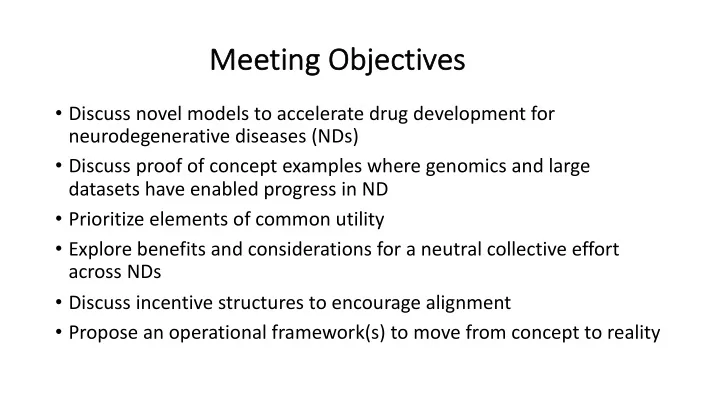
Me Meeting O Objectives

  • Discuss novel models to accelerate drug development for

neurodegenerative diseases (NDs)

  • Discuss proof of concept examples where genomics and large

datasets have enabled progress in ND

  • Prioritize elements of common utility
  • Explore benefits and considerations for a neutral collective effort

across NDs

  • Discuss incentive structures to encourage alignment
  • Propose an operational framework(s) to move from concept to reality
slide-2
SLIDE 2

Ex Exampl ples s of f enha nhanc ncing ng clini nical trial effi ficienc ncy

Once breast cancer has been diagnosed, doctors will create a personalized treatment plan that depends on...

  • The tumor’s subtype, including hormone receptor status (ER, PR) and

HER2 status

  • The stage of the tumor
  • Genomic markers, such as Oncotype DX™ and MammaPrint™
  • The patient’s age, general health, menopausal status, and preferences
  • The presence of known mutations in inherited breast cancer genes,

such as BRCA1 or BRCA2

slide-3
SLIDE 3

Major Neurodegenerative Diseases

  • Parkinson’s disease
  • Alzheimer’s disease/FTD/Dementias
  • Amyotrophic Lateral Sclerosis (ALS)
  • Huntington’s Disease

10% Genetic Known Target Syn, Amyloid, SOD1, RP, etc. 90% Sporadic Unknown Target Complex genetics/low penetrance Environment

Develop Animal Model Gene Therapy – shRNAi, CRISPR Antisense Therapy – ISIS (Ionics)

slide-4
SLIDE 4

Major Neurodegenerative Diseases

  • Parkinson’s disease
  • Alzheimer’s disease/FTD/Dementias
  • Amyotrophic Lateral Sclerosis (ALS)
  • Huntington’s Disease

10% Genetic Known Target Syn, Amyloid, SOD1, RP, etc. 90% Sporadic Unknown Target Complex genetics/low penetrance Environment

Develop Animal Mdoel Gene Therapy – shRNAi, CRISPR Antisense Therapy – ISIS (Ionics)

No Animal Model!!! Need iPSC model Drugs/biologics to reduce pathology Stem cell therapy Growth factor therapy Learn more about cause of disease

slide-5
SLIDE 5

Deep brain stimulation – example of using clinical data to guide therapy for Parkinson’s Disease

5

Adam Mamalak Michele Tagliati

slide-6
SLIDE 6

(EBV) Oct3/4, Sox2, L-Myc, Lin28

Genetic correction through genome editing

  • Go back in time to start of disease
  • Replay again and again
  • Look for first pathology
  • Discover causes
  • Determine sub types
  • Develop targeted drugs
  • Perform precision clinical trials

Induced pluripotent stem cells

slide-7
SLIDE 7

7

Rilozule blocks release of glutamate

slide-8
SLIDE 8

Wainger et al. Cell Reports, 2014

iPSC derived motor neurons show hyper excitability

Voltage-Clamp

+ Retigabine

Retigabine (ezogabine) opens Kv7 Channels

slide-9
SLIDE 9

Rapid Translation

  • 2014: Published iPSC modeling of motor excitability and identified candidate drug
  • 2015: Investigator’s meeting with TMS and TT-NCS workshops
  • 2015: Control subject recruitment to validate TMS and TT-NCS techniques at

NEALS sites.

  • 2016: Recruited first ALS patient for 12-site Phase 2 study with primary outcome:

change cortical hyperexcitability during 10 week drug study

  • 2018: finished Phase 2 study

Wainger, Cudkowicz et al. Unpublished

First example of using iPSC data to inform a clinical trial