MCOs, ACOs and for Health Exchange Products Tools and Strategies to - - PowerPoint PPT Presentation

mcos acos and for health exchange products
SMART_READER_LITE
LIVE PREVIEW

MCOs, ACOs and for Health Exchange Products Tools and Strategies to - - PowerPoint PPT Presentation

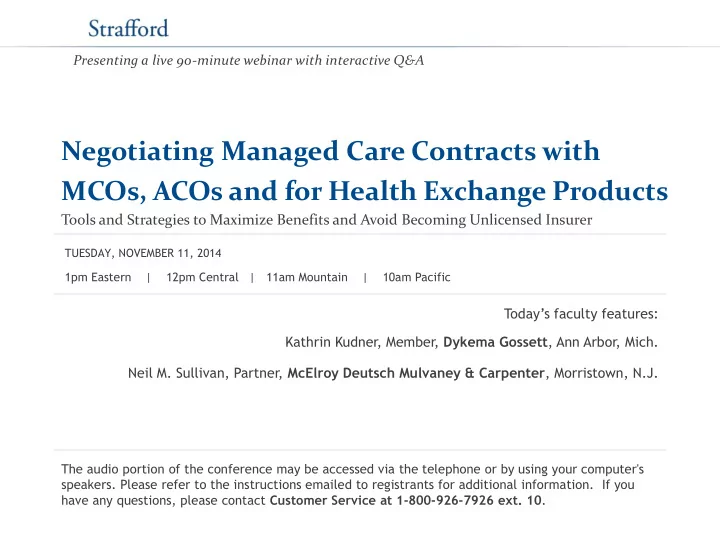
Presenting a live 90-minute webinar with interactive Q&A Negotiating Managed Care Contracts with MCOs, ACOs and for Health Exchange Products Tools and Strategies to Maximize Benefits and Avoid Becoming Unlicensed Insurer TUESDAY, NOVEMBER


slide-1
SLIDE 1

Negotiating Managed Care Contracts with MCOs, ACOs and for Health Exchange Products

Tools and Strategies to Maximize Benefits and Avoid Becoming Unlicensed Insurer

Today’s faculty features:

1pm Eastern | 12pm Central | 11am Mountain | 10am Pacific

The audio portion of the conference may be accessed via the telephone or by using your computer's

  • speakers. Please refer to the instructions emailed to registrants for additional information. If you

have any questions, please contact Customer Service at 1-800-926-7926 ext. 10.

TUESDAY, NOVEMBER 11, 2014

Presenting a live 90-minute webinar with interactive Q&A Kathrin Kudner, Member, Dykema Gossett, Ann Arbor , Mich. Neil M. Sullivan, Partner, McElroy Deutsch Mulvaney & Carpenter, Morristown, N.J.

slide-2
SLIDE 2

Tips for Optimal Quality

Sound Quality If you are listening via your computer speakers, please note that the quality

  • f your sound will vary depending on the speed and quality of your internet

connection. If the sound quality is not satisfactory, you may listen via the phone: dial 1-866-819-0113 and enter your PIN when prompted. Otherwise, please send us a chat or e-mail sound@straffordpub.com immediately so we can address the problem. If you dialed in and have any difficulties during the call, press *0 for assistance. Viewing Quality To maximize your screen, press the F11 key on your keyboard. To exit full screen, press the F11 key again.

FOR LIVE EVENT ONLY

slide-3
SLIDE 3

Continuing Education Credits

For CLE purposes, please let us know how many people are listening at your location by completing each of the following steps:

  • In the chat box, type (1) your company name and (2) the number of

attendees at your location

  • Click the word balloon button to send

FOR LIVE EVENT ONLY

slide-4
SLIDE 4

California | Illinois | Michigan | Minnesota | Texas | Washington, D.C.

www.dykema.com

Exceptional service. Dykema delivers.

Negotiating Managed Care Contracts With MCOs, ACOs and for Health Exchange Products

Presented by Kathrin E. Kudner

slide-5
SLIDE 5

Exceptional service. Dykema delivers. 5

Agenda for Discussion

  • Overview of trends in health care reform
  • Contracting with ACOs and for health Exchange products
  • Managed care contracting
  • Practical tips and strategies for negotiating key contract

provisions

slide-6
SLIDE 6

Exceptional service. Dykema delivers. 6

OVERVIEW OF TRENDS IN HEALTH CARE REFORM

slide-7
SLIDE 7

Exceptional service. Dykema delivers. 7

Trends in Health Care Reform

  • Health Insurance Exchanges
  • Medicaid expansion
  • Subsidies
  • Payment reform
  • Reinsurance
  • Reporting requirements
  • Legislative and litigation efforts to repeal/modify the

Affordable Care Act (ACA)

7

slide-8
SLIDE 8

Exceptional service. Dykema delivers. 8

Health Insurance Exchanges

  • Effective 1/1/2014, each state was required to establish a

Health Insurance Marketplace (also known as an Exchange) for the purchase of health insurance coverage by individuals and small employers

  • Open to individuals and small groups (generally <100

employees) with potential expansion to larger groups in future

  • States could elect to operate a state Exchange, a

federal/state partnership Exchange, a federal Exchange

  • r a hybrid

– Majority chose federal Exchanges

8

slide-9
SLIDE 9

Exceptional service. Dykema delivers. 9

Exchanges in 2015

  • Will States move from federal to state or from state to federal?

– Legislation introduced in 14 states to change from federal to state

  • Will the number of participating Plans increase or decrease?
  • Have premium costs increased or decreased?
  • What is the status of SHOPs?
  • Will there be clarification of the ability of providers to offer

premium assistance to patients?

– Mixed messages

  • Open enrollment begins 11/15/2014 and continues through

2/15/2015

9

slide-10
SLIDE 10

Exceptional service. Dykema delivers. 10

Medicaid Expansion

  • Expands eligibility for Medicaid to 133% (effectively

138%) of Federal Poverty Level

  • Carve out from Supreme Court decision upholding ACA

– Optional for states – 27 states have expanded Medicaid in some form

  • CMS has been flexible allowing expansion in different

ways by various states (e.g., Arkansas, Pennsylvania, Michigan and Iowa)

  • Experts say no real changes expected with election

10

slide-11
SLIDE 11

Exceptional service. Dykema delivers. 11

Exchange Health Premium Subsidies

  • ACA provides that lower income people qualify for tax credits

to help reduce their premium costs

  • ACA language states that tax credits/subsidies are permitted
  • n Exchanges “established by the state”
  • Question is whether Congress intended that the tax credits

be limited to only the state Exchanges and not the federal Exchanges

– Key to ACA because 36 states rely on the federal Exchange and if tax credits are not available, cost to consumer will increase

  • 11/7/14 – US Supreme Court agreed to hear King v. Burwell

appeal where Fourth Circuit held the tax credits applied on the federal Exchange

11

slide-12
SLIDE 12

Exceptional service. Dykema delivers. 12

Exchange Health Premium Subsidies (cont’d)

  • Recent agreements CMS sent to QHPs include clause that

QHPs may terminate contracts with federal Exchange if federal subsidies cease (subject to state law)

12

slide-13
SLIDE 13

Exceptional service. Dykema delivers. 13

Payment Reform

  • Bundled payments
  • Value-based purchasing

– Physician payments based on value (quality) not volume

  • Patient-centered medical homes
  • Reduction in disproportionate share payments

– Based on percentage of uninsured (rather than Medicaid) patients

  • Accountable care organizations

13

slide-14
SLIDE 14

Exceptional service. Dykema delivers. 14

Other

  • Reporting requirements
  • Reinsurance
  • Requirement for employer plan to adequately cover hospital

and physician services – Notice 2014-69 – HHS/IRS to issue regulations

  • Notice 2014-67 – private use implications of participation in

ACO by hospital with tax exempt bond financed property

  • 14
slide-15
SLIDE 15

Exceptional service. Dykema delivers. 15

Crystal Ball – What is the future of ACA?

  • Repeal in whole or in part – Clearly part of Republican

agenda – Targets include medical device excise tax; 30 hour work week

  • Court challenges to

– Premium cost subsidies – Coverage mandates

  • Future of individual mandate
  • Future of contraception mandate

15

slide-16
SLIDE 16

Contracting with ACOs and for Health Exchange (Marketplace) Products

Neil Sullivan

nsullivan@mdmc-law.com

slide-17
SLIDE 17

17

Integrating Healthcare Finance And Delivery Systems

The Past (eventually):

Providers deliver and bill for services a la carte:

  • Fee for service – more services = more fees. Providers with enough clout increase

revenues by increasing fees Payers pay per service:

  • Payers with enough clout decrease expenses by holding down reimbursements, or

determining that some services were unnecessary and therefore not reimbursable. The Economic Interests are therefore adverse.

The paradigm shift:

  • Fee for value - Deliver cost effective, high quality healthcare by aligning the

economic interests with the desired outcome – getting and keeping the population

  • healthy. The successful models are likely to include:
  • Flexibility to discard the outdated approaches but maintain the proven.
  • Access to human and financial capital.
  • Flexibility in creating economic alignments.
slide-18
SLIDE 18

18

Integrating Healthcare Finance And Delivery Systems (Cont’d)

What’s it take?

  • A foundation of high functioning, properly

incentivized providers with tools, information and staff support.

  • System-wide processes for quality improvement

that include analysis and reporting of patient

  • utcomes against evidence-based benchmarks.
  • Engaged patients with access to information.
slide-19
SLIDE 19

19

Integrating Healthcare Finance And Delivery Systems (Cont’d)

What’s it look like?

  • Examples of Integrated Structures:
  • Health system-based health plans:
  • Hospital systems getting licensed as insurers
  • Hospital systems sponsoring Multiple Employer Welfare Arrangements
  • Payer/Provider joint ventures including jointly owned health plans.
  • Physician/Hospital organized delivery systems or Accountable Care

Organizations with shared savings incentives/risk arrangements contracting with health plans or directly with self-insured employers. Each structure presents distinct opportunities and challenges around issues like market reception, regulatory approval, compliance with applicable laws and regulations, resource allocation, and competition.

slide-20
SLIDE 20

20

Integrating Healthcare Finance And Delivery Systems (Cont’d)

Countervailing Policy Considerations:

  • Concentration of Market Power May Lead to Cost Increases
  • So watch anti-trust requirements
  • Assumption of Too Much Risk May Lead to System Failure
  • So watch for insurance licensure triggers; capitalization
  • Rewarding the wrong behavior may result in poor clinical
  • utcomes
  • So watch quality metrics and bases of clinical protocols
slide-21
SLIDE 21

21

What’s an Accountable Care Organization?

■Different Things to Different People ■CMS: “Accountable Care Organizations are

groups of doctors, hospitals, and other health care providers, who come together voluntarily to give coordinated high quality care to their Medicare patients.”

slide-22
SLIDE 22

22

What’s an Accountable Care Organization? (Cont’d)

■ Medicare Shared Savings Program—Medicare fee-for-service

program providers billing under a single TIN enter into a 3-year contract to become an ACO.

■ Advance Payment ACO Model—To help smaller ACOs with less

access to capital participate in the Shared Savings Program.

■ Pioneer ACO Model—Program designed for early adopters of

coordinated care – the most ambitious of the 3.

slide-23
SLIDE 23

23

ACOs – State vs Federal Jurisdiction

■ ACA – “No Interference With State Regulatory Authority—Nothing

in this title shall be construed to preempt any State law that does not prevent the application of the provisions of this title.” ACA §1321(d)

■ MMA – “The standards established under this part shall supersede

any State law or regulation (other than State licensing laws or State laws relating to plan solvency) with respect to MA plans which are

  • ffered by MA organizations under this part.” Medicare

Prescription Drug, Improvement, and Modernization Act of 2003, 42 U.S.C. 1395w-26(b)(3).

slide-24
SLIDE 24

24

ACOs – Commercial Applications

■ May not be a heavy lift if the infrastructure is being created for Medicare

population anyway.

■ Not subject to Anti-kickback rules, but no MMA pre-emption either - watch

corporate practice of medicine, antitrust, unlicensed insurer.

■ States may also regulate directly depending upon the structure. See, for

example, N.J.S.A. 17:48H-1 et seq.

■ IRS – Query whether ACO associated with an exempt hospital organization

that enters into a commercial contract has a basis for 501(c)(3) tax exemption.

slide-25
SLIDE 25

25

What’s an Exchange (Marketplace) Product?

■ Qualified Health Plan » Certified by the Health Insurance Marketplace, » Provides Essential Health Benefits, » Follows established limits on cost-sharing (like deductibles,

copayments, and out-of-pocket maximum amounts), and

» Meets other requirements.

slide-26
SLIDE 26

26

What’s an Exchange (Marketplace) Product?(Cont’d)

Really an Oxymoron:

■ Guaranteed issuance of coverage in the Individual and Group

Market; and

■ Single risk pool; so ■ A health plan couldn’t restrict a product to the Exchange if it

wanted to.

slide-27
SLIDE 27

27

What’s an Essential Health Benefit?

■ ACA Section 1302: “the Secretary shall define the essential health benefits, except

that such benefits shall include at least the following general categories and the items and services covered within the categories:”

Ambulatory patient services

Emergency services

Inpatient hospital services

Maternity and newborn care

Mental health and substance abuse services

Prescription drugs

Rehabilitative services and devices

Laboratory services

Preventive and wellness services and chronic disease management

Pediatric services, including vision and dental

slide-28
SLIDE 28

28

What’s an Essential Health Benefit? (Cont’d)

■ Individual and Small Employer Plans: » Uniform within a State for 2014 and 2015 » Required to be Covered ■ Large Group Plan » Could be based on any state EHB benchmark plan » Not required to be covered, but no annual/lifetime limits, used

as denominator in Minimum Value Calculation

■ See 45 CFR 156.100 et. seq.

slide-29
SLIDE 29

29

Increasing Impact of Federal Law on Self- Insured Employee Benefits

■ ERISA Preempts State Law » Pre-ACA, Self-insured plans were lightly regulated (COBRA, Maternity,

WHCRA, DOL claim rules)

■ ACA: » Preventive Services Without Cost-Sharing » Minimum Value » Appeal rights, including IURO » Emergency services » Dependents Under 26 » No lifetime, annual limits on EHBs MOOP applies (but no requirement to cover

EHBs in large group, either)

slide-30
SLIDE 30

30

Increasing Impact of Federal Law on Self- Insured Employee Benefits (Cont’d)

■ Recent Developments: » DOL/CMS/DOT FAQ on reference-based pricing (plan pays a fixed amount

some providers will accept as payment in full)

□ Limitation on payment carries network adequacy requirements, if balance

bills of providers not accepting price don’t count toward MOOP

» Notice 2014-69 – Plans that fail to provide “substantial coverage” for

hospitalization/physician services do not provide Minimum Value.

slide-31
SLIDE 31

Managed Care Contracting

Neil Sullivan

slide-32
SLIDE 32

32

Managed Care Contracting

At any point in time, provider contracts govern the amount and circumstances for reimbursement of facility services, professional care, and supply delivery for many thousands of services and supplies for many thousands of diagnoses in multiple settings under many different circumstances. During the life of a contract, new technologies, practice patterns, and standards of excellence emerge, and some old technologies, practice patterns, and standards become discredited or fall into disuse. Providers join together and separate over time.

Your job is to anticipate all of those things.

slide-33
SLIDE 33

33

Managed Care Contracting (Cont’d)

■ Market share = Bargaining Position » Know your network adequacy requirements ■ Take a Holistic View – What is the Benefit of the Bargain? » If an Assumption matters, you better nail it down ■ For a Long-term Relationship, Both sides Need to Win ■ Know Your Statutory and Regulatory Environment » An agreement to waive statutory prompt pay interest may be

void as against public policy, e.g.

slide-34
SLIDE 34

34

Managed Care Contracting (Cont’d)

■ Parties to the Agreement » Look at the Corporate structure – yours and theirs » On the facility side, is it with a facility, a system, or a non-

provider legal entity set up as a conduit?

» For practitioners, is it with each practitioner? All practitioners

sharing a TIN? Something else?

» On the payer side, does the contract run to affiliates? Other

licensees? Unrelated parties (i.e. rental networks)

slide-35
SLIDE 35

35

Managed Care Contracting (Cont’d)

■ Products included » Insured and self-insured? » All products clause? » Which tier are you? » Who is guaranteeing payment on each? » Ability to collect member cost-sharing up-front?

slide-36
SLIDE 36

36

Managed Care Contracting (Cont’d)

■ Services included » All within scope of practice? » Any excluded? » Insurer reserves the right to exclude? » Ability to perform and bill for excluded services? » Access requirements

slide-37
SLIDE 37

37

Managed Care Contracting (Cont’d)

■ Points of Pain » Authorization/Referral Requirements » Claim Submission Requirements » Medical Necessity Protocols » Timely Filing Limits » Retrospective Audits » Incorporation By Reference

slide-38
SLIDE 38

38

Managed Care Contracting (Cont’d)

■ Reimbursement Provisions » Strictly fee-for-service? □ What happens when fees change? » Capitation, per diem, DRG or case rate – What’s in and what’s

  • ut?

□ Pressure relief valve for overutilization? » Gain-sharing or loss-sharing? How much risk do you bear? » Timeliness of payment

slide-39
SLIDE 39

39

Managed Care Contracting (Cont’d)

■ Modification of the Contract » Contract may give the Plan the unilateral right to change: □ Fee schedules □ Policies and Procedures □ Products included □ Other terms » Provider needs (at a minimum): □ Advance notice □ Escape clause

slide-40
SLIDE 40

40

Managed Care Contracting (Cont’d)

■ Other Contracting Hotspots » Indemnification □ What’s the standard: » Simple negligence, gross negligence, intentional? » Is it reciprocal? □ Blurring lines between coverage decisions and practice of

medicine

» Most-Favored Nation Clause » Dispute Resolution Requirements

slide-41
SLIDE 41

41

Managed Care Contracting (Cont’d)

■ Term and Termination » One-year Vs Multi-year Term » Evergreen Requirements » Cooling-Off Periods » With Cause Provisions – What Constitutes Cause? » Without Cause Provisions » Obligations on Termination □ Continuity of Care » What Happens if the Other Party Gets Sold?

slide-42
SLIDE 42

Exceptional service. Dykema delivers. 42

TIPS AND STRATEGIES FOR NEGOTIATING KEY CONTRACT PROVISIONS

slide-43
SLIDE 43

Exceptional service. Dykema delivers. 43

Pros and Cons to Contracting on the Exchange

  • Pros – Potential for:

– Participation in narrow network at expense of competitors – Additional volume - improvement to margin – Limited term – May assist with high uninsured and Medicaid patient population

  • Cons

– Inability to negotiate favorable contract terms – Lower rates – Operational difficulties

43

slide-44
SLIDE 44

Exceptional service. Dykema delivers. 44

Contracting with QHPs

  • Most QHPs have standard contract template
  • QHPs initially viewed the contracting process in different ways

– Amend existing participation agreements – Execute new participation agreements covering Exchange and non-Exchange products – Execute new participation agreements only for Exchange only products

  • Certain States require notice of amendment to existing

contracts and affirmative acceptance by providers to participate with the QHP

  • Can leave providers with uncertainty about which contract

terms and rates apply to which products

44

slide-45
SLIDE 45

Exceptional service. Dykema delivers. 45

Contracting with QHPs (cont’d)

  • Be aware that each agreement/amendment/addenda may build
  • n each other or conflict with each other

– New terms may be added – Is it clear the changes apply

  • nly to the Exchange product?

– Does deleted or replaced language negate language which was negotiated in current contracts?

  • Understand federal requirements for QHP structure, function,

network, reporting and monitoring – QHP may be limiting provider access to network for Exchange product

  • Understand role of state in QHP monitoring and enforcement

45

slide-46
SLIDE 46

Exceptional service. Dykema delivers. 46

Contracting with QHPs (cont’d)

  • Should QHP provider contracts be any different?

– Are there really different requirements or is a new contract

  • r addendum just an opportunity for the Plan to make

changes? – Generally no state mandated form – Need to address preemption and state insurance regulation

46

slide-47
SLIDE 47

Exceptional service. Dykema delivers. 47

Begin the Contracting Process – From the Provider Perspective

  • Who are the QHPs in the provider service area?
  • Does the provider currently have a contract with each QHP?
  • Does the contract cover both Exchange and non-Exchange

products?

  • Does the QHP have the unilateral right to amend the contract

to add products, change terms, or change rates?

  • What is the impact on provider’s business of likely Exchange

population contract terms and rates?

  • Does the provider have the capability and required resources

for quality management, preventive care, compliance and

  • ther QHP requirements?

47

slide-48
SLIDE 48

Exceptional service. Dykema delivers. 48

Begin the Contracting Process – From the QHP Perspective

  • Does the provider fill a need?
  • Is the provider an “essential community provider (ECP)?”

– QHPs must have a sufficient number and geographical distribution of ECPs where available – ACA defines ECP as providers that predominately serve low-income medically underserved individuals, such as those eligible to participate in the 340B drug discount program

  • Does the provider have the capability and required resources

for quality management, preventive care, compliance and

  • ther QHP requirements?

48

slide-49
SLIDE 49

Exceptional service. Dykema delivers. 49

Recitals

  • Not required, but…
  • Use as background/context
  • Do not include contract terms

49

slide-50
SLIDE 50

Exceptional service. Dykema delivers. 50

Defined terms

  • Comprehensive and specific
  • All capitalized terms should be defined
  • Define the agreement – Ddoes it include manuals,

policies and procedures, exhibits?

  • Triple check consistency with defined terms and use in

contract

  • Incorporate in text or attach appendix
  • Certain definitions are KEY

– Covered Services – Medically Necessary – Emergency

50

slide-51
SLIDE 51

Exceptional service. Dykema delivers. 51

Member/Enrollee

  • Refers to the person entitled to received the Covered

Services

  • Who is covered?
  • Focus on eligibility and verification
  • Dependent – Definition may be mandated by state and

federal laws

  • May vary depending on product

– Exchange product - Has to be someone signed up on the Exchange

51

slide-52
SLIDE 52

Exceptional service. Dykema delivers. 52

Covered Services

  • Key to what is provided and what is paid
  • “Essential Health Benefits” under ACA
  • Tiered Metal Products

– Bronze level – Covers 60% of expected costs – Silver level – Covers 70% of expected costs – Gold level – Covers 80% of expected costs – Platinum level – Covers 90% of expected costs

  • QHP view: Broad language; tie to medical necessity;

right to modify

  • Provider view: Clear definition; want an “out;” control
  • ver types of service and access

52

slide-53
SLIDE 53

Exceptional service. Dykema delivers. 53

Covered Services – Sample Language

“Those medically necessary health care services to which Enrollee is entitled under the Enrollee’s Plan.” “Those services and supplies that are within the scope of provider’s license and that provider is willing to provide based on

  • availability. Provider shall not be required to provide any service

that it does not provide to its own patients.” “If provider admits, arranges for admission or refers an Exchange member to a non-Exchange network provider, provider must: (i) give member notice that provider is out of Exchange network, (ii) member may be eligible only for reduced benefits, (iii) provider will not be restricted from seeking payment from QHP and may bill member.” (Note: State law may require hold harmless)

53

slide-54
SLIDE 54

Exceptional service. Dykema delivers. 54

Required Provider Services

  • Distinguish between Covered Services and Scope of

Services

  • Covered Services are those services available to the

enrollee under the Plan and for which reimbursement will be made by the Plan

  • Scope of Services are those Covered Services that the

specific provider is responsible for providing

  • Address who may provide the services – physician only
  • r PA and NP?
  • Address whether the provider may subcontract for

services

54

slide-55
SLIDE 55

Exceptional service. Dykema delivers. 55

“All Products” Clauses

  • Plan may include an “all products clause” requiring provider

to participate in all products offered by Plan – Products may include Medicare, Medicaid, workers’ compensation, high deductible plans, self-funded employer health benefit plans – Specific requirements for each product may be incorporated in the contract or in detailed addenda

  • Certain states have enacted statutes to prohibit the inclusion
  • f “all products clauses” in contracts

– E.g., Indiana, Maryland, Florida, Massachusetts, Ohio – Watch for national contracts

55

slide-56
SLIDE 56

Exceptional service. Dykema delivers. 56

“All Products” Clause – Sample Language

“Provider agrees to participate in the plans and health products described in this Agreement or as may be developed by Plan in

  • future. Plan reserves the sole discretion to add or modify plans

and products under this Agreement during its term and Provider agrees to participate in all such additional plans and products and agrees further that the terms of this Agreement shall control all such additional plans and products.”

56

slide-57
SLIDE 57

Exceptional service. Dykema delivers. 57

“All Products” Clauses – Provider Concerns

  • Should the provider accept the clause?

– Potentially gives access to volume – Risk of the unknown

  • Ask the following?

– Does the “all products clause” apply only to currently offered products or does it require participation in all future products? – Can provider opt out of a product (e.g., Medicaid; dual eligibles)? – Can provider terminate as to only one product?

  • Avoid clause where terms and rates of current contract

apply to all new products

  • Include ability to terminate if unacceptable

57

slide-58
SLIDE 58

Exceptional service. Dykema delivers. 58

Access to Care

  • QHPs likely to be looking for greater access from ECPs

to show sufficiency of network

  • Don’t commit to more than you offer to regular patients
  • Access measured in hours and days of operation, after

hours coverage, appointment waiting times, distance, waiting room times, and intervals for annual and periodic check-ups

58

slide-59
SLIDE 59

Exceptional service. Dykema delivers. 59

Medical Necessity

  • Objective criteria
  • Proactively address exceptions
  • Exercise of professional judgment cuts both ways
  • May be statutory or government contract definitions
  • QHP view: Way to control costs; wants sole discretion
  • Provider view: Way for QHPs to deny payment

59

slide-60
SLIDE 60

Exceptional service. Dykema delivers. 60

Medical Necessity – Sample Language

“Plan’s Medical Director shall make all determinations of Medical

Necessity and the Medical Director’s determination shall be final and binding.” “Treatment shall be deemed Medically Necessary upon demonstration that such treatment is appropriate and likely to result in demonstrable medical benefit.” “ …appropriate and necessary…not for convenience of physician or patient…performed in most cost efficient manner.” “if, under generally accepted principals of good medical practice, they are required for and consistent with diagnosis, treatment or care of illness, injury or ailment covered by Plan.”

60

slide-61
SLIDE 61

Exceptional service. Dykema delivers. 61

Claims Submission and Payment

  • Clean claim

– Define by kind of claim form – Discretion of Plan – Penalty for errors – Evidence of medical necessity – Ability to correct and resubmit

  • Timely submission

– Penalty for late submission – Demand by Plan for additional information – Waiver of right to payment

  • May be statutory

61

slide-62
SLIDE 62

Exceptional service. Dykema delivers. 62

Pended Claims

  • Significant risk to providers
  • Enrollees with insurance subsidies have 90-day grace period

for non-payment of premium for products on the Exchange

  • Plan may (but is not required to) “pend” a claim for the last 60

days of grace period and if enrollee does not pay, Plan is not required to pay Provider. Enrollee is retroactively terminated to end of first month.

  • Address process for how payments for denied claims will be

made following the expiration of the grace period – Who is responsible? – Process for resubmission – Time period

62

slide-63
SLIDE 63

Exceptional service. Dykema delivers. 63

Pended Claims – Sample Language

  • QHP continues to pay - Provides that QHP will continue to pay

provider for claims submitted during the grace period – Note: QHP will likely still be collecting the premium subsidies during the grace period which may cover the majority of the premium cost – QHP can cover with reinsurance – negotiate share of cost

  • QHP pends payment – Require QHP to provide complete,

binding and timely notification of grace period to provider so that provider knows claim will be pended and could ultimately be denied and of termination of member – Enables provider to mitigate the risk to some extent

63

slide-64
SLIDE 64

Exceptional service. Dykema delivers. 64

Negotiating a Competitive Fee

  • Conduct a complete review of proposed fee structure,

including all penalties, withholds, incentives

  • Compare proposed fees to current Medicare payment

rates

  • Request sample fee schedule from QHP (e.g., top 10 or

20 CPT codes)

  • Consider fee schedule carve out mechanism to

establish fees for services that are undervalued by QHP

64

slide-65
SLIDE 65

Exceptional service. Dykema delivers. 65

Retroactive Audit, Adjustment and Recoupment

  • Contract should define process for audit, adjustment

and recoupment

  • Provider agrees by contract to comply
  • Rights of QHP and Provider may vary by state law and

product or payor type – Notice requirements – Sharing of claims information – Time period where QHP action permitted

  • Provider limit to 1 year
  • Usually defined period except for fraud or misconduct
  • Medicare – 10 years

65