Maze exit finder (cont.) Choosing maze data structures How to - - PDF document

maze exit finder cont choosing maze data structures
SMART_READER_LITE
LIVE PREVIEW

Maze exit finder (cont.) Choosing maze data structures How to - - PDF document

Maze exit finder (cont.) Choosing maze data structures How to represent a maze square? Solution must lead to smaller problems boolean find_exit(int x, int y) /* 2 nd try */ Okay, a class, but what data are stored? { if ( we have been


slide-1
SLIDE 1

1

Maze exit finder (cont.)

Solution must lead to smaller problems boolean find_exit(int x, int y) /* 2nd try */ { if (we have been here before) return false; /* don’t try same spot again */ if ( x,y is an exit) return true; /* success! */ /* rest as before */ So need a way to remember where we’ve been

– e.g., mark square upon entering find_exit – Q: is it ever necessary to remove the mark?

Choosing maze data structures

How to represent a maze square?

– Okay, a class, but what data are stored?

Ways to know if exit or not, if has been visited yet or not Maybe ways to know about neighboring squares

– How about some helper methods?

e.g., isExit(), isMarked(), hasNeighbor(direction), …

How to represent the whole maze?

– Suggest: array of references to maze squares – Any other ways?

Towers of Hanoi (demo)

Problem: move n disks from peg a to peg c, using

peg b to hold disks temporarily; keep small on top

Recursive solution: method with params n, a, b, c

– Base case: just one disk – trivial:

If n is 1, move 1 disk from a to c

– General case: assume a method that can move a tower

  • f height n-1. This method!!!

Move top n-1 disks from a to b, using c for holding purposes Move the bottom disk from a to c Move all n-1 disks on b to c, using a for holding purposes

Iterative solution much more difficult in this case

Decimal (value) to binary (string)

/** * Returns a String representation of the binary equivalent * of a specified integer. The worstTime(n) is O(log n). * @param n – an int in decimal notation. * @return the binary equivalent of n, as a String * @throws IllegalArgumentException, if n is less than 0 */ // (From Collins text’s instructor resources)

public static String getBinary (int n) { if (n < 0) throw new IllegalArgumentException( ); if (n <= 1) return Integer.toString (n); return getBinary (n / 2) + Integer.toString (n % 2); } Demo

Eliminating recursion

Can always simulate recursion by explicit stack

– Use iteration instead of recursion

Instead of recursive call: push key values onto stack

– e.g., maze finder – push coordinates (x, y)

Instead of return: pop values from stack

– e.g., back to square (x, y) in maze finder

Sometimes an easy non-recursive translation

without a stack – especially if “tail recursion”

– e.g, factorial, fibonacci, ruler tick marks, … – Much harder for maze and Hanoi examples

Queues

FIFO data structure – First In, First Out Typical operations similar to stacks

– enqueue (an item at rear of queue) – dequeue (item at front of queue) – peek (at front item) – isEmpty, isFull, size, clear

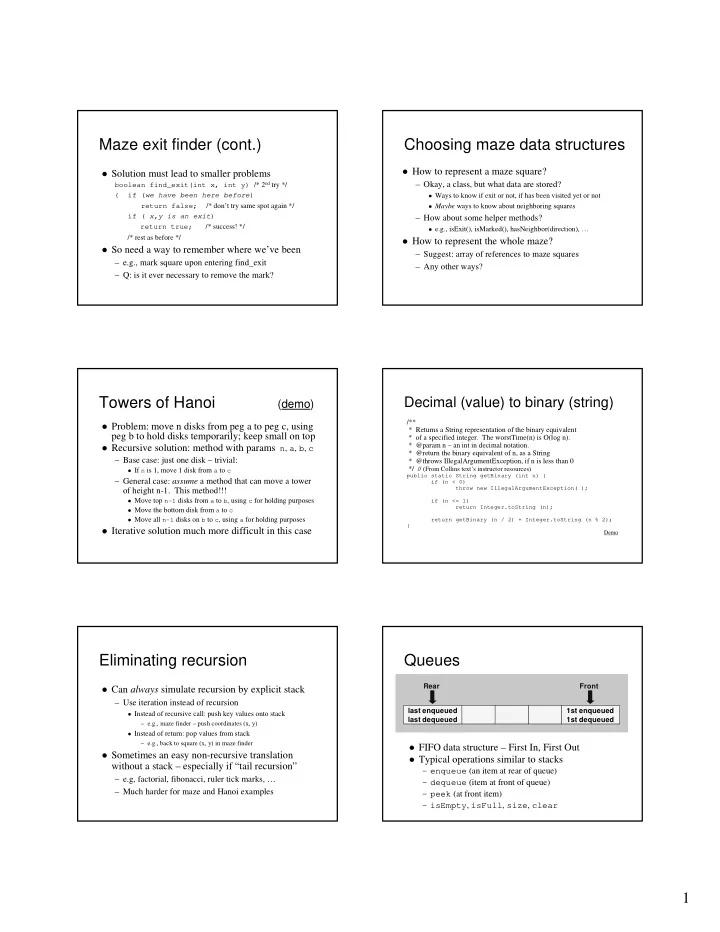
Rear Front 1st enqueued 1st dequeued last enqueued last dequeued

slide-2
SLIDE 2

2

Some queue applications

Many operating system applications

– Time-sharing systems rely on process queues

Often separate queues for high priority jobs that take little

time, and low priority jobs that require more time

– Printer queues and spoolers

Printer has its own queue with bounded capacity Spoolers queue up print jobs on disk, waiting for print queue

– Buffers – coordinate processes with varying speeds

Simulation experiments

– Models of queues at traffic signals, in banks, etc., used to “see what happens” under various conditions

Applying a queue – palindrome

Palindrome - same forward and backward

– e.g., Abba, and “Able was I ere I saw Elba.”

Lots of ways to solve, including recursive Can use a queue and a stack together

– Fill a queue and a stack with copies of letters (only) – Then empty both together, verifying equality

Reminder – we’re using an abstraction

– We still don’t know how queues are implemented!!! To use them, it does not matter! – Abstraction is Good!

Queue interface

e.g., java.util.Queue:

public interface Queue<E> extends Collection<E> { boolean offer(E o); // enqueue E poll(); // dequeue (null if empty) E remove(); // dequeue (exception if empty) E peek(); // peek (null if empty) E element(); // peek (exception if empty) }

All Known Implementing Classes:

– AbstractQueue, ArrayBlockingQueue, ConcurrentLinkedQueue, DelayQueue, LinkedBlockingQueue, LinkedList, PriorityBlockingQueue, PriorityQueue, SynchronousQueue

Implementing queues

Easy to do with a list (e.g., ArrayList):

– Mostly same as stack implementation – Enqueue – add to end – list.add(item); – Then to dequeue and peek: refer to first item

e.g., to dequeue – list.remove(0);

Array implementation is trickier:

– Must keep track of front and rear indices – Increment front/rear using modulus arithmetic

Indices cycle past last index to first again – idea is to reuse

the beginning of the array after dequeues

See demos in ~mikec/cs20/demo03/queue/ at CSIL

Queue operation complexity

Implementing a queue with an array

– enqueue(object) – add to end and increment tail index

O(1) if array is not full; otherwise O(n) to resize/copy

– dequeue() – remove front and increment front index

O(1) – does not depend on size of queue

Implementing with single-linked list

– enqueue(object) – add a last item

O(n) – for single-linked list with just a first pointer But O(1) if also have a pointer to last element – an easy fix

– dequeue() – remove first item

O(1) – point first at first.next – not affected by n size

– Why not enqueue first and dequeue last?

What are iterators?

Objects for iterating over elements of structure e.g., java.util.Iterator: interface Iterator<E> { boolean hasNext(); // true if more objects E next(); // return object and increment // throws NoSuchElementException if !hasNext() void remove(); // optional – and potentially dangerous // may throw UnsupportedOperationException } Handy to implement as inner class of structure

– Has reference to all data structure fields/methods – Could be anonymous/local to getIterator method

slide-3
SLIDE 3

3

Why iterators?

Provide ability to traverse list (or other structure)

without direct access to nodes

Easy to use – e.g., print list with while loop:

Iterator it = list.getIterator(); while (it.hasNext()) print(it.next());

Even shorter with a for loop:

for(Iterator it=list.getIterator(); it.hasNext();) print(it.next()); // the increment step happens here

– And simpler with enhanced for loop:

for (DataType d : list) print(d);

Implementing linked lists

e.g., a method to insert a new second node –

imagine list now is (DUS→ORD→SAN), want (DUS→BRU→ORD→SAN)

  • r now (DUS), want (DUS→BRU)
  • r now (), want (BRU)

– Any other special cases?

A strategy: create new node to hold BRU – call it n; if empty list – set first to n; return; else set n.next to first.next; set first.next to n; return;

Code to insert new 2nd node

Assume instance variable for first node: ListNode first; // refers to first node or null if list is empty So use that fact to write “is empty” method: boolean isEmpty() { return first == null; } Then easy to code insert 2nd node method: void insertNewSecondNode(Object data){ ListNode n = new ListNode(); // null data and next n.data = data; if (isEmpty()) first = n; // leave next null else { n.next = first.next; first.next = n; } }

Searching for a node

Idea: return reference to the node that contains

particular info, or return null if the info is not in the list (Note: probably a private method – returns node reference)

Strategy: declare local node reference - call it n; point n at first node in list; while (n points to non-null node) { if (n’s referent has the info) return n; else advance n to n.next; } return null if get this far;

List traversal without iterators

Search strategy typifies list-hopping activity:

start by referencing first node; process that node; change reference to that node’s next link; keep going until success (e.g., found info), or until end (i.e., reference is null);

– Same idea works for lots of list operations

e.g., print list – immediately applicable To append (add last), first must link-hop to last node To remove a node, must link-hop to node that precedes it

But also usually consider potential special cases

– e.g., first node, last node, empty list, just one node, …