Maxwells Equations, Universality, and Relativity D. H. Sattinger - - PDF document

maxwell s equations universality and relativity
SMART_READER_LITE
LIVE PREVIEW

Maxwells Equations, Universality, and Relativity D. H. Sattinger - - PDF document

Maxwells Equations, Universality, and Relativity D. H. Sattinger Department of Mathematics University of Arizona Notes of a plenary lecture at the 34 th Western States Mathematical Physics Conference, California Institute of Technology,


slide-1
SLIDE 1

Maxwell’s Equations, Universality, and Relativity

  • D. H. Sattinger

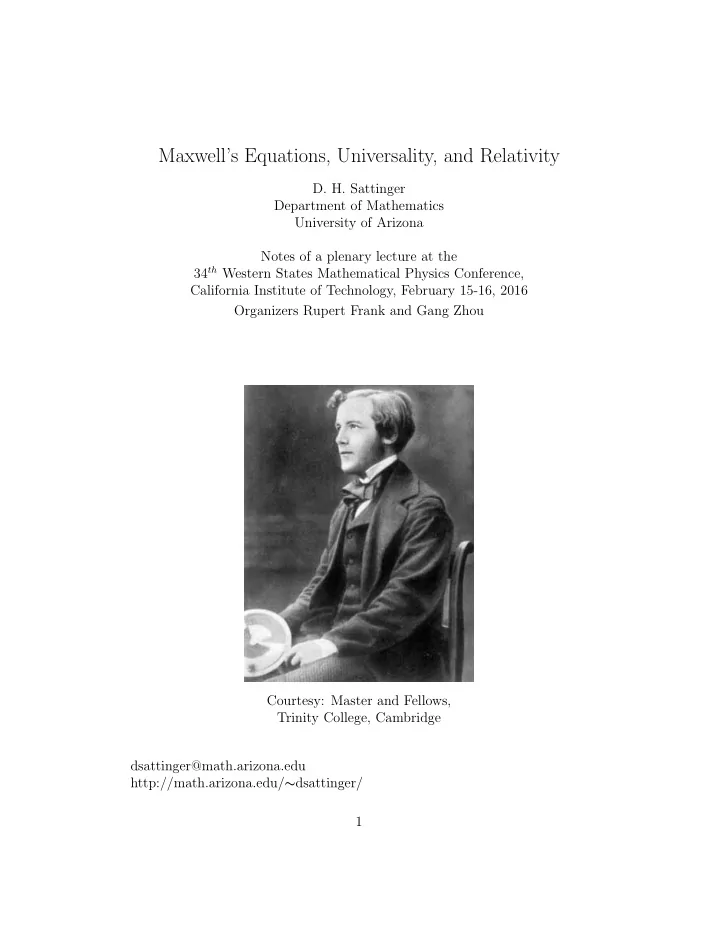
Department of Mathematics University of Arizona Notes of a plenary lecture at the 34th Western States Mathematical Physics Conference, California Institute of Technology, February 15-16, 2016 Organizers Rupert Frank and Gang Zhou Courtesy: Master and Fellows, Trinity College, Cambridge dsattinger@math.arizona.edu http://math.arizona.edu/∼dsattinger/ 1

slide-2
SLIDE 2

Abstract The success of Einstein’s theory of General Relativity proves con- clusively that gravitation is a manifestation of the curvature of space-

  • time. But in this talk we discuss a recent mathematical derivation of

Maxwell’s equations showing that they are universal – depending on a parameter µ, they hold for all force fields, attractive or repulsive, generated by a material source such as charge or mass. This puts gravitation and electromagnetism on an equal footing on flat, Minkowski space-time. Maxwell’s equations for gravitation have long been held to be a formalism, irrelevant to gravitation. But we show that they are fundamental to the determination of the energy- momentum tensor in Einstein’s equations, and that General Relativity can be reformulated in terms of Maxwellian fields, rather than specific force fields. The proof of universality requires the conservation of material and Einstein’s two postulates of special relativity, and makes substantive use of Hodge theory.

1 Einstein’s Premise

Einstein’s theory of general relativity introduced a new paradigm into

  • physics. The dynamics of a charged particle in an electromagnetic

field is governed by Newton’s second law of motion, the force given by the Lorentz force. But Einstein’s theory is geometric, and the dynamics of a particle are given by the geodesics of the metric tensor

  • n a semi-Riemannian manifold, generated by the presence of mass.

Nevertheless, in a recent paper [14], I proved that the electro- magnetic field equations are universal, in the sense that they con- stitute a general mathematical theory, apply to all fields generated by a material source, and are valid for both attractive and repulsive

  • fields. Maxwell’s equations therefore put gravitation and electromag-

netism on an equal footing on flat space-time; and the relationship of Maxwell’s linear field theory to Einstein’s nonlinear geometric theory must be explained. We shall show in this section that the two theories fit naturally together, but that their unification leads to a fundamen- tally new paradigm in the theory of relativity: namely the equations

  • f both special and general relativity are universal, and are formulated

in terms of Maxwellian fields, rather than specific force fields.

2

slide-3
SLIDE 3

Prior attempts to build a relativistic theory of gravitation were based on an application of Maxwell’s equations. Maxwell himself mentioned the idea briefly in his original tract on electrodynamics, but abandoned it because of the implications of the negative energy

  • f an attractive field.

Nevertheless, efforts to do so were proposed by Heaviside (1893 [5]), Lorentz (1900 [9]), and Poincar´ e (1905, [12]). There was a good deal of debate concerning a relativistic treatment

  • f gravitation based on Lorentz invariance in the years leading up to

Einstein’s publication of his work in 1915. Those efforts were abandoned with the success of Einstein’s theory; and the notion that Maxwell’s equations might be relevant to gravita- tion has been strenuously rejected. (See Pais [11], Chapter 13, as well as the discussion in [13]). But we shall see that Maxwell’s equations for gravitation are essential in determining the energy-momentum tensor in the Einstein Field equations of general relativity. Special relativity is built on the equivalence of inertial frames [2]; while Einstein’s general theory of relativity is built on the Principle of Equivalence, which he introduced in 1907 [3]. In that paper he pro- posed that the laws of physics should be valid in all frames of reference, including non-inertial (accelerated) frames. He posited two identical clocks, one accelerating at a constant rate along the negative real axis, and one on the right, stationary, but in a constant gravitational field. If the laws of physics are the same for both observers, then the two clocks ought to keep the same time. He showed that the rate of the clock on the right is determined by the potential of the gravitational

  • field. This ultimately becomes the coefficient g44 in his metric tensor

in his general theory of relativity, and is the basis for gravitational red-shift. Einstein showed that the assumption of general invariance un- der general coordinate transformations, together with the Principle

  • f Equivalence, leads by purely mathematical considerations to a ge-
  • metric field theory, in which Newton’s law of motion is replaced by

the geodesics on a semi-Riemannian manifold. But Einstein’s theory is incomplete, for the source term for the field equations is not determined by the Principle of Equivalence. Einstein introduced the notion of an energy-momentum tensor as the source, in analogy with the material source in Maxwell’s equations, and dis- cusses two physical examples – the energy-stress tensor of a frictionless adiabatic gas, and the Maxwell stress tensor for the electromagnetic

  • field. Since Maxwell’s equations were seen as specific to electromag-

3

slide-4
SLIDE 4

netism, while Einstein identified the geometry of space-time with the gravitational field, he did not use the Maxwell stress tensor in his equations. Einstein uses the word gravitation in his 1907 paper, but his argu- ment is entirely mathematical and easily extends to any conservative force field. Why then should the Principle of Equivalence apply to the gravitational but not the electromagnetic field? And why should the proposition that the laws of physics be the same in any coordi- nate system apply only to gravity and not to electromagnetism? He says nothing about this, and builds the theory of general relativity on the premise that “gravitation occupies an exceptional position with regard to other forces, particularly the electromagnetic forces . . . ” That premise is contradicted by the proof of universality, which we shall discuss in §2. The natural mathematical language for general relativity is tensor analysis; and Einstein gives a succinct exposition of this machinery in [4]. Tensor analysis is the natural language of differential geome- try, and Hilbert’s approach to general relativity is grounded in that

  • discipline. The notion of intrinsic geometry is fundamental to the sub-
  • ject. Natural objects are ones which do not depend on the choice of
  • coordinates. Gauss’ Theorem Egregium, for example, states that the

Gaussian curvature on a 2-dimensional surface embedded in R3 de- pends only on the metric tensor, not on the embedding of the surface, and not on the coordinate system. Hilbert [7] obtains the field equations of general relativity as an action principle, δH = 0, H = K + L, where K =

  • K√g dΩ,

L =

  • L√g dΩ.

Here K is the Riemannian curvature invariant, better known as the Ricci scalar curvature R; L is the Lagrangian of a physical system with coordinates qi and their derivatives qi,j, invariant under the group of diffeomorphisms of space-time; and √g dΩ, is the invariant volume element, where g = det ||gij|| and dΩ = dx1dx2dx3dx4. Hilbert calculates all the invariants and finds that the simplest case is that in which L is the Lagrangian for Maxwell’s equations, where qi = Ai, the Maxwell 4-potential. We write L = FijF ij (+µAiJi), Fij = Aj,i − Ai,j, F ij = gikgjlFkl.

4

slide-5
SLIDE 5

The term in parentheses is the source term for Maxwell’s equations and was not included in Hilbert’s original discussion; we shall discuss it presently. The expression FijF ij comes from Minkowski’s treatment

  • f the electromagnetic field; it is specific to the electromagnetic field

in free space. A variant of Hilbert’s original method will be very useful. The variation δL with respect to the field variables Ai Ai,j alone can be viewed as a variation under the constraint that the geometry of space- time is fixed; and the equations so obtained are Maxwell’s equations in a fixed curvilinear space-time. The field equations of general relativity are obtained by relaxing this constraint, introducing K, and allowing variations over both field and the geometric variables, consisting of the gij and the Christoffel symbols Γi

  • jk. (The latter are linear in the

derivatives of the gij.) This approach by-passes the Principle of Equivalence, as well as the postulate that space-time bends in the presence of a force field, by showing that space-time must bend in the presence of a Maxwellian field unless it is constrained not to do so. In this way, no special postulates must be made to obtain the equations of general relativity: they appear naturally without further ado. In Hilbert’s approach, the energy-momentum tensor is obtained from the variation of L with respect to the entries of the metric tensor: Tmn = 1 √g ∂√g L ∂gmn . (1) Minkowski’s Lagrangian L = FijF ij is that of the electromagnetic field in free space, and Tmn is then the Maxwell stress-tensor specific to that field. Both Einstein and Hilbert based their discussions of the energy-momentum tensor on that Minkowski’s work, and ended up with a stress tensor specific to the electromagnetic field. Hilbert de- scribes this as “the appearance of electrodynamics in connection with gravitation” (§82, Die elektrodynamischen Erscheinungen als Wirkung der Gravitation). When the source terms µAiJi are included, the Lagrangian is no longer specific to the electromagnetic field. The parameter µ is related to the universality of Maxwell’s equations; they form a one-parameter family of field theories which include both the electromagnetic and gravitational fields as specific cases. The energy-momentum tensor is

5

slide-6
SLIDE 6

then Tmn = 1 2

  • −FmjF j

n + 1 4FijF ijgmn

  • + µ
  • AmJn − 1

2gmnAiJi

. (2) The quadratic term is the Maxwell stress-tensor associated with the parameter µ. Note that Maxwell’s equations in general coordinates are F ij

; j = µJi; so µ2 appears implicitly in the first term of (2). The

Maxwell stress-tensor (without the µ) appears throughout the litera- ture in general relativity, but it is always specific to the electromag- netic field. The lack of a uniquely determined energy-momentum tensor in Einstein’s theory of gravity has resulted in a proliferation of possible

  • tensors. For example, the energy-momentum tensor for a system of

particles is sometimes taken to be the sum of the energy-momenta of the individual particles, e.g. ([8] 106.4) T ij = c √−g

  • n

mn dxi ds dxj dt δ(x − xn). (3) The use of a Dirac delta function in a highly nonlinear system of partial differential equations is problematic; and summing over the particles, for example, if one is attempting to model the dynamics of a galaxy, is cumbersome at best. Extensive discussions of possible energy-momentum tensors, all based on physical arguments, can be found in Misner, Thorne and Wheeler, Chapter 5, and Weinberg [17], also Chapter 5. Weinberg asserts that the energy-momentum tensor for a system consisting of both radiation and particles is the sum of the classical Maxwell stress-tensor and that for a system of particles, similar to (3). No proofs are given that these tensors are relevant to the Einstein Field equations. By contrast, the energy-momentum tensor (2) is uniquely deter- mined mathematically by Hilbert’s variational approach. The uni- versality of Maxwell’s equations, together with Hilbert’s variational method, thus leads to a new paradigm in general relativity, one based

  • n Maxwellian, rather than specific force fields. Not only are Maxwell’s

equations relevant to gravitation, but general relativity is relevant in cases where the electromagnetic field is intense, in the interior of a star, or the early Universe, for example. Since Maxwell’s equations are linear, two or more fields can be superposed, and since (1) is linear,

6

slide-7
SLIDE 7

the energy-momentum tensor of a superposition of fields is the sum of the individual tensors. The new paradigm thus leads immediately to a unified field theory. Since the correct form of the energy-momentum tensor has never been properly determined, the entire body of work in general relativity must be re-evaluated from the perspective of the new paradigm.

2 Universality

The proof of universality of the electromagnetic field equations con- sists in their derivation from first principles for any field generated by a material source. The basic axioms needed are conservation of material and Einstein’s two axioms of special relativity. The dynam- ical equations, Maxwell’s equations, are therefore the field equations

  • f special relativity; and special relativity is also universal.

Maxwell’s equations are generally written in the language of vec- tor analysis, which was developed expressly by J.W. Gibbs to write the theory concisely. Vector analysis, however, has a number of draw-

  • backs. For one thing, it is not tensorial: the operations div, curl and

grad are defined in Cartesian coordinates, and must then be converted to general coordinates (see [17] §4.8.) The curl is defined using the cross product, which is restricted to 3 dimensions. Finally, vector analysis does not explicitly distinguish between polar and axial vector fields, both of which play a fundamental role in Maxwell’s equations. Nevertheless, students in physics and applied mathematics are largely trained in vector analysis; whereas the natural language for Maxwell’s equations is the exterior differential calculus developed by Cartan, together with the basic notion of Hodge duality. Let me ex- plain briefly why this is so. We noted above that tensor analysis and invariant theory are fun- damental to general relativity as well as to the notion of intrinsic ge-

  • metry. Integration theory is also an example of an invariant theory.

The value of an integral does not depend on the choice of coordinates in which the integration is carried out. The natural objects to integrate over a p−dimensional manifold are p−forms, called differential forms. These are covariant, completely an- tisymmetric tensors of rank p, and the natural language of integration theory is the exterior calculus of differential forms, developed by Car-

  • tan. This is based on two operations, the exterior derivative d, and

7

slide-8
SLIDE 8

the wedge product ∧, both of which are tensorial – that is, they are the same in all coordinate systems. It is this fact that makes them so useful. Moreover, the exterior differential calculus is far easier to learn, and far more powerful, than vector analysis. Introductory treat- ments of the exterior differential calculus can be found in many texts: Misner et.al., chapter 4; Weinberg §4.11; and in my book [15] §§18,19 with Larry Weaver.1 With that, let us take up the subject of universality. We begin by showing that the full structure of Maxwell’s equations are an artifact

  • f Hodge theory2. We say that a force field F is generated by material

source ρ, J if ∂ρ ∂t + div · J = 0. (4) and div · F = ρ, ∇ × F = J. (5) In the static case, the classical Helmholtz3 decomposition [6] states that there is a scalar function φ and a vector field A such that F = −∇φ + B, B = ∇ × A, (6) The two vector fields ∇φ and B on the right side of (4) differ in an important respect: the first is a polar vector field and the second an axial field. Under the inversion x → −x, polar vector fields change sign while axial vector fields do not.4 The Helmholtz decomposition is therefore mathematically imprecise; it is a sum of two dissimilar vector fields. To properly formulate the potential problems for φ and A, the Helmholtz decomposition must be replaced by the Hodge decompo- sition of differential forms. Hodge theory is a natural add-on to the exterior differential calculus. A Hodge star operation ∗ : Λp → Λn−p, is a linear map on differential forms from p-forms to n−p-forms, where Λp(En) denotes the space of square integrable p-forms on En.

1By the way, Larry was an undergraduate physics major at Cal Tech. 2another Scot, as it turns out. 3Helmholtz was one of the first to understand Maxwell’s theory; see the Essay by

Freeman Dyson [1] on the history of Maxwell’s paper.

4The issue of polar and axial vector fields was discussed in my talk. Those interested

in pursuing the matter further should see Stratton [16] as well as my preprint [14].

8

slide-9
SLIDE 9

The ∗ operation induces an inner product on p−forms, called a Hodge duality, defined by (ξ, η) =

  • ξ ∧ ∗η,

ξ, η ∈ Λp. The exterior derivative d : Λp → Λp+1 is a partial differential operator mapping p forms to p + 1 forms. For example, dφ = ∂φ ∂xj dxj, d(ξjdxj) = ∂ξj ∂xk dxk ∧ dxj. The Hodge duality induces a formal adjoint operator δ : Λp → Λp−1, called the co-derivative, defined by (dξ, η) = (ξ, δη). A differential form ξ is exact if ξ = dφ, φ ∈ Λp−1; and η ∈ Λp is said to be co-exact: if η = δψ, ψ ∈ Λp+1. The Hodge star interchanges exact and co-exact forms. Given a vector field F on E3 we define F = F · dx = Fjdxj, and ∗F = F · dS = Fj dxk ∧ dxl. The Hodge decomposition theorem on Λ2 and Λ3 states that 5 F = E + H ∈ Λ1, ∗F = B + D ∈ Λ2 where E and B are exact, and H and D are coexact. This result is completely general. The 1-forms E and H correspond to polar vector fields E and H via E = E · dx and H = H · dx. Similarly the 2-forms B and D are associated with axial vector fields B, D via B = B · dS, etc. where dS denotes an infinitesimal area element. In the specific case

  • f electromagnetism, E is the static electric field; H is the magnetic

field; B is the magnetic induction; and D is the dielectric displacement introduced by Maxwell. Theorem 2.1 There exist scalars ǫ = ǫ(x, n, E), µ = µ(x, n, B) such that D = ǫ ∗ E, B = µ ∗ H (7) Equations (7) are called constituency laws. The parameters ǫ and µ are central to the proof of universality, and played a pivotal

5In general the Hodge decomposition theorem involves harmonic forms, forms ξ such

that dξ = δξ = 0; but these vanish on E3 because they involve harmonic functions in L2 and so vanish [14]

9

slide-10
SLIDE 10

role in Maxwell’s demonstration that light is an electromagnetic phe-

  • nomenon. They account for the interaction of the field with matter.

In the case of the electromagnetic field they are related to such phe- nomena as Snell’s laws of reflection and refraction (see, for example, Stratton), chromatic aberration, rainbows. When trying to couple Maxwell’s equations to general relativity, it is necessary to restrict the discussion to the special case where ǫ and µ are independent of the field variables as well as of x and n. In that case the field equations are isotropic and homogeneous. Maxwell’s equations are obtained by requiring the dynamical equations to sat- isfy Einstein’s two axioms of special relativity. This is attained by formulating them on 4-dimensional Minkowski space-time M4, which is obtained from E4 by replacing x4 by ict. Maxwell’s equations in the language of Hodge theory take the sim- ple form of a potential problem F = dA, δF = −µJ, (8) where A = Aidxi, J = Jidxi are respectively the 4-potential and 4-current. This form of the equations (without the parameter µ) is derived for the electromagnetic field equations in Misner, Thorne, and Wheeler [10] §4.5, based on the vector form of Maxwell’s equations. In the specific case of electromagnetism, F is called the Faraday 2-form; and the first equation is tantamount to Faradays law, an empirical law, specific to the electromagnetic field. That first equation is often assumed in an “axiomatic derivation”

  • f Maxwell’s equations; but this is clearly a circular argument. For

example, in the case of gravitation, there is presently no experimental analog of Faradays Law of magnetic induction. To prove universality we cannot presume Faraday’s law. Instead, we proceed as follows. The Hodge star operation maps Λ2(M4) to itself, and the notion of exact and co-exact forms is still intact. The structure of the exact 2-forms on M4 is given in Theorem 5.1 of [14]: Theorem 2.2 Every exact form in Λ2(M4) can be written as F = E ic ∧ dx4 + B, (9) where E = Ejdxj, and B = Bjdxk ∧ dxl. In the specific case of electromagnetism (9) can be found in various forms throughout the literature, for example in Landau and Lifshitz

10

slide-11
SLIDE 11

§23, or Stratton p. 71; it is due ultimately to Minkowski. But The-

  • rem 2.2 is a statement about the structure of the exact 2-forms in

Λ2(M4), and is not specific to the electromagnetic field. We have only used the notation of electromagnetism as a guide to the reader; the considerations are general. The second equation in (8) is the equivalent to the Maxwell-Amp` ere equation in electromagnetic theory. In the general case, the conserva- tion of material (4), in the language of differential forms, is d ∗ J = 0. This implies that ∗J is closed, hence exact, hence that there is a 2- form G such that dG = ∗J. The core of the proof of universality of Maxwell’s equations is to show that ∗F = µG, using only the con- stituency laws (7). That proof can be found in §5 of [14]; it is entirely mathematical and uses Hodge theory in a substantive way to do the calculations. In the course of that proof the following result is obtained: µǫ = 1 c2 . (10) This formula was central to Maxwell’s proof that light is an electro- magnetic phenomenon. That it holds for all fields regardless of the material source proves that c is a universal constant, not specifically tied to the electromagnetic field. Gravitational waves, for example, are also thought to progress with the same speed c, a proposition first advanced by Poincar´ e in 1906.6

3 Paradigms

Learning is an active process, and such discussions as took place during my lecture are an integral part of that process. I especially want to thank J¨ urg Fr¨

  • hlich for his input on the energy-momentum tensor; I

was strongly influenced by his remarks in the writing of §1. I would be happy to answer further questions regarding this, as well as any

  • ther, issues.

To put the discussion in perspective, it must be noted that a new paradigm in general relativity was unveiled in the course of the lec-

  • ture. Any new paradigm worth its salt ruptures the existing one, and

6Last week, LIGO, the Laser Interferometer Gravitational Wave Observatory at Cal

Tech, announced that they had finally succeeded in detecting a gravitational wave, gener- ated approximately 1.3 billion years ago by the collision of two black holes of approximately 29 and 36 solar masses each. See www.ligo.caltech.edu

11

slide-12
SLIDE 12

can only be understood by setting aside the old ideas in favor of new

  • nes. It threatens much of the existing work. Once recognized and

accepted, of course, it opens up new methods, new directions for re-

  • search. The theory of plate tectonics, proposed by Alfred Wegener

in 1915 [18], is just such an example. His theory was attacked and ridiculed during his lifetime; and it was not until the 1960’s, long af- ter his death on an expedition to Greenland, that scientific evidence was finally obtained that validated his work, resulting in a sudden and dramatic transformation of the field of geology. By contrast, the paradigm of universality, the details of which are carefully worked out in [14], is based entirely on mathematical arguments, and does not require going to Antarctica or Greenland in search of data to support the theory. One just has to sit down and go through that paper with a fine tooth comb. The mathematics consists of classical harmonic analysis (linear PDE) in the guise of Hodge theory. If you would like a copy of that manuscript, contact me by email and I will gladly send you one. I would be greatly surprised if the paradigm of universality does not have at least as much of an impact on general relativity and modern cosmology as Wegener’s theory of tectonic plates has had on geology.

References

[1] F. Dyson. Why is Maxwell’s Theory so Hard to Understand? Technical report, James Clerk Maxwell Foundation. [2] A. Einstein. Zur Elektrodynamik bewegter K¨

  • rper. Annalen der

Physik, 1905. Translated as ”On the Electrodynamics of Mov- ing Bodies”, in The collected papers of Albert Einstein. Vol. 2, Princeton University Press, Princeton, New Jersey, 1989; Anna Beck translator. [3] A. Einstein. ¨ Uber das Relativit¨ atsprinzip und die aus demsel- ben gezogene Folgerungen. Jahrbuch der Radioaktivit¨ at und Elek- tronik, 1907. Translated as “On the relativity principle and the conclusions drawn from it”, op. cit. [4] A. Einstein. Die Grundlagen der Allgemeine Theorie der Rela- tivit¨

  • at. Annalen der Physik, 1916. Translated as “The Foundation
  • f the General Theory of Relativity”, op. cit.

[5] O. Heaviside. A gravitational and electromagnetic analogy. The Electrician, 31:281–282, 1893.

12

slide-13
SLIDE 13

[6] H. Helmholtz. ¨ Uber Integrale der hydrodynamischen Gleichun- gen, welche den Wirbel-bewegungen entsprechen. Crelles J., 55, 1858. [7] Hilbert, D. David Hilbert’s Lectures on the Foundations of Physics, 1915-1927, volume 5 of David Hilbert’s Lectures on the Foundations of Mathematics and Physics, 1891-1933. Springer- Verlag, Berlin, Heidelberg, 2009. [8] L.D. Landau and E. M. Lifshitz. The Classical Theory of Fields. Elsevier, Amsterdam, 1975. [9] H.A. Lorentz. Considerations on gravitation. Proc. Royal Nether- lands Academy of Arts and Sciences, 2:559–574, 1900. [10] Misner, C., K. Thorne and J.A. Wheeler. Gravitation. Freeman, New York, 1973. [11] A. Pais. Subtle is the Lord, The Science and Life of Albert Ein-

  • stein. Oxford University Press, Oxford, 1982.

[12] H. Poincar´ e. Sur la dynamique de l’´ electron. Rendiconti del Circolo Matematico di Palermo, 21:129–176, 1906. [13] D.H. Sattinger. Gravitation and special relativity. Journal of Dynamics and Differential Equations, 27:1007–1025, 2015. [14] D.H. Sattinger. On the universality of Maxwell’s equations. Tech- nical report, Department of Mathematics, University of Arizona,

  • 2015. Submitted for publication.

[15] D.H. Sattinger and O.L. Weaver. Lie groups and Algebras with Applications to Physics, Geometry, and Mechanics. Springer- Verlag, New York, Berlin, 1986. [16] J.A. Stratton. Electromagnetic Theory. McGraw-Hill, New York and London, 1941. [17] S. Weinberg. Gravitation and Cosmology: Principles and Appli- cations of the General Theory of Relativity. John Wiley & Sons, New York, 1972. [18] S. Winchester. Krakatoa: The Day the World Exploded. Peren- nial, New York, 2004.

13