Matrices with Integer Eigenvalues 4 1 1 0 1 1 4 0 1 - - PowerPoint PPT Presentation

matrices with integer eigenvalues
SMART_READER_LITE
LIVE PREVIEW

Matrices with Integer Eigenvalues 4 1 1 0 1 1 4 0 1 - - PowerPoint PPT Presentation

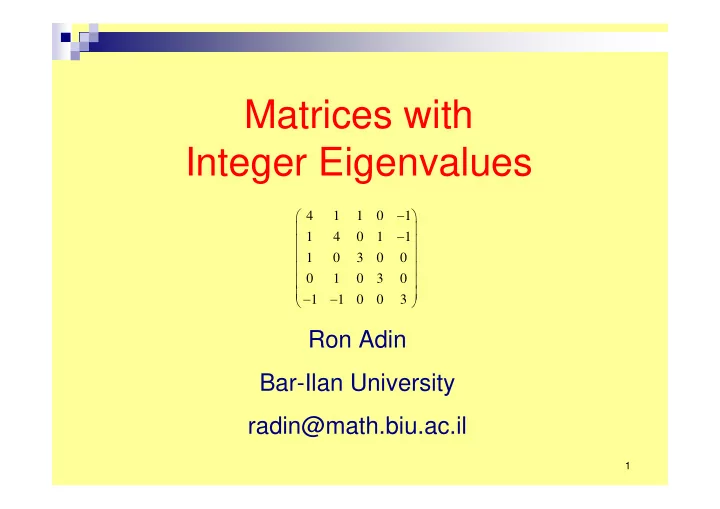
Matrices with Integer Eigenvalues 4 1 1 0 1 1 4 0 1 1 1 0 3 0 0 0 1 0 3 0 1 1 0 0 3 Ron Adin Bar-Ilan University


slide-1
SLIDE 1

1

Matrices with Integer Eigenvalues

Ron Adin Bar-Ilan University radin@math.biu.ac.il

4 1 1 1 1 4 1 1 1 3 1 3 1 1 3 −     −           − −  

slide-2
SLIDE 2

2

A Recent Monthly Paper

Almost All Integer Matrices Have No Integer Eigenvalues, G. Martin and E. B. Wong,

  • Amer. Math. Monthly 116 (2009), 588-597.

We want to deal with (specific) exceptions.

slide-3
SLIDE 3

3

Highlights

Certain matrices with integer entries have,

conjecturally, integer eigenvalues only.

Partial results are known. The multiplicity of the zero eigenvalue has

an algebraic interpretation.

slide-4
SLIDE 4

4

A Signed Graph: Vertices

  • For and let

set of all pairs s.t.

Weight:

  • set of all

with weight

[0, ]: {0,1, , } r r = … k ≥ , 1 a b k ≤ ≤ + ( , : )

k a b

Ω = ( , ) U V , [0, ], , . U V k U a V b ⊆ = = , : ( )

u U v V

wt U V u v

∈ ∈

= +

∑ ∑

) : ( , ,

k a b w

Ω = ( , ) ( , )

k

U V a b ∈Ω . w

slide-5
SLIDE 5

5

A Signed Graph: Vertices (cont.)

Example:

  • Note:

0,1: (2,2,4)

k

k = Ω = ∅ 2, 4. a b w = = = 2: (2,2,4) {(12,01),(02,02),(01,12)}

k

k = Ω = 3: (2,2,4) {(03,01),(12,01),(02,02), (01,12),(01,03)}

k

k = Ω =

min max

, ( ) 2 2 2 2 a b a b k a w b w         = + = + − −                

slide-6
SLIDE 6

6

A Signed Graph: Edges

For

and write if 1. 2. 3.

( , ),( , ) ( , , )

k

U V U V a b w ∈Ω ɶ ɶ , , , u U v V z ∈ ∈ ∈ℤ

( , , )

( , ) ( , )

u v z

U V U V ɶ ɶ ∼ ( \{ }) { } U U u u z = ∪ + ɶ ( \{ }) { } V V v v z = ∪ − ɶ u v k + ≤

slide-7
SLIDE 7

7

A Signed Graph: Edges

For

and write if 1. 2. 3.

( , ),( , ) ( , , )

k

U V U V a b w ∈Ω ɶ ɶ , , , u U v V z ∈ ∈ ∈ℤ

( , , )

( , ) ( , )

u v z

U V U V ɶ ɶ ∼ ( \{ }) { } U U u u z = ∪ + ɶ ( \{ }) { } V V v v z = ∪ − ɶ u v k + ≤ U u v V u v + U u z + ɶ v z V − ɶ

slide-8
SLIDE 8

8

A Signed Graph

  • graph with vertex set

and edges corresponding to the various

Loops and multiple edges may occur. Attach signs to edges:

( , , )

k a b w

( , , )

( , ) ( , ).

u v z

U V U V ɶ ɶ ∼ ( , , )

k

G a b w =

slide-9
SLIDE 9

9

Signs

For define:

if or has repeated elements; if

For

where , define

  • ( , )

u u ε = ɶ

1 1

( , , ), ( , , )

a a

u u u u u u = = ɶ ɶ ɶ … … u u ɶ ( , ) ( ) ( ) u u sign sign ε σ τ = ɶ

(1) ( ) (1) ( )

, .

a a

u u u u

σ σ τ τ

< < < < ɶ ɶ … …

1 1

{ , , }, { , , , , }

a i a

U u u U u u z u = = + ɶ … … …

1 a

u u < < …

1 1

( , ) : (( , , ),( , , , , )).

a i a

U U u u u u z u ε ε = + ɶ … … … : (( , ),( , ) ( , ) ( , ) ) U U V U V V V U ε ε ε = ⋅ ɶ ɶ ɶ ɶ

slide-10
SLIDE 10

10

Signed Adjacency Matrix

  • the (signed) adjacency matrix
  • f the graph

Note:

Diagonal elements are nonnegative

integers. Off-diagonal elements are or

( , , )

k

T a b w = ( , , ).

k

G a b w 0, 1 1. −

slide-11
SLIDE 11

11

Signed Adjacency Matrix

Example:

4 1 1 1 1 4 1 1 ( , , ) 1 3 1 3 1 1 3

k

T a b w −     −     =       − −   3, 2, 3, 8 k a b w = = = =

slide-12
SLIDE 12

12

Conjectures

Conjecture: [Hanlon, ’92]

All the eigenvalues of are nonnegative integers.

( , , )

k

T a b w

slide-13
SLIDE 13

13

Conjectures (cont.)

Let

where multiplicity of as an e.v.

  • f

Conjecture: [Hanlon, ’92]

Still open (in general)!

, ,

( , , ) : ( , , )

r a b k a b k r

m a b x x y r M y λ λ = ∑ ( , , )

k

m a b r = r ( , , ) ( , ) .

k w k

T T a a b b w = ⊕

( )

1

( , , ) 1

k i k i

M x y x y xy λ λ +

=

= + + +

slide-14
SLIDE 14

14

Background

Macdonald’s root system conjecture

slide-15
SLIDE 15

15

Background

Macdonald’s root system conjecture Hanlon’s property M conjecture:

where the Lie algebra is either * semisimple, or * upper triangular (nilpotent), or * Heisenberg (nilpotent)

1 ( 1) * *

( [ ]/( )) ( )

k k

H L t t H L

+ ⊗ +

⊗ ≅ ℂ L

slide-16
SLIDE 16

16

Background

Macdonald’s root system conjecture Hanlon’s property M conjecture:

where the Lie algebra is either * semisimple, or * upper triangular (nilpotent), or * Heisenberg (nilpotent)

1 ( 1) * *

( [ ]/( )) ( )

k k

H L t t H L

+ ⊗ +

⊗ ≅ ℂ L

slide-17
SLIDE 17

17

Background

Macdonald’s root system conjecture

TRUE [Cherednik, ’95]

Hanlon’s property M conjecture:

where the Lie algebra is either * semisimple, or * upper triangular (nilpotent), or * Heisenberg (nilpotent)

1 ( 1) * *

( [ ]/( )) ( )

k k

H L t t H L

+ ⊗ +

⊗ ≅ ℂ L

slide-18
SLIDE 18

18

Background

Macdonald’s root system conjecture

TRUE [Cherednik, ’95]

Hanlon’s property M conjecture:

where the Lie algebra is either * semisimple, or TRUE [FGT, ’08] * upper triangular (nilpotent), or * Heisenberg (nilpotent)

1 ( 1) * *

( [ ]/( )) ( )

k k

H L t t H L

+ ⊗ +

⊗ ≅ ℂ L

slide-19
SLIDE 19

19

Background

Macdonald’s root system conjecture

TRUE [Cherednik, ’95]

Hanlon’s property M conjecture:

where the Lie algebra is either * semisimple, or TRUE [FGT, ’08] * upper triangular (nilpotent), or FALSE [Kumar, ’99] * Heisenberg (nilpotent)

1 ( 1) * *

( [ ]/( )) ( )

k k

H L t t H L

+ ⊗ +

⊗ ≅ ℂ L

slide-20
SLIDE 20

20

Background

Macdonald’s root system conjecture

TRUE [Cherednik, ’95]

Hanlon’s property M conjecture:

where the Lie algebra is either * semisimple, or TRUE [FGT, ’08] * upper triangular (nilpotent), or FALSE [Kumar, ’99] * Heisenberg (nilpotent) ?

1 ( 1) * *

( [ ]/( )) ( )

k k

H L t t H L

+ ⊗ +

⊗ ≅ ℂ L

slide-21
SLIDE 21

21

Background (cont.)

For the 3-dim Heisenberg

with basis the Laplacian for is (in a suitable basis).

The property M conjecture is then equivalent to

(an extension of)

3

, * * * L         =             { , , }, e f x

* *

∂∂ + ∂ ∂

1 3

[ ]/( )

k

L t t + ⊗ℂ

, ,

( , , )

k a b wT a b w

1

( , ,0) (1 )k

k

M x y x y

+

= + +

slide-22
SLIDE 22

22

Partial Results

[Hanlon, ’92]

Explicit eigenvalues in the stable case: * * *

a b ≤ 2 2 a b w     ≤ +         ( 1) ( 1) 2 2 a b k a b w     ≥ − + − + − −        

slide-23
SLIDE 23

23

Partial Results (cont.)

Theorem: [Hanlon, ’92]

In the stable case, pairs

  • f partitions with

The eigenvalues of are The proof uses Schur functions in two sets

  • f variables.

1:1

( , )

k a b

Ω ↔ ( , ) λ µ

min.

w w λ µ + = − ( , )

k

T a b . ab λ µ − +

slide-24
SLIDE 24

24

Partial Results (cont.)

[A.-Athanasiadis, ’96]

  • 1. The nonzero eigenvalues
  • f are

each with multiplicity (and explicit distribution over ).

  • 2. The multiplicity of the zero e.v.:

1, 2, : a b k = = ∀ 1, , : a b k = ∀ ( , , )

w k

T a b w ⊕ 1, , 1, k λ = + … k w 1 (1, ,0) ( 1) 1

k

k k m b k b k b b +     = = +     −    

slide-25
SLIDE 25

25

Partial Results (cont.)

[Hanlon-Wachs, ’02]

Extend result 2 above to

1 ( , ,0) 1

k

k m a b a b k a b +   =   + − −   , , : a b k ∀

slide-26
SLIDE 26

26

Partial Results (cont.)

[Kuflik, ’06]

Distribution over coefficient of in where

( , , ,0)

k

m a b w = 1 1

q

k a b k a b +     + − −  

min

w w

q

, ( ) : , a b k w ∀

1

[ ]! : [1] [2] [ ] , [ ] : 1 .

q q q q m q

m m m q q

= ⋅ = + + + ⋯ …

slide-27
SLIDE 27

27

הבשקהה לע הדות!