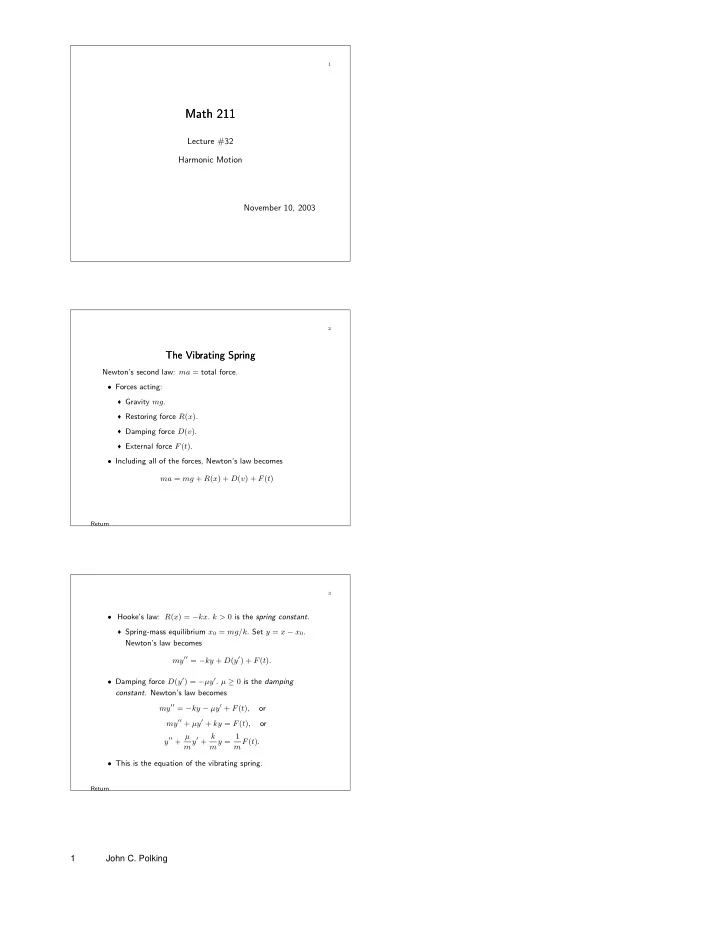

SLIDE 1
1
Math 211 Math 211
Lecture #32 Harmonic Motion November 10, 2003
Return
2
The Vibrating Spring The Vibrating Spring
Newton’s second law: ma = total force.
- Forces acting:
Gravity mg. Restoring force R(x). Damping force D(v). External force F(t).
- Including all of the forces, Newton’s law becomes
ma = mg + R(x) + D(v) + F(t)
Return
3
- Hooke’s law: R(x) = −kx. k > 0 is the spring constant.
Spring-mass equilibrium x0 = mg/k. Set y = x − x0.
Newton’s law becomes my′′ = −ky + D(y′) + F(t).
- Damping force D(y′) = −µy′. µ ≥ 0 is the damping
- constant. Newton’s law becomes
my′′ = −ky − µy′ + F(t),
- r
my′′ + µy′ + ky = F(t),
- r
y′′ + µ my′ + k my = 1 mF(t).
- This is the equation of the vibrating spring.