MAT137 - Calculus with proofs Assignment #3 due on November 5 - - PowerPoint PPT Presentation

mat137 calculus with proofs assignment 3 due on november
SMART_READER_LITE
LIVE PREVIEW

MAT137 - Calculus with proofs Assignment #3 due on November 5 - - PowerPoint PPT Presentation

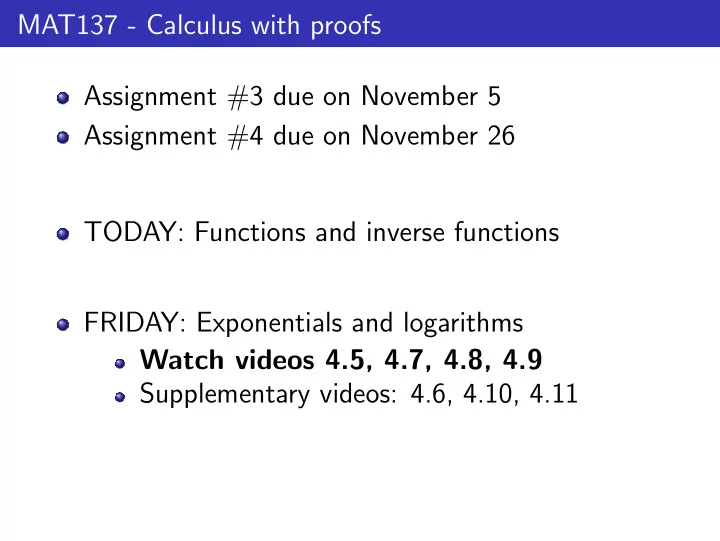
MAT137 - Calculus with proofs Assignment #3 due on November 5 Assignment #4 due on November 26 TODAY: Functions and inverse functions FRIDAY: Exponentials and logarithms Watch videos 4.5, 4.7, 4.8, 4.9 Supplementary videos: 4.6, 4.10, 4.11


slide-1
SLIDE 1

MAT137 - Calculus with proofs Assignment #3 due on November 5 Assignment #4 due on November 26 TODAY: Functions and inverse functions FRIDAY: Exponentials and logarithms Watch videos 4.5, 4.7, 4.8, 4.9 Supplementary videos: 4.6, 4.10, 4.11

slide-2
SLIDE 2

Fill in the Blanks Assume that f is an invertible function. Fill in the blanks.

  • 1. If f (−1) = 0, then f −1(

) = .

  • 2. If f −1(2) = 1, then f (

) = .

  • 3. If (2, 3) is on the graph of f , then

is on the graph of f −1.

  • 4. If (2, 3) is on the graph of f −1, then

is on the graph of f .

slide-3
SLIDE 3

Where is the error? We know that (f −1)′ = 1 f ′ Let f (x) = x2, restricted to the domain x ∈ (0, ∞) f ′(x) = 2x and f ′(4) = 8 Then f −1(x) = √x (f −1)′(x) = 1 2√x and (f −1)′(4) = 1 4 But (f −1)′(4) = 1 f ′(4)

slide-4
SLIDE 4

Derivatives of the inverse function Let f be a one-to-one function. Let a, b ∈ R such that b = f (a).

  • 1. Obtain a formula for
  • f −1′ (b) in terms of f ′(a).

Hint: This appeared in Video 4.4 Take d

dy of both sides of f (f −1(y)) = y.

  • 2. Obtain a formula for
  • f −1′′ (b) in terms of f ′(a)

and f ′′(a).

  • 3. Challenge: Obtain a formula for
  • f −1′′′ (b) in terms
  • f f ′(a), f ′′(a), and f ′′′(a).
slide-5
SLIDE 5

Composition of one-to-one functions

Assume for simplicity that all functions in this problem have domain

  • R. Prove the following theorem.

Theorem A Let f and g be functions. IF f and g are one-to-one, THEN f ◦ g is one-to-one. Suggestion:

  • 1. Write the definition of what you want to prove.
  • 2. Figure out the formal structure of the proof.
  • 3. Complete the proof (use the hypotheses!)