Section 7.3 Formal Proofs in Predicate Calculus All proof rules for - - PowerPoint PPT Presentation

section 7 3 formal proofs in predicate calculus all proof
SMART_READER_LITE
LIVE PREVIEW

Section 7.3 Formal Proofs in Predicate Calculus All proof rules for - - PowerPoint PPT Presentation

Section 7.3 Formal Proofs in Predicate Calculus All proof rules for propositional calculus extend to predicate calculus. Example . k . x p ( x ) P k +1. x p ( x ) x p ( x ) P k +2. x p ( x ) 1, 2, MP But we need


slide-1
SLIDE 1

1

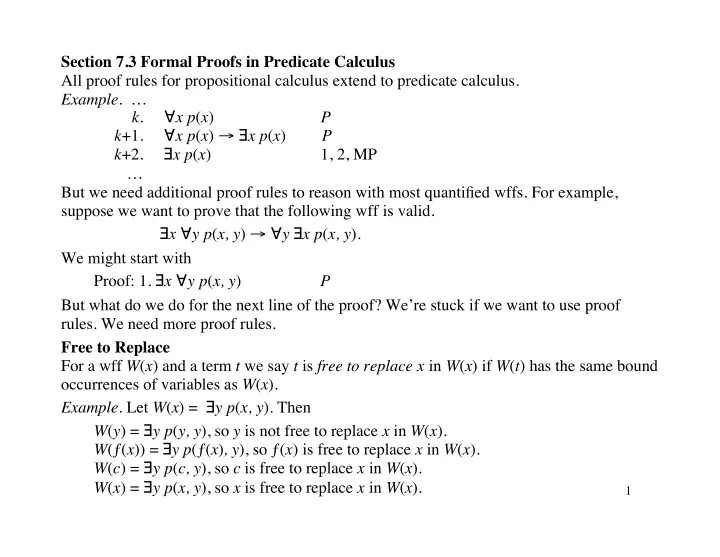
Section 7.3 Formal Proofs in Predicate Calculus All proof rules for propositional calculus extend to predicate calculus.

  • Example. …

k. ∀x p(x) P k+1. ∀x p(x) → ∃x p(x) P k+2. ∃x p(x) 1, 2, MP … But we need additional proof rules to reason with most quantified wffs. For example, suppose we want to prove that the following wff is valid. ∃x ∀y p(x, y) → ∀y ∃x p(x, y). We might start with Proof: 1. ∃x ∀y p(x, y) P But what do we do for the next line of the proof? We’re stuck if we want to use proof

  • rules. We need more proof rules.

Free to Replace For a wff W(x) and a term t we say t is free to replace x in W(x) if W(t) has the same bound

  • ccurrences of variables as W(x).
  • Example. Let W(x) = ∃y p(x, y). Then

W(y) = ∃y p(y, y), so y is not free to replace x in W(x). W(ƒ(x)) = ∃y p(ƒ(x), y), so ƒ(x) is free to replace x in W(x). W(c) = ∃y p(c, y), so c is free to replace x in W(x). W(x) = ∃y p(x, y), so x is free to replace x in W(x).

slide-2
SLIDE 2

2

Universal Instantiation (UI) "xW (x) W (x)

"xW (x) W (c)

"xW (x) W (t) if t is free to replace x in W(x).

W (x) "xW (x) W (c) "xW (x)

W (t) "xW (x) Existential Generalization (EG) Existential Instantiation (EI) Universal Generalization (UG) If ∃x W(x) occurs on some line of a proof, then W(c) may be placed on any subsequent line of the proof subject to the following restrictions: Choose c to be a new constant in the proof and such that c does not occur in the statement to be proven. If W(x) occurs on some line of a proof, then ∀x W(x) may be placed on any subsequent line of the proof subject to the following restrictions: Among the wffs used to obtain W(x), x is not free in any premise and x is not free in any wff obtained by EI. if t is free to replace x in W(x). Special cases that satisfy the restriction: Special cases that satisfy the restriction:

slide-3
SLIDE 3

3

Restrictions on quantifier inference rules are necessary

  • Example. ∀x ∃y p(x, y) → ∃y ∀x p(x, y) is invalid. Here is an attempted proof.

1. ∀x ∃y p(x, y) P 2. ∃y p(x, y) 1, UI 3. p(x, c) 2, EI 4. ∀x p(x, c) 3, UG (NO, x on line 3 is free in wff obtained by EI) 5. ∃y ∀x p(x, y) 4, EG NOT QED 1–5, CP

  • Example. ∃x p(x) → ∀x p(x) is invalid. Here is an attempted proof.

1. ∃x p(x) P 2. p(x) 1, EI (NO, x is not a new constant in the proof) 3. ∀x p(x) 2, UG (NO, x on line 2 is free in wff obtained by EI) NOT QED 1–3, CP

  • Example. ∃x p(x) ∧ ∃x q(x) → ∃x (p(x) ∧ q(x)) is invalid. Here is an attempted proof.

1. ∃x p(x) P 2. ∃x q(x) P 3. p(c) 1, EI 4. q(c) 2, EI (NO, c is not a new constant in the proof) 5. p(c) ∧ q(c) 3, 4, Conj 6. ∃x (p(x) ∧ q(x)) 5, EG NOT QED 1–6, CP

slide-4
SLIDE 4

4

  • Example. p(x) → ∀x p(x) is invalid. Here is an attempted proof.

1. p(x) P 2. ∀x p(x) 1, UG (NO, x is free in a premise) NOT QED 1, 2, CP

  • Example. ∀x ∃y p(x, y) → ∃y p(y, y) is invalid. Here is an attempted proof.

1. ∀x ∃y p(x, y) P 2. ∃y p(y, y) 1, UI (NO, y is not free to replace x in ∃y p(x, y)) NOT QED 1, 2, CP

  • Example. ∀x p(x, ƒ(x)) → ∃x p(x, x) is invalid. Here is an attempted proof.

1. ∀x p(x, ƒ(x)) P 2. p(x, ƒ(x)) 1, UI 3. ∃x p(x, x) 2, EG (NO, p(x, ƒ(x)) ≠ p(x, x)(x/t) for any term t) NOT QED 1–3, CP

  • Example. ∀x p(x, ƒ(x)) → ∃y ∀x p(x, y) is invalid. Here is an attempted proof.

1. ∀x p(x, ƒ(x)) P 2. ∃y ∀x p(x, y) 1, EG (NO, ƒ(x) is not free to replace y in ∀x p(x, y)) NOT QED 1, 2, CP

  • Example. ∃x p(x) → p(c) is invalid. Here is an attempted proof.

1. ∃x p(x) P 2. p(c) 1, EI (NO, c occurs in statement to be proved) NOT QED 1, 2, CP

slide-5
SLIDE 5

5

Now Some Valid Wffs

  • Example. ∀x ∀y p(x, y) → ∀y p(y, y) is valid. Here is an attempted proof.

1. ∀x ∀y p(x, y) P 2. ∀y p(y, y) 1, UI (NO, y is not free to replace x in ∀y p(x, y)) NOT QED 1, 2, CP But here is a correct proof. 1. ∀x ∀y p(x, y) P 2. ∀y p(x, y) 1, UI 3. p(x, x) 2, UI 4. ∀x p(x, x) 3, UG 5. p(y, y) 4, UI 6. ∀y p(y, y) 5, UG QED 1–6, CP.

  • Quiz. Find a proof of the statement that uses IP.

Example/Quiz. ∀x (A(x) → B(x)) → (∀x A(x) → ∀x B(x)) is valid. Find a proof. 1. ∀x (A(x) → B(x)) P 2. ∀x A(x) P [for ∀x A(x) → ∀x B(x)] 3. A(x) 2, UI 4. A(x) → B(x) 1, UI 5. B(x) 3, 4, MP 6. ∀x B(x) 5, UG 7. ∀x A(x) → ∀x B(x) 2–6, CP QED 1, 7, CP.

slide-6
SLIDE 6

6

Example/Quiz. Prove that the following wff is valid using IP. ∀x ¬ p(x, x) ∧ ∀x ∀y ∀z (p(x, y) ∧ p(y, z) → p(x, z)) → ∀x ∀y ¬ (p(x, y) ∧ p(y, x)). 1. ∀x ¬ p(x, x) P 2. ∀x ∀y ∀z (p(x, y) ∧ p(y, z) → p(x, z)) P 3. ∃x ∃y (p(x, y) ∧ p(y, x)) P [for ∀x ∀y ¬ (p(x, y) ∧ p(y, x)], T 4. p(a, b) ∧ p(b, a) 3, EI, EI 5. p(a, b) ∧ p(b, a) → p(a, a) 2, UI, UI, UI 6. p(a, a) 4, 5, MP 7. ¬ p(a, a) 1, UI 8. False 6, 7, Contr 9. ∀x ∀y ¬ (p(x, y) ∧ p(y, x) 3–8, IP QED 1, 2, 9, CP. Example/Quiz. Use IP to prove that the ∀x ∃y (p(x) → p(y)) is valid.

  • 1. ∃x ∀y (p(x) ∧ ¬ p(y))

P [for IP]

  • 2. ∀y (p(c) ∧ ¬ p(y))

1, EI

  • 3. p(c) ∧ ¬ p(c)

2, UI

  • 4. p(c)

3, Simp

  • 5. ¬ p(c)

4, Simp

  • 6. False

4, 5, Contr QED 1–6, IP.

  • Quiz. Find a CP proof of the statement.
  • 1. ∀x ¬ p(x, x)

P

  • 2. ∀x ∀y ∀z (p(x, y) ∧ p(y, z) → p(x, z)) P
  • 3. ¬ p(x, x)

1, UI

  • 4. p(x, y) ∧ p(y, x) → p(x, x)

2, UI, UI, UI

  • 5. ¬ (p(x, y) ∧ p(y, x))

3, 4, MT

  • 6. ∀x ∀y ¬ (p(x, y) ∧ p(y, x))

5, UG, UG QED 1– 6, CP.

slide-7
SLIDE 7

7

Group Quiz. Divide the class into six subgroups and assign each group one of the following six wffs to prove using CP (no IP and no T’s). Assume that x does not occur free in C. 1. ∀x (A(x) → C) → (∃x A(x) → C). 2. (∃x A(x) → C) → ∀x (A(x) → C). 3. (C → ∀x A(x)) → ∀x (C → A(x)). 4. (C → ∃x A(x)) → ∃x (C → A(x)). 5. ∃x (C → A(x)) → (C → ∃x A(x)). 6. ∃x (A(x) → C) → (∀x A(x) → C). Solutions.

  • 1. ∀x (A(x) → C) → (∃x A(x) → C).

1. ∀x (A(x) → C) P 2. ∃x A(x) P[for ∃x A(x) → C ] 3. A(d) 2, EI 4. A(d) → C 1, UI 5. C 3, 4, MP 6. ∃x A(x) → C 2–5, CP QED 1, 6, CP.

  • 2. (∃x A(x) → C) → ∀x (A(x) → C).

1. ∃x A(x) → C P 2. A(x) P [for A(x) → C] 3. ∃x A(x) 2, EG 4. C 1, 3, MP 5. A(x) → C 2–4, CP 6. ∀x (A(x) → C) 5, UG QED 1, 5–6, CP.

slide-8
SLIDE 8

8

  • 3. (C → ∀x A(x)) → ∀x (C → A(x)).

1. C → ∀x A(x) P 2. C P [for C → A(x)] 3. ∀x A(x) 1, 2, MP 4. A(x) 3, UI 5. C → A(x) 2–4, CP 6. ∀x (C → A(x)) 5, UG QED 1, 5–6, CP.

  • 4. (C → ∃x A(x)) → ∃x (C → A(x)).

1. C → ∃x A(x) P 2. C P [for C → A(?)] 3. ∃x A(x) 1, 2, MP 4. A(d) 3, EI 5. C → A(d) 2–4, CP 6. ∃x (C → A(x)) 5, EG QED 1, 5–6, CP.

  • 5. ∃x (C → A(x)) → (C → ∃x A(x)).

1. ∃x (C → A(x)) P 2. C P [for C → ∃x A(x)] 3. C → A(d) 1, EI 4. A(d) 2, 3, MP 5. ∃x A(x) 4, EG 6. C → ∃x A(x) 2–5, CP QED 1, 6, CP.

  • 6. ∃x (A(x) → C) → (∀x A(x) → C).

1. ∃x (A(x) → C) P 2. ∀x A(x) P [for ∀x A(x) → C ] 3. A(d) → C 1, EI 4. A(d) 2, UI 5. C 3, 4, MP 6. ∀x A(x) → C 2–5, CP QED 1, 6, CP.