SLIDE 1
MAT 137 — LEC 0601
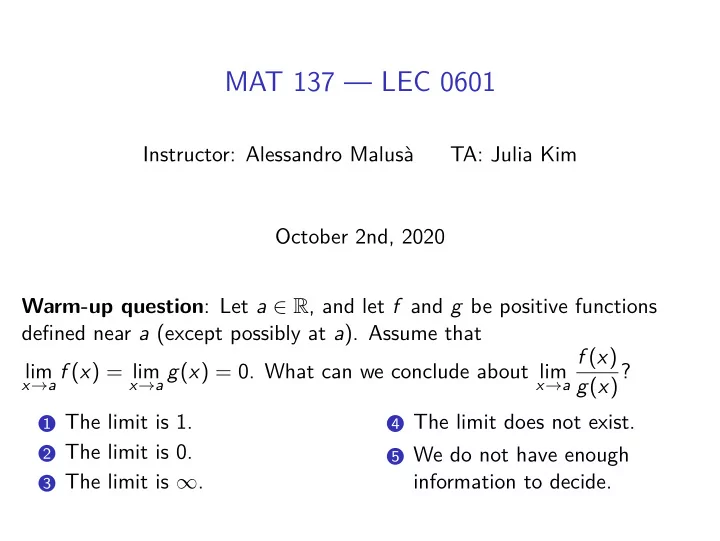
Instructor: Alessandro Malusà TA: Julia Kim October 2nd, 2020 Warm-up question: Let a ∈ R, and let f and g be positive functions defined near a (except possibly at a). Assume that lim
x→a f (x) = lim x→a g(x) = 0. What can we conclude about lim x→a
f (x) g(x)?
1 The limit is 1. 2 The limit is 0. 3 The limit is ∞. 4 The limit does not exist. 5 We do not have enough
information to decide.
SLIDE 2
A theorem about limits
Let f be a function with domain R such that lim
x→0 f (x) = 3
Prove that lim
x→0
5f (2x) = 15
directly from the definition of limit. Do not use any of the limit laws.
SLIDE 3
A theorem about limits
Let f be a function with domain R such that lim
x→0 f (x) = 3
Prove that lim
x→0
5f (2x) = 15
directly from the definition of limit. Do not use any of the limit laws.
1 Write down the formal definition of the statement you want to prove.
SLIDE 4
A theorem about limits
Let f be a function with domain R such that lim
x→0 f (x) = 3
Prove that lim
x→0
5f (2x) = 15
directly from the definition of limit. Do not use any of the limit laws.
1 Write down the formal definition of the statement you want to prove. 2 Write down what the structure of the formal proof should be, without
filling the details.
SLIDE 5
A theorem about limits
Let f be a function with domain R such that lim
x→0 f (x) = 3
Prove that lim
x→0
5f (2x) = 15
directly from the definition of limit. Do not use any of the limit laws.
1 Write down the formal definition of the statement you want to prove. 2 Write down what the structure of the formal proof should be, without
filling the details.
3 Rough work.
SLIDE 6
A theorem about limits
Let f be a function with domain R such that lim
x→0 f (x) = 3
Prove that lim
x→0
5f (2x) = 15
directly from the definition of limit. Do not use any of the limit laws.
1 Write down the formal definition of the statement you want to prove. 2 Write down what the structure of the formal proof should be, without
filling the details.
3 Rough work. 4 Write down a complete proof.
SLIDE 7
Proof feedback
1 Is the structure of the proof correct?
(First fix ε, then choose δ, then ...)
2 Did you say exactly what δ is? 3 Is the proof self-contained?
(I do not need to read the rough work)
4 Are all variables defined? In the right order? 5 Do all steps follow logically from what comes before?
Do you start from what you know and prove what you have to prove?
6 Are you proving your conclusion or assuming it?
SLIDE 8 Rational limits
Consider the function h(x) = (x − 1)(2 + x) x2(x − 1)(2 − x).
- Find all real values a for which h(a) is undefined.
- For each such value of a, compute lim
x→a+ h(x) and lim x→a− h(x).
- Based on your answer, and nothing else, try to sketch the graph of h.
SLIDE 9 Before next class...
- Watch videos 2.12, 2.13.
- Download the next class’s slides (no need to look at them!)